Quick Navigation:
| | | |
Electrolysis
A & B. Introduction and Key Terms
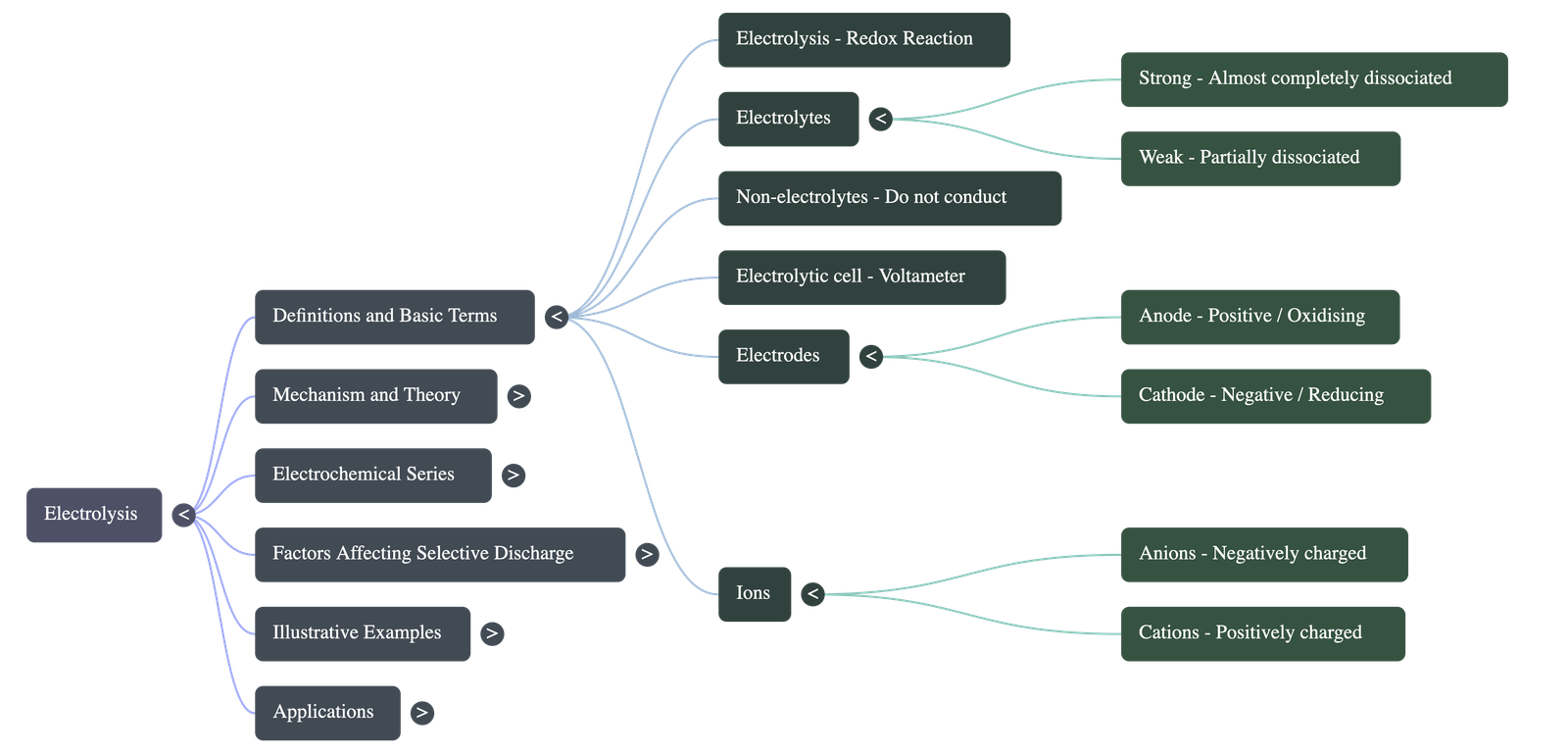
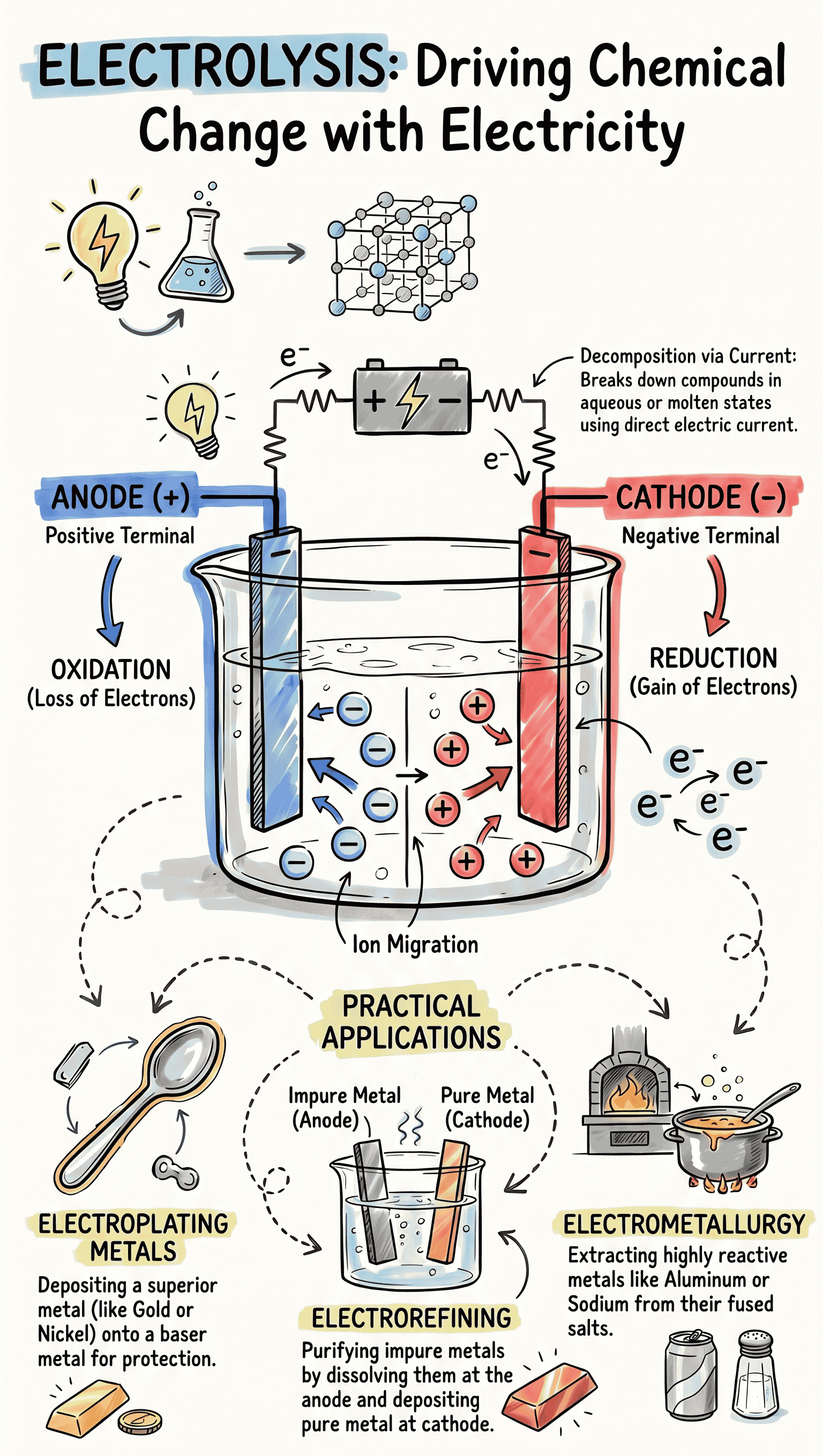
- Electrolysis: The decomposition of a chemical compound (electrolyte) in the aqueous or fused (molten) state by passing a direct electric current, resulting in the discharge of ions as neutral atoms at the respective electrodes. It involves a chemical change and is a redox reaction.
- Electrolytes: Ionic compounds that conduct electricity in fused or aqueous states and undergo chemical decomposition. They contain ions (or ions and molecules).
- Strong Electrolytes: Allow a large amount of electricity to flow, are almost completely dissociated, and contain mainly free ions (e.g., dilute HCl, NaOH, aqueous NaCl).
- Weak Electrolytes: Allow small amounts of electricity to flow, are partially dissociated, and contain both ions and unionised molecules (e.g., Acetic acid, Ammonium hydroxide).
- Non-Electrolytes: Covalent compounds that do not conduct electricity in fused or aqueous states and do not undergo chemical decomposition. They contain molecules only (e.g., Distilled water, Alcohol, Kerosene, Sugar solution).
- Electrolytic Cell: The non-conducting vessel containing the electrolyte and electrodes where electrolysis is carried out.
- Electrodes: Metal or carbon rods that allow current to enter or leave the electrolyte.
- Anode (Positive Electrode): Connected to the positive terminal. Anions migrate here, lose electrons, and get oxidised. It is the oxidising electrode.
- Cathode (Negative Electrode): Connected to the negative terminal. Cations migrate here, gain electrons, and get reduced. It is the reducing electrode.
- Ions: Atoms or groups of atoms carrying a positive or negative charge.
- Anions: Negatively charged ions that migrate to the anode.
- Cations: Positively charged ions that migrate to the cathode.
C. Mechanism of Electrolysis
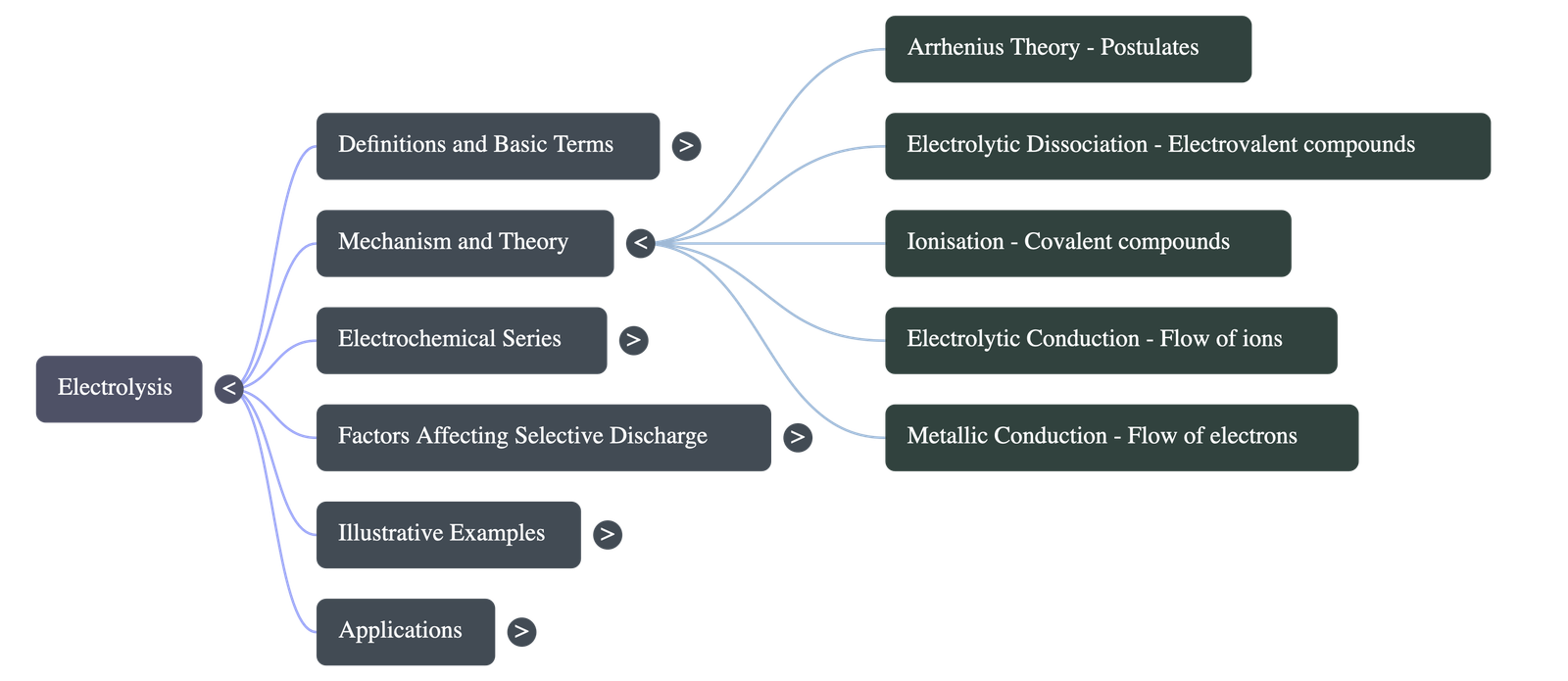
- Arrhenius Theory: Proposed in 1887, it states that electrolytes dissociate into free cations and anions in water. The degree of dissociation determines the extent of breakdown. The solution remains electrically neutral as the total positive charge equals the total negative charge.
- Characteristics of Electrolysis:
- Cations migrate to the cathode; anions migrate to the anode.
- The number of electrons gained at the cathode equals the number donated at the anode.
- Only hydrogen gas and metals (electropositive elements) are liberated at the cathode.
- Only non-metals (electronegative elements) are liberated at the anode.
- Electrolytic Dissociation vs. Ionisation:
- Dissociation: Separation of already existing ions in electrovalent (ionic) compounds when molten or in an aqueous solution (e.g., NaCl breaking into Na+ and Cl-). Solid ionic compounds do not conduct electricity due to strong electrostatic forces holding the ions.
- Ionisation: Formation of charged ions from molecules that are not originally in the ionic state, occurring in polar covalent compounds when dissolved in water (e.g., HCl forming H3O+ and Cl-).
- Metallic vs. Electrolytic Conduction: Metallic conduction involves the flow of electrons without decomposition of the metal, forming no new products. Electrolytic conduction involves the flow of ions, causing chemical decomposition of the electrolyte and forming new products.
D. Acids, Bases and Salts as Electrolytes
- Acids, bases, and salts dissociate into free mobile ions in an aqueous solution or fused state.
- Experiment to identify strong/weak electrolytes: If a compound placed in an electrolytic cell with a bulb in the circuit causes the bulb to glow brightly, it is a strong electrolyte. If the glow is dim, it is a weak electrolyte.
- Classification:
- Acids: Mineral acids (HCl, HNO3, H2SO4) are strong. Organic acids (Carbonic, Acetic, Formic) are weak.
- Bases: NaOH, KOH are strong. NH4OH, Ca(OH)2 are weak.
- Salts: Lead bromide, Copper chloride, Silver nitrate are strong. Lead acetate, Sodium carbonate are weak.
E. Electrochemical Series
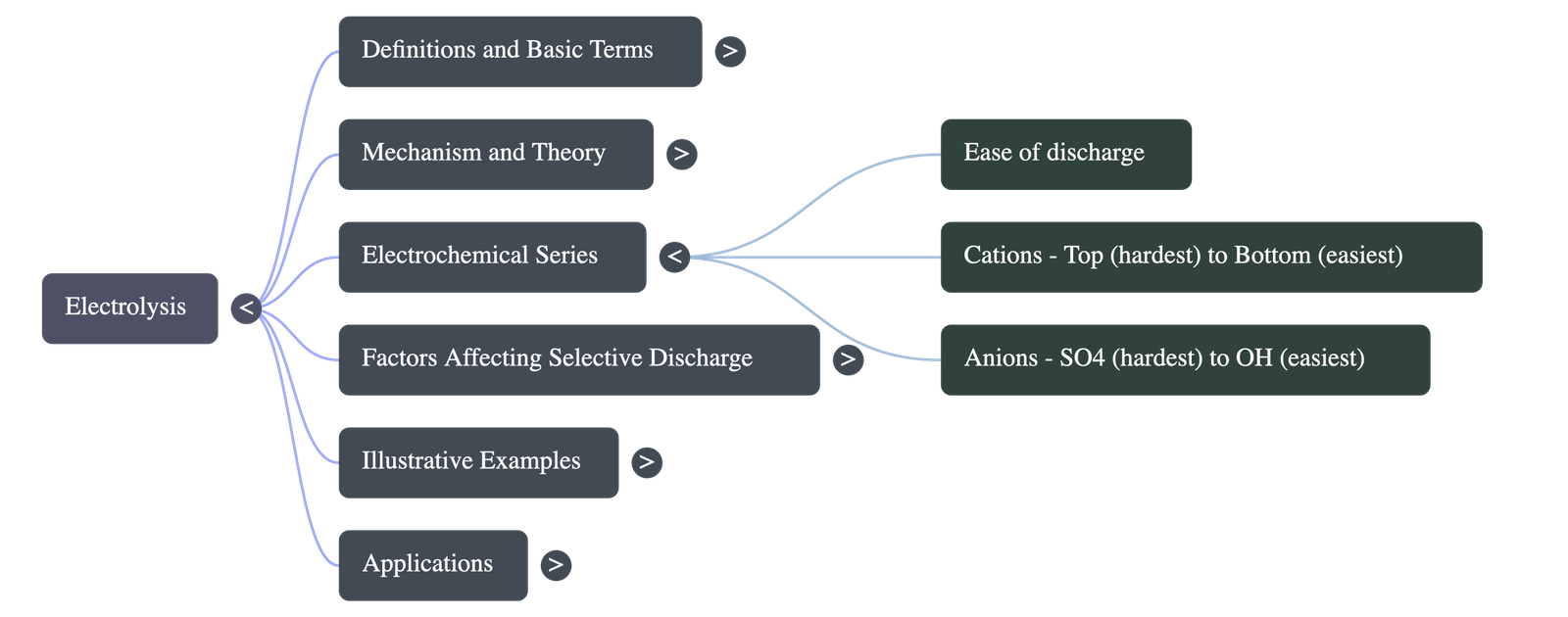
- Metals are arranged based on the ease with which they lose electrons and form ions.
- Top of the Series: Metals that ionize most readily (e.g., K, Ca, Na). Their cations are discharged at the cathode with the most difficulty.
- Lower End of the Series: Metals that ionize least readily (e.g., Cu, Hg, Ag). Their cations are discharged at the cathode most easily.
- A similar principle applies to anions, where those lower in the series (like OH-) are discharged more easily than those higher up (like SO4²- or NO3-).
F. Selective Discharge of Ions
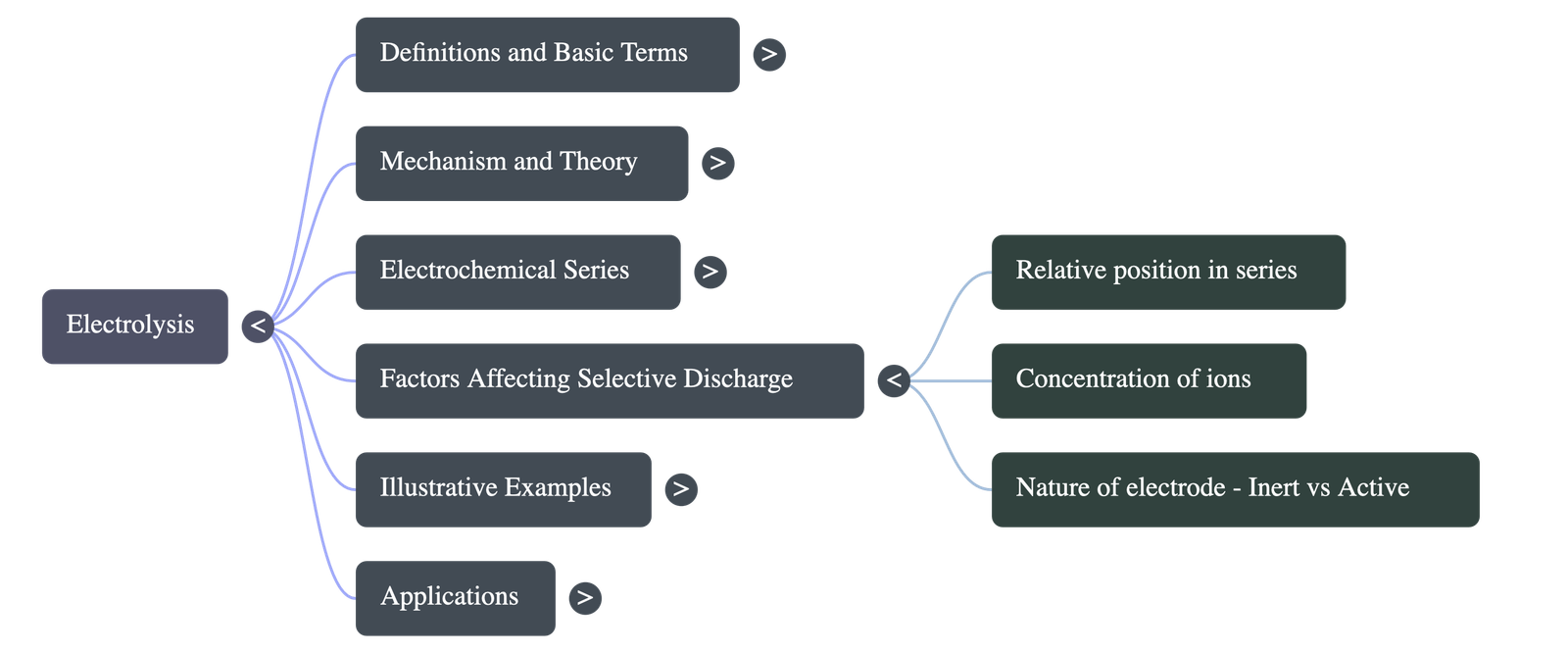
- When multiple ions are present in an electrolyte, one ion is preferentially discharged over another. This depends on three main factors:
- Relative Position in Electrochemical Series: Ions lower in the series have a greater tendency to be liberated.
- Concentration of Ions: A higher concentration of an ion increases its probability of being discharged, sometimes overriding its position in the series (e.g., in concentrated NaCl, Cl- is discharged over OH- despite being higher in the series).
- Nature of the Electrode:
- Inert Electrodes (Iron, Graphite, Platinum): Do not take part in the reaction.
- Active Electrodes (Copper, Nickel, Silver): Participate in the reaction. The active anode will lose electrons and dissolve as ions rather than discharging the anions present in the solution.
G. Examples of Electrolysis
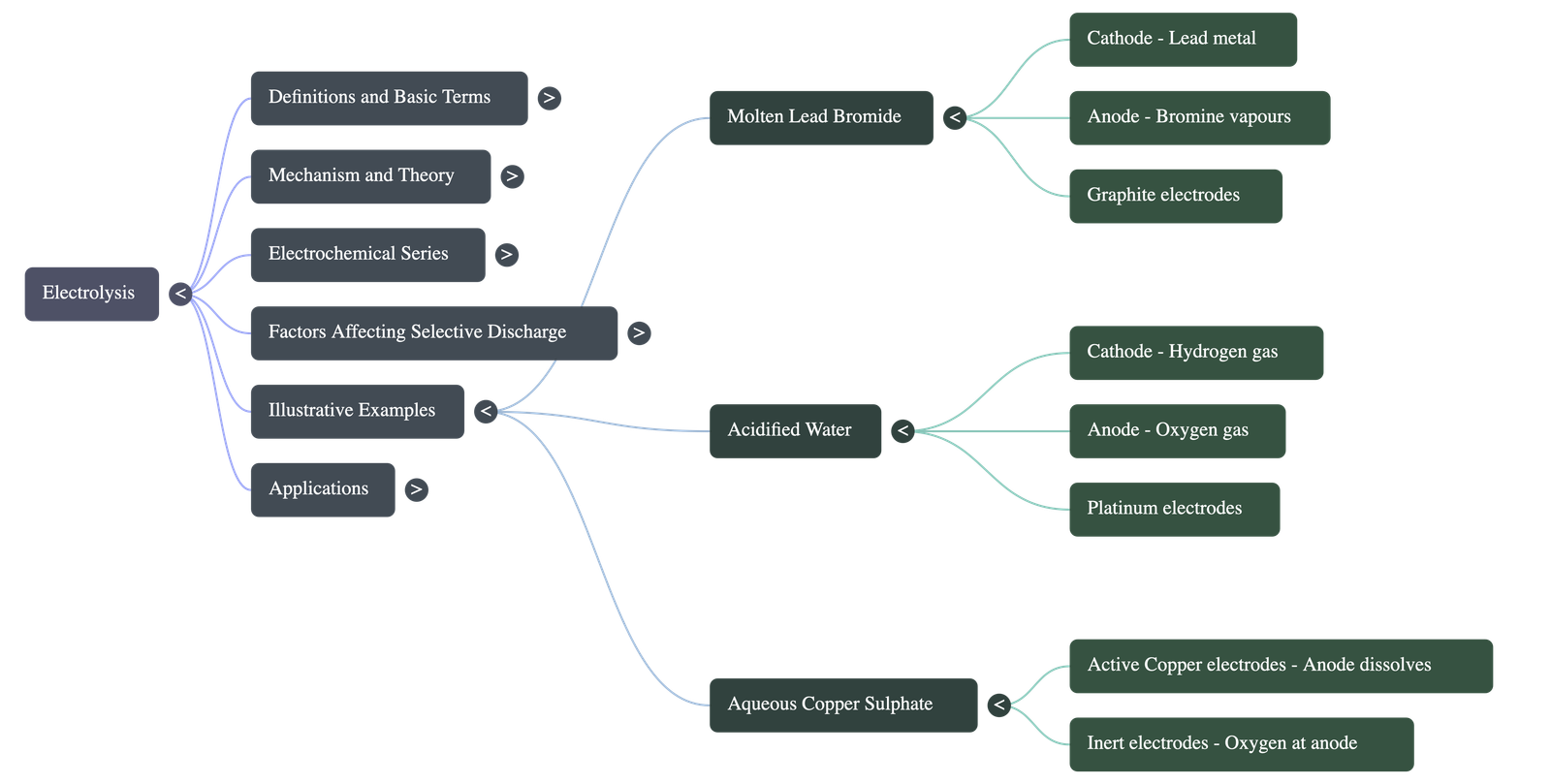
- 1. Molten or Fused Lead Bromide (PbBr2):
- Crucible: Silica (withstands high temperature and is a non-conductor).
- Electrodes: Graphite anode and Iron/Graphite cathode (Inert).
- Reaction at Cathode: Pb²⁺ ions gain electrons and are deposited as silvery-grey Lead metal.
- Reaction at Anode: Br⁻ ions lose electrons and evolve as reddish-brown Bromine vapours.
- 2. Acidified Water (H2O + trace dilute H2SO4):
- Pure water is practically a non-electrolyte. Dilute H2SO4 is added to increase conductivity (catalysis).
- Electrodes: Platinum foil (Inert).
- Reaction at Cathode: H⁺ ions are discharged forming Hydrogen gas.
- Reaction at Anode: OH⁻ ions are discharged preferentially (over SO4²⁻) forming water and Oxygen gas.
- Result: Hydrogen and Oxygen gases are liberated at the cathode and anode respectively, in a 2:1 ratio by volume.
- 3. Aqueous Copper (II) Sulphate (CuSO4):
- Using Active Copper Electrodes:
- Cathode: Cu²⁺ ions gain electrons and deposit as pinkish-brown copper metal.
- Anode: Neither SO4²⁻ nor OH⁻ are discharged. Instead, the Copper anode loses electrons, forming Cu²⁺ ions and dissolving.
- Observation: The blue colour of the solution remains unchanged because the Cu²⁺ ions discharged at the cathode are constantly replenished by the anode. - Using Inert Platinum/Carbon Electrodes:
- Cathode: Cu²⁺ is discharged as copper metal.
- Anode: OH⁻ is discharged, liberating Oxygen gas.
- Observation: The blue colour of the solution fades because Cu²⁺ ions are depleted and not replenished.
- Using Active Copper Electrodes:
H. Applications of Electrolysis
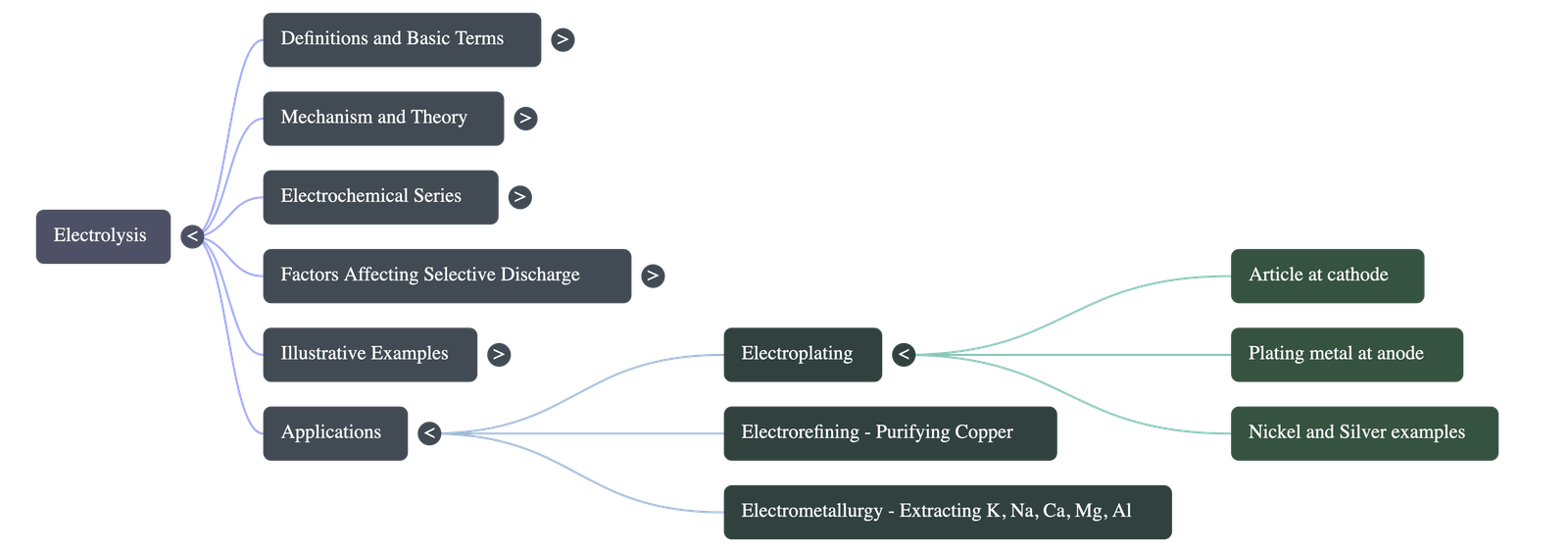
- 1. Electroplating: The electrolytic process of depositing a superior metal (like nickel, silver, or gold) on a baser metal.
- Reasons: Prevents corrosion/rusting and gives an attractive, expensive appearance.
- Conditions:
- The article to be plated is placed at the Cathode.
- A block of the pure plating metal is placed at the Anode.
- The electrolyte must contain ions of the plating metal.
- A low, direct current (DC) is used for a longer time to ensure a smooth, firm, and uniform deposit. - Examples: Plating with Nickel (Nickel sulphate electrolyte, Nickel anode) and plating with Silver (Sodium argentocyanide electrolyte preferred over silver nitrate for slower, even deposition, Silver anode).
- 2. Electro-refining (Purification of Metals):
- Process (e.g., Copper): A thick block of impure copper is the anode, and a thin sheet of pure copper is the cathode. The electrolyte is acidified aqueous copper sulphate.
- Pure copper dissolves from the anode and deposits on the cathode.
- Insoluble impurities (like gold and silver) settle at the bottom as "anode mud" or slime. Soluble impurities (iron, zinc) dissolve in the electrolyte.
- 3. Electrometallurgy (Extraction of Metals):
- Highly electropositive metals at the top of the activity series (K, Na, Ca, Mg, Al) form highly stable oxides that cannot be reduced by common agents like carbon or carbon monoxide.
- They are extracted by the electrolysis of their fused (molten) salts. The pure metal deposits at the cathode.
Do checkout all questions & answers of this chapter.
Quick Navigation:
| | | |
1 / 1
Quick Navigation:
| | | |