Quick Navigation:
| | | |
Ch. 3-A: Acids, Bases and Salts
A. Introduction & B. Simple Definitions
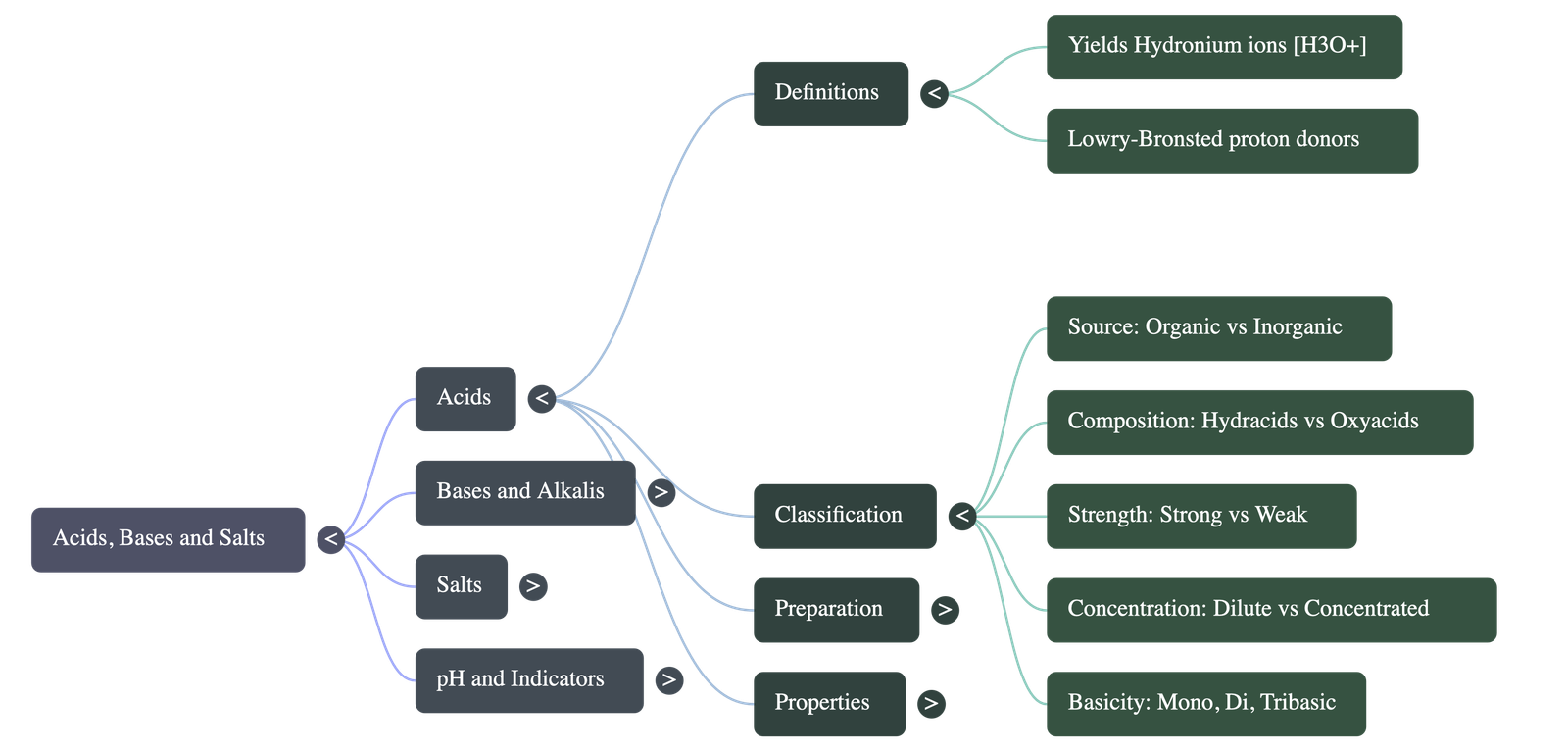
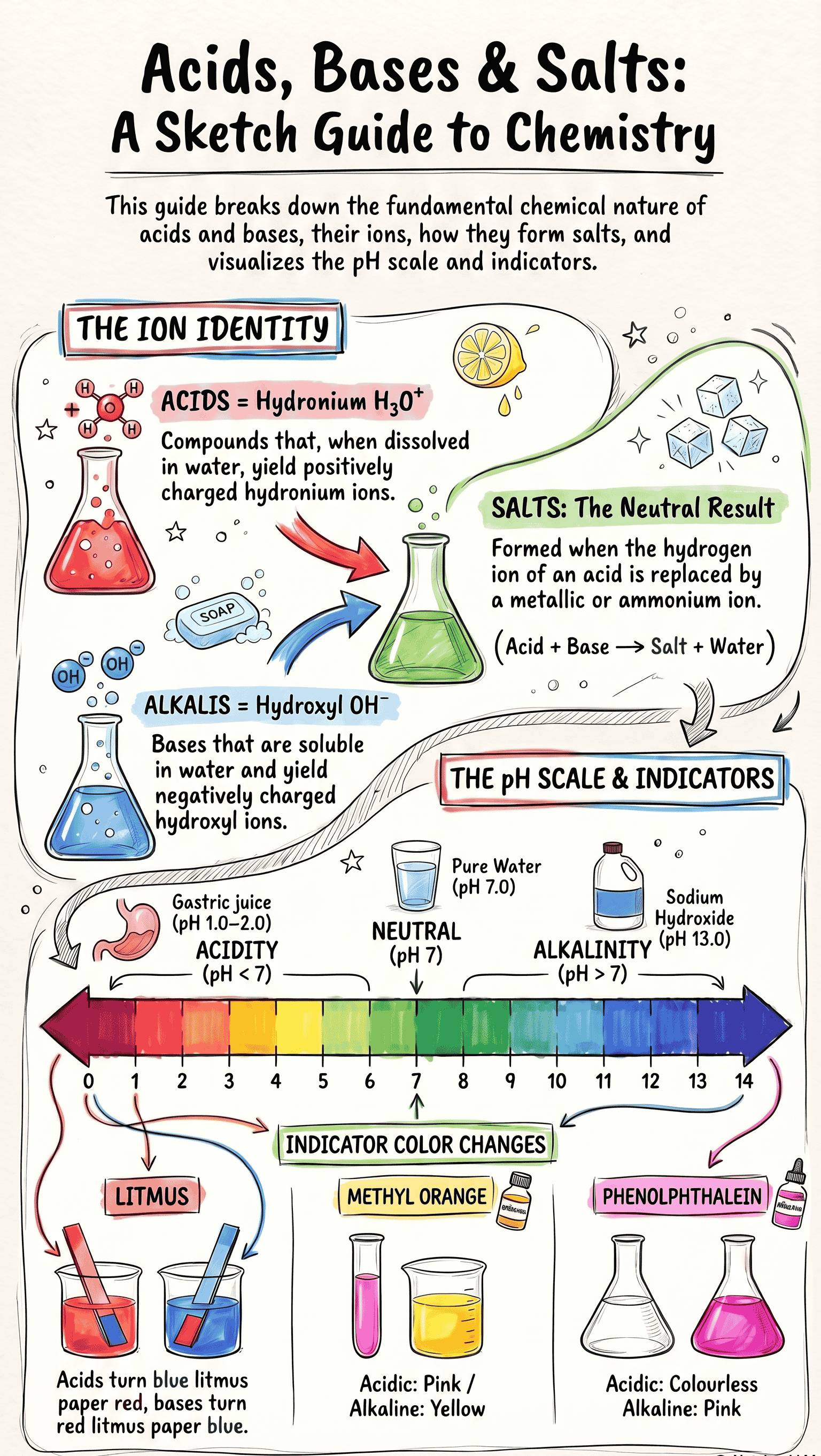
- Acids: Derived from the Latin word meaning 'sour'. An acid is a compound that, when dissolved in water, yields hydronium ions (H₃O⁺) as the only positively charged ions.
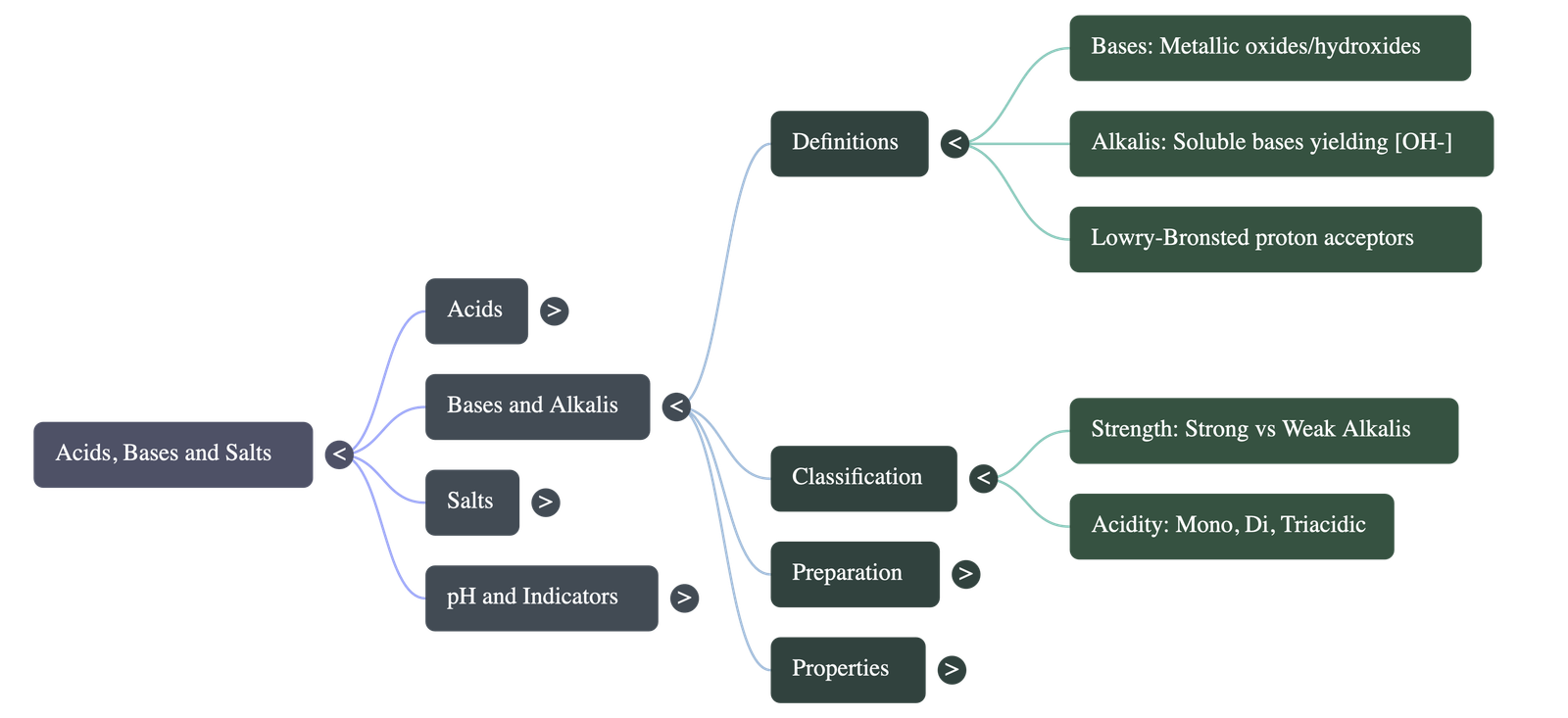
- Bases: Metallic oxides and hydroxides. A base is a compound that reacts with hydronium ions of an acid to give salt and water only.
- Alkalis: A base that is soluble in water and yields hydroxyl ions (OH⁻) as the only negatively charged ions when dissolved. Note: All alkalis are bases, but all bases are not alkalis.
C. Classification of Acids & Bases
- Based on Source:
- Organic acids: Derived from plants (e.g., citric, acetic acid).
- Inorganic acids: Derived from minerals (e.g., HCl, H₂SO₄).
- Based on Molecular Composition:
- Hydracids: Contain hydrogen and a non-metal other than oxygen (e.g., HCl).
- Oxyacids: Contain hydrogen, another element, and oxygen (e.g., HNO₃).
- Based on Strength:
- Strong Acids/Alkalis: Dissociate almost completely in an aqueous solution, producing a high concentration of ions (almost only ions present).
- Weak Acids/Alkalis: Dissociate only partially, producing a low concentration of ions (contain both molecules and ions).
- Based on Concentration: Concentrated (high percentage of acid/alkali) vs. Dilute (low percentage in aqueous solution).
- Based on Basicity of Acids: The number of replaceable hydrogen ions per molecule (Monobasic = 1, Dibasic = 2, Tribasic = 3).
- Based on Acidity of Bases: The number of replaceable hydroxyl ions per molecule (Monoacidic = 1, Diacidic = 2, Triacidic = 3).
D. Formation of Hydronium & Hydroxyl Ions
- Theories: Arrhenius states acids give H⁺ ions in water. Lowry-Bronsted theory defines acids as proton donors and bases as proton acceptors.
- Hydronium Ion (H₃O⁺): A proton (H⁺) from an acid cannot exist independently. It adds to the lone pair of electrons on the oxygen atom of a water molecule, forming a coordinate covalent bond.
- Hydroxyl Ion (OH⁻): When ammonia dissolves in water, a proton from water adds to the lone pair of the nitrogen atom in ammonia forming an ammonium ion (NH₄⁺), leaving behind the hydroxyl ion (OH⁻).
E. Preparation of Acids & Bases
- Preparation of Acids:
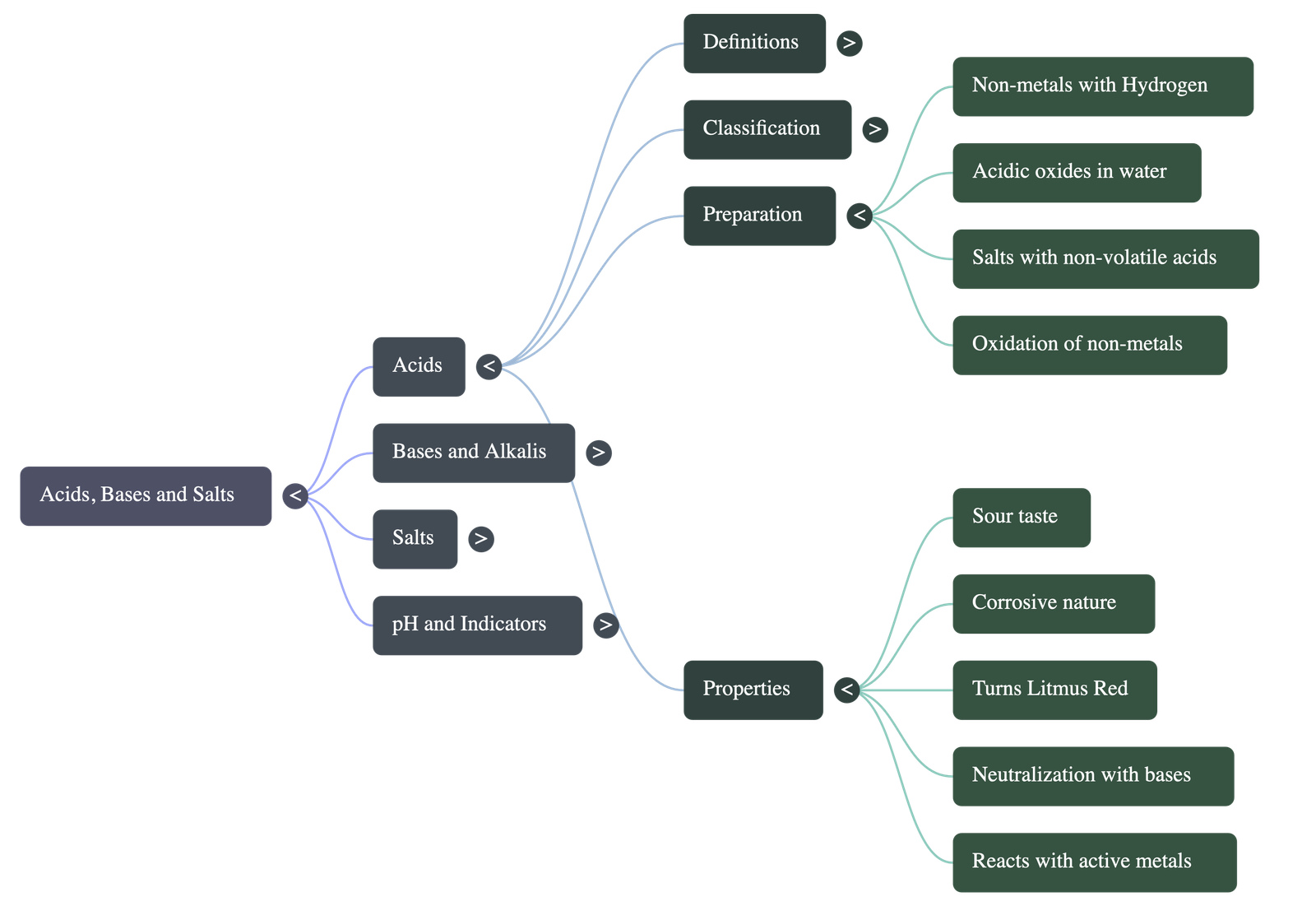
- By direct synthesis from non-metals and hydrogen.
- By dissolving acidic oxides (like CO₂, SO₂) in water.
- By heating salts of more volatile acids with a less volatile acid (like conc. H₂SO₄).
- By oxidation of non-metals using concentrated nitric acid.
- Preparation of Bases:
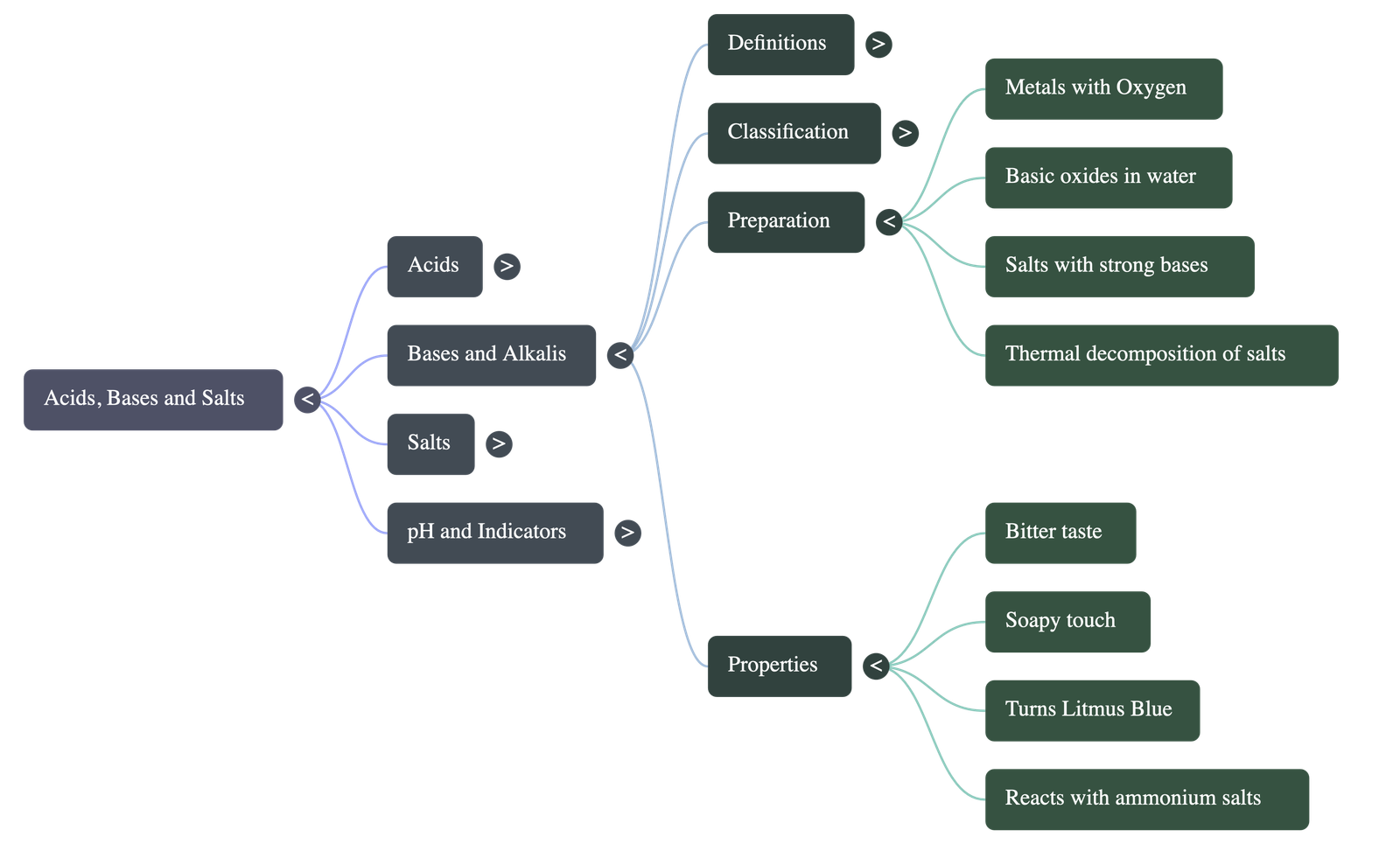
- By reacting metals with oxygen to form basic oxides.
- By dissolving soluble basic oxides in water to form alkalis.
- By precipitating basic hydroxides from metallic salts using aqueous alkalis.
- By thermal decomposition of heavy metal carbonates or nitrates.
F. Properties of Acids & Bases
- Physical Properties: Acids taste sour; alkalis taste bitter. Mineral acids and caustic alkalis are highly corrosive. Both change colors of specific indicators (e.g., acids turn blue litmus red, alkalis turn red litmus blue).
- Chemical Properties of Acids:
- Neutralize bases to yield salt and water.
- React with active metals (Mg, Al, Zn, Fe) to liberate hydrogen gas.
- React with carbonates and bicarbonates to release carbon dioxide (CO₂).
- React with sulphides and sulphites to release H₂S and SO₂ gas respectively.
- Chemical Properties of Bases:
- React with ammonium salts on heating to liberate ammonia gas (NH₃).
- React with metallic salt solutions to precipitate characteristic insoluble hydroxides (e.g., copper gives a blue precipitate).
- Neutralization (Ionic Theory): The process where hydrogen ions (H⁺) from an acid completely combine with hydroxyl ions (OH⁻) from a base to yield unionized water molecules (H₂O).
G. Uses & Acid Rain
- Uses: Acids are used in eye-washes (boric acid), food preservation, flavorings, and pickling metals. Bases are heavily used in manufacturing soap (NaOH), bleaching powder, and as antacids (magnesium hydroxide).
- Acid Rain: Rain with a pH of less than 5.6. It is caused by atmospheric pollutants (SO₂ and Nitrogen oxides from fossil fuels and combustion) reacting with water vapor to form sulphuric and nitric acids. Acid rain depletes soil fertility, damages materials, and harms marine life.
H. Indicators & pH Scale
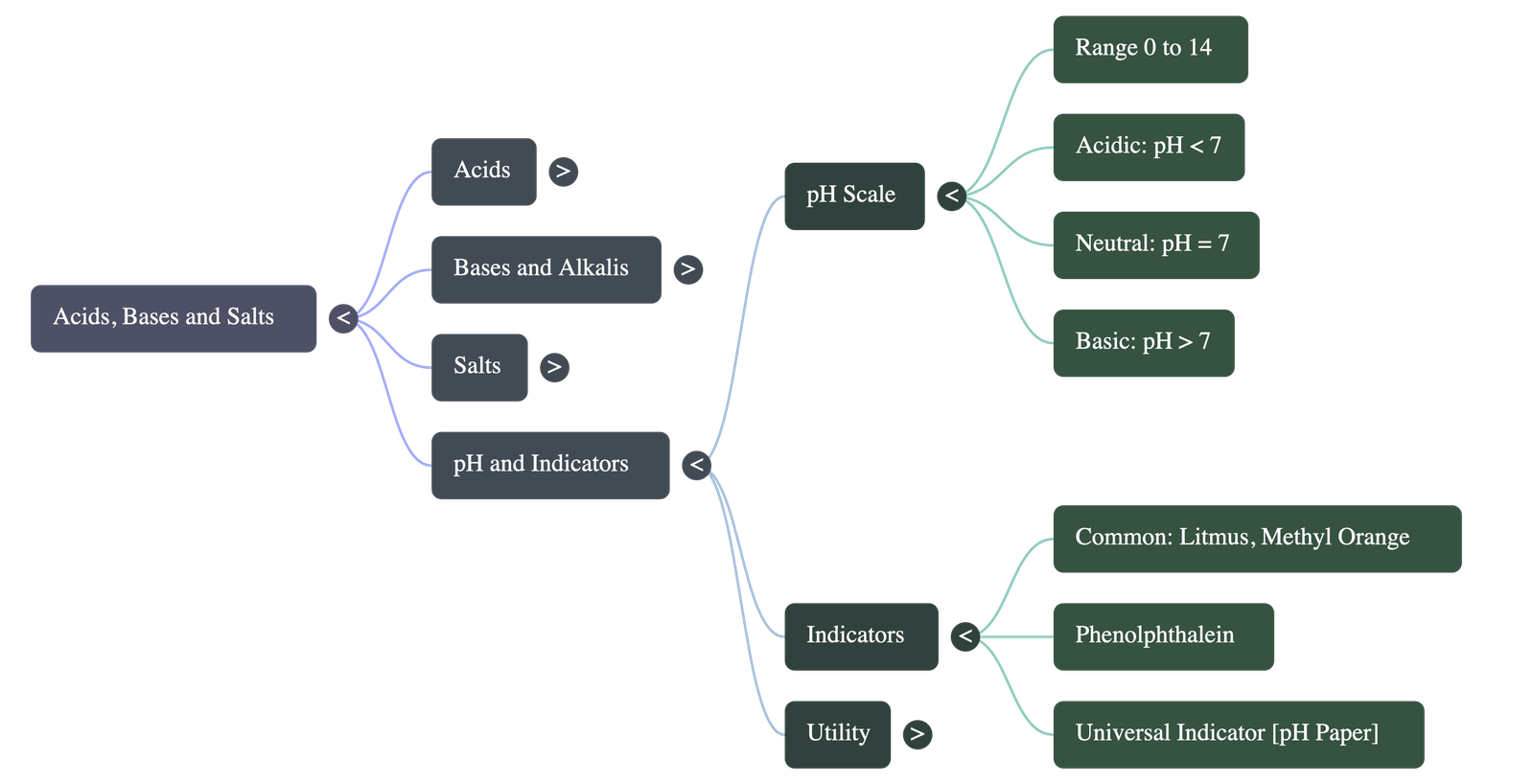
- Indicators: Weak organic compounds that change color in accordance with the pH of a solution. Common indicators only tell if a substance is acidic or alkaline, not its exact strength.
- Common Colour Changes:
- Litmus: Red in Acid, Blue in Alkali.
- Methyl Orange: Pink in Acid, Yellow in Alkali.
- Phenolphthalein: Colourless in Acid, Pink in Alkali.
- pH Scale: Represents the strength of acids and alkalis, defined as the negative logarithm of the hydrogen ion concentration.
- pH = 7 indicates a Neutral solution (pure water).
- pH < 7 indicates an Acidic solution (lower the number, stronger the acid).
- pH > 7 indicates a Basic/Alkaline solution (higher the number, stronger the alkali).
- Universal Indicator: A mixture of dyes that gives different colors at different pH values, allowing for determination of exact acidic or alkaline strength (e.g., Red for strongly acidic, Green for neutral, Violet for strongly alkaline).
I. Salts - Definition, Classification & Solubility
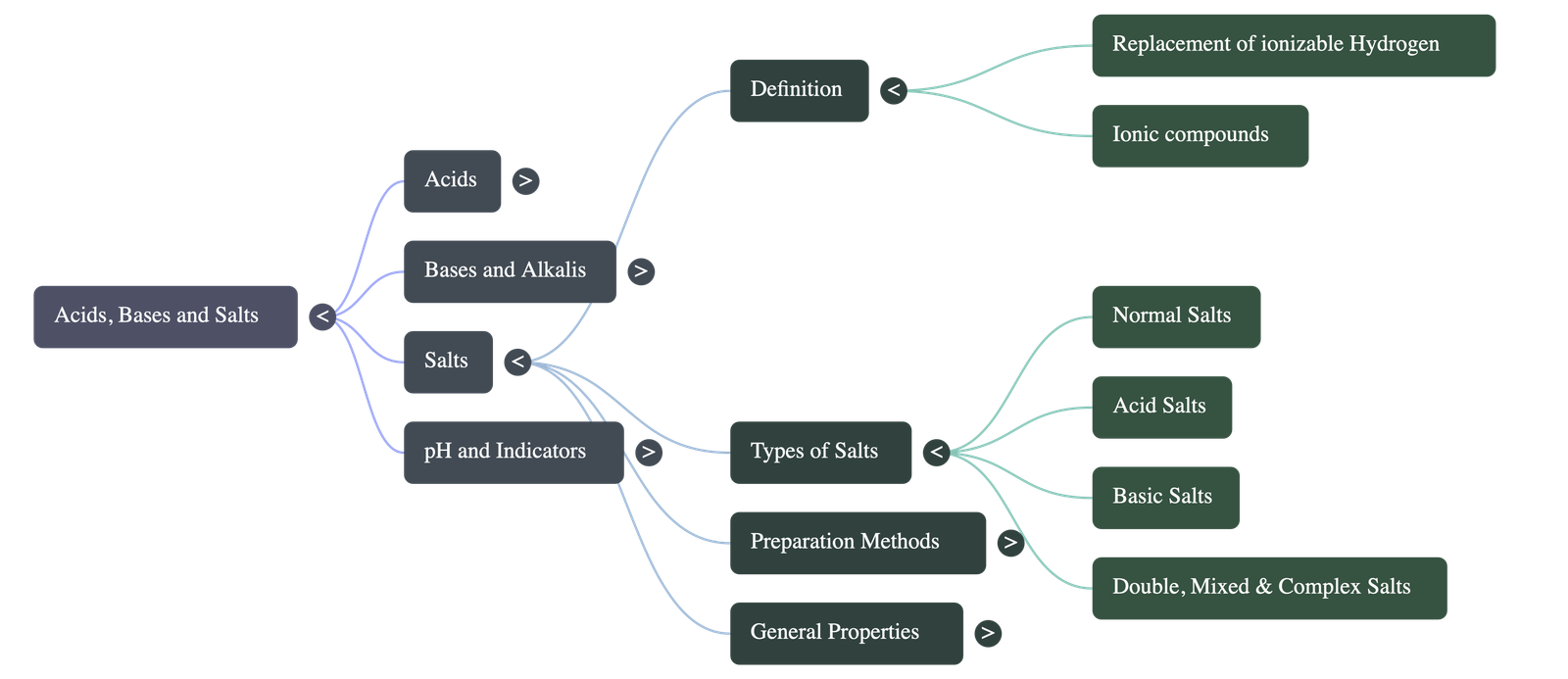
- Definition: A salt is an ionic compound formed by the partial or complete replacement of the ionizable hydrogen ion of an acid by a metallic or ammonium ion.
- Classification of Salts:
- Normal Salt: Complete replacement of hydrogen ions (no replaceable H⁺).
- Acid Salt: Partial replacement of hydrogen ions (contains replaceable H⁺).
- Basic Salt: Partial replacement of hydroxyl radicals of a base.
- Double Salt: Mixture of two simple salts crystallized together (e.g., Alum).
- Mixed Salt: Contains two or more basic or acid radicals (e.g., Bleaching powder).
- Complex Salt: Contains a simple ion and a complex ion (e.g., Sodium zincate).
- Solubility Rules:
- All Sodium (Na⁺), Potassium (K⁺), and Ammonium (NH₄⁺) salts are soluble.
- All Nitrates and Nitrites are soluble.
- Most Chlorides and Sulphates are soluble (Exceptions: PbCl₂, AgCl, BaSO₄, PbSO₄ are insoluble).
- Most Carbonates, Sulphides, Oxides, and Hydroxides are insoluble (except those of Na, K, and NH₄).
J. Methods of Preparation of Normal Salts
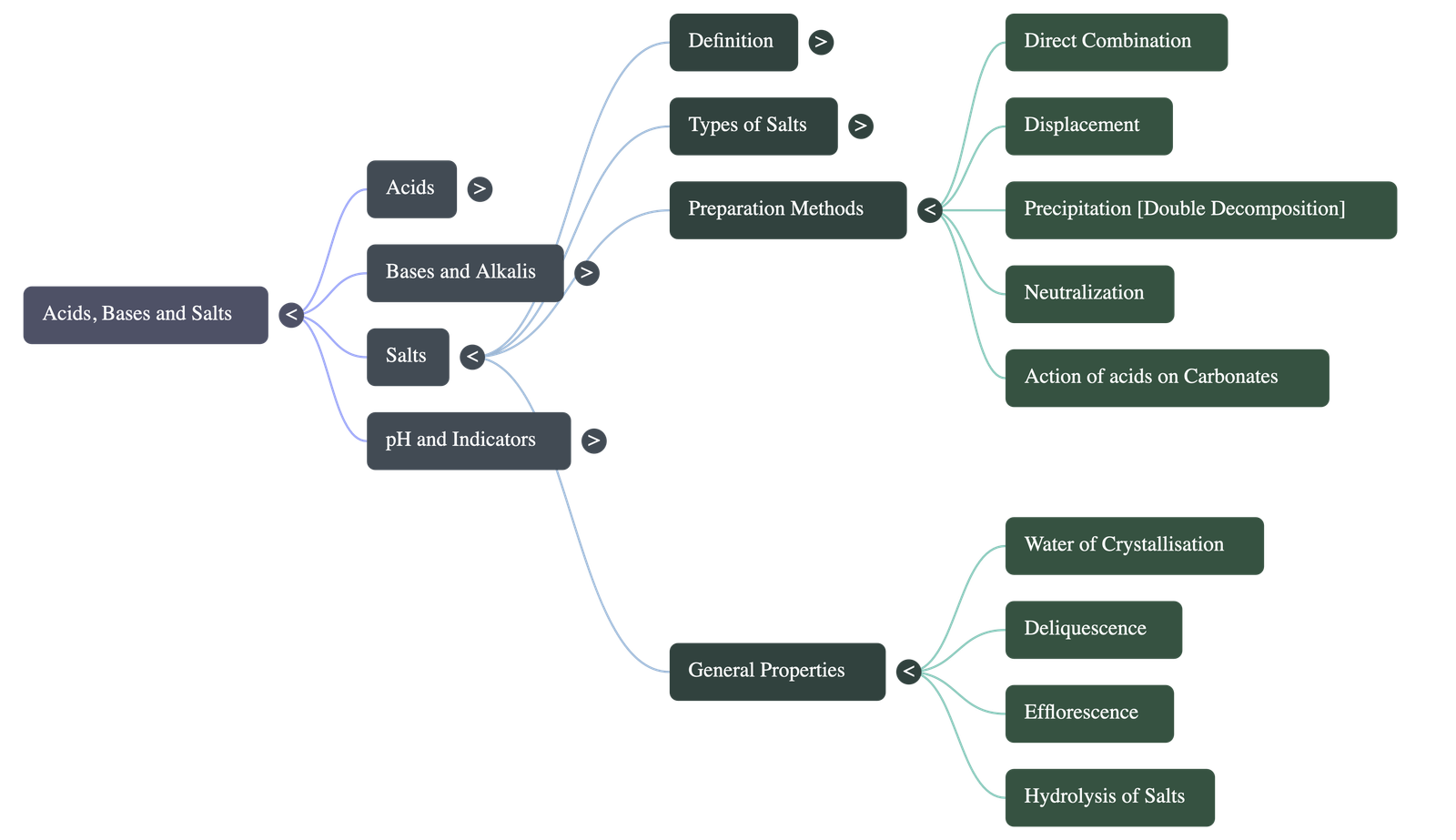
- Direct Combination (Synthesis): Heating a metal with a non-metal (e.g., Iron + Chlorine gas → Iron (III) chloride).
- Displacement: Active metal reacting with dilute acid to displace hydrogen (e.g., Zinc + dil. H₂SO₄ → Zinc sulphate + Hydrogen).
- Precipitation (Double Decomposition): Mixing two soluble salt solutions to precipitate an insoluble salt (e.g., Lead nitrate + Sodium chloride → Lead (II) chloride precipitate + Sodium nitrate).
- Neutralization of an Insoluble Base: Reacting an insoluble base (like copper oxide) with dilute acid (like sulphuric acid) to form a soluble salt (Copper (II) sulphate).
- Neutralization of an Alkali (Titration): Precisely mixing a soluble base (alkali) and acid using an indicator to form soluble salts of Na, K, or NH₄ (e.g., Sodium hydroxide + Sulphuric acid → Sodium sulphate).
- Action of Dilute Acids on Carbonates/Bicarbonates: Acid reacts with carbonate to yield salt, water, and carbon dioxide.
K. Properties of Salts
- General Properties: Salts are non-volatile, electrovalent compounds with high melting points. They can decompose upon reaction with dilute acids.
- Hydrolysis of Salts: Salts react with water to form a solution that may be acidic, alkaline, or neutral (e.g., Salt of strong acid + weak base = acidic solution).
- Water of Crystallisation: The fixed amount of water molecules in loose chemical combination with one molecule of a salt upon crystallization (e.g., Copper sulphate pentahydrate / blue vitriol).
- Deliquescence: The property of certain water-soluble salts to absorb moisture from the atmosphere and dissolve in it to form a solution (e.g., Iron (III) chloride).
- Efflorescence: The property of crystalline hydrated salts to lose their water of crystallization completely or partially when exposed to the air, changing into a powder (e.g., washing soda).
Do checkout all questions & answers of this chapter.
Quick Navigation:
| | | |
1 / 1
Quick Navigation:
| | | |