Quick Navigation:
| | | |
Ch. 4: Mole Concept & Stoichiometry
4-A: Gay Lussac's Law, Avogadro's Law
A. Introduction to States of Matter
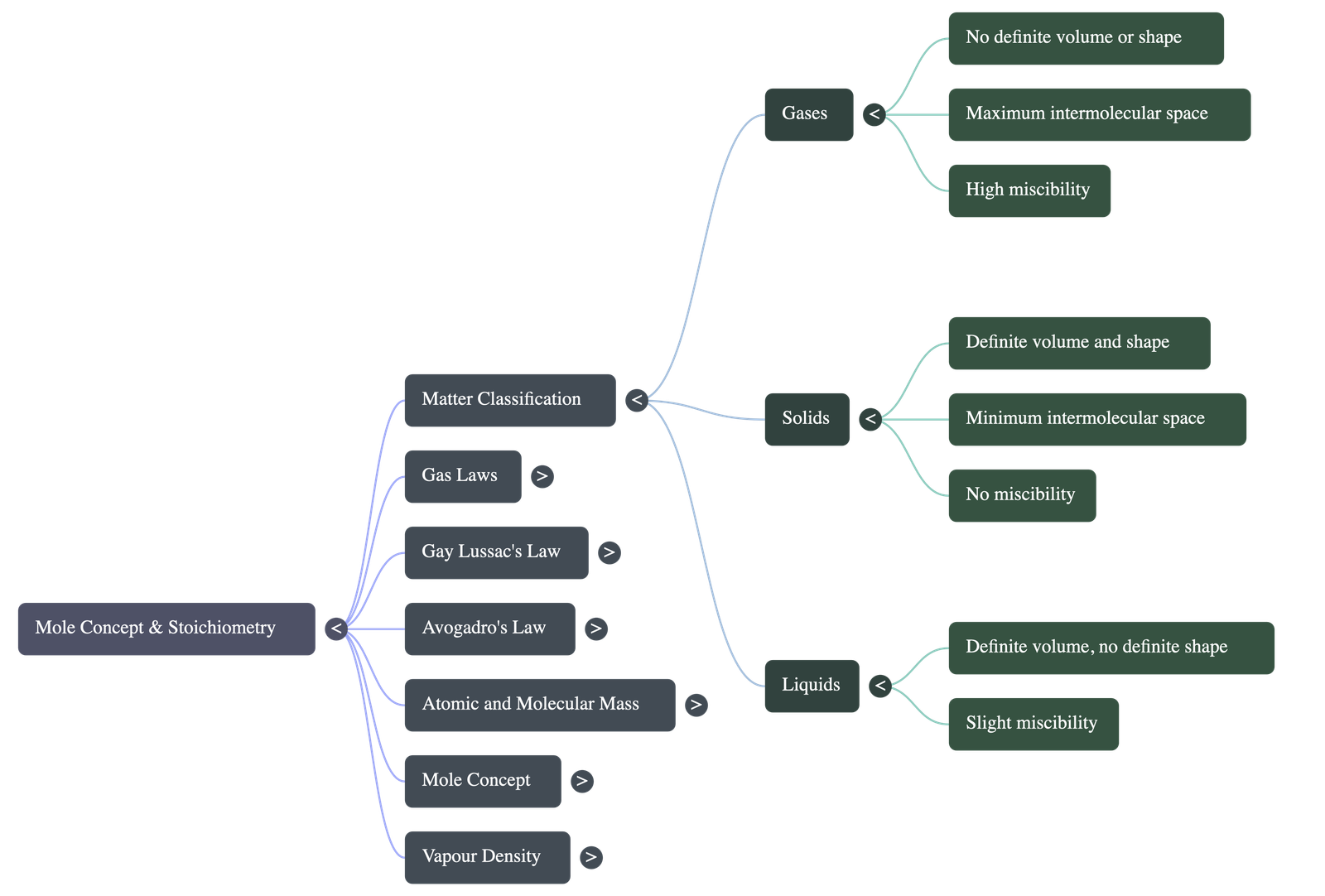
Matter exists in three primary states, each with distinct characteristics:
- Gases: Have no definite volume or shape and possess no rigidity. They have the maximum intermolecular space and negligible force of attraction between particles. Gases exert pressure on all walls of their container, have very low densities, and diffuse rapidly (high miscibility).
- Solids: Have a definite volume and shape and are highly rigid. They have minimum intermolecular space and maximum force of attraction. Solids exert pressure only downwards, have high densities, and do not diffuse with particles of another solid.
- Liquids: Have a definite volume but no definite shape (less rigid). Their intermolecular space and force of attraction lie between those of solids and gases. They exert pressure mainly downwards, have densities less than solids, and show slight miscibility.
B. Gas Laws & Standard Conditions
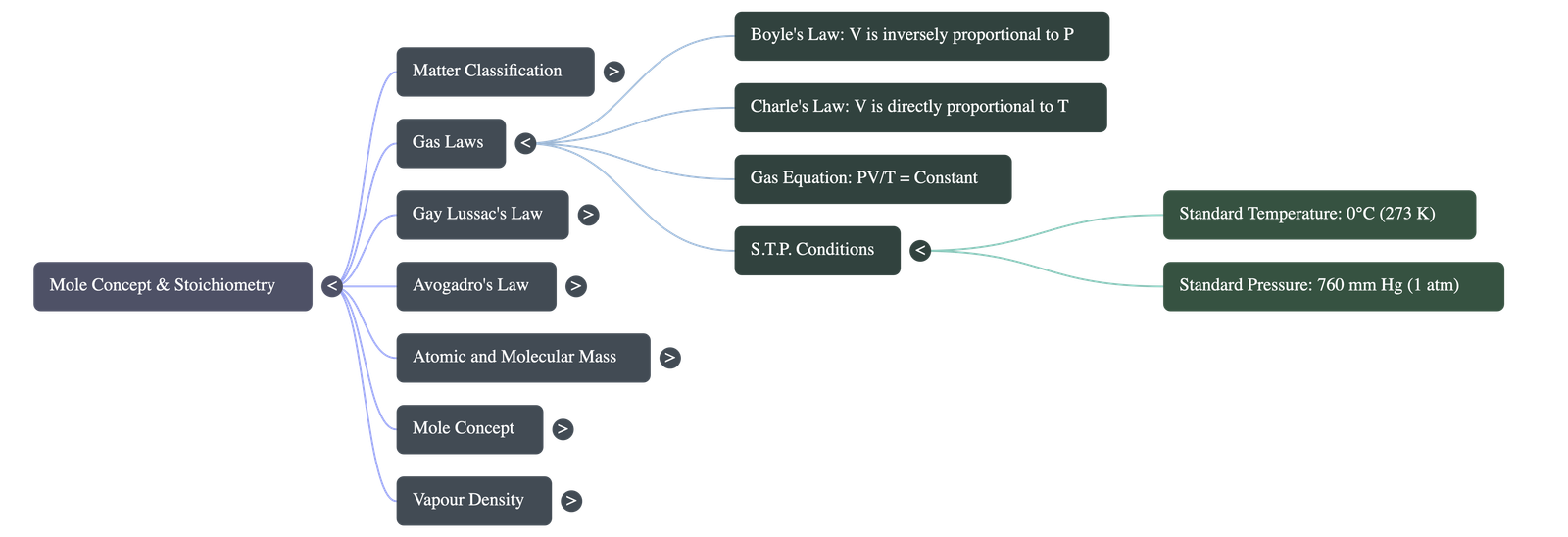
Gas laws are specific rules that dictate how a gas behaves when subjected to changes in temperature, pressure, or volume.
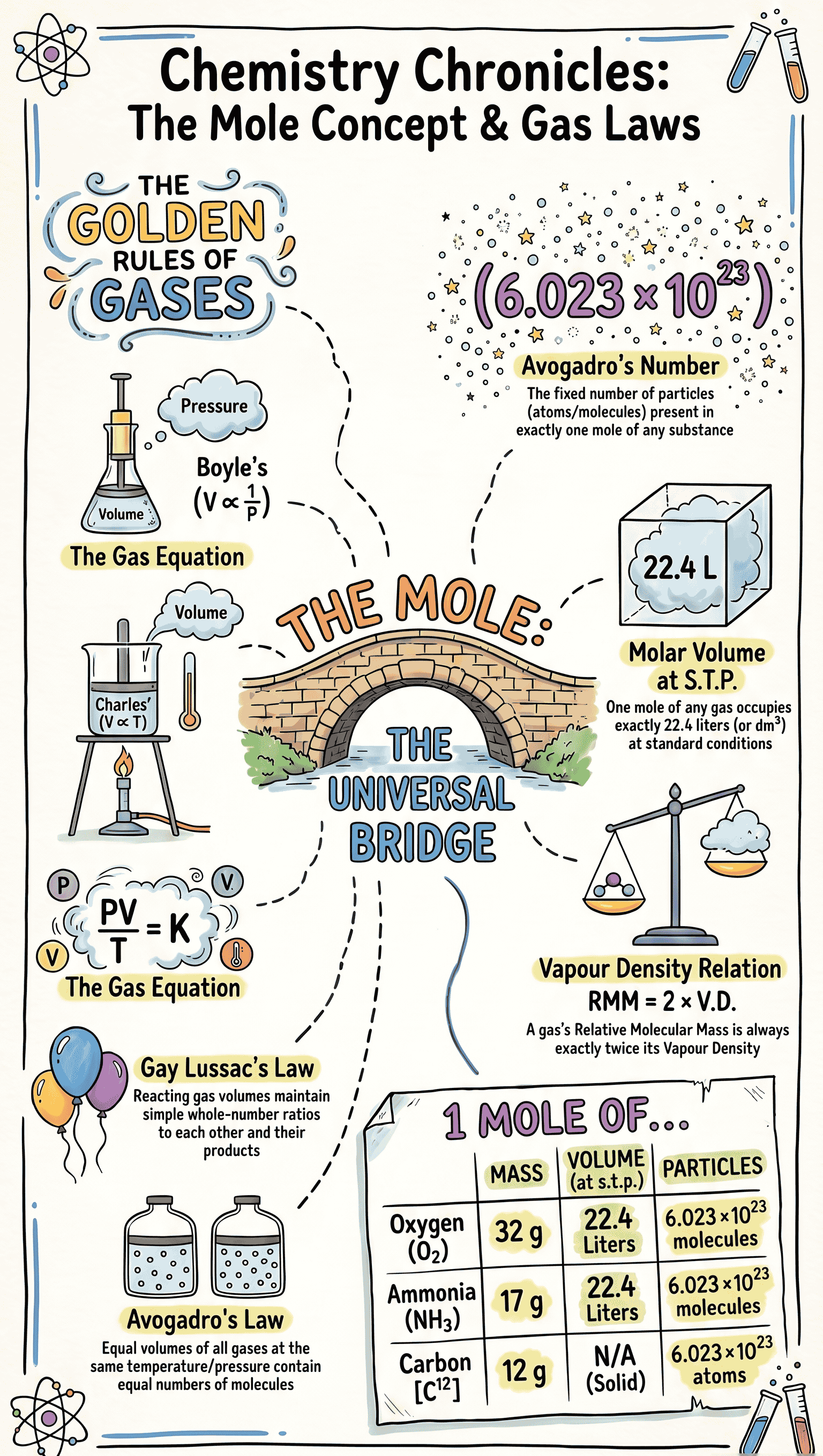
- Boyle's Law: At a constant temperature, the volume of a given mass of dry gas is inversely proportional to its pressure. (V ∝ 1/P)
- Charles's Law: At a constant pressure, the volume of a given mass of dry gas is directly proportional to its absolute (Kelvin) temperature. (V ∝ T)
- Gas Equation: Combining these laws gives the equation: P₁V₁ / T₁ = P₂V₂ / T₂
- Standard Temperature and Pressure (S.T.P.): Gas volumes are typically compared at a standard set of conditions to account for volume changes due to environmental factors.
- Standard Temperature: 0°C or 273 K
- Standard Pressure: 760 mm of Hg (or 76 cm of Hg) = 1 atmospheric pressure (1 atm)
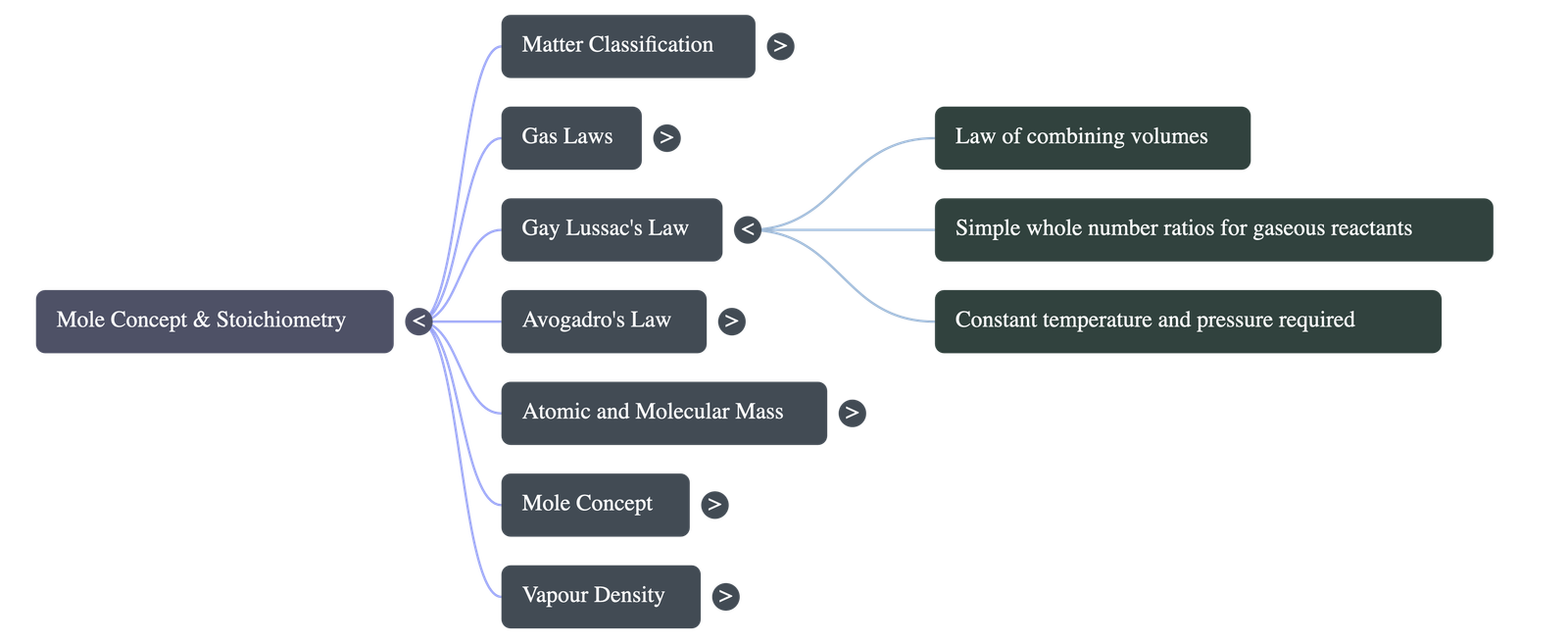
1. Gay Lussac's Law of Combining Volumes
Discovered by Joseph Louis Gay-Lussac in 1805 through experimental work.
- The Law: When gases react, they do so in volumes which bear a simple whole number ratio to one another, and to the volumes of the products (if gaseous), provided the temperature and pressure of the reacting gases and their products remain constant.
- Example 1 (Water): 2 volumes of Hydrogen react with 1 volume of Oxygen to form 2 volumes of Steam. (Ratio is 2:1:2)
- Example 2 (Ammonia): 1 volume of Nitrogen reacts with 3 volumes of Hydrogen to form 2 volumes of Ammonia. (Ratio is 1:3:2)
2. Avogadro's Law
Proposed by Amedeo Avogadro in 1811, making a crucial distinction between atoms and molecules.
- Atom vs. Molecule: An atom is the smallest particle taking part in a chemical reaction (may not exist independently). A molecule is the smallest particle of an element or compound capable of independent existence.
- Atomicity: The number of atoms present in one molecule of an element.
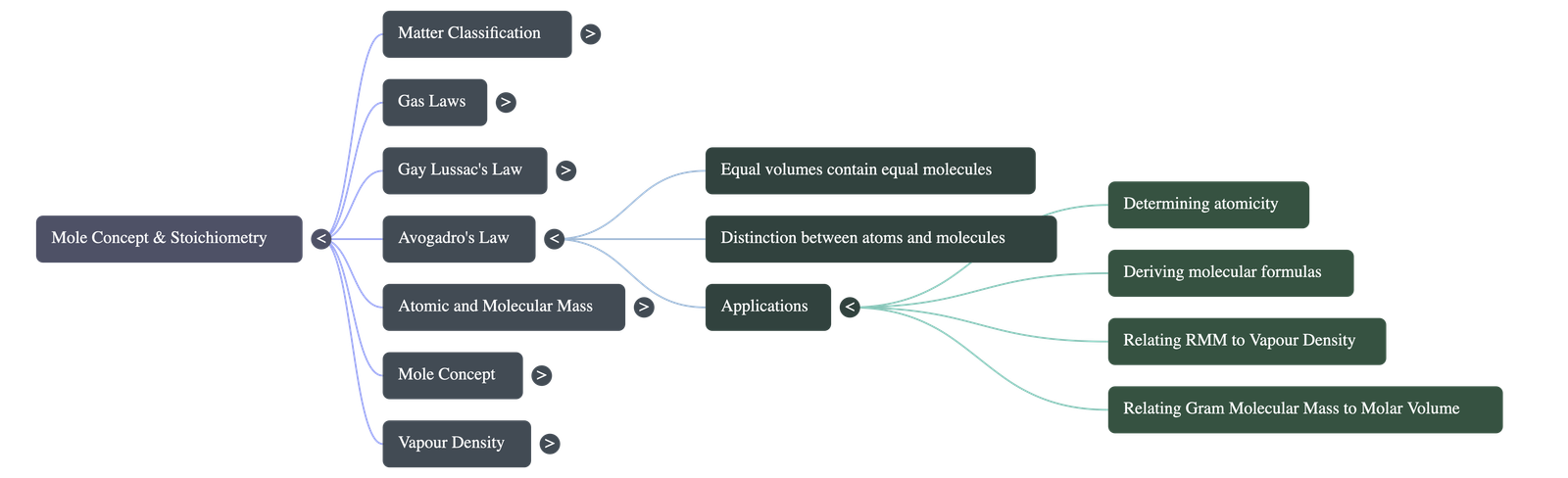
- The Law: Under the same conditions of temperature and pressure, equal volumes of all gases contain the same number of molecules.
- Significance: If 1 litre of oxygen contains 'n' molecules, then 1 litre of hydrogen or nitrogen will also contain 'n' molecules under identical conditions.
3. Atomic and Molecular Mass Concepts
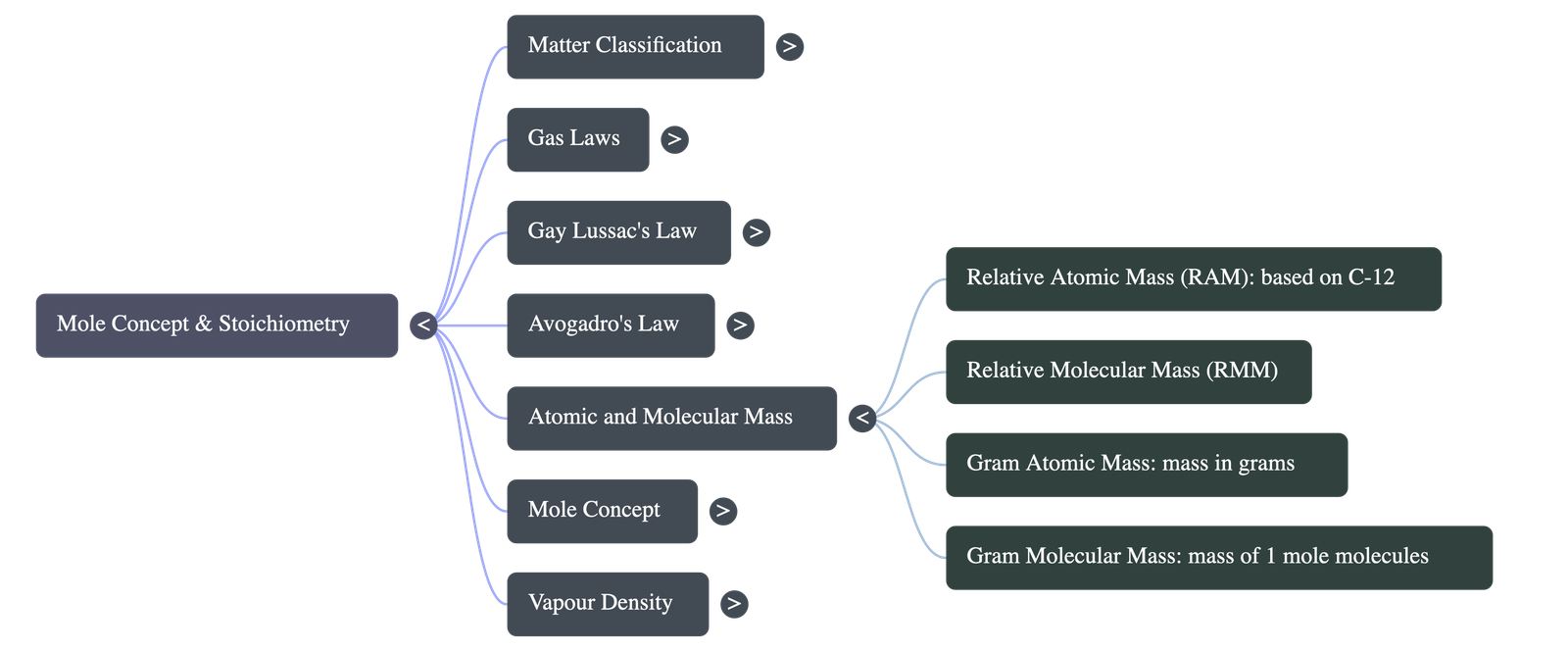
Since atoms are too small to be weighed directly, their masses are compared relatively, using the Carbon-12 isotope as the standard.
- Relative Atomic Mass (RAM): The number of times one atom of an element is heavier than 1/12th the mass of an atom of Carbon-12.
- Relative Molecular Mass (RMM): The number of times one molecule of a substance is heavier than 1/12th the mass of an atom of Carbon-12.
- Gram Atomic/Molecular Mass: When RAM or RMM is expressed in grams, it is known as the gram atomic mass (or gram atom) and gram molecular mass (or gram molecule), respectively.
- Fractional Atomic Weights: Atomic weights are not always whole numbers because elements in nature often exist as mixtures of isotopes. The atomic weight is a weighted average of these naturally occurring isotopes (e.g., Chlorine is 35.453 because of 35Cl and 37Cl isotopes).
4. The Mole & Avogadro's Number
The central concept used to measure the amount of substance in chemistry.
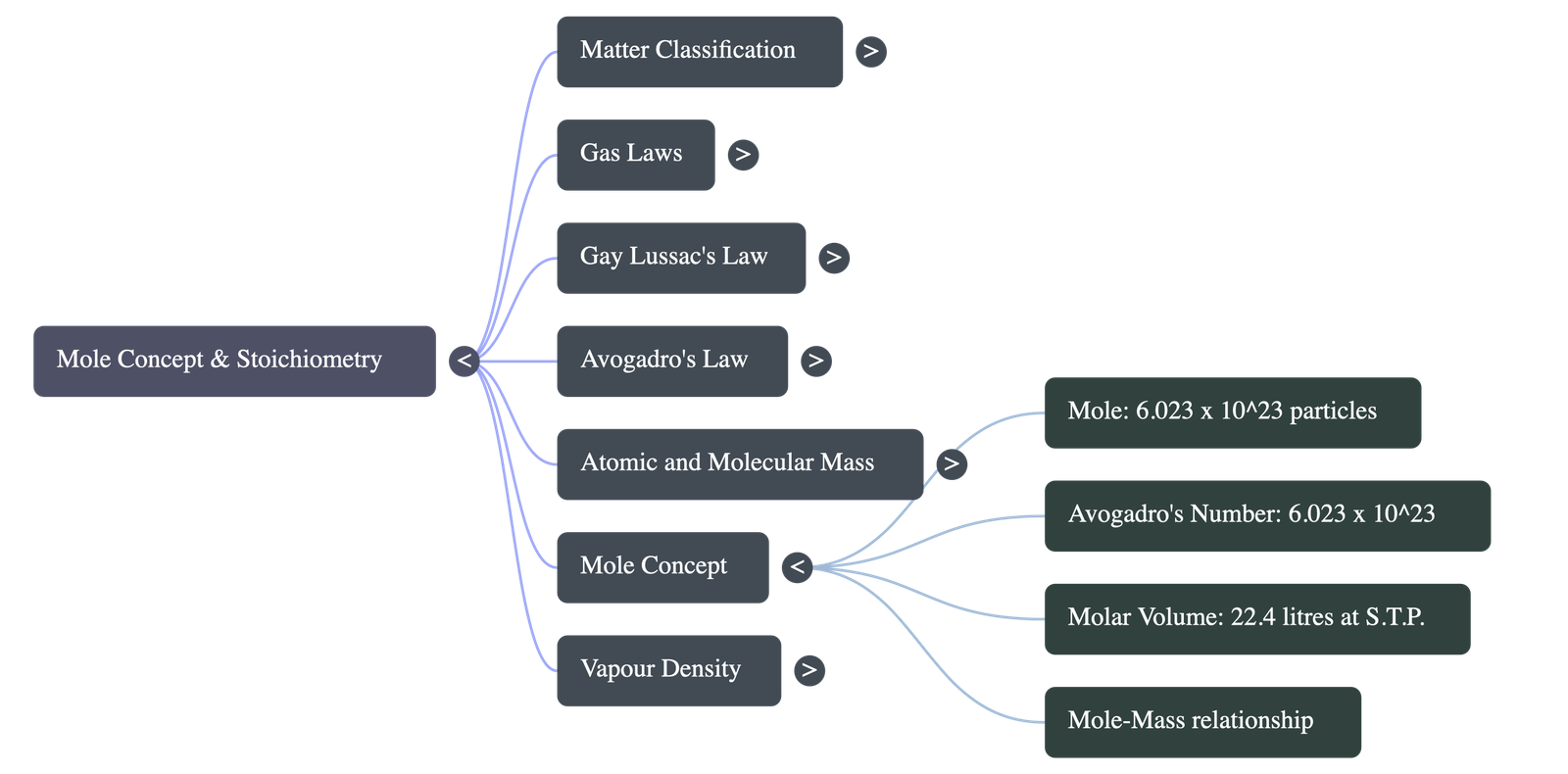
- Mole: The amount of substance that contains the same number of elementary units (atoms, molecules, or ions) as the number of atoms in exactly 12.000 g of Carbon-12. It serves as a basic unit for a collection of particles.
- Avogadro's Number: Denoted by NA or L, its value is exactly 6.023 × 10²³. It represents the number of particles in one mole of any substance.
- Key Mole Relationships:
- Mass: 1 mole of a substance equals its gram atomic mass (for elements) or gram molecular mass (for compounds).
- Particles: 1 mole of any substance always contains 6.023 × 10²³ units (atoms, molecules, or ions).
- Volume (Molar Volume): 1 mole of any gas at S.T.P. occupies a constant volume of 22.4 litres (or 22,400 cm³ or dm³).
5. Applications of Avogadro's Law
Avogadro's law is extremely useful in deducing several chemical principles:
- Determines the Atomicity of a Gas: By applying the law to reaction volumes, we can prove elements like Hydrogen, Nitrogen, and Oxygen are diatomic (contain 2 atoms per molecule).
- Determines the Molecular Formula of a Gas: Helps derive precise molecular formulas (e.g., proving the formula of Hydrogen chloride is HCl).
- Relation between Molecular Weight & Vapour Density:
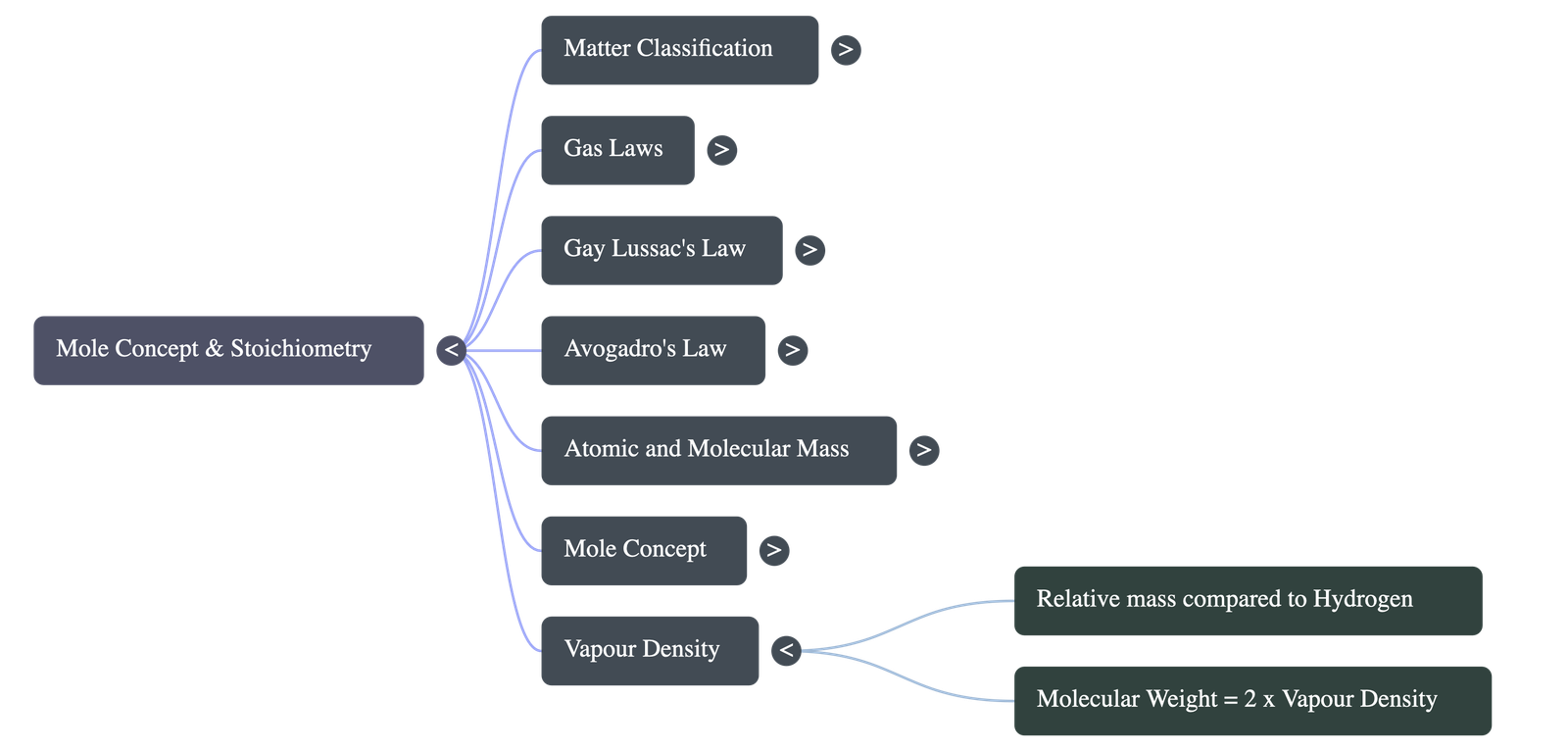
Vapour Density is the ratio of the mass of a certain volume of gas to the mass of the same volume of hydrogen under identical conditions.
The derived relationship is: Molecular Weight = 2 × Vapour Density - Explains Gay-Lussac's Law: Validates why gases react in simple volume ratios by showing that equal volumes represent proportional numbers of reacting molecules.
- Relationship between Gram Molecular Mass and Volume: Confirms that one mole of any gas occupies exactly 22.4 L at standard temperature and pressure.
Do checkout all questions & answers of this chapter.
Quick Navigation:
| | | |
1 / 1
Quick Navigation:
| | | |