Quick Navigation:
| | | |
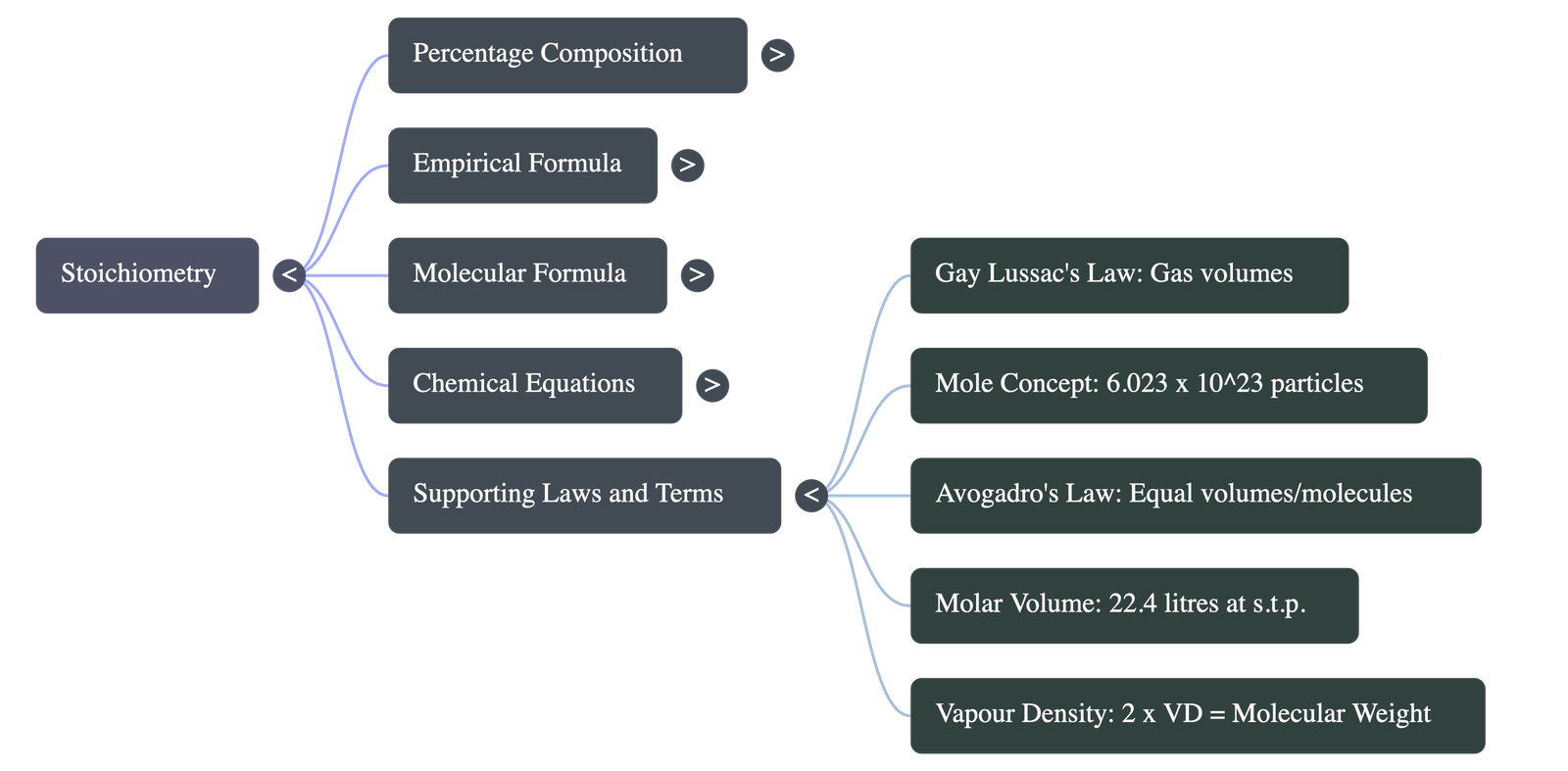
Ch. 4-B: Stoichiometry - Percentage Composition, Empirical & Molecular Formula, Chemical Equation Calculations
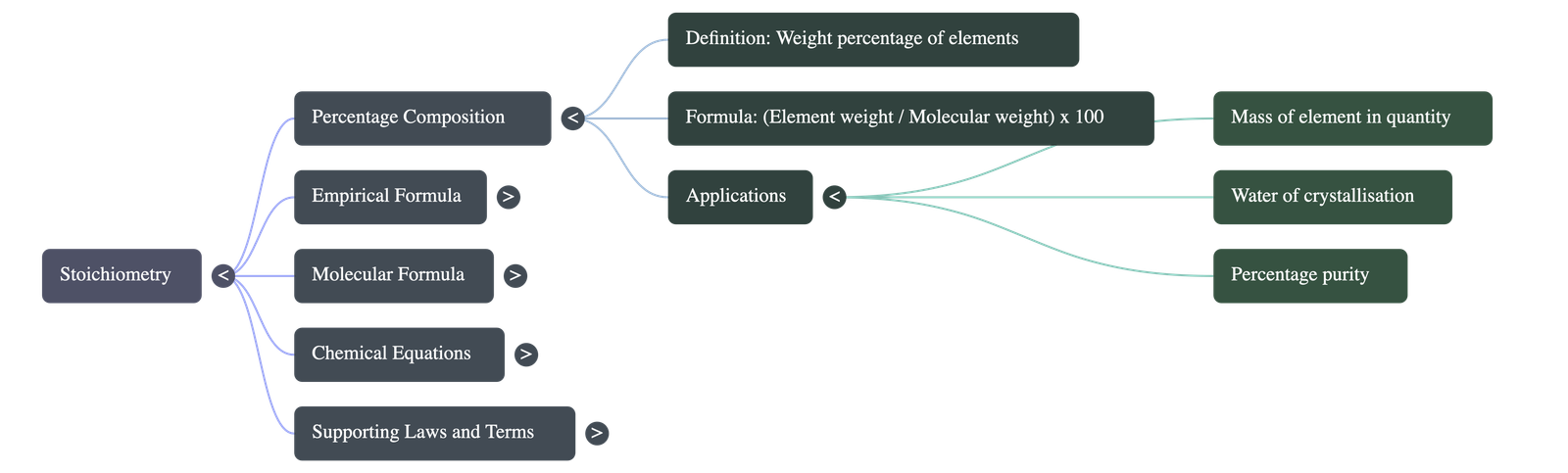
1. Percentage Composition
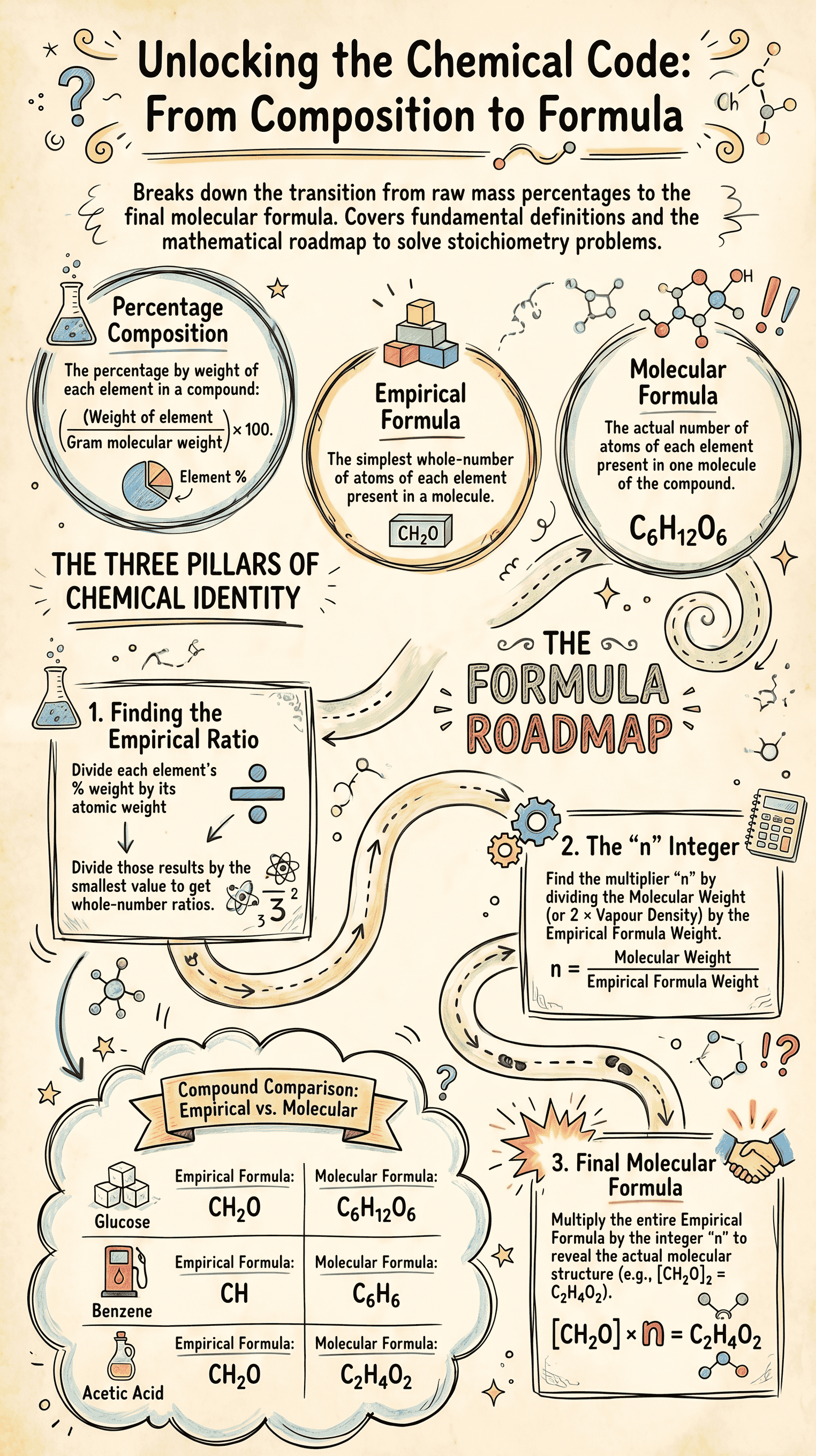
- Definition: Percentage composition is the percentage by weight of each specific element present in a compound.
- It represents the percentage by mass of atoms of an element present in exactly one mole of the given compound.
- Main Formula:
Percentage Composition = (Weight of the element in one molecule of the compound / Gram molecular weight of the compound) × 100
- Water of Crystallisation: This same concept is used to find the percentage of water of crystallisation in hydrated salts (like washing soda or copper sulphate crystals) by dividing the mass of the water molecules by the total molecular mass of the hydrated salt and multiplying by 100.
2. Empirical Formula
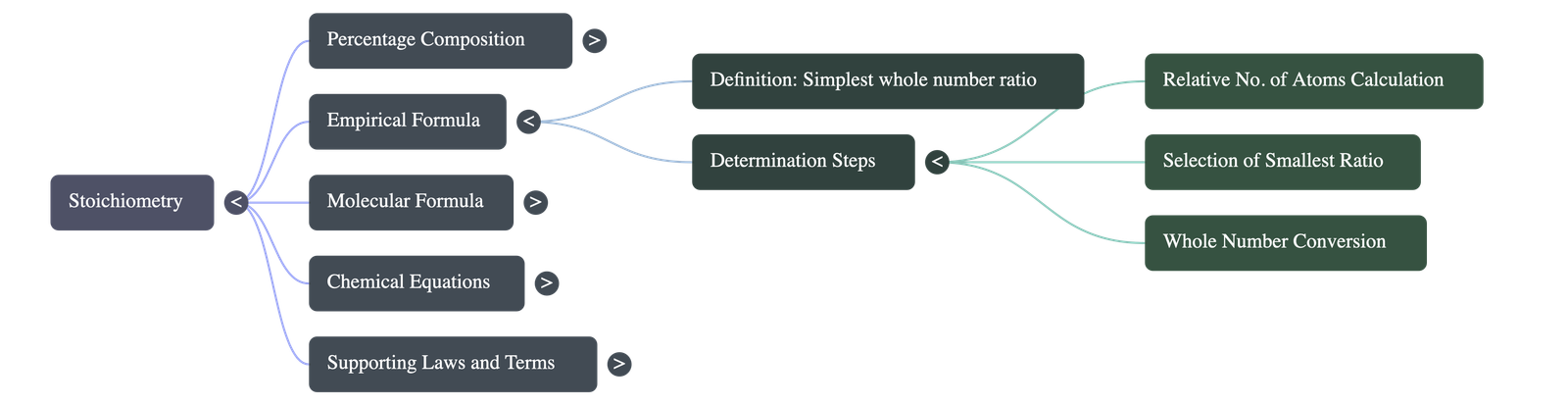
- Definition: The empirical formula of a compound represents the simplest whole number ratio between the atoms of the various elements present in one molecule of the compound.
- For example, the molecular formula of Glucose is C₆H₁₂O₆, but its empirical formula is CH₂O (which is the simplest 1:2:1 ratio).
- Step-by-Step Determination Method:
- List Details: Write down the elements, their given percentage compositions (or weights), and their atomic weights.
- Find Relative Number of Atoms: Divide the percentage composition of each element by its respective atomic weight.
- Determine Simplest Ratio: Identify the smallest relative number of atoms from the previous step. Divide all the relative numbers by this smallest value.
- Convert to Whole Numbers: If the simplest ratio contains decimals, multiply all ratios by the smallest suitable integer to convert them all into whole numbers.
- Write Formula: Write the symbols of the elements side-by-side and append their respective whole-number ratios as subscripts to get the final empirical formula.
3. Molecular Formula
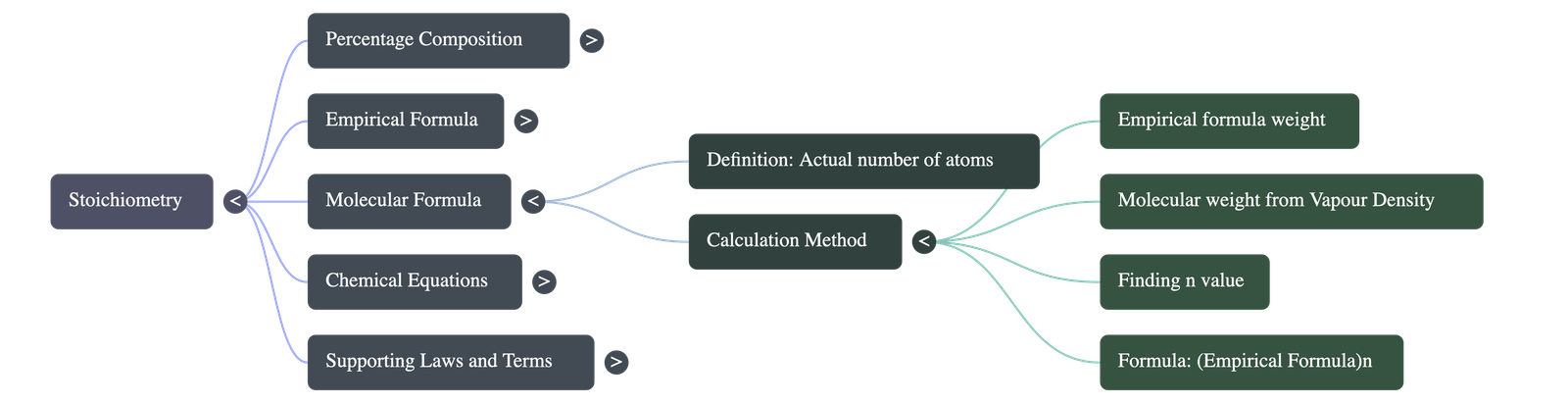
- Definition: The molecular formula is the chemical formula that represents the actual, exact number of atoms of each element present in a single molecule of the compound.
- Step-by-Step Determination (from Empirical Formula):
- Calculate Empirical Formula Weight: Add up the atomic weights of all the atoms in the determined empirical formula.
- Find Molecular Weight: This is often given directly in the problem, or it can be calculated using Vapour Density.
Molecular Weight = 2 × Vapour Density (V.D.)
- Determine 'n': Find the multiplying integer 'n' using the formula:
n = Molecular Weight / Empirical Formula Weight
- Calculate Molecular Formula: Multiply the entire empirical formula by the integer 'n'.
Molecular Formula = (Empirical Formula)ₙ
4. Chemical Equations & Problem Solving
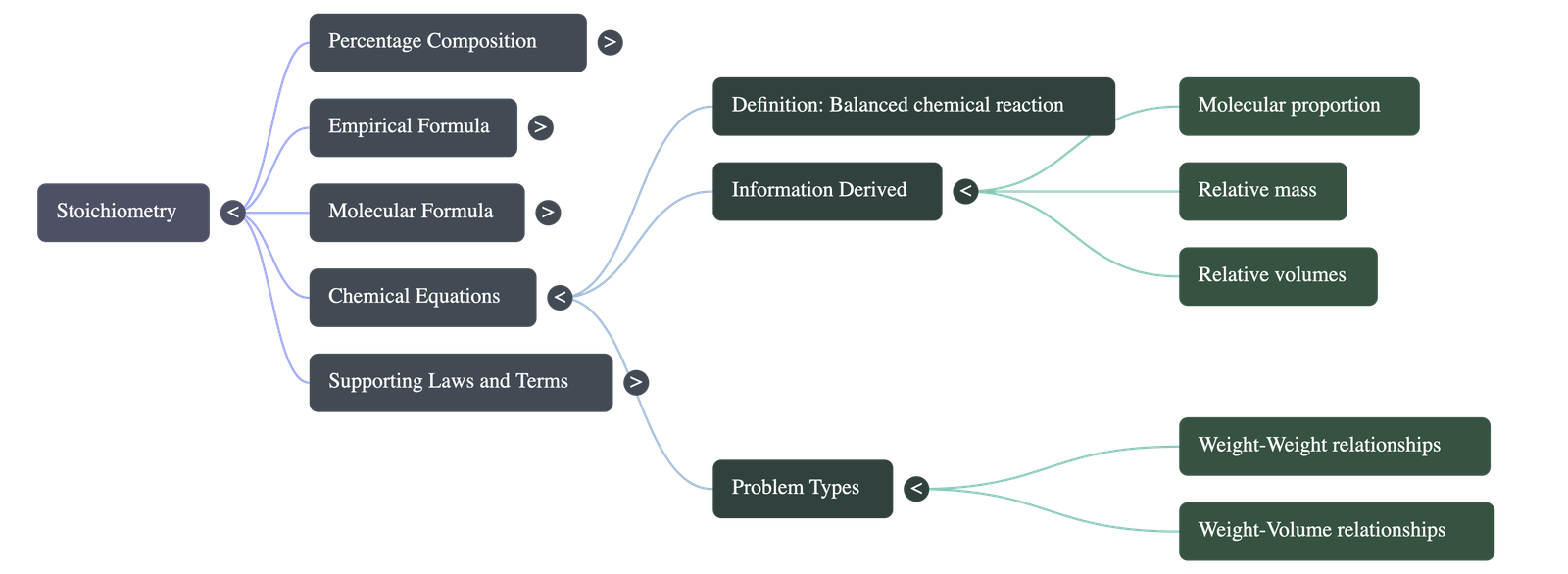
- Definition: A chemical equation is a balanced chemical transition reaction. It shows the rearrangement of particles where the properties of the products are entirely different from the reactants.
- Information Conveyed: A balanced equation gives information regarding:
- The molecular proportions of reactants and products.
- The relative masses of substances taking part.
- The relative volumes (if the reactants/products are gaseous).
- Procedure for Solving Equations (Weight-Weight or Weight-Volume relations):
- Write the Balanced Equation: You must start with a fully balanced chemical equation.
- Calculate Standard Weights/Volumes: Write the standard molecular weight beneath each required substance (multiply the formula weight by the stoichiometric coefficient). For gases, multiply the number of moles by 22.4 Litres (since 1 mole of any gas occupies 22.4 L at S.T.P.).
- Set Up the Proportion: Use the standard relationship established in the previous step to find the unknown value based on the actual given weight/volume in the problem (using the unitary method or cross-multiplication).
5. Summary of Laws & Additional Problem Concepts
- Gay-Lussac’s Law: When gases react, they do so in volumes which bear a simple whole number ratio to one another and to the products (provided temperatures and pressures remain constant). In problems, equations are represented in terms of "volumes" corresponding to their balanced molar coefficients.
- Mole Concept & Avogadro's Number:
- 1 Mole of a substance always weighs equal to its Gram Molecular Weight.
- 1 Mole of any gas occupies exactly 22.4 Litres (or 22,400 cc) at Standard Temperature and Pressure (S.T.P.).
- 1 Mole contains exactly 6.023 × 10²³ molecules/atoms/ions (Avogadro's Number).
- Avogadro’s Law: Under identical conditions of temperature and pressure, equal volumes of all gases contain the same number of molecules. If 10 Litres of Hydrogen has 'X' molecules, 10 Litres of Chlorine under the same conditions will also have 'X' molecules.
- Vapour Density: The ratio of the weight of a certain volume of gas to the weight of an equal volume of hydrogen under the exact same conditions of temperature and pressure.
Do checkout all questions & answers of this chapter.
Quick Navigation:
| | | |
1 / 1
Quick Navigation:
| | | |