Quick Navigation:
| | | | |

Quick Navigation:
| | | | |
Traders to Rulers
Point-wise summary of the chapter detailing the British East India Company's transition from traders to political rulers in India:
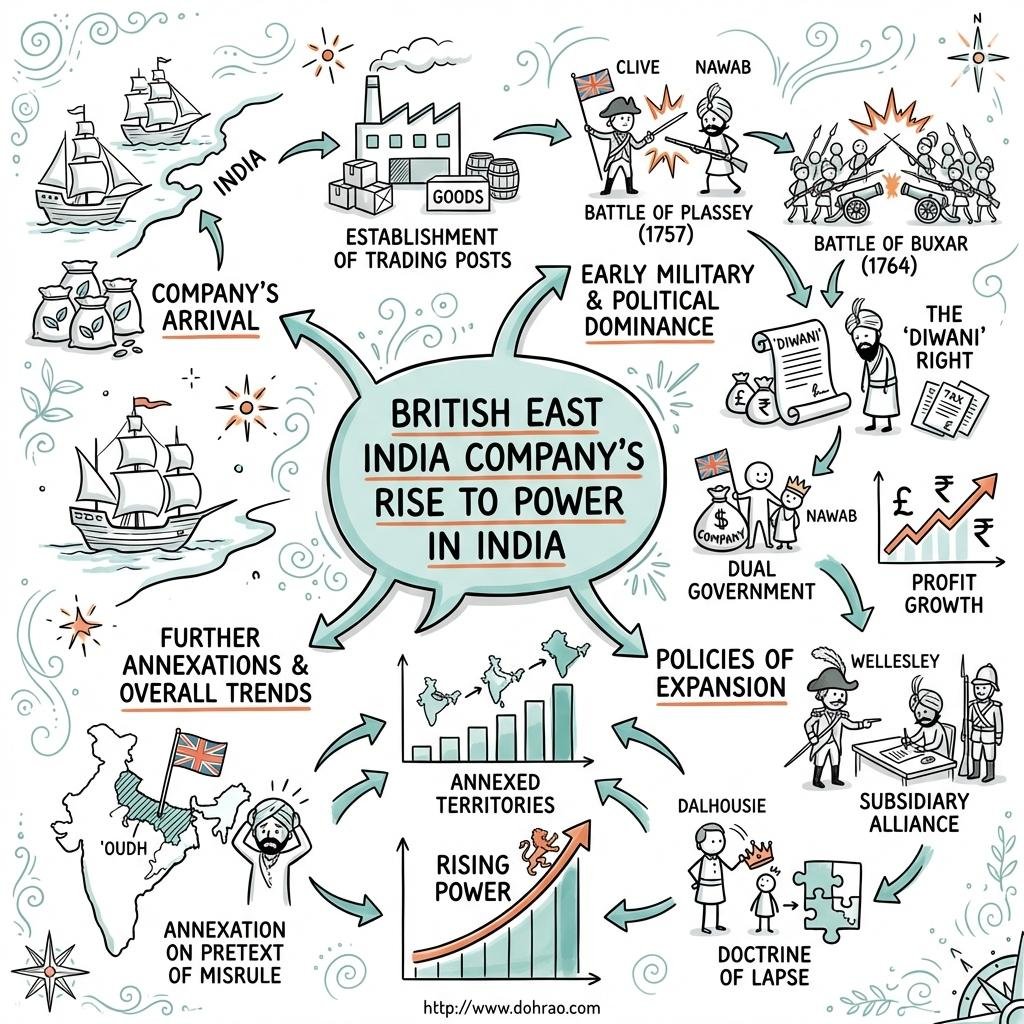
- Transition from Commerce to Politics: Initially established in 1600 to trade spices and cotton, the East India Company eventually realized that securing political power was necessary to maximize profits and protect its commercial interests from European rivals like the French and Dutch.
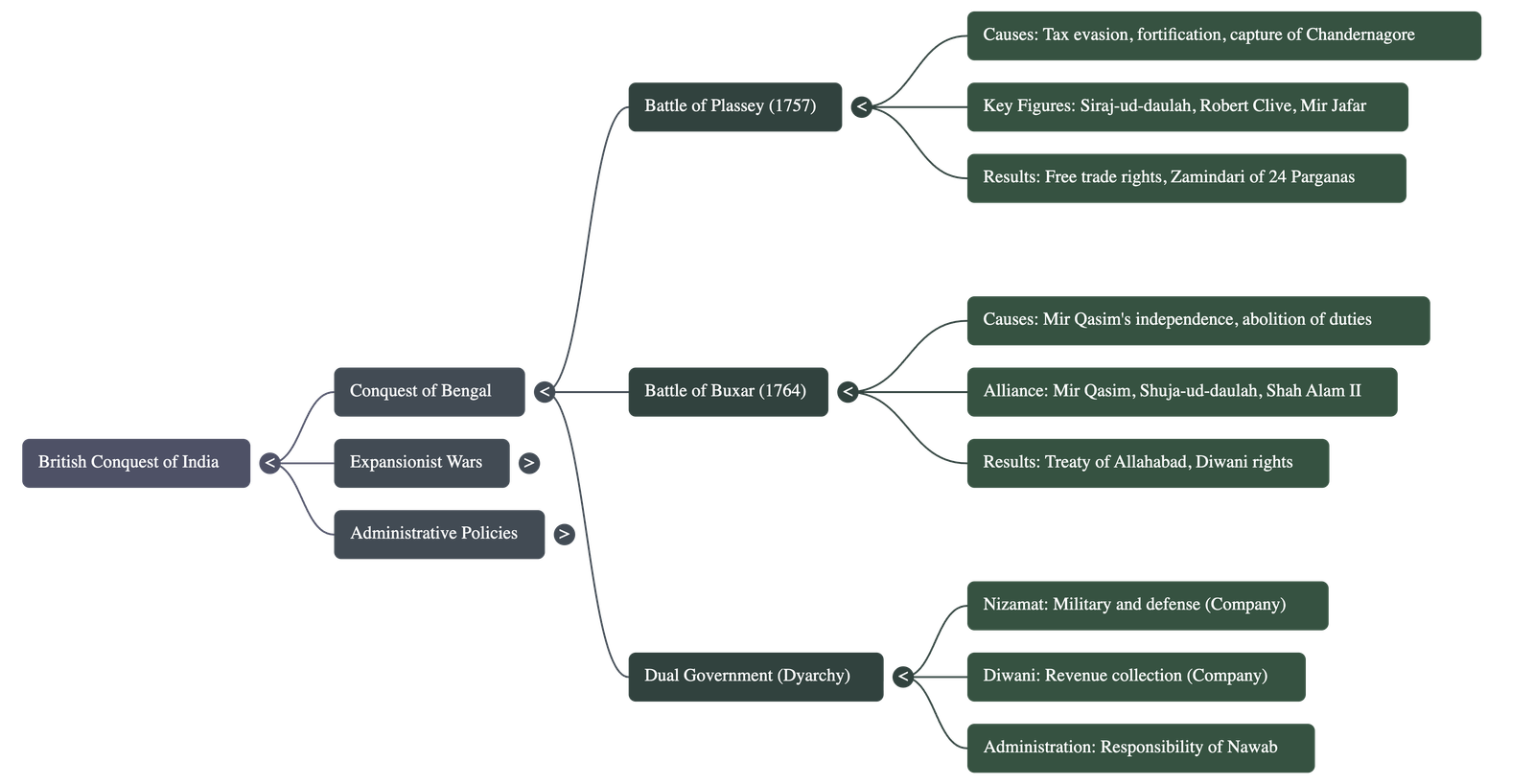
- The Conquest of Bengal:
- Battle of Plassey (1757): This marked the beginning of British political sway in India. The British, led by Robert Clive, defeated Siraj-ud-daulah after his commander-in-chief, Mir Jafar, betrayed him.
- Battle of Buxar (1764): After the Company clashed with Mir Qasim, Shuja-ud-daulah, and the Mughal Emperor Shah Alam II, the British victory firmly established them as the masters of Bengal, Bihar, and Odisha.
- Treaty of Allahabad (1765): Following Buxar, the Company gained Diwani rights (the right to collect revenue) and Nizamat functions (military and foreign affairs) over Bengal, effectively turning the Mughal Emperor into their pensioner.
- Administrative Systems of Control:
- Dual Government (Dyarchy): Introduced by Robert Clive in 1765, this system divided power; the Company held the actual power and revenue collection, while the Nawab remained responsible for the administration without having the resources to fund it.
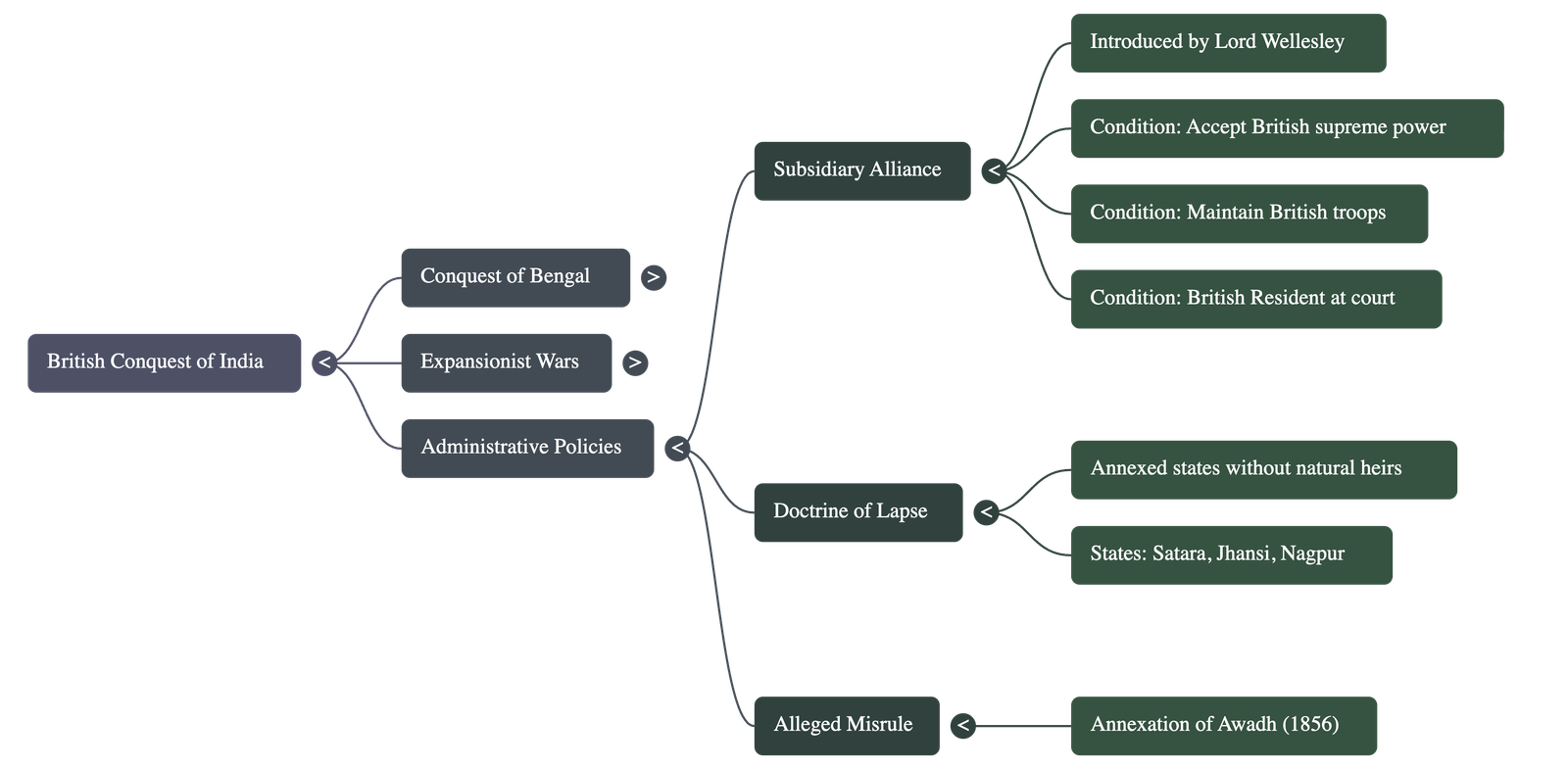
- Subsidiary Alliance: Orchestrated by Lord Wellesley, this was a diplomatic tool where Indian rulers accepted British supremacy, maintained British troops at their own expense, and kept a British Resident at their court. Rulers who signed this, such as the Nizam of Hyderabad and the Nawab of Awadh, lost their independence in exchange for British "protection".
- Doctrine of Lapse: Under this policy, if an Indian ruler died without a natural heir, their kingdom was annexed by the British. This led to the annexation of states like Satara, Jhansi, and Nagpur.
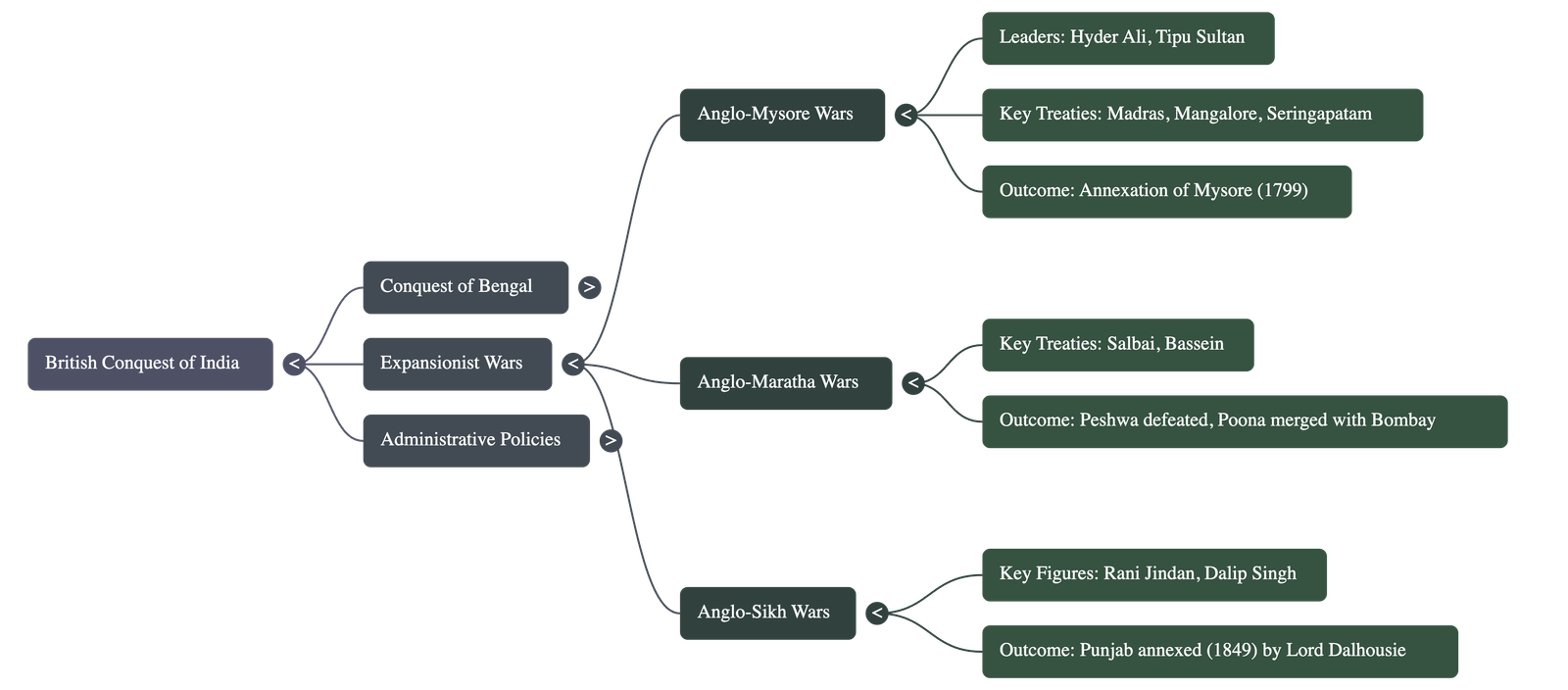
- Expansion through Major Wars:
- Anglo-Mysore Wars (1767–1799): Through four major conflicts, the British eventually defeated Hyder Ali and Tipu Sultan, leading to the annexation of Mysore.
- Anglo-Maratha Wars (1775–1818): Despite the Marathas being strong rivals, three wars ended with the defeat of the Peshwa and the merging of their territories into British presidencies.
- Anglo-Sikh Wars (1845–1849): Following the death of Maharaja Ranjit Singh, internal strife in Punjab allowed the British to win two wars and annex the region under Lord Dalhousie.
- Annexation via "Alleged Misrule": In 1856, the British used the pretext of misgovernance to annex the kingdom of Awadh, further extending their imperial reach.
To understand the British rise to power, imagine a guest invited into a large house to trade goods who slowly begins locking the doors and charging the family rent for their own rooms. By first controlling the money (Diwani) and then the security (Subsidiary Alliance), the guest eventually becomes the landlord, while the original owners are left with the responsibility of cleaning the house but no keys to the cabinets.
Do checkout all questions & answers of this chapter.
Quick Navigation:
| | | | |
1 / 1
Quick Navigation:
| | | | |