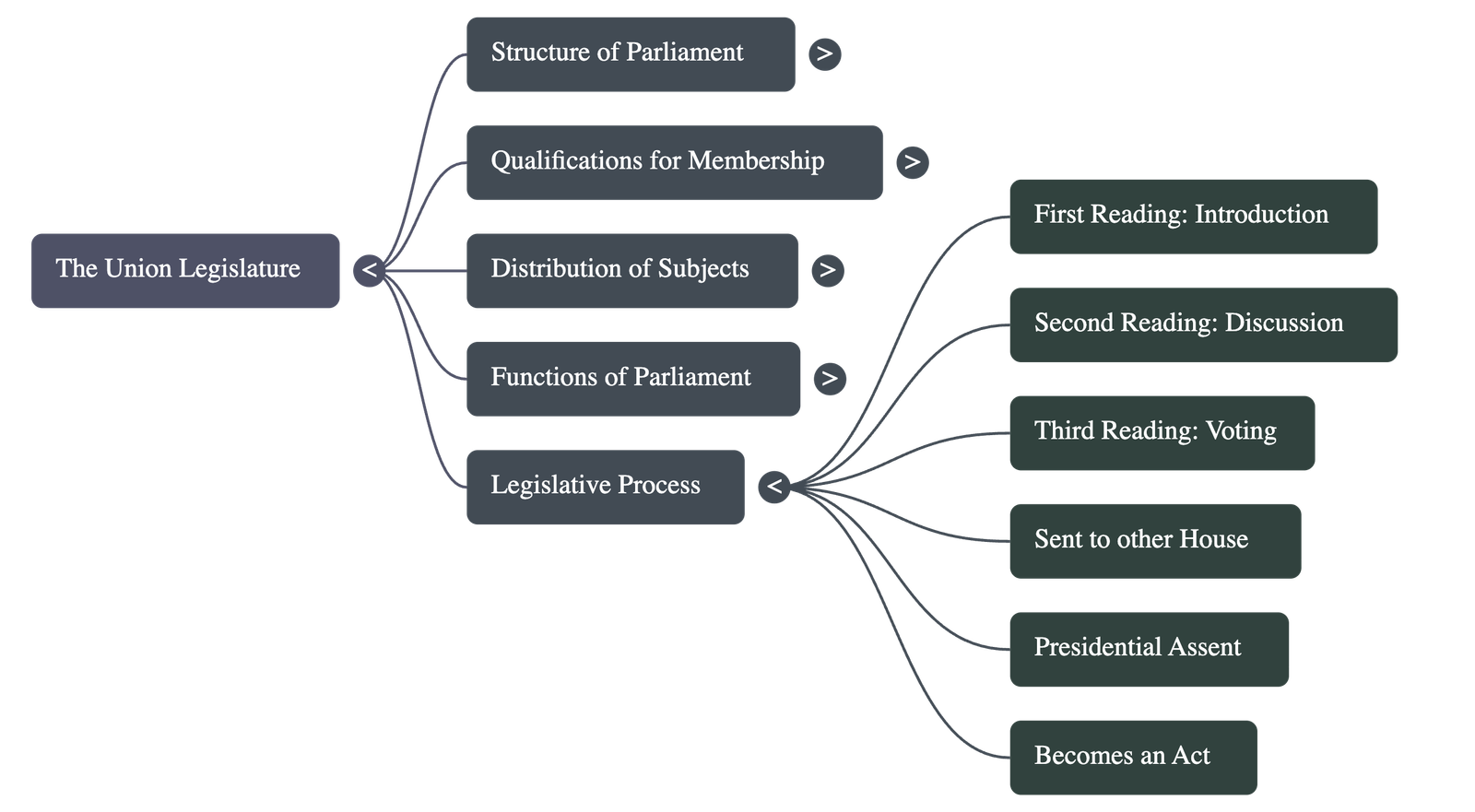
Quick Navigation:
| | | | |
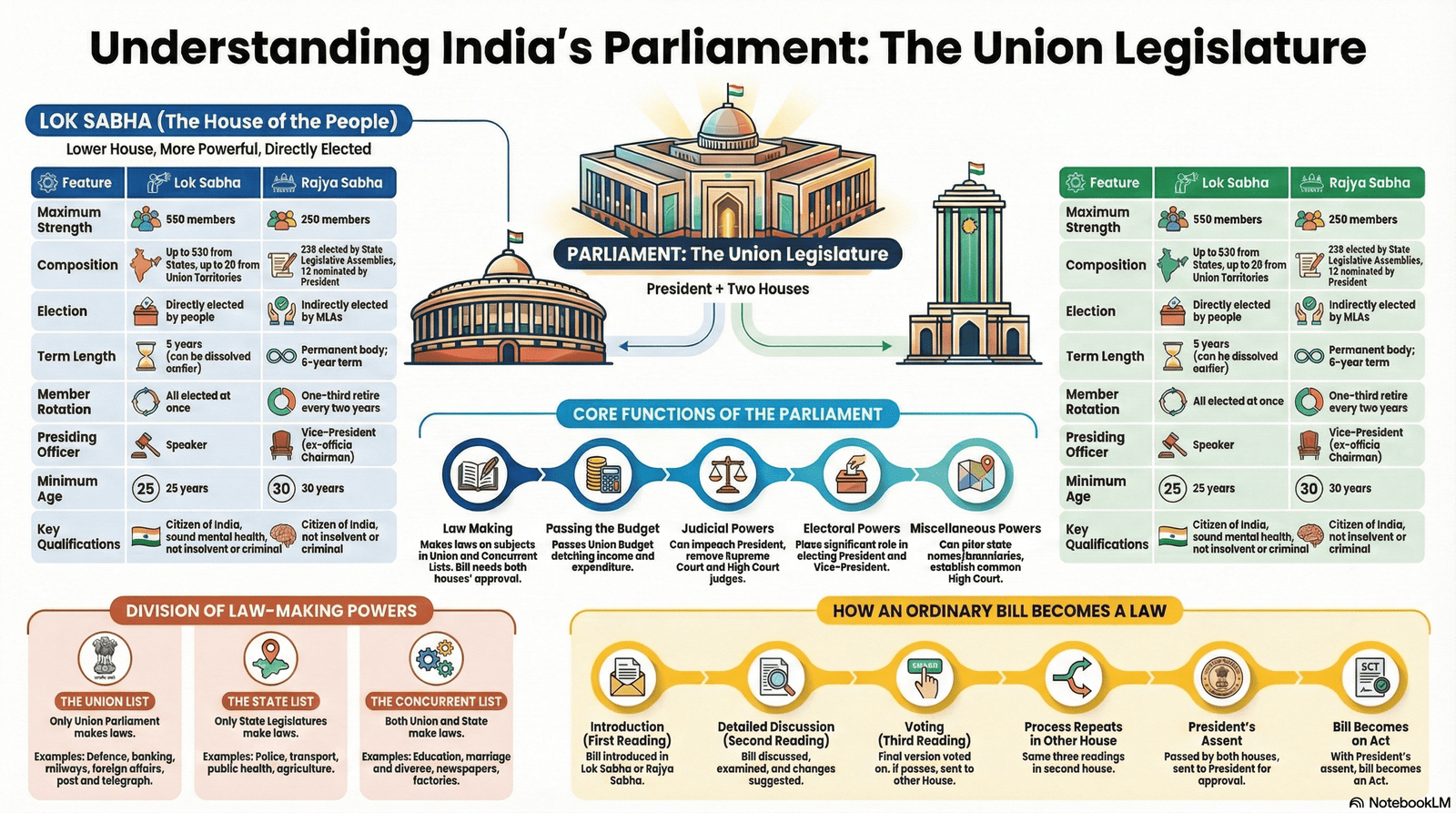
Quick Navigation:
| | | | |
Ppointwise summary of the chapter titled "The Union Legislature":
1. Structure of the Union Legislature
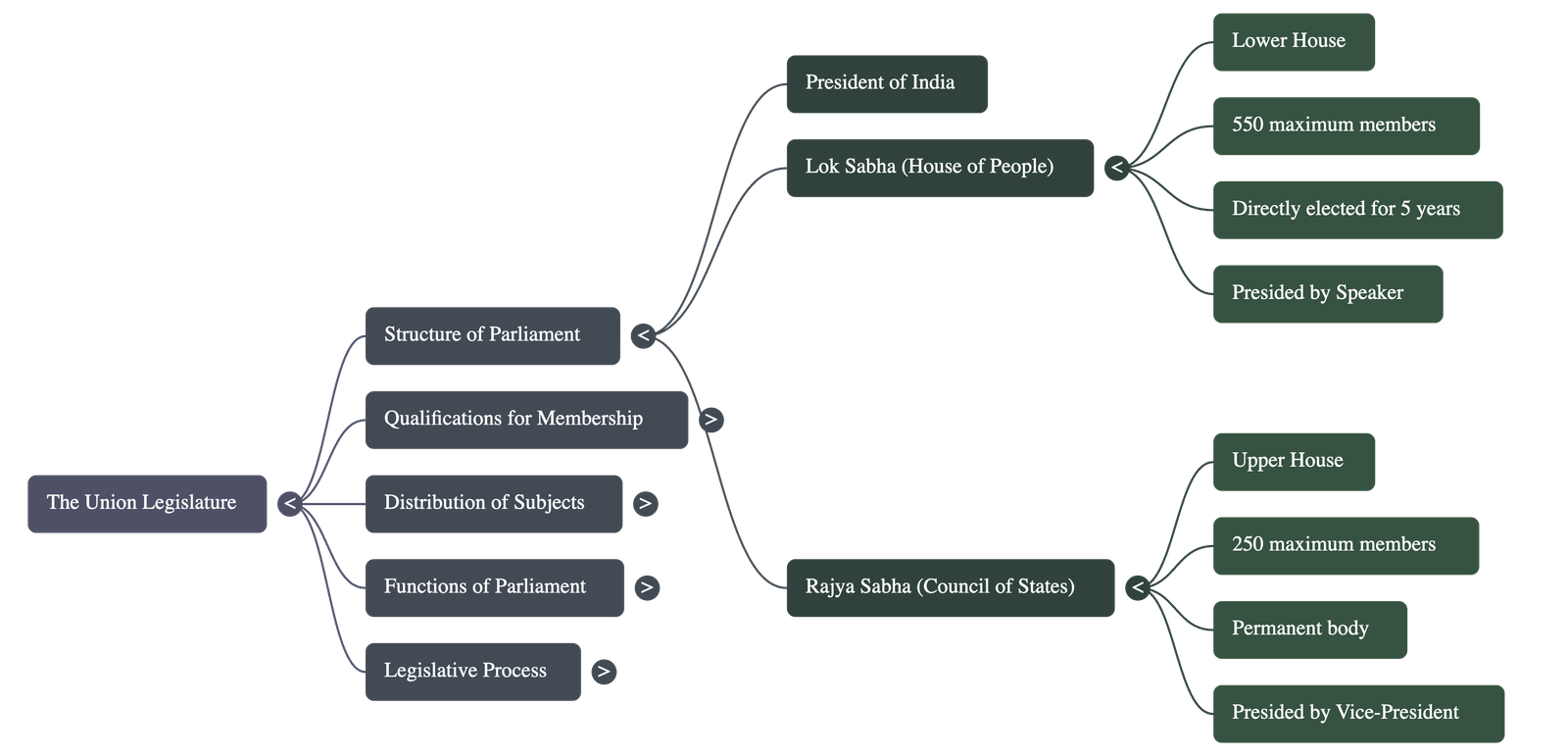
- The Union Legislature, also known as the Parliament, consists of the President and two houses: the Lok Sabha (House of the People) and the Rajya Sabha (Council of States).
- India follows a Parliamentary system with three organs of government: the Legislature (which makes laws), the Executive, and the Judiciary.
2. The Lok Sabha (Lower House)
- Composition: It has a maximum permissible strength of 550 members. This includes 530 members directly elected from the States and up to 20 from Union Territories.
- Term: Members are elected for five years. However, the President can dissolve the house earlier if the ruling party loses support, or the term can be extended by one year during an emergency.
- Elections: Conducted every five years by secret ballot. All Indian citizens aged 18 and above have the right to vote.
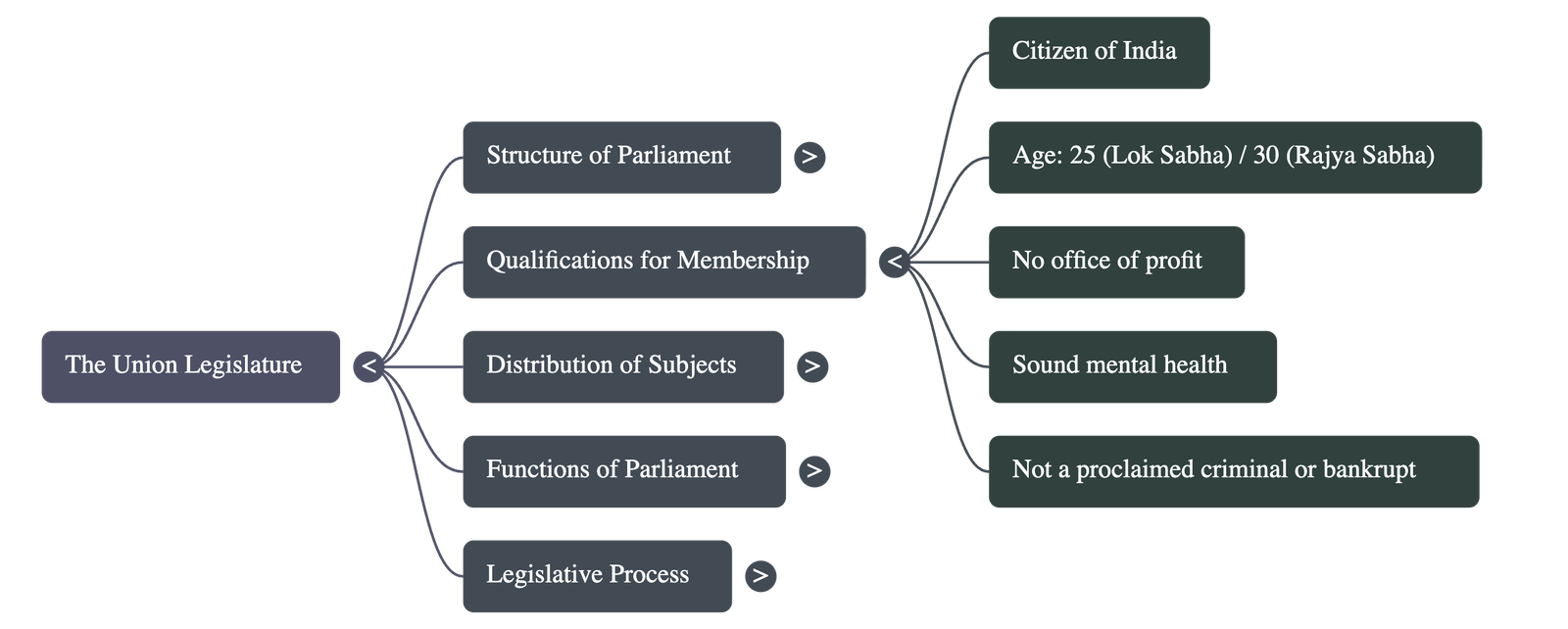
- Qualifications: To be a member, one must be a citizen of India, at least 25 years of age, of sound mental health, and not a proclaimed criminal or hold an office of profit.
- Presiding Officer: The members elect a Speaker and a Deputy Speaker. The Speaker maintains order and has a casting vote to break ties.
3. The Rajya Sabha (Upper House)
- Composition: It has a maximum strength of 250 members. Currently, 238 are elected by the members of State Legislative Assemblies (MLAs), and 12 members are nominated by the President from fields like literature, science, art, and social service.
- Term: It is a permanent house and is never dissolved. Members serve a six-year term, with one-third of the members retiring every two years.
- Qualifications: Requirements are similar to the Lok Sabha, but the minimum age is 30 years.
- Presiding Officer: The Vice-President of India serves as the ex-officio Chairman. A Deputy Chairman is elected from among the members.
4. Distribution of Legislative Subjects
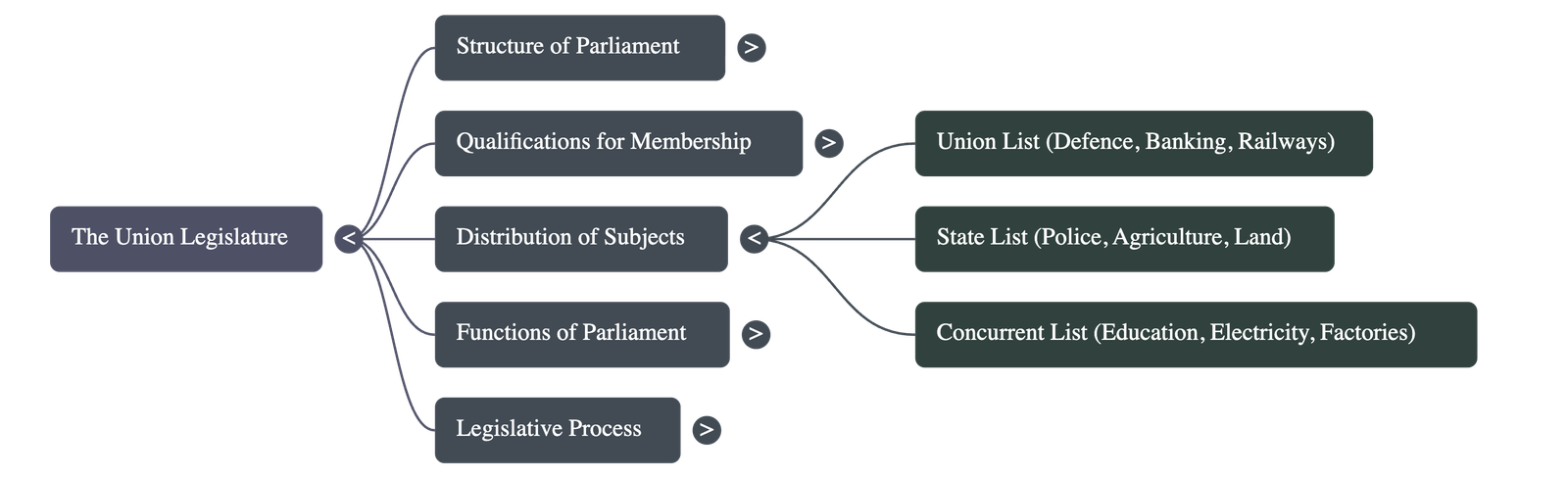
Powers are divided into three lists to categorize which level of government can make laws:
- Union List: Exclusive powers for the Union Parliament (e.g., defense, banking, railways, foreign affairs).
- State List: Exclusive powers for State Legislatures (e.g., police, public health, agriculture).
- Concurrent List: Both the Union and State can make laws (e.g., education, electricity, factories). If there is a conflict, the Union Law prevails.
5. Key Functions of the Parliament
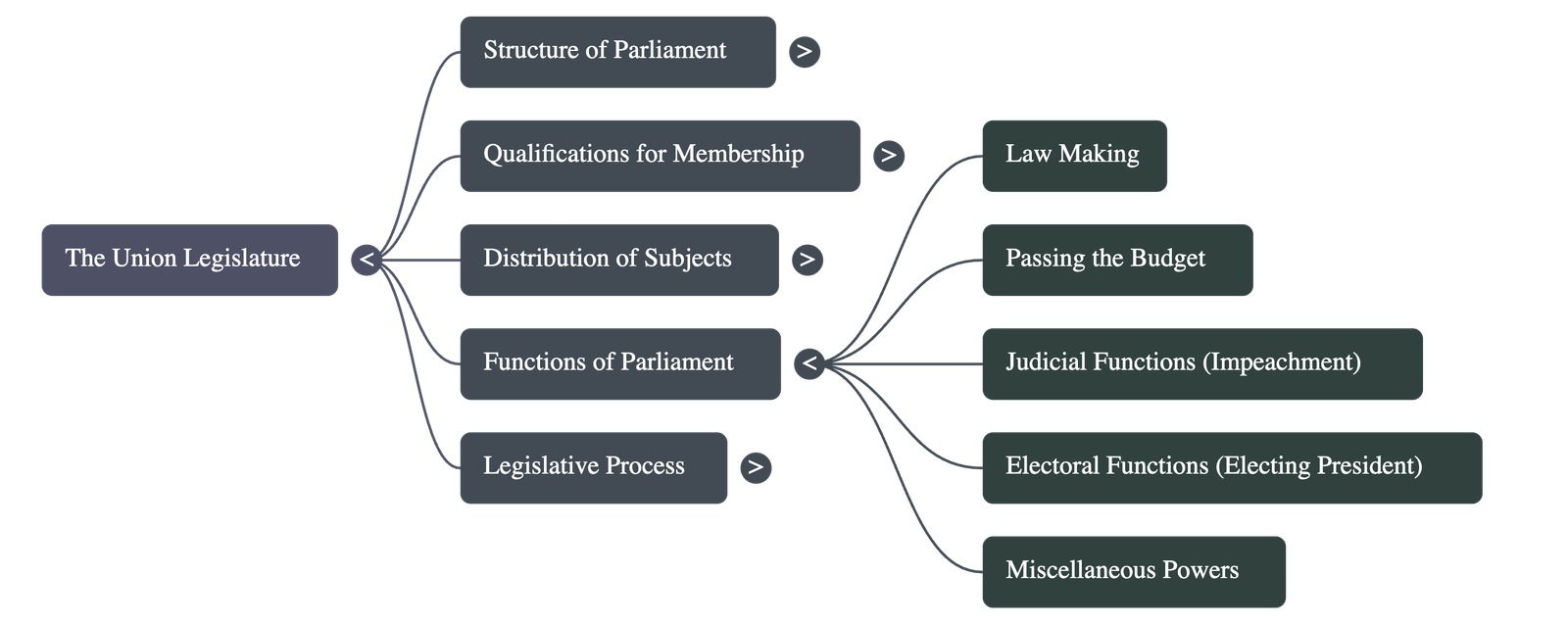
- Law-Making: Its primary role is to create laws on subjects in the Union and Concurrent lists.
- Passing the Budget: The Parliament reviews and passes the Union Budget, which details the government's expected income and expenditures.
- Judicial Functions: It has the power to impeach the President and judges of the Supreme Court and High Courts.
- Electoral Functions: It plays a role in electing the President and Vice-President.
- Miscellaneous Powers: It can alter state boundaries, create new states, and regulate the jurisdiction of the Supreme Court.
6. How a Bill Becomes a Law
- A Bill is a draft of a proposed law. There are three types: Ordinary Bills, Money Bills, and Constitution Amendment Bills.
- The Process: A bill must pass through three readings (Introduction, Detailed Discussion, and Acceptance/Rejection) in both Houses.
- Deadlocks: If the two houses disagree, the President can call a joint session where a decision is made by a majority vote.
- Final Approval: A bill becomes an Act (law) only after it is passed by both houses and receives the assent of the President.
Analogy for Understanding: Think of the Union Legislature like a large school board. The Lok Sabha is like the student council (directly elected to represent the students), while the Rajya Sabha is like a committee of senior teachers (permanent and providing stability). Together, they decide on the school's rules (Law-making) and how the school's funds should be spent (The Budget), but no rule is official until the Principal (the President) signs off on it.
Do checkout all questions & answers of this chapter.
Quick Navigation:
| | | | |
1 / 1
Quick Navigation:
| | | | |