Quick Navigation:
| | | | |
Quick Navigation:
| | | | |
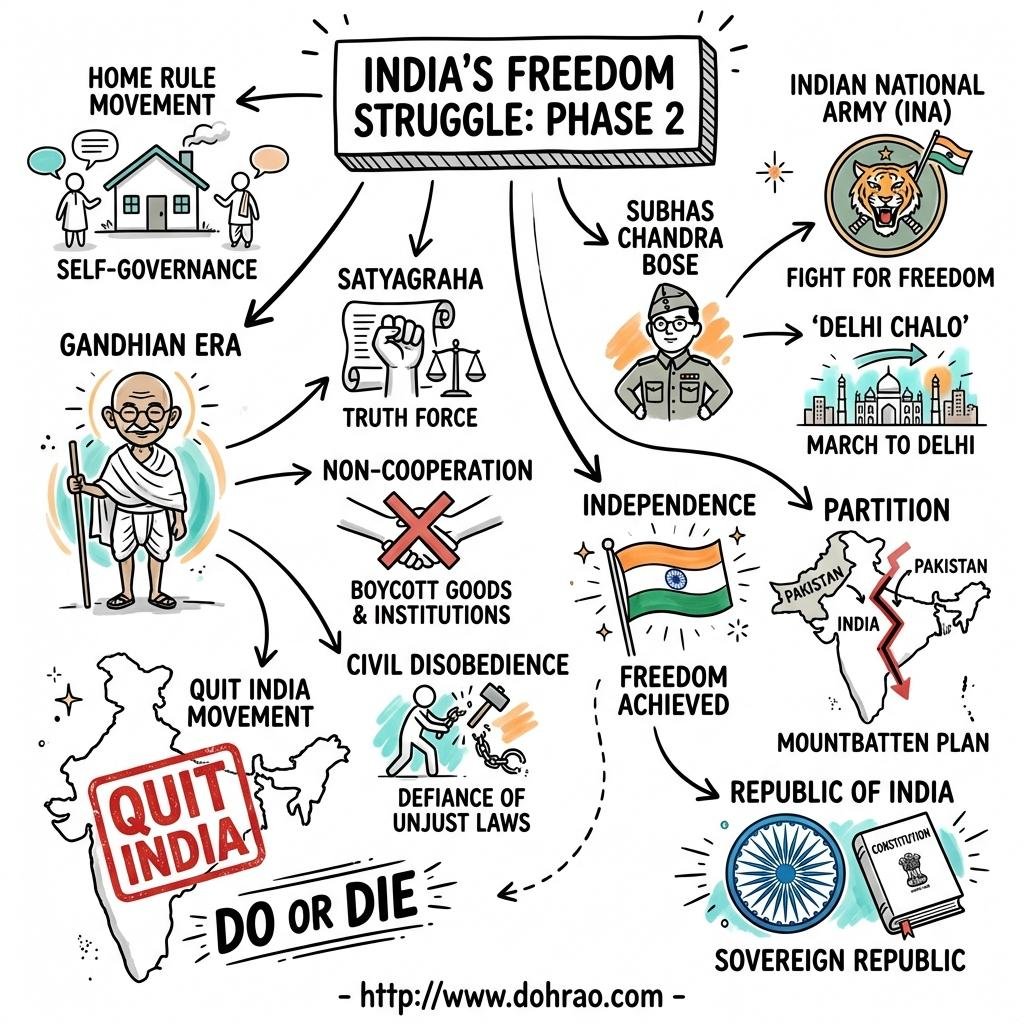
Based on the sources provided, here is a point-wise summary of the chapter focusing on "India's Struggle for Freedom – Phase 2":
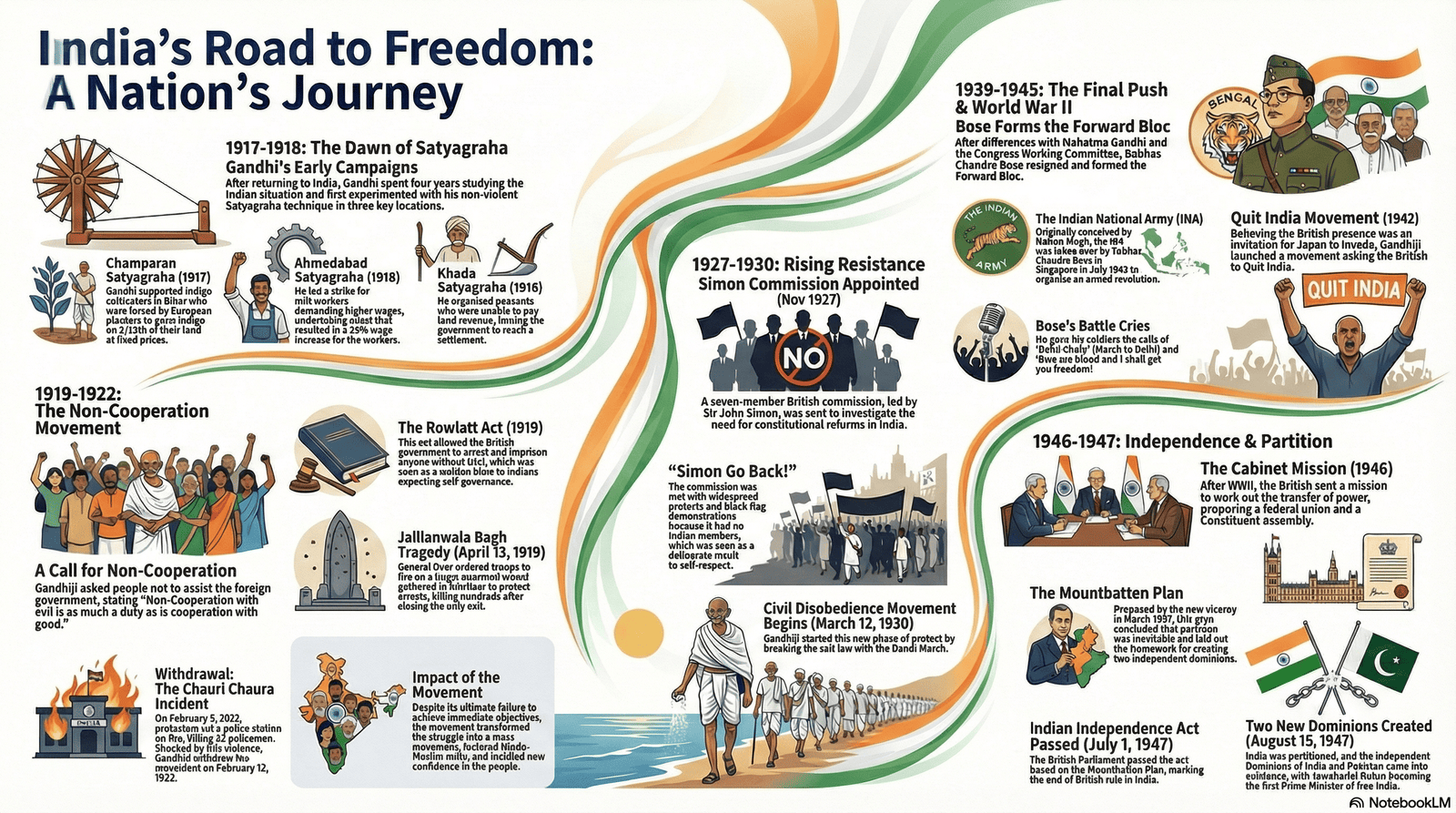
- The Home Rule League and Lucknow Pact: In 1916, Bal Gangadhar Tilak and Annie Besant started the Home Rule League to seek self-government within the British Empire through constitutional means. That same year, the Lucknow Pact established a joint scheme of political reforms between the Congress and the Muslim League, fostering Hindu-Muslim unity.
- Gandhiji’s Early Satyagraha Campaigns: After returning to India, Mahatma Gandhi experimented with his technique of Satyagraha (non-violent resistance) through three major local campaigns:
- Champaran (Bihar): To support indigo cultivators exploited by European planters.
- Ahmedabad (Gujarat): To support mill-workers striking for higher wages.
- Kheda (Gujarat): To help peasants who could not pay land revenue due to crop failure.
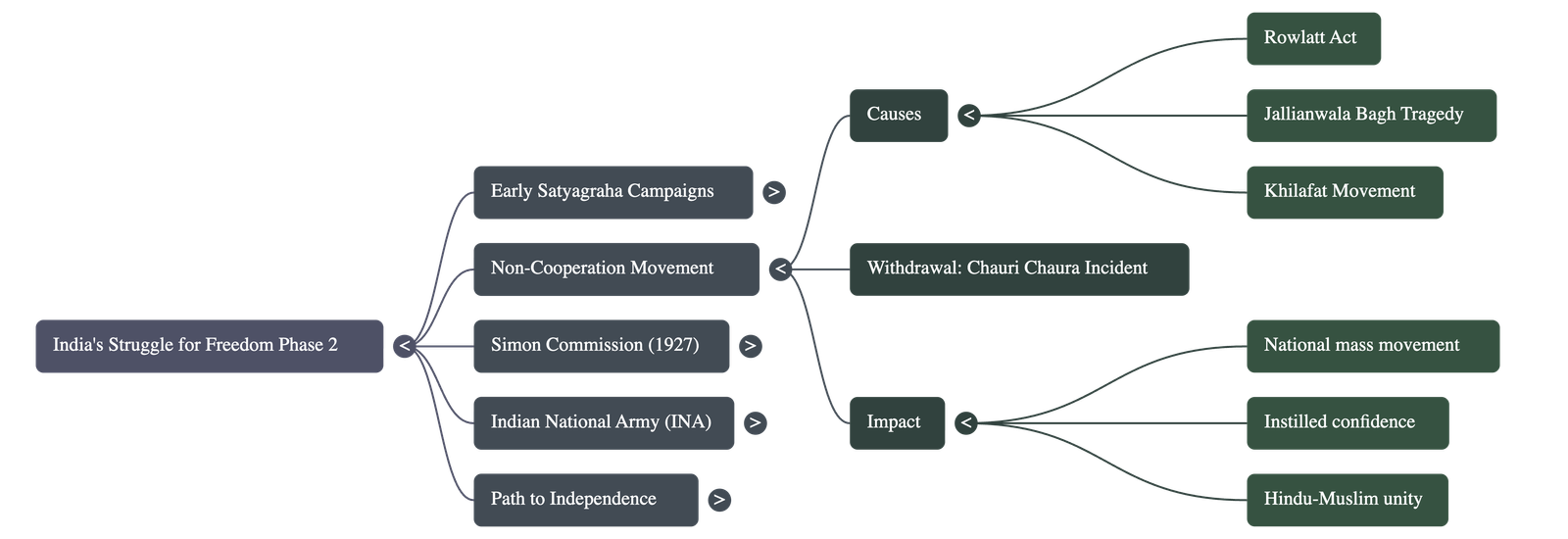
- Causes for the Non-Cooperation Movement: Three critical events led to this movement:
- The Rowlatt Act: Allowed the British to arrest and imprison people without trial.
- The Jallianwala Bagh Tragedy: General Dyer ordered troops to fire on an unarmed crowd in Amritsar on April 13, 1919.
- The Khilafat Issue: Launched to support the redressal of wrongs related to the Khilafat and the attainment of Swaraj.
- The Non-Cooperation Movement (1920–1922): Gandhiji urged Indians not to assist the "evil" foreign government. It became a mass movement where people renounced titles, boycotted foreign goods, and used Charkhas to spin their own cloth. However, Gandhiji suspended the movement in 1922 following the Chauri Chaura incident, where a violent mob set a police station on fire, killing 22 policemen.
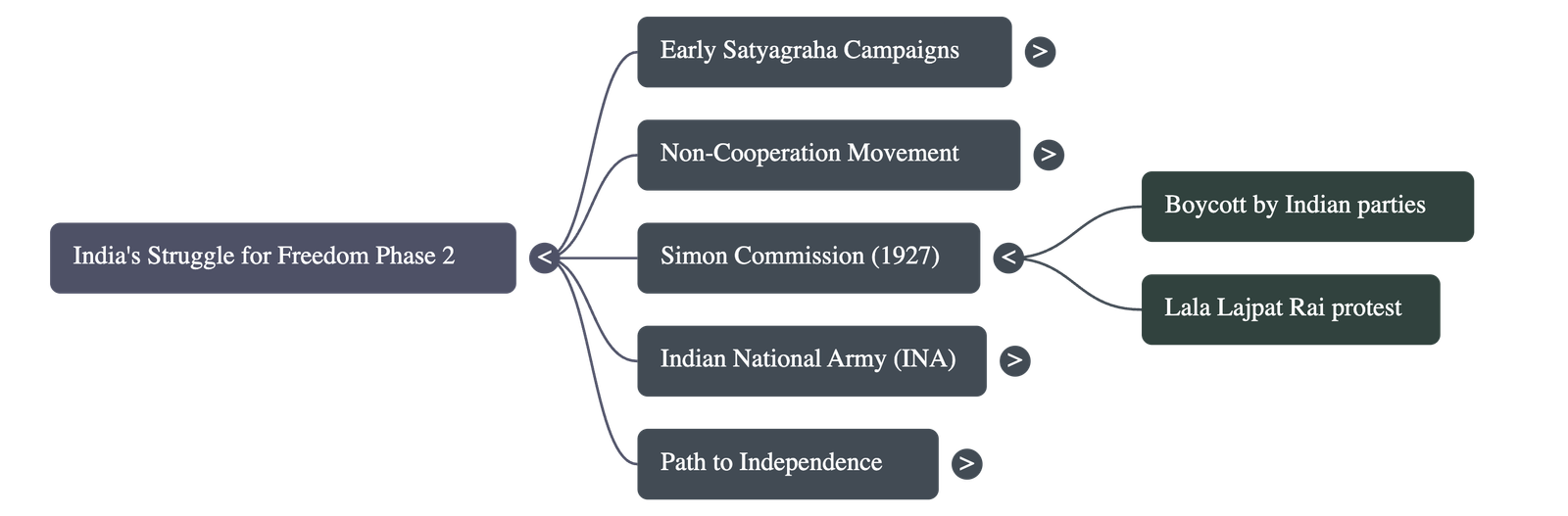
- Protests Against the Simon Commission (1927): The British appointed an all-British commission to investigate constitutional reforms. Because it had no Indian members, it was boycotted with the slogan "Simon Go Back".
- Major Mass Movements (1930s–1940s):
- Civil Disobedience Movement: Started in 1930 with the Dandi March to break the salt law.
- Quit India Movement: Launched in 1942, Gandhiji gave the slogan "Do or Die", believing the British presence invited Japanese invasion.
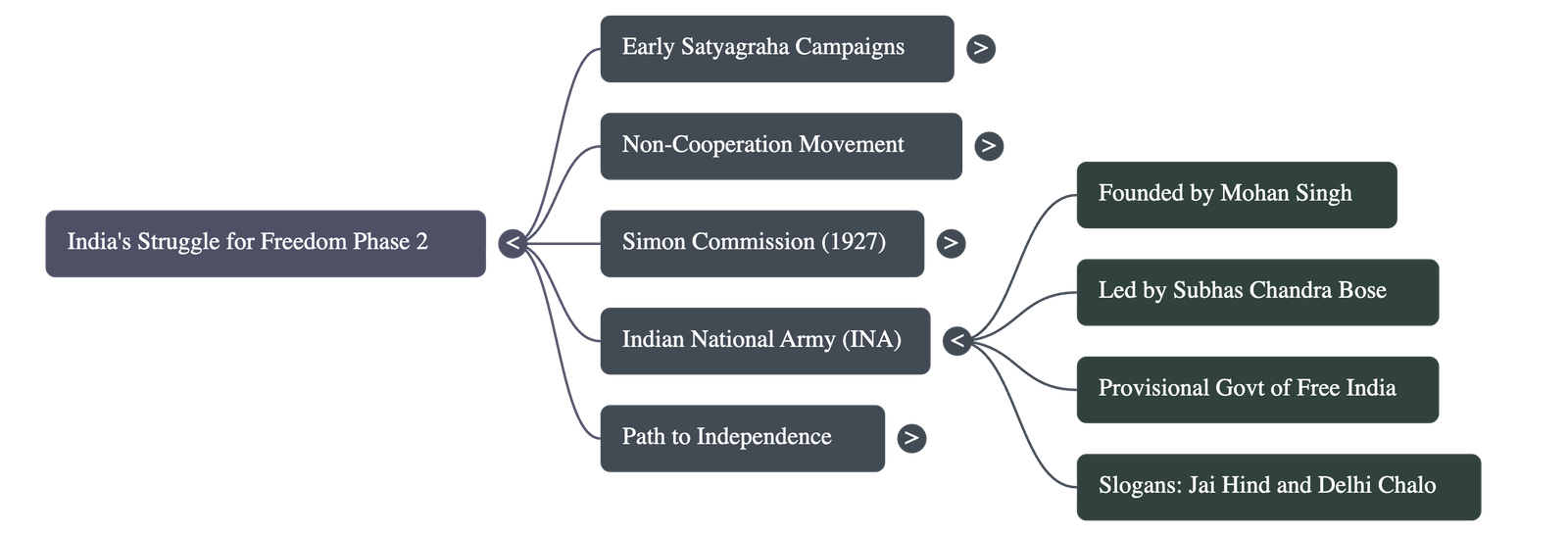
- The Forward Bloc and Indian National Army (INA): Subhas Chandra Bose resigned from the Congress to form the Forward Bloc. He later took command of the INA, which aimed to liberate India through an armed revolution with the help of Indians living abroad and modern arms.
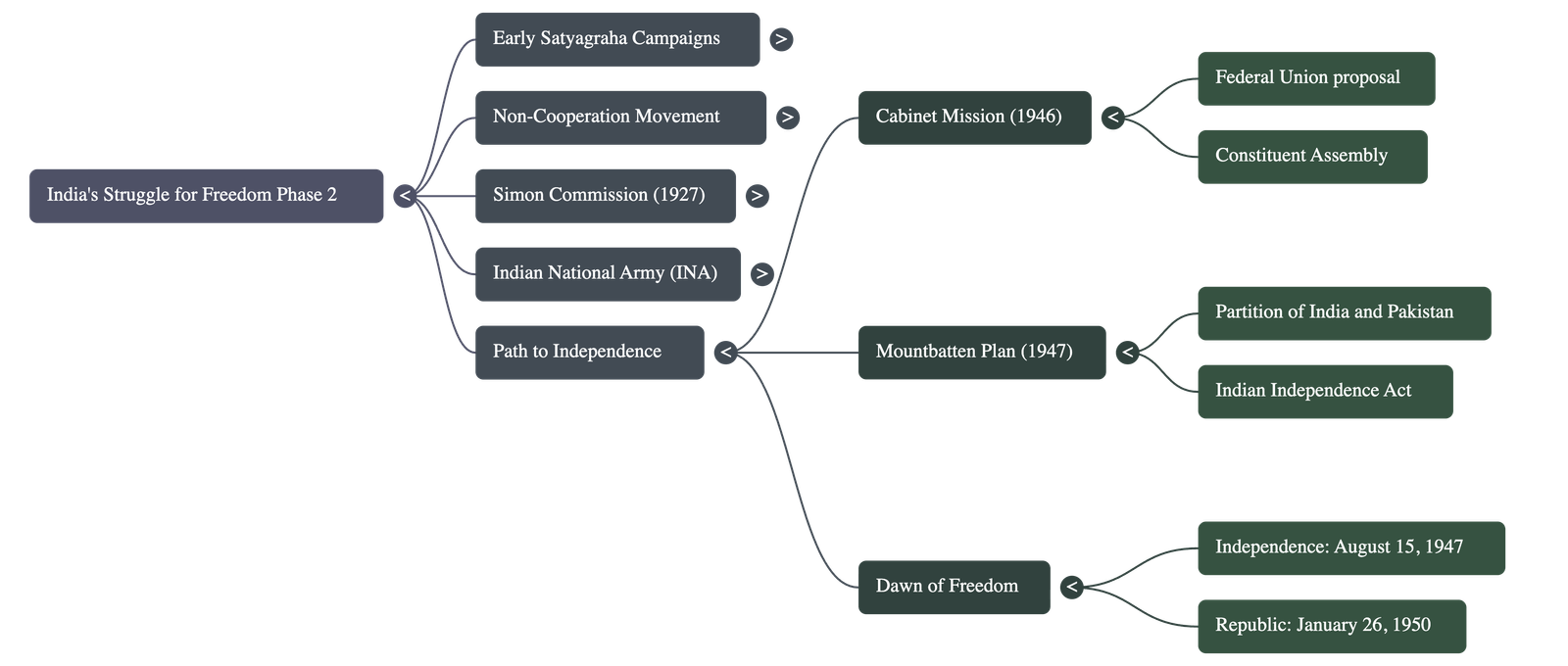
- The Path to Independence (1946–1947):
- Cabinet Mission: Proposed a federal union and a Constituent Assembly to draw up a constitution.
- Mountbatten Plan: Concluded that partition was inevitable; it provided for the creation of two independent states, India and Pakistan.
- Independence and Republic Status: The Indian Independence Act of 1947 ended British rule on August 15, 1947. Jawaharlal Nehru became the first Prime Minister, delivering his "Tryst with Destiny" speech. India eventually became a Republic on January 26, 1950, with Dr. Rajendra Prasad as the first President.
To understand this struggle, one might view the various movements—from Non-Cooperation to Quit India—as successive waves hitting a shoreline. While one wave might recede (like the suspension of a movement), each one eroded the foundation of British rule further until the entire structure finally gave way to independence.
Do checkout all questions & answers of this chapter.
Quick Navigation:
| | | | |
1 / 1
Quick Navigation:
| | | | |