Quick Navigation:
| | | | |
Quick Navigation:
| | | | |
The following summary captures the key concepts and details of the chapter on sound::
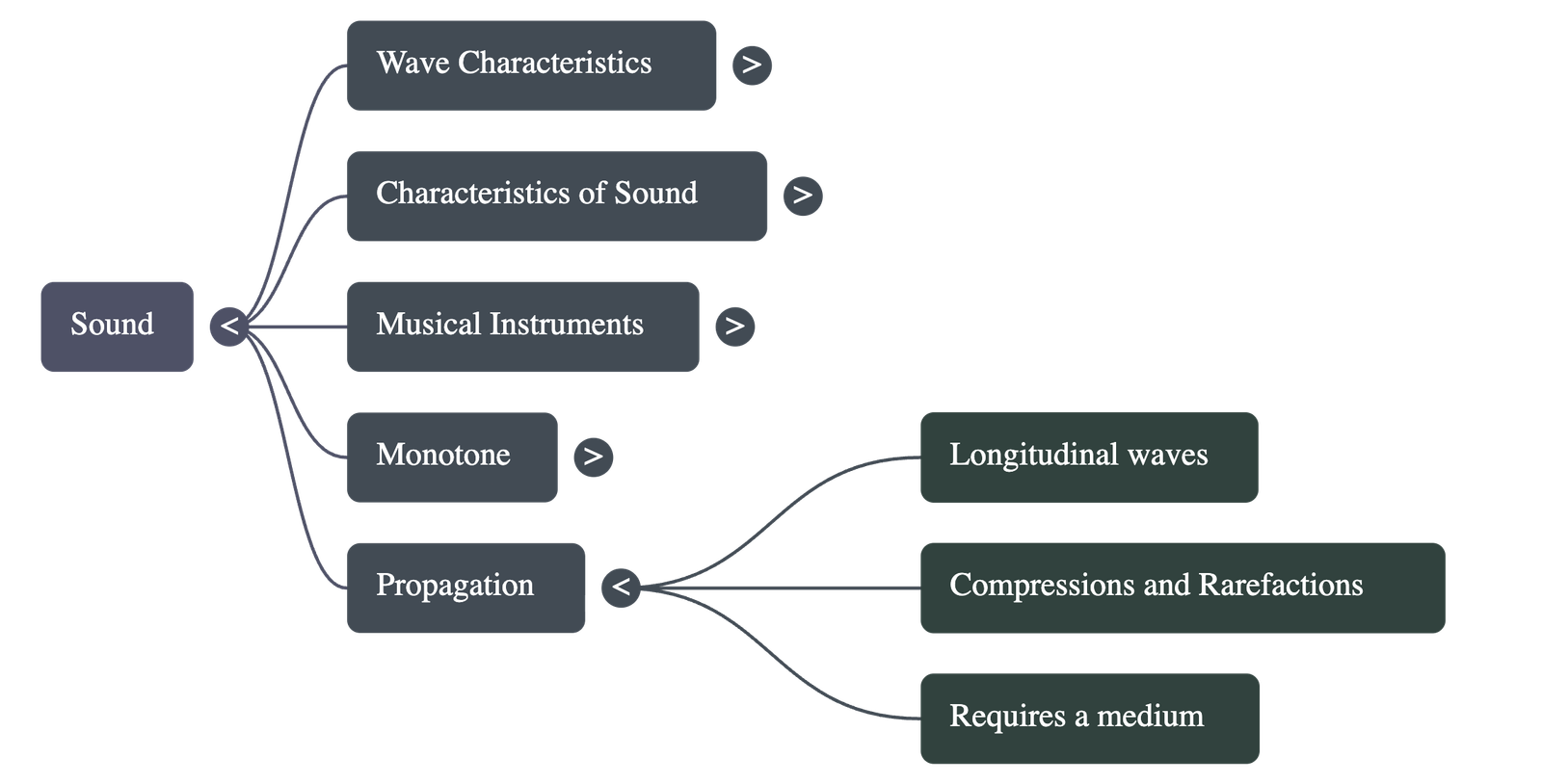
Nature and Propagation of Sound
- Definition: Sound is a form of energy that produces a sensation of hearing in our ears.
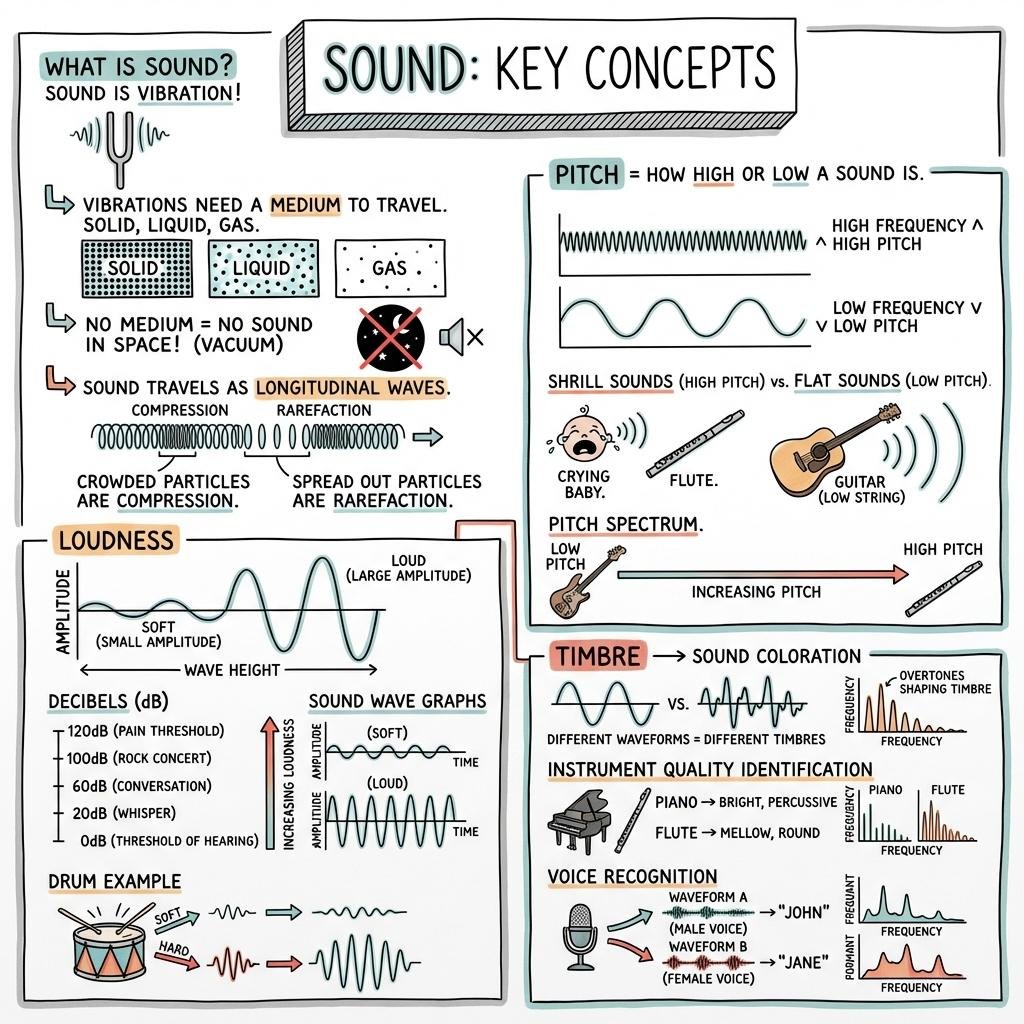
- Wave Type: In air, sound travels as longitudinal waves, which consist of regions of compression (high pressure) and rarefaction (low pressure).
- Energy Transfer: Particles of the medium vibrate about their mean positions to transfer energy from one place to another without leaving their positions.
- Transverse Waves: While sound in air is longitudinal, sound waves produced in strings are transverse, where particles vibrate normal to the direction of wave propagation.
Key Parameters of a Wave
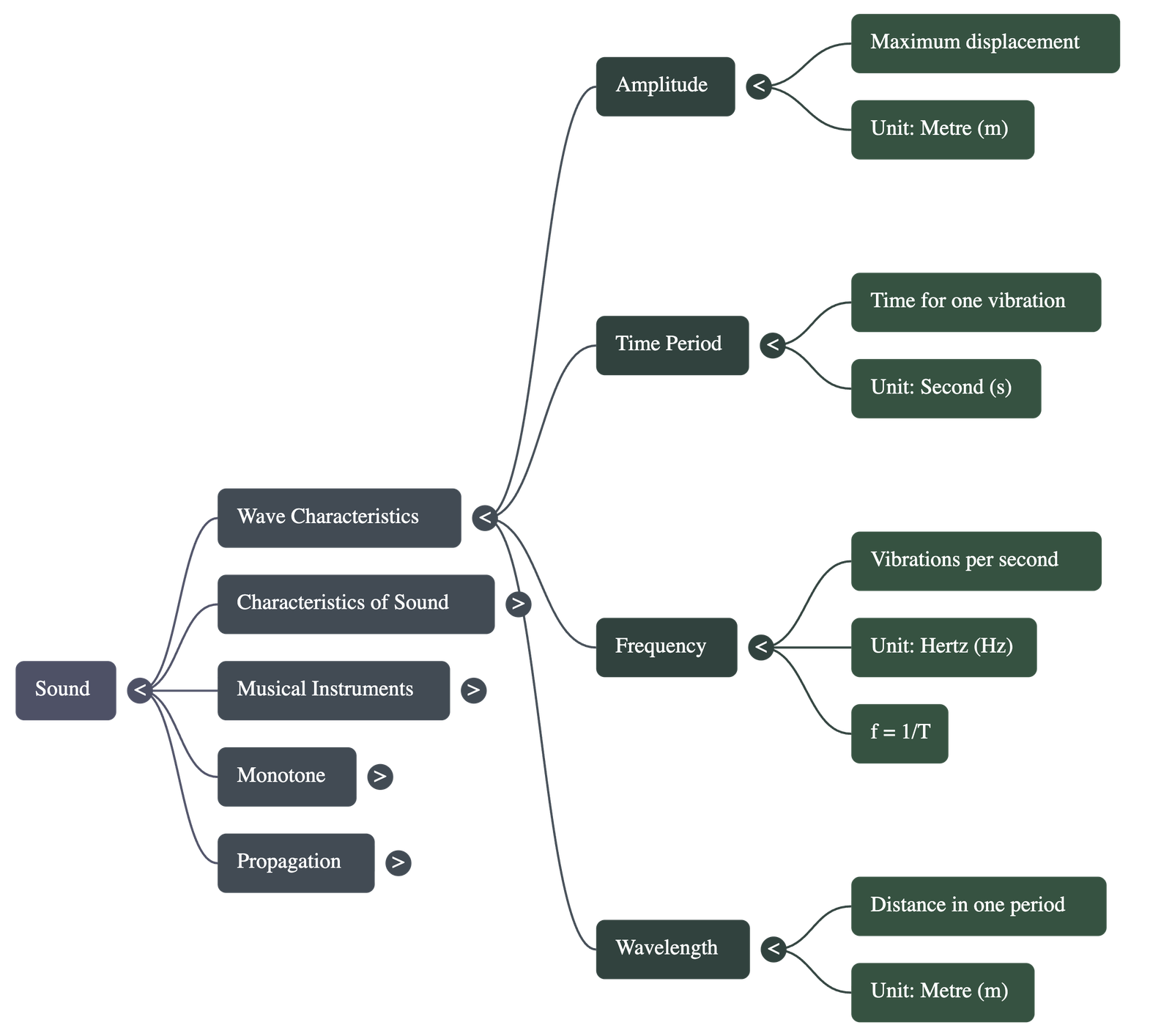
- Amplitude ($a$): The maximum displacement of a particle on either side of its mean position, measured in metres (m).
- Time Period ($T$): The time taken to complete one vibration, measured in seconds (s).
- Frequency ($f$): The number of vibrations produced in one second, measured in hertz (Hz).
- Wavelength ($\lambda$): The distance travelled by a wave in one time period, or the distance between two consecutive compressions/rarefactions.
- Relationship: Frequency and time period are related by the formula $f = 1/T$.
Characteristics of Sound
According to the sources, three main characteristics distinguish sounds from one another:
-
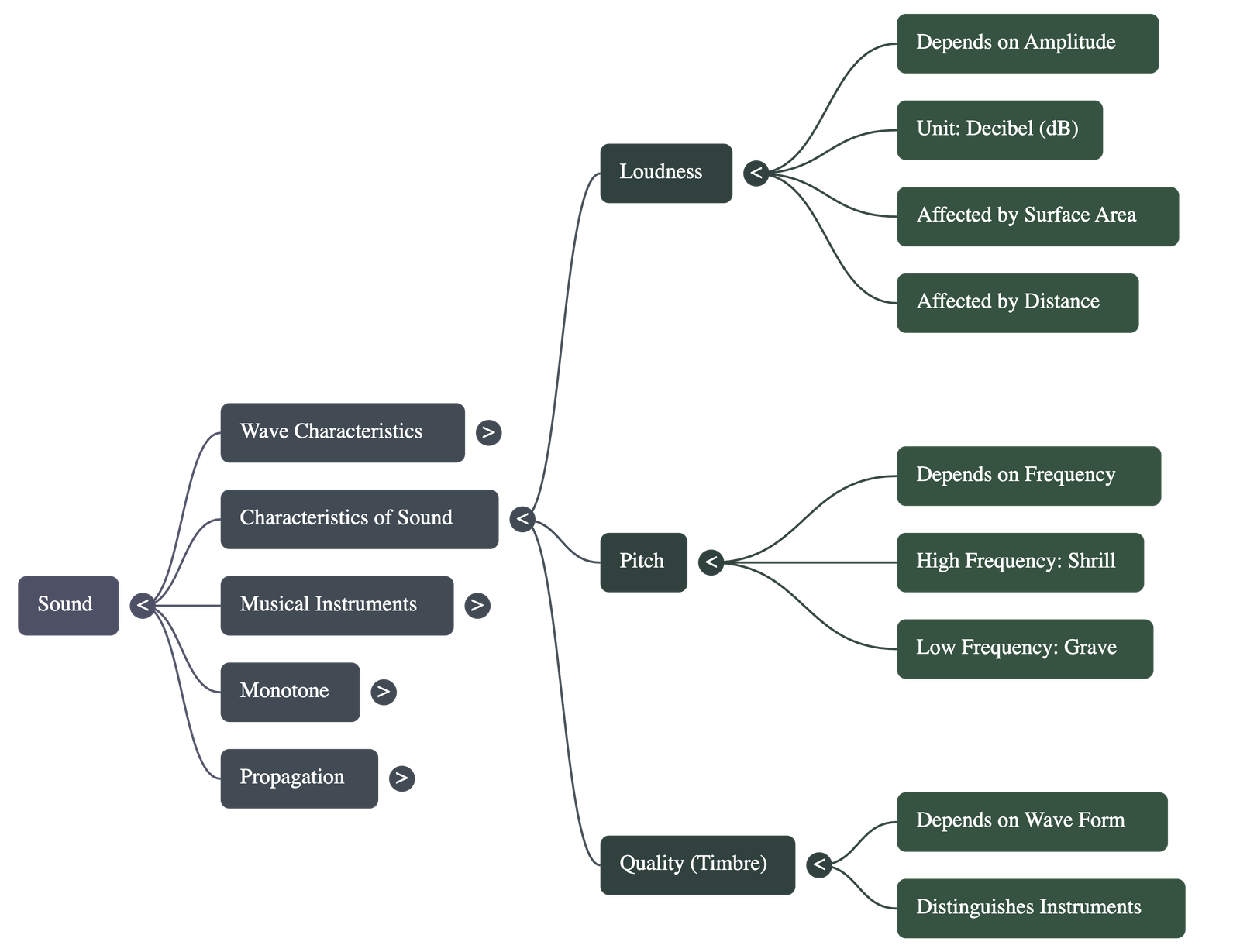
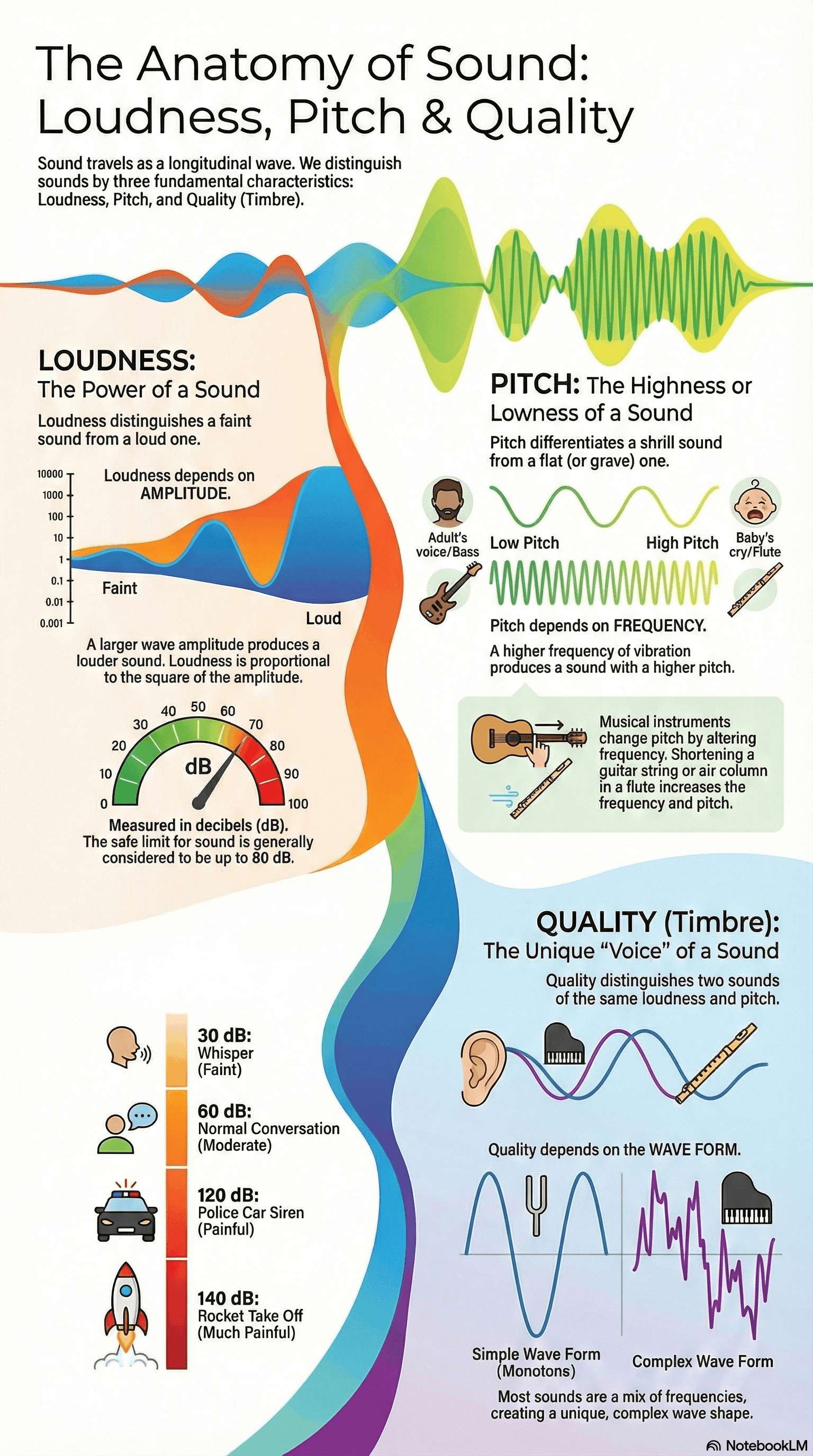
Loudness:
- Distinguishes a loud sound from a faint one.
- It is directly proportional to the square of the amplitude ($L \propto a^2$).
- Factors affecting it include the amplitude, distance from the source, the surface area of the vibrating body, and the sensitivity of the listener.
- It is measured on the decibel (dB) scale. The safe limit for hearing is 0 to 80 dB; sounds above 120 dB are considered painful noise.
-
Pitch (or Shrillness):
- Distinguishes a shrill sound from a flat (or grave) sound.
- It depends entirely on the frequency of vibrations; higher frequency results in a higher pitch.
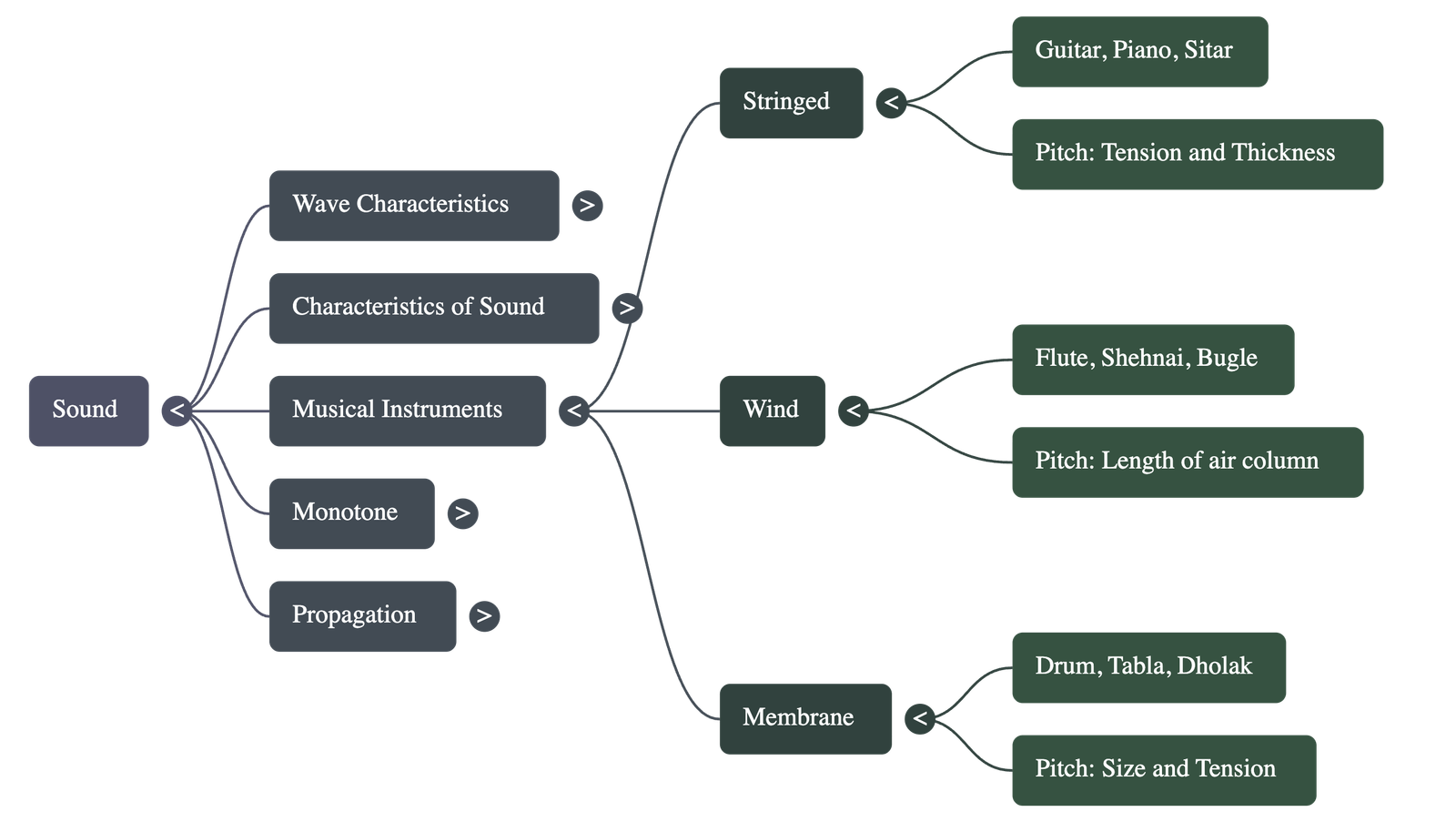
- In instruments, pitch can be increased by increasing string tension, decreasing the length of an air column (wind instruments), or using a smaller membrane.
-
Quality (or Timbre):
- Enables the distinction between two sounds of the same pitch and loudness.
- It depends on the wave form, which is affected by the presence of subsidiary vibrations (integer multiples of the source frequency).
Special Concepts
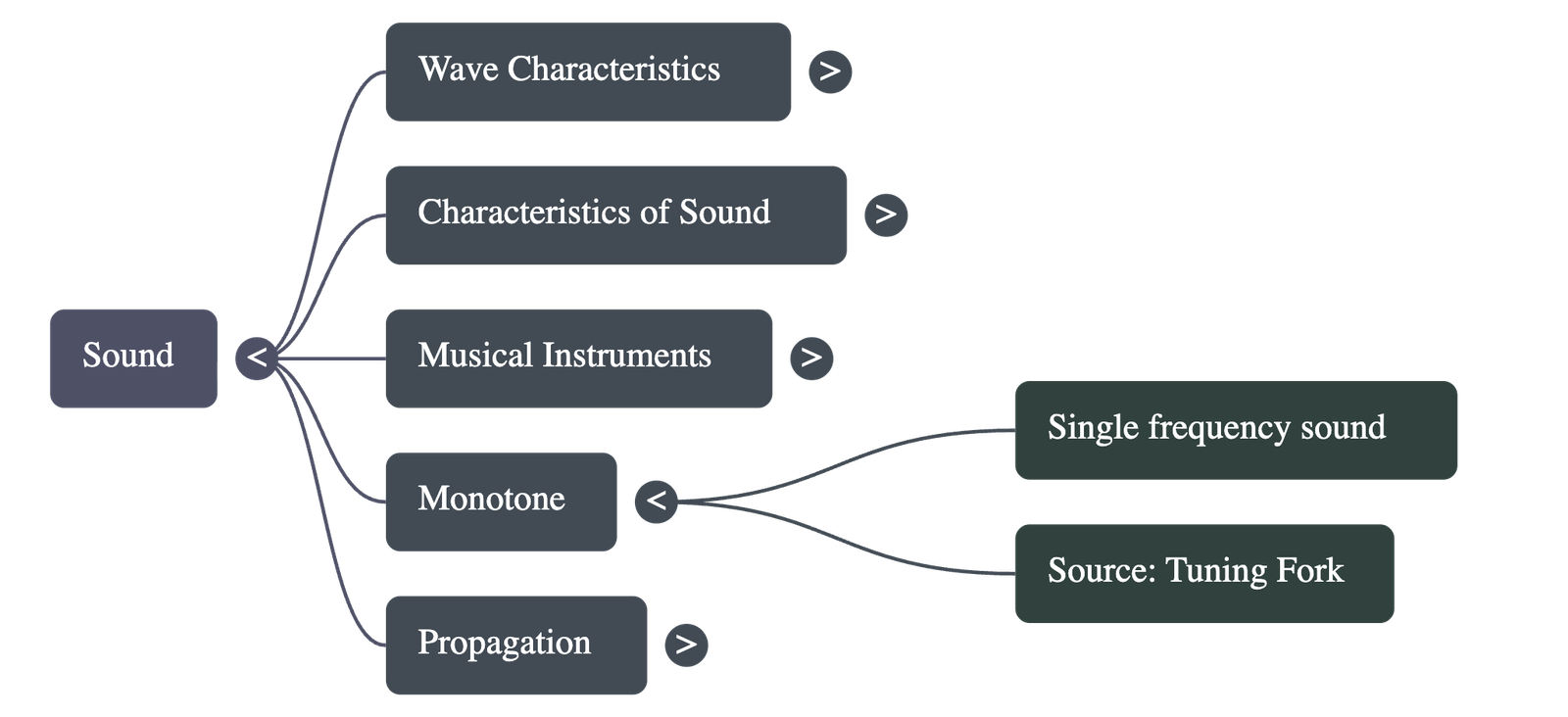
- Monotone: A sound consisting of a single frequency is called a monotone. A tuning fork is the only source that produces such a sound.
- Intensity: This is the energy of sound reaching a unit area of surface each second; while intensity can be measured physically, loudness is a sensation that depends on the listener.
Analogy for Sound Characteristics: Think of sound like a bouncing ball. The loudness is how high you throw the ball (the amplitude of its bounce). The pitch is how fast the ball dribbles against the floor (the frequency of the hits). Finally, the quality is the difference between a rubber ball and a tennis ball hitting the floor—even if they bounce at the same height and speed, they sound different because of their "shape" and material (the wave form).
Do checkout all questions & answers of this chapter.
Quick Navigation:
| | | | |
1 / 1
Quick Navigation:
| | | | |