Quick Navigation:
| | | | |
Quick Navigation:
| | | | |
Point-wise summary of Chapter 3, Force and Pressure:
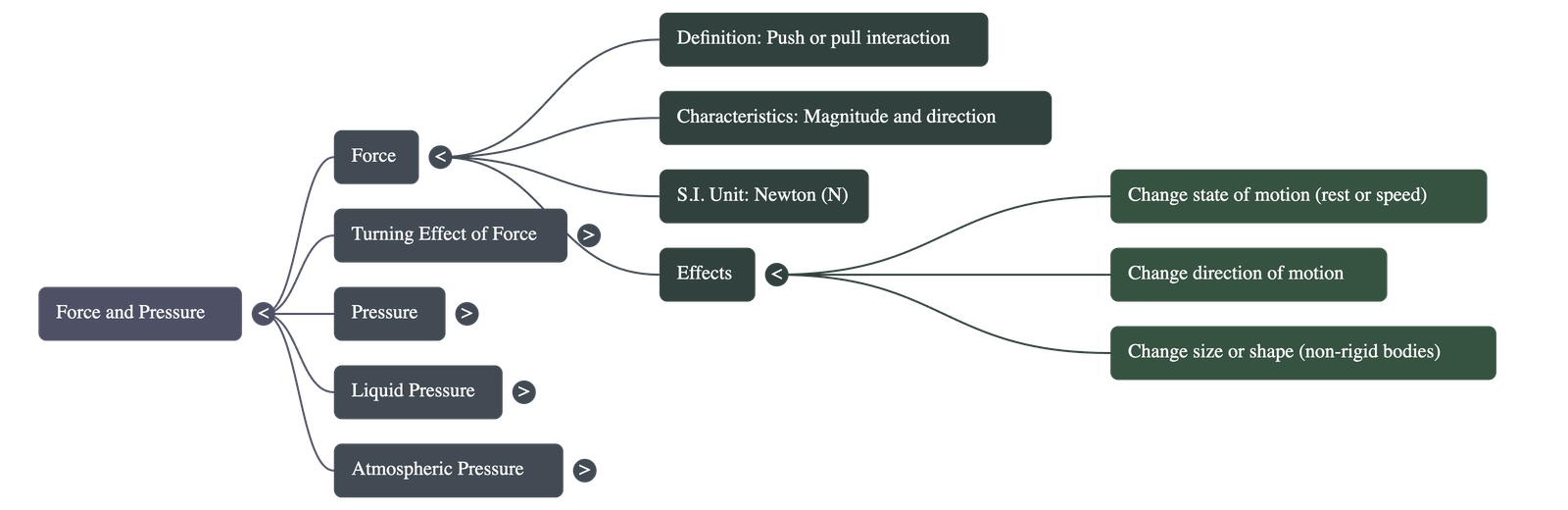
1. Concept of Force
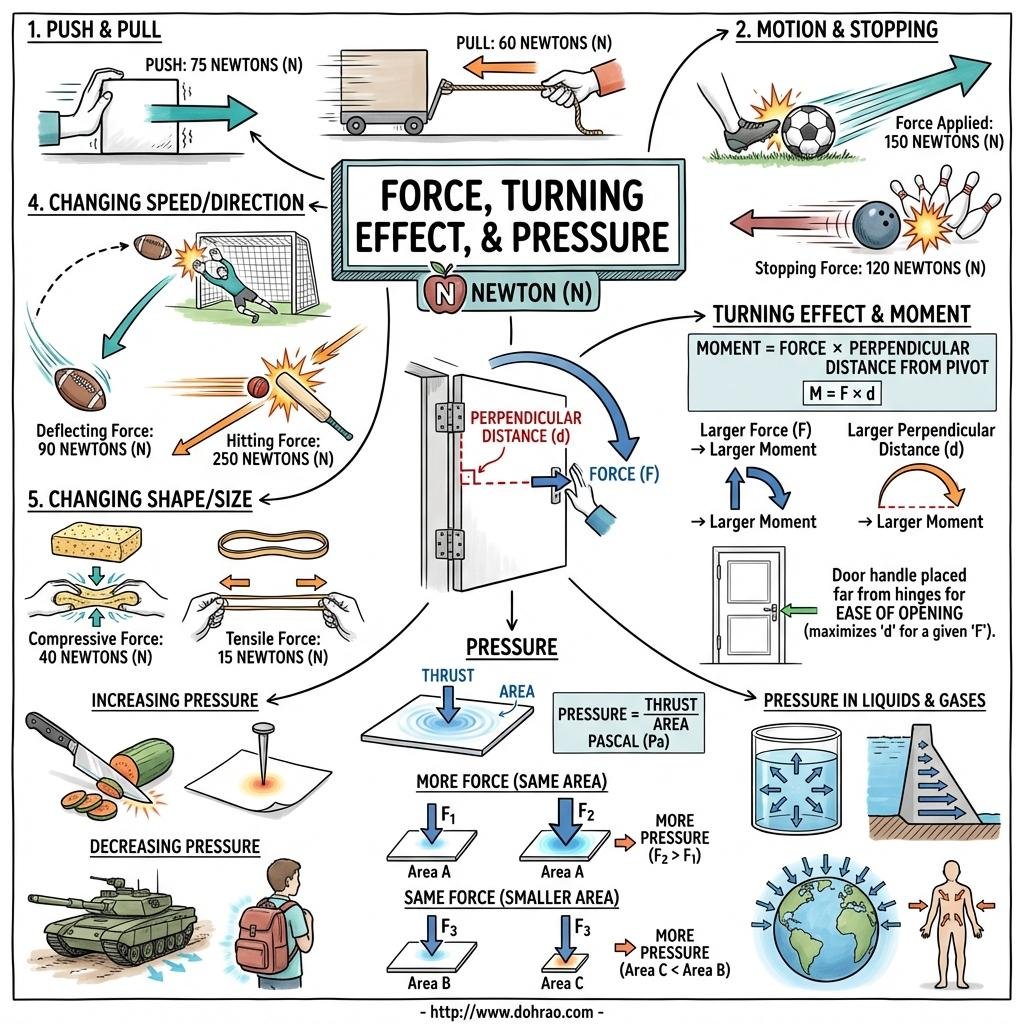
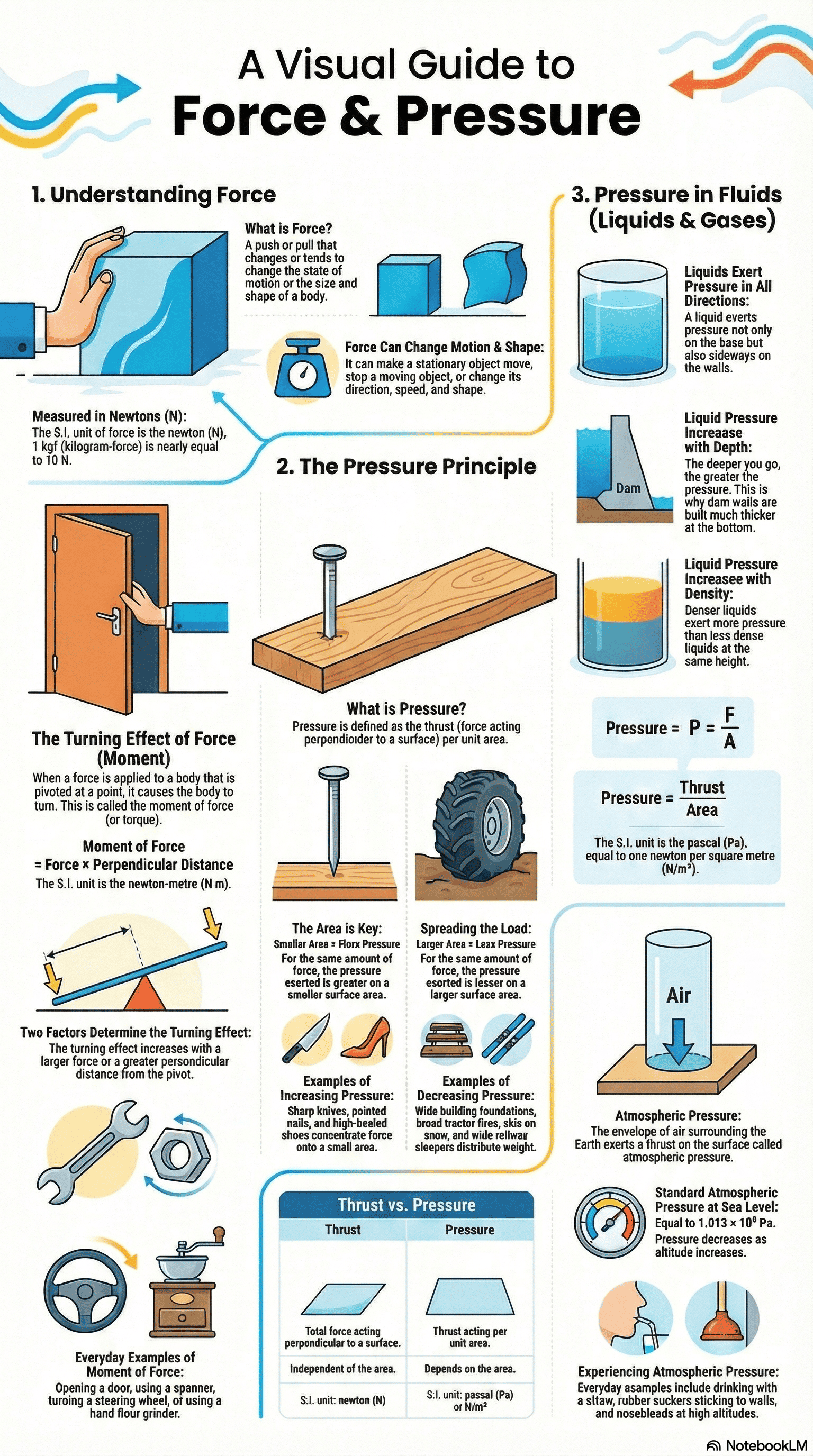
- Definition: A force is a push or pull that changes or tends to change the state of rest or motion of a body, or changes its size and shape.
- Characteristics: Force is a vector quantity, meaning it has both magnitude and direction. It does not change the mass of the body it is applied to.
- Units: The S.I. unit of force is the newton (N). Another common unit is kilogram-force (kgf), where $1 \text{ kgf} \approx 10 \text{ N}$ ($9.8 \text{ N}$ precisely).
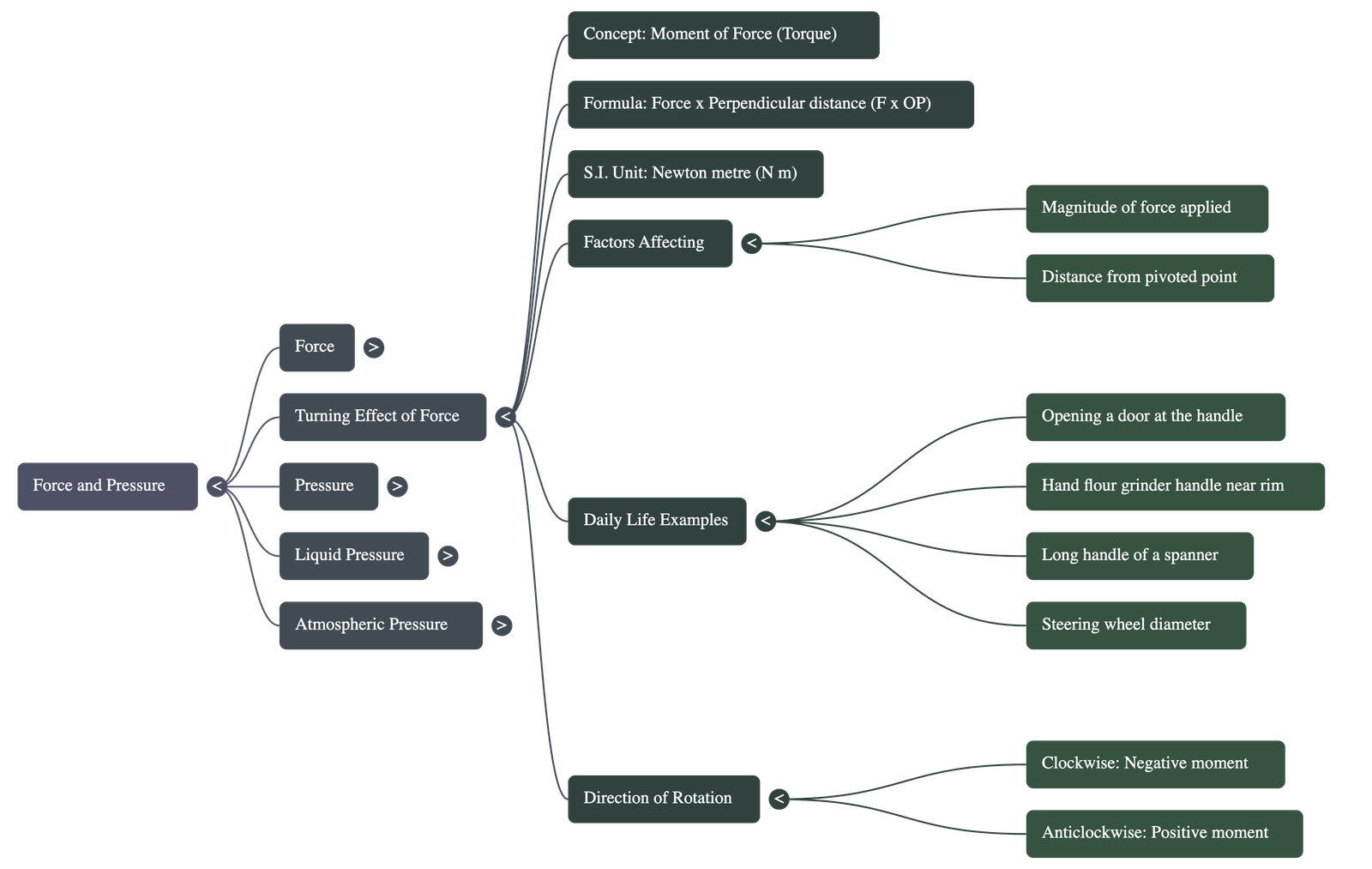
2. Turning Effect and Moment of Force
- Turning Effect: When a force is applied to a body pivoted at a point, it causes the body to rotate about that point (the axis of rotation).
- Moment of Force (Torque): This is the measure of the turning effect and is calculated as the product of the magnitude of the force and the perpendicular distance of the force from the pivoted point.
- Factors Affecting It: The turning effect increases if either the magnitude of the force increases or the perpendicular distance from the pivot point increases.
- Direction: By convention, an anticlockwise moment is taken as positive, while a clockwise moment is taken as negative.
- S.I. Unit: The unit for the moment of force is newton $\times$ metre (N m).
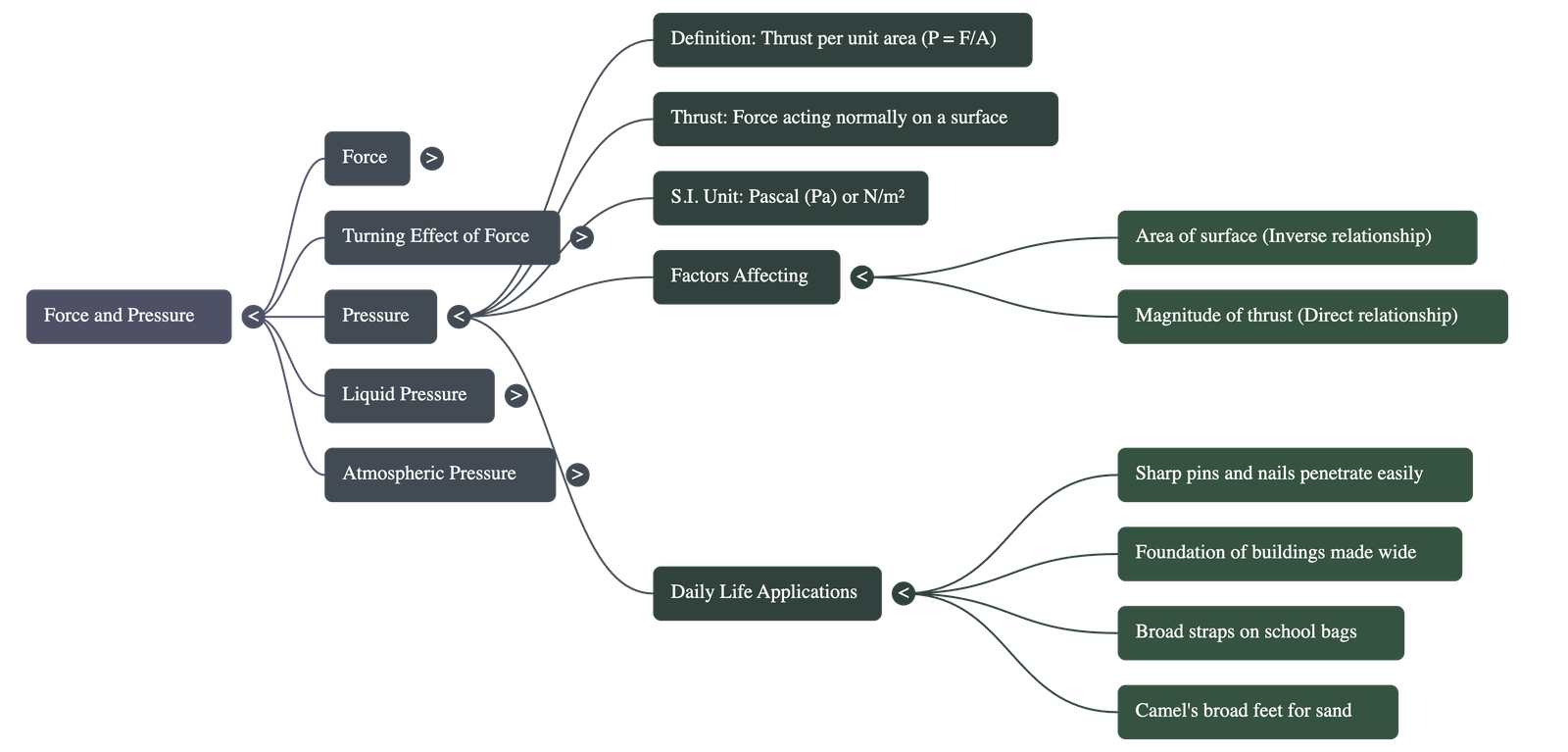
3. Thrust and Pressure
- Thrust: This is the total force acting normally (perpendicularly) on a surface. Its S.I. unit is the newton (N).
- Pressure: Defined as the thrust per unit area ($P = \frac{F}{A}$). Its S.I. unit is the pascal (Pa), which is equal to $1 \text{ N m}^{-2}$.
- Relationship with Area: For a constant thrust, pressure is inversely proportional to the area. This explains why sharp needles (small area) penetrate easily and why foundations of buildings are made wide (large area) to reduce pressure.
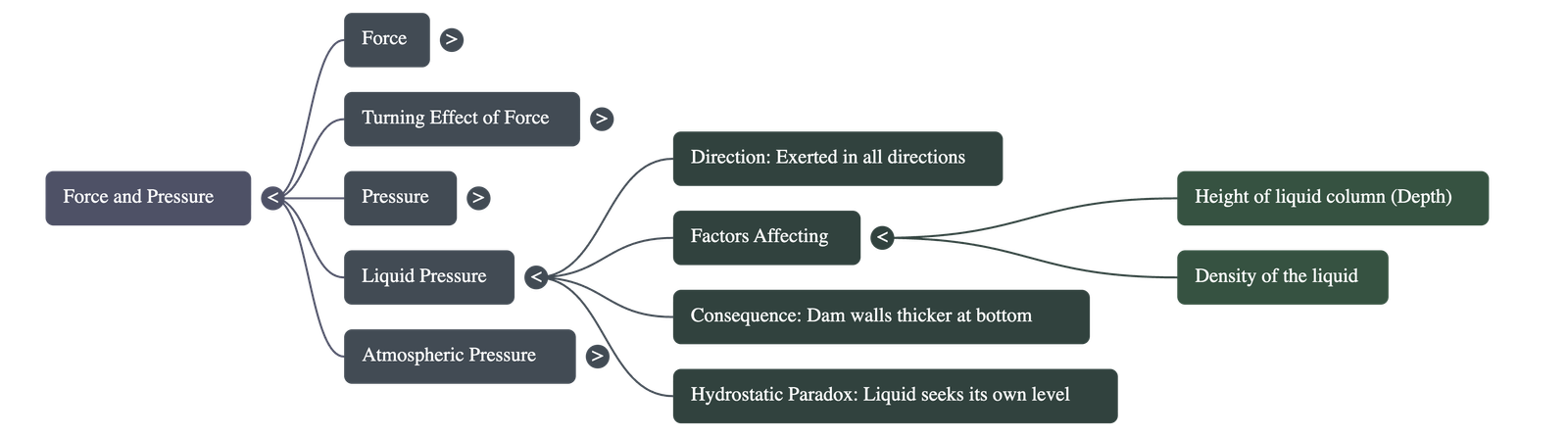
4. Liquid Pressure
- General Behavior: Unlike solids, which only exert pressure downwards due to weight, liquids exert pressure in all directions (downwards, sideways, and upwards).
- Factors Affecting Liquid Pressure:
- Height of the liquid column: Pressure increases with depth.
- Density of the liquid: Pressure increases with the increase in the density of the liquid.
- Pascal's Law: The sources state that the pressure exerted by a liquid at a specific depth is the same in all directions.
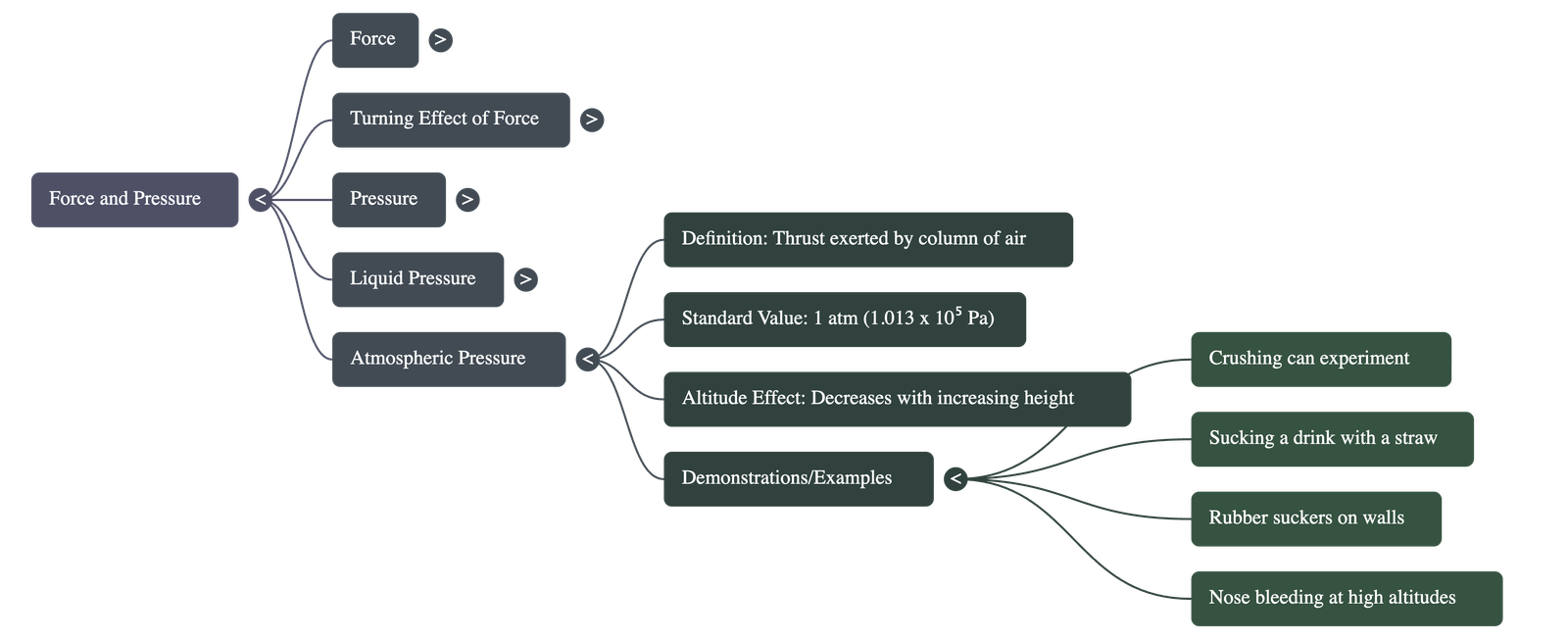
5. Atmospheric Pressure
- Definition: The envelope of air surrounding the earth is the atmosphere; the thrust exerted by the weight of this air column on a unit area of the earth's surface is called atmospheric pressure.
- Standard Value: At sea level, it is approximately $1.013 \times 10^5 \text{ Pa}$, equivalent to the pressure of a $76 \text{ cm}$ mercury column.
- Altitude: Atmospheric pressure decreases as altitude increases because the air becomes less dense and the height of the air column above decreases.
- Biological Effect: Humans do not feel this pressure because our blood pressure is slightly higher than atmospheric pressure, effectively neutralizing it.
Analogy for Understanding Pressure: To understand the relationship between force and area, think of walking on snow. If you walk in regular boots, your feet sink deeply because your weight is concentrated on a small area. However, if you wear skis, your weight is spread over a much larger surface area, resulting in less pressure on the snow, which allows you to glide on top without sinking.
Do checkout all questions & answers of this chapter.
Quick Navigation:
| | | | |
1 / 1
Quick Navigation:
| | | | |