Quick Navigation:
| | | | |
Quick Navigation:
| | | | |
Point-wise summary of Chapter 5, "Light Energy":
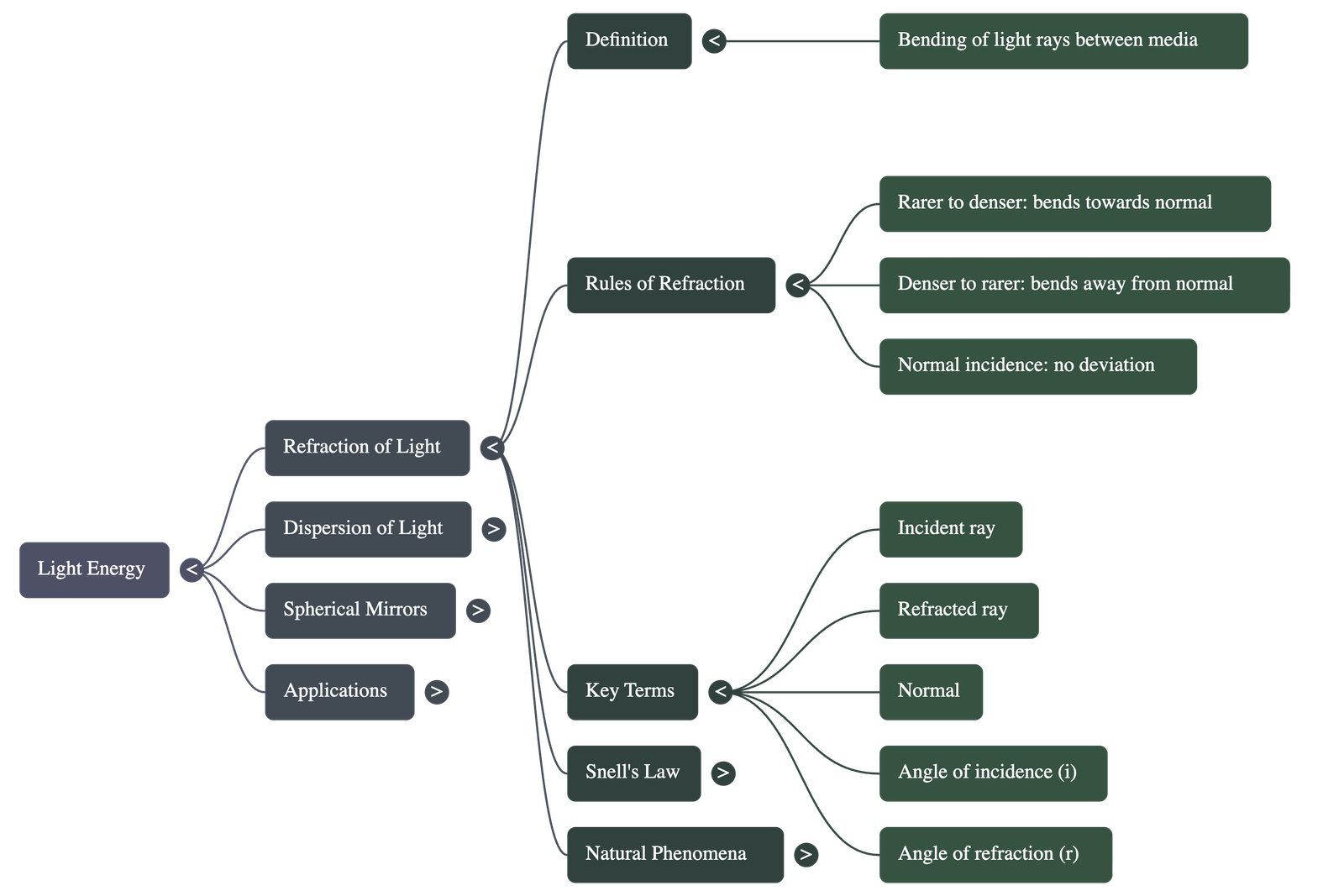
Refraction of Light
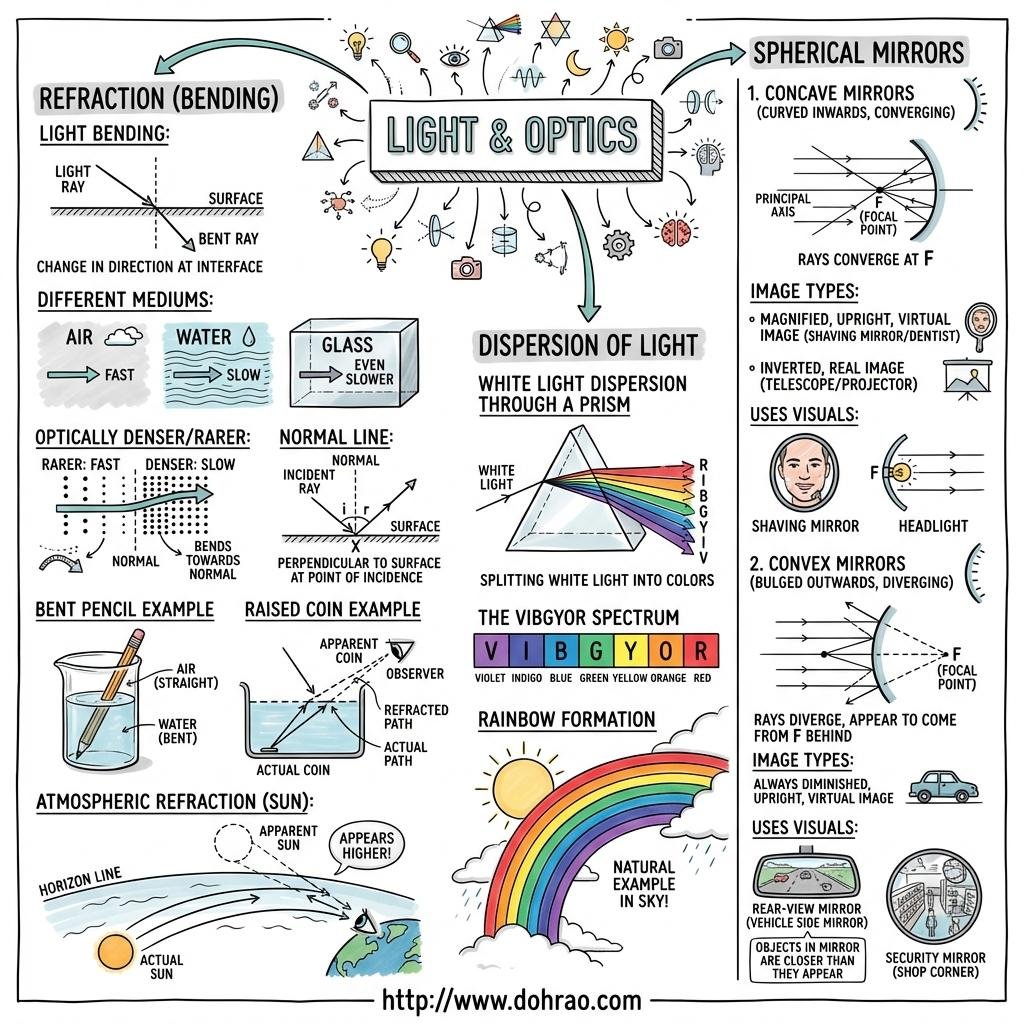
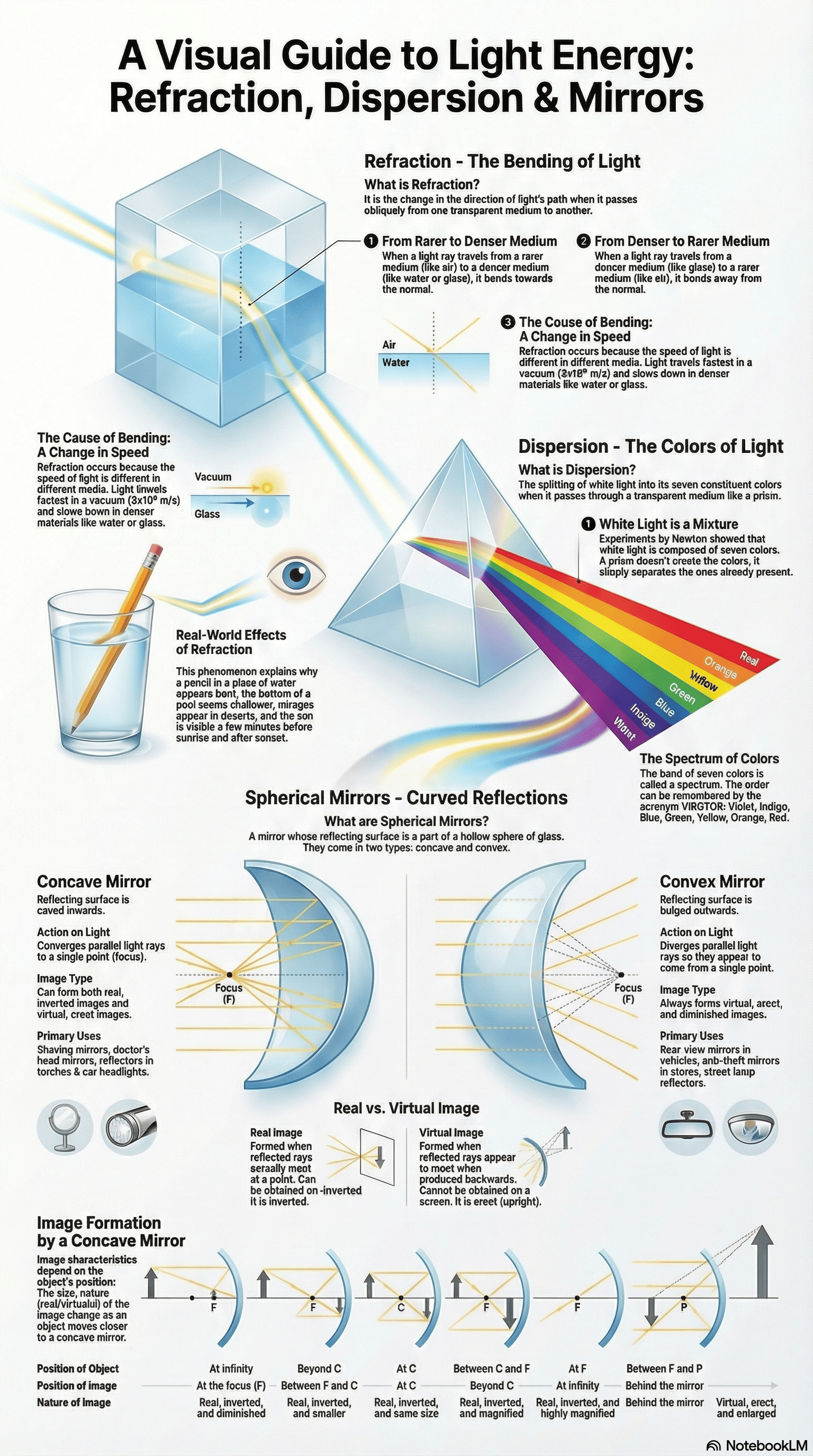
- Definition: Refraction is the change in the direction of the path of light when it passes obliquely from one transparent medium to another.
- Speed of Light: Light travels fastest in a vacuum or air ($3 \times 10^8 \text{ m s}^{-1}$) and slows down in other media like water ($2.25 \times 10^8 \text{ m s}^{-1}$) or glass ($2 \times 10^8 \text{ m s}^{-1}$).
- Rules of Bending:
- Light bends towards the normal when moving from a rarer to a denser medium.
- Light bends away from the normal when moving from a denser to a rarer medium.
- Light traveling along the normal (angle of incidence is $0^{\circ}$) passes undeviated.
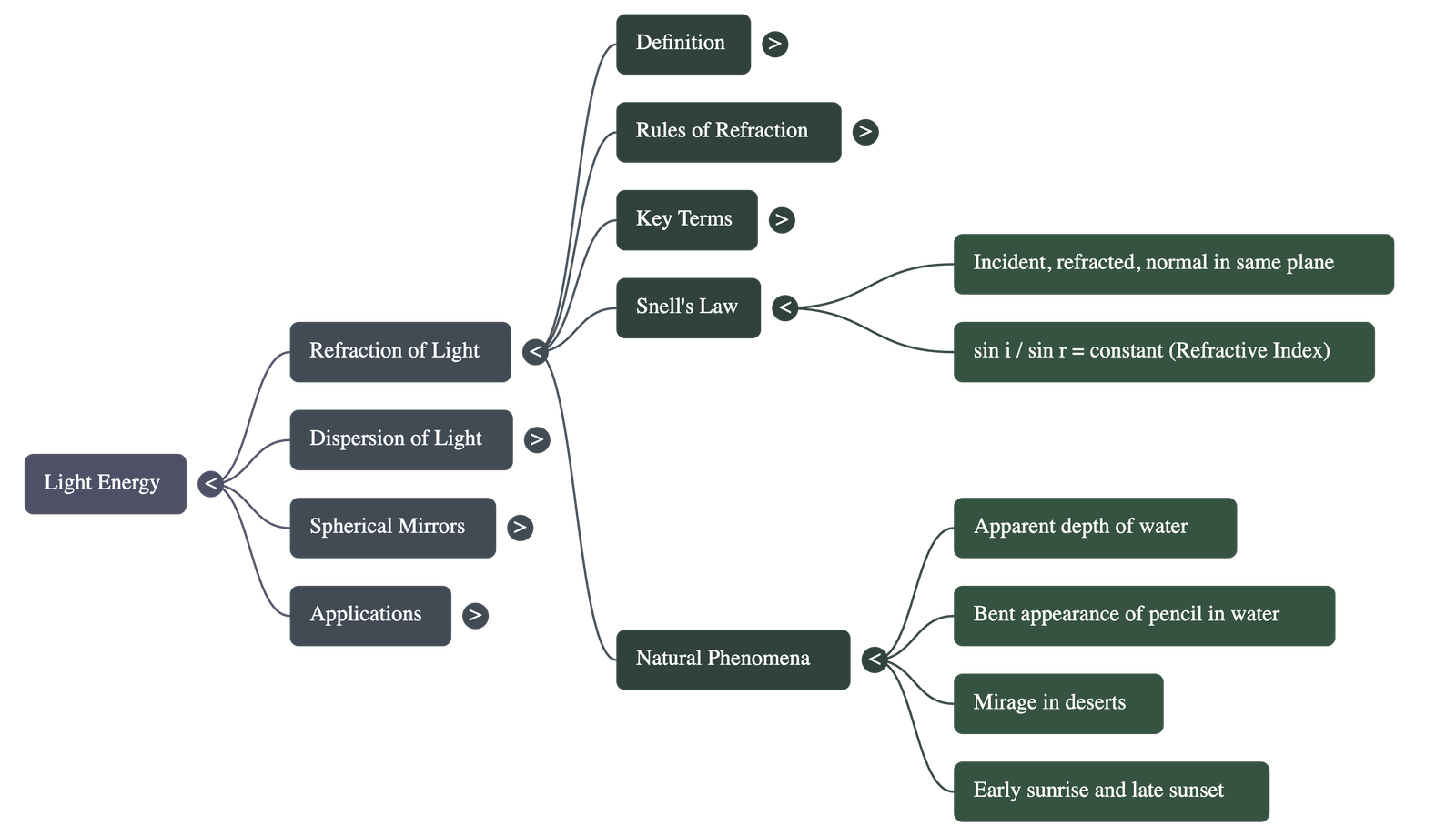
- Snell’s Law: The ratio of the sine of the angle of incidence ($i$) to the sine of the angle of refraction ($r$) is constant for a given pair of media, known as the refractive index ($\mu$).
- Effects of Refraction: Common phenomena include the apparent depth of water appearing shallower, a pencil appearing bent in water, mirages in deserts, and the sun being seen slightly before sunrise and after sunset.
Dispersion and Prisms
- Prisms: A prism is a transparent medium with five plane surfaces that bends light towards its base.
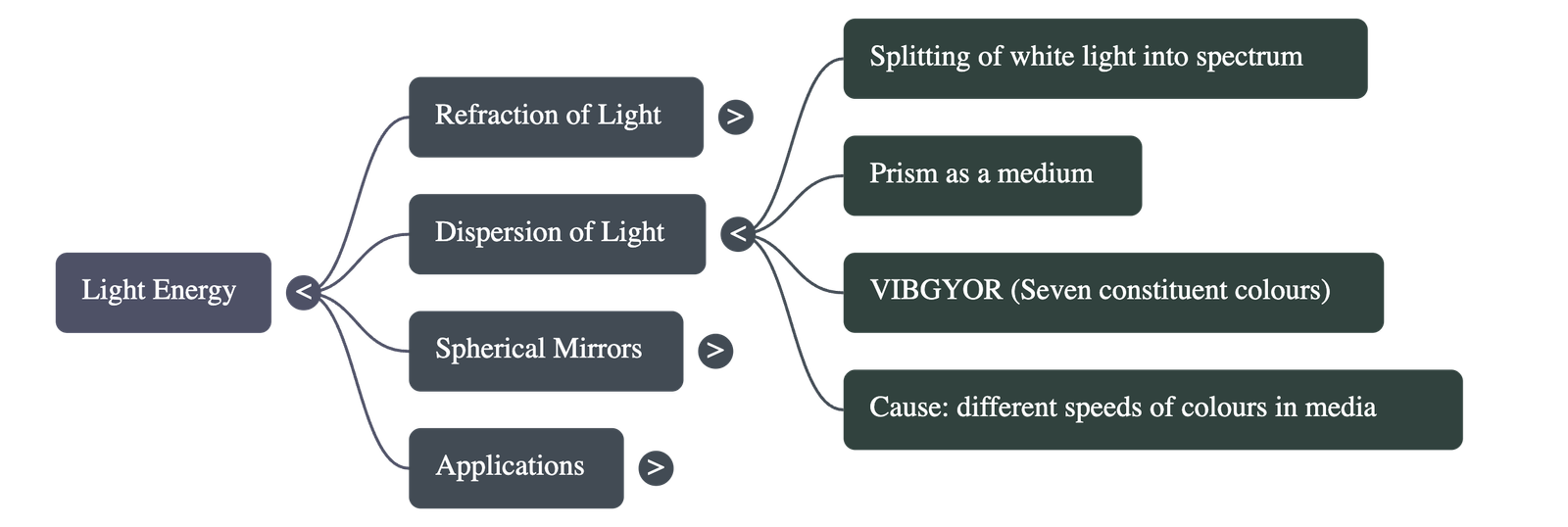
- Dispersion: This is the splitting of white light into its constituent colors (VIBGYOR: Violet, Indigo, Blue, Green, Yellow, Orange, Red) when passing through a prism.
- Cause of Dispersion: Different colors of light travel at different speeds in a transparent medium (e.g., violet is slowest, red is fastest), leading to different refractive indices for each color.
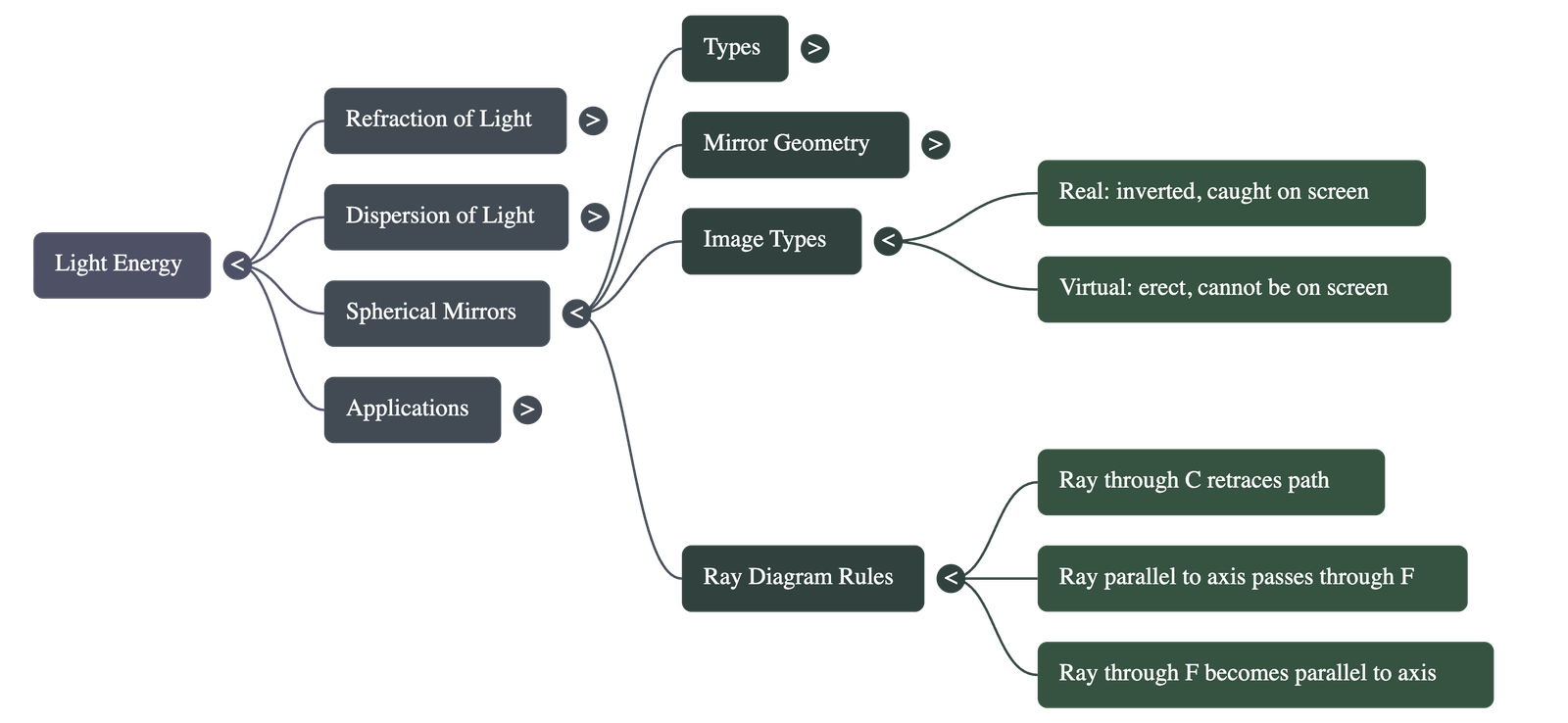
Spherical Mirrors
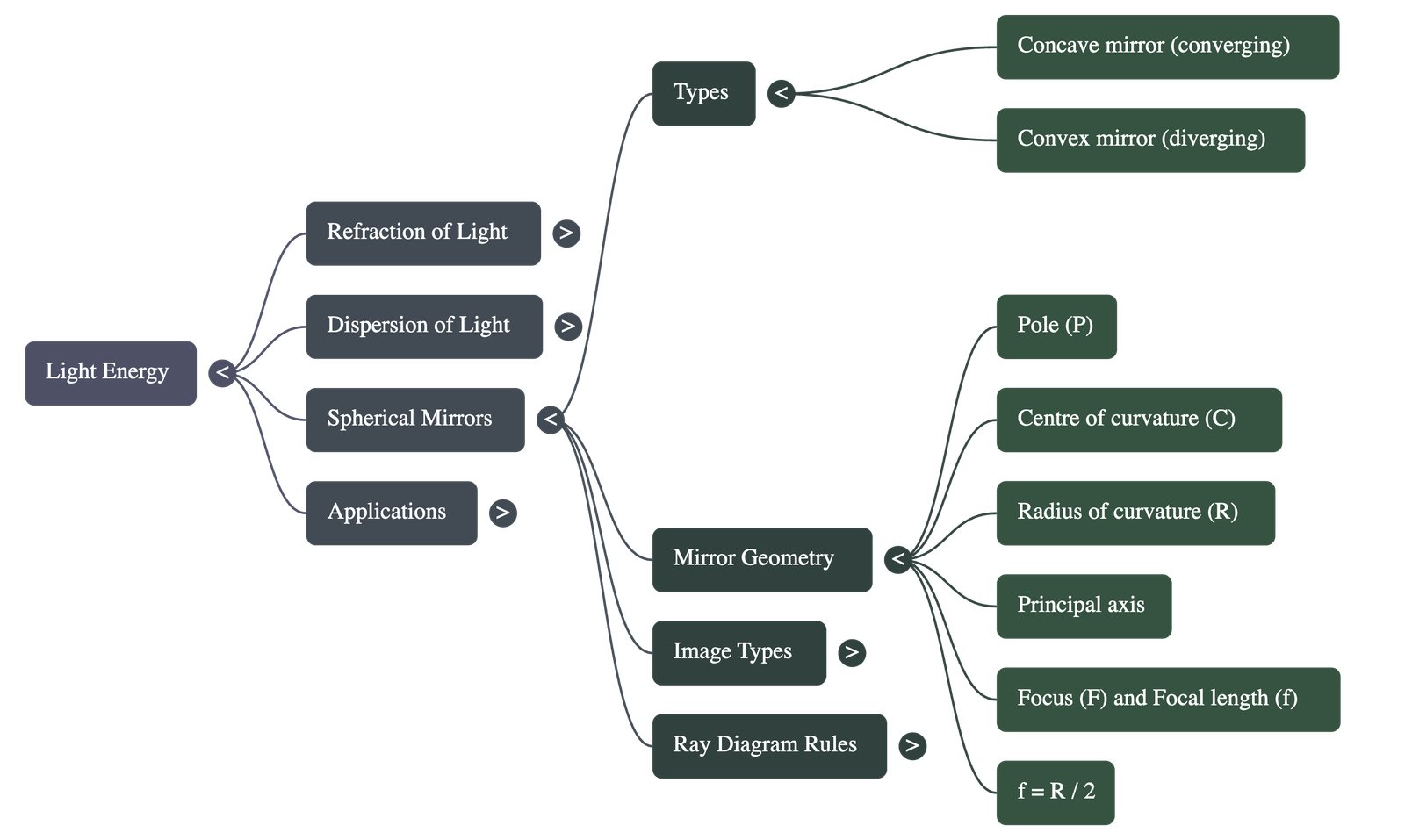
- Types of Mirrors:
- Concave mirror: Reflection takes place from the inner (hollow) surface.
- Convex mirror: Reflection takes place from the outer (bulged) surface.
- Key Terms: Important concepts include the Pole (geometric center), Centre of Curvature (center of the sphere the mirror belongs to), and Principal Axis (line joining the pole and center of curvature).
- Focal Length ($f$): The distance between the pole and the focus. For spherical mirrors, the focal length is half of the radius of curvature ($R$): $f = \frac{1}{2}R$.
Image Formation
- Real vs. Virtual Images:
- Real images are formed when rays actually meet, are inverted, and can be caught on a screen.
- Virtual images are formed when rays only appear to meet when produced backward, are erect, and cannot be caught on a screen.
- Concave Mirror Characteristics: Depending on the object's position, it can form real, inverted images of varying sizes. However, if the object is between the pole and focus, it forms a virtual, erect, and magnified image.
- Convex Mirror Characteristics: It always forms a virtual, erect, and diminished image, regardless of the object's position.
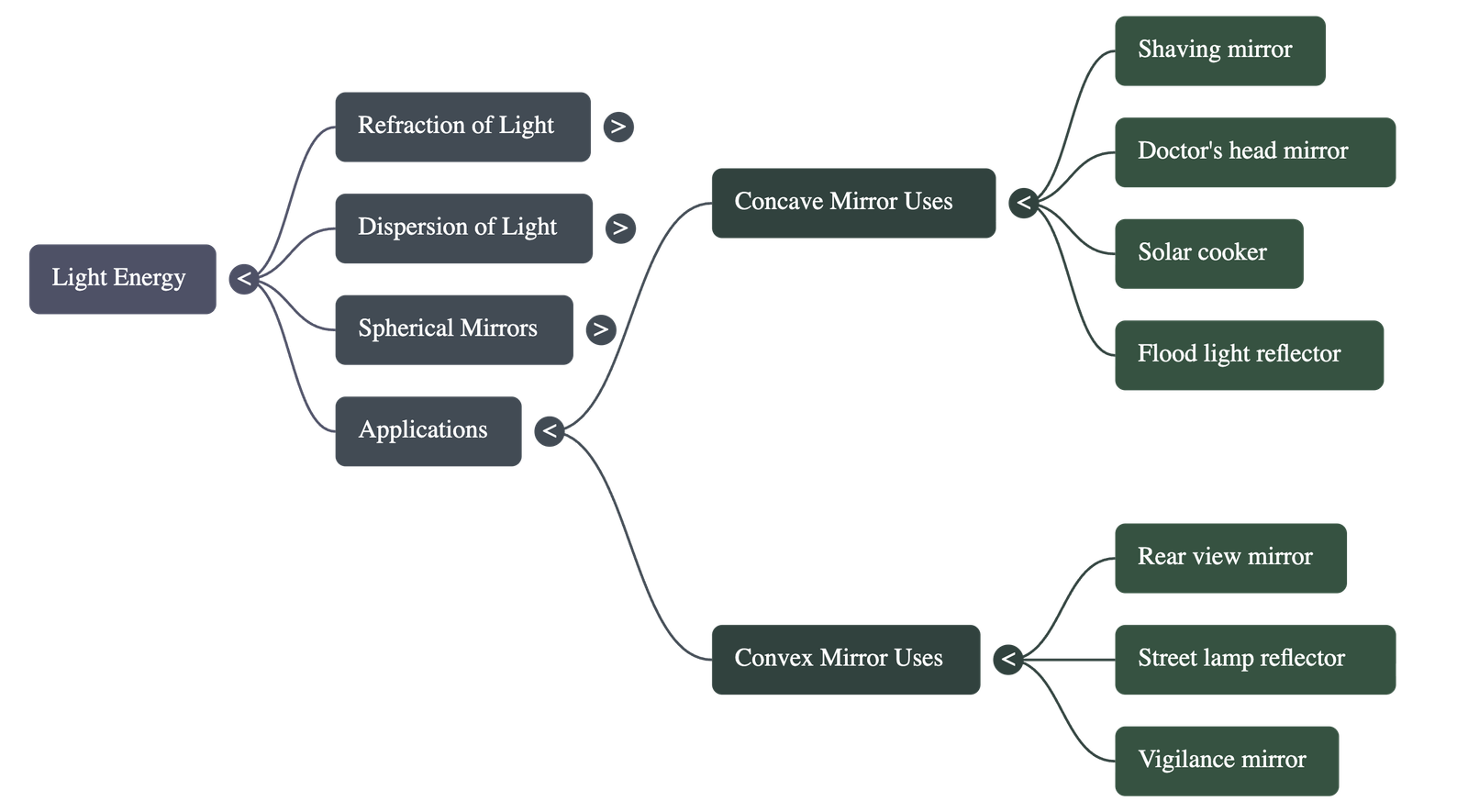
Practical Applications
- Concave Mirrors: Used as shaving mirrors, reflectors in torches/headlights, doctor’s head mirrors, and in solar cookers to converge sun rays.
- Convex Mirrors: Primarily used as rear-view mirrors in vehicles because they provide a wider field of view, and as vigilance mirrors in stores.
Analogy: Refraction is like a shopping cart moving from a smooth tile floor onto a thick carpet at an angle; as the wheels hit the "denser" carpet, they slow down and the cart pivots, changing its direction.
Do checkout all questions & answers of this chapter.
Quick Navigation:
| | | | |
1 / 1
Quick Navigation:
| | | | |