Quick Navigation:
| | |
Minerals and Energy Resources
Introduction to Minerals
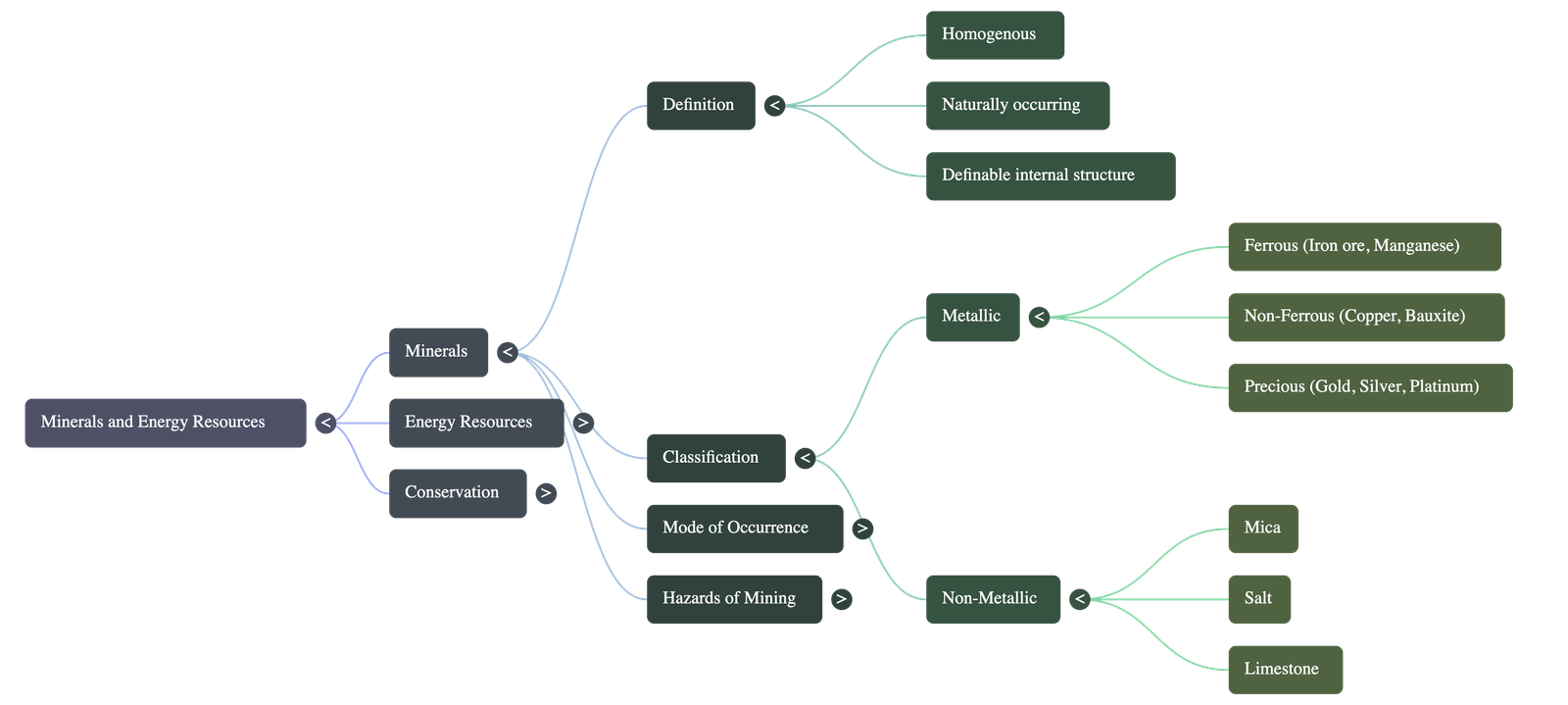
- Definition: Geologists define a mineral as a "homogenous, naturally occurring substance with a definable internal structure."
- Importance: Minerals are indispensable to daily life, found in everything from tiny pins to large ships, buildings, and machinery. Even food contains minerals essential for life processes.
- Forms: They range from the hardest diamond to the softest talc.
Mode of Occurrence
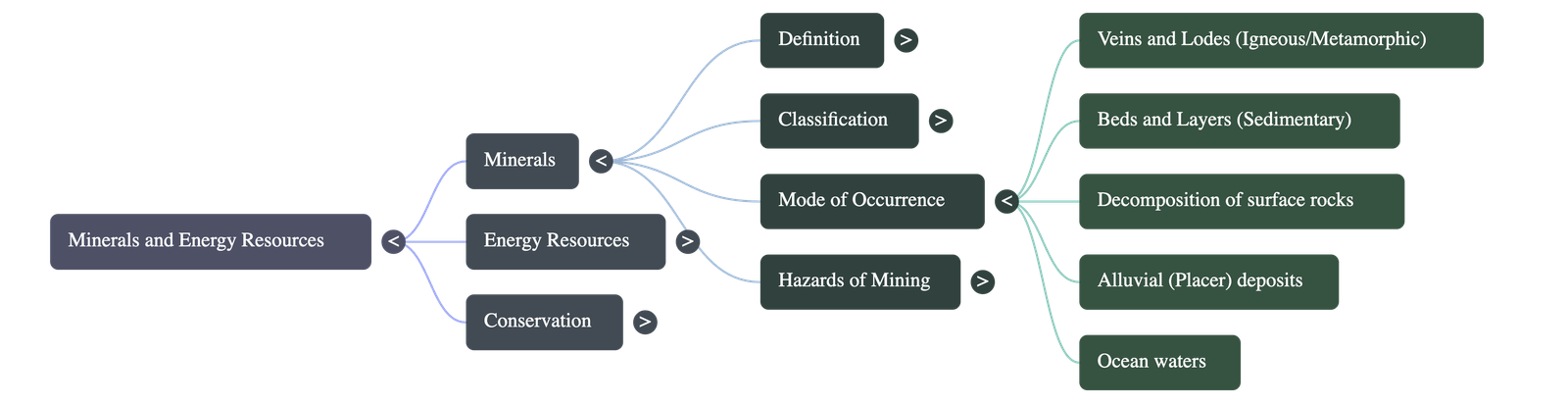
Minerals are usually found in "ores" (accumulations mixed with other elements). They occur in the following forms:
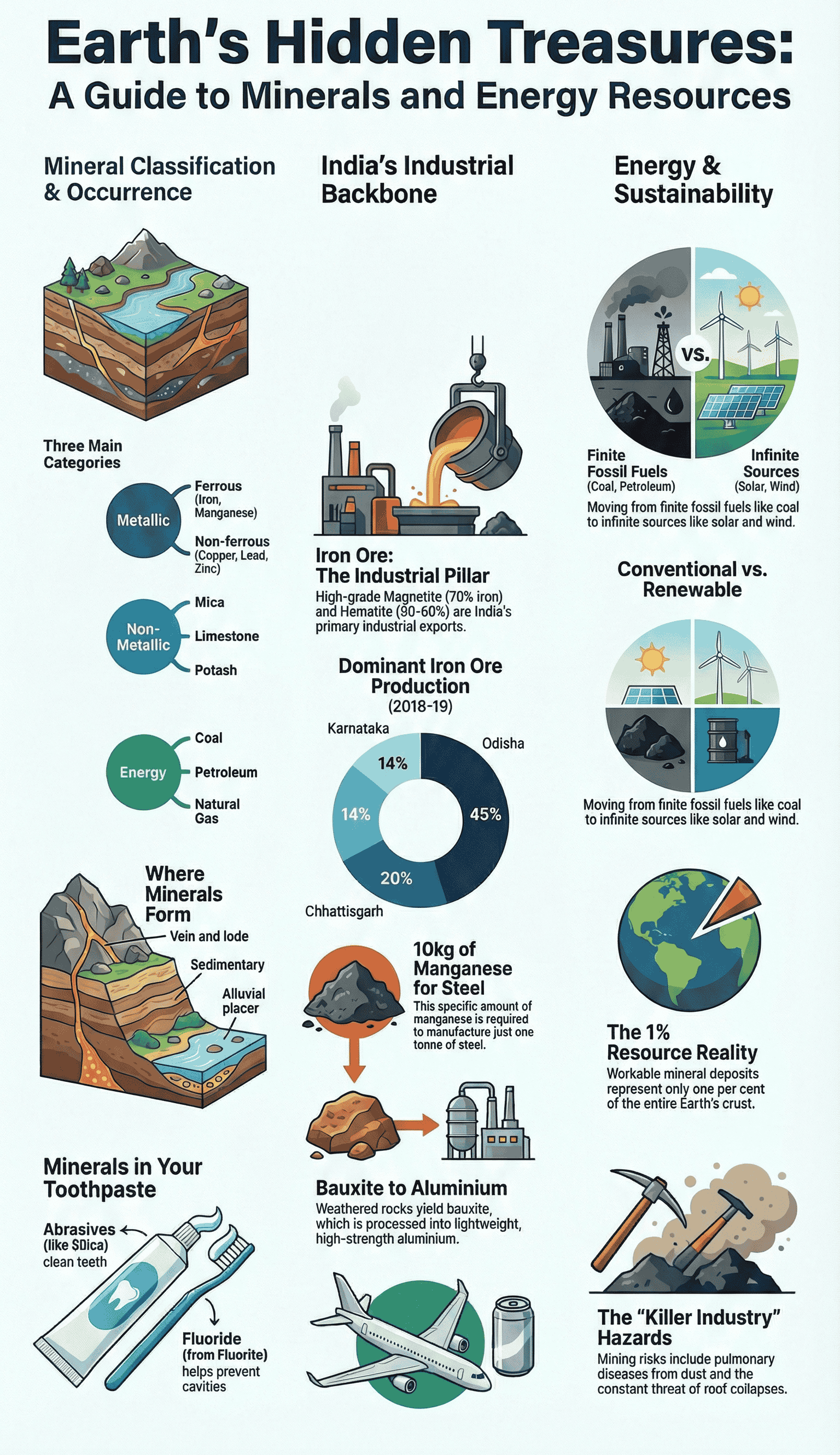
- Igneous and Metamorphic Rocks: Found in cracks, crevices, faults, or joints. Smaller occurrences are called veins and larger ones lodes (e.g., tin, copper, zinc, lead).
- Sedimentary Rocks: Occur in beds or layers due to deposition, accumulation, and concentration (e.g., coal, iron ore, gypsum, potash salt).
- Decomposition of Surface Rocks: Formed by the removal of soluble constituents, leaving a residual mass (e.g., Bauxite).
- Alluvial Deposits: Found in valley floor sands and hill bases as placer deposits which are not corroded by water (e.g., gold, silver, tin, platinum).
- Ocean Waters: Contain vast quantities of minerals like common salt, magnesium, and bromine. Manganese nodules are found in ocean beds.
Classification of Minerals
1. Ferrous Minerals
These account for three-fourths of the total value of metallic mineral production.
- Iron Ore: The backbone of industrial development.
- Magnetite: Finest ore with up to 70% iron content; excellent magnetic qualities.
- Hematite: Most important industrial iron ore (50-60% iron content).
- Major Belts: Odisha-Jharkhand, Durg-Bastar-Chandrapur, Ballari-Chitradurga-Chikkamagaluru-Tumakuru, and Maharashtra-Goa.
- Manganese: Mainly used in steel manufacturing and ferro-manganese alloys. Also used in bleaching powder, insecticides, and paints.
2. Non-Ferrous Minerals
India’s reserves are not very satisfactory, but these are vital for metallurgical, engineering, and electrical industries.
- Copper: Malleable, ductile, and a good conductor. Used in electrical cables, electronics, and chemicals. Major mines: Balaghat (MP), Khetri (Rajasthan), Singhbhum (Jharkhand).
- Bauxite: A clay-like substance from which alumina and later aluminium is obtained. Aluminium is known for its strength, extreme lightness, and conductivity. Major deposits: Amarkantak plateau, Maikal hills, Bilaspur-Katni. Odisha is the largest producing state.
3. Non-Metallic Minerals
- Mica: Made of plates/leaves that split into thin sheets. Indispensable for electric and electronic industries due to insulating properties and resistance to high voltage. Major belts: Chota Nagpur plateau (Jharkhand), Ajmer (Rajasthan), Nellore (Andhra Pradesh).
- Limestone: Associated with rocks composed of calcium carbonates. Basic raw material for the cement industry and essential for smelting iron ore.
Hazards of Mining and Conservation
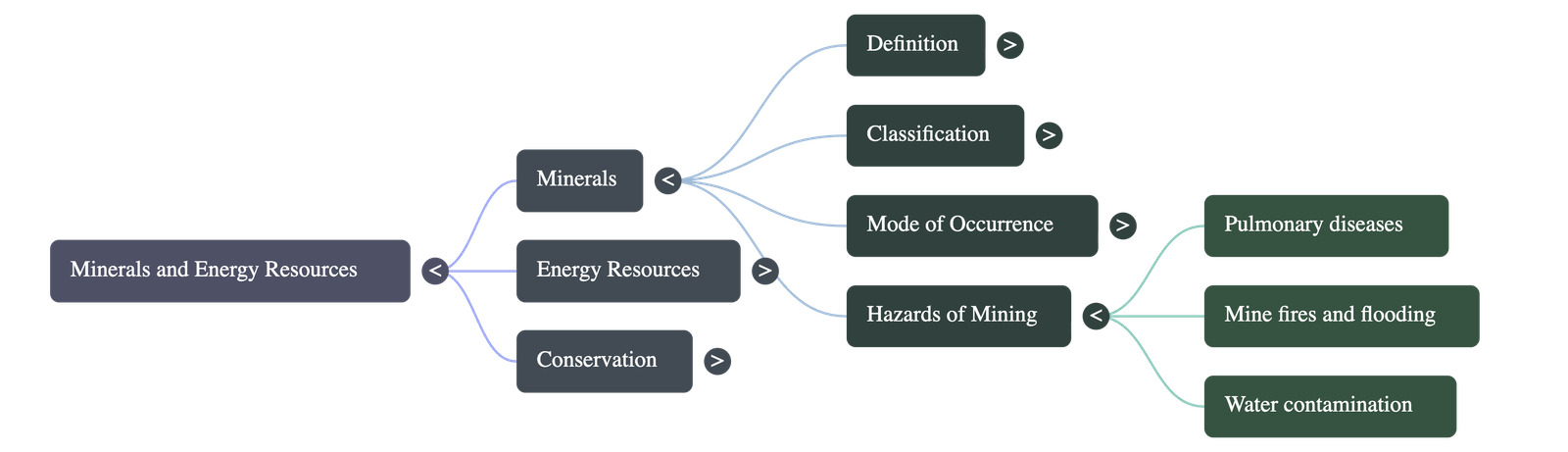
- Hazards: "Killer industry" risks include pulmonary diseases from dust/fumes, roof collapses, inundation, fires, and environmental degradation (land degradation, water pollution).
- Conservation Necessity: Mineral resources are finite and non-renewable (only 1% of the earth's crust). Formation takes millions of years, while consumption is rapid.
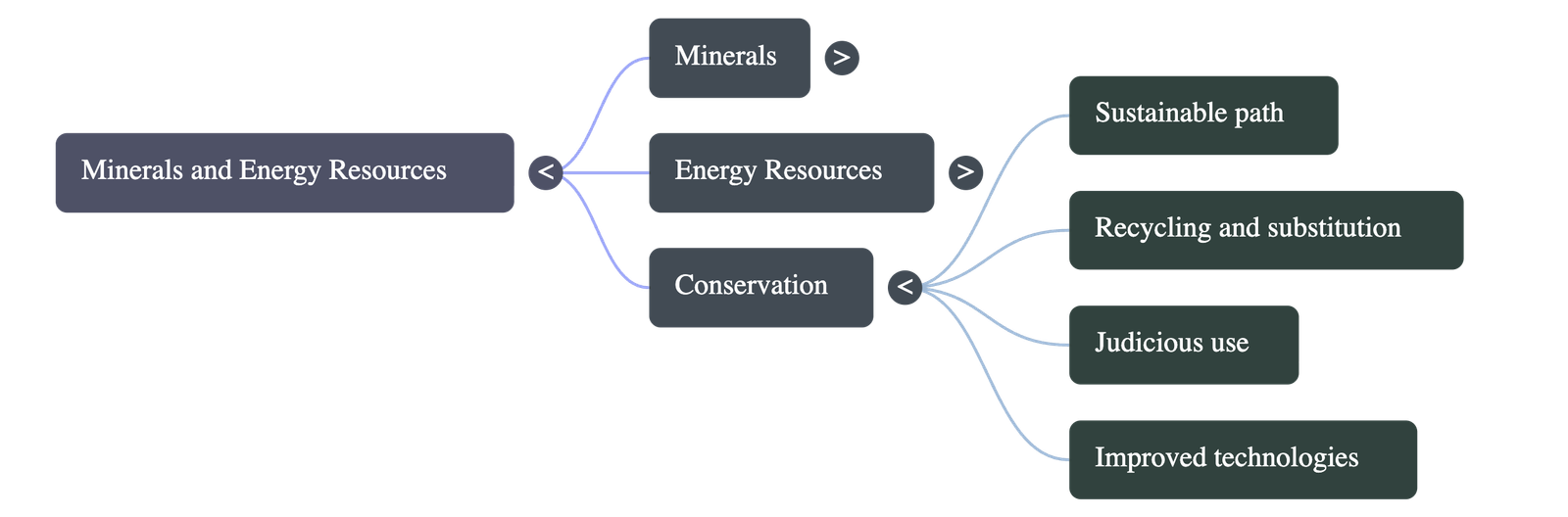
- Conservation Methods: Sustainable use, improved technologies to use low-grade ores, recycling of metals, and using substitutes.
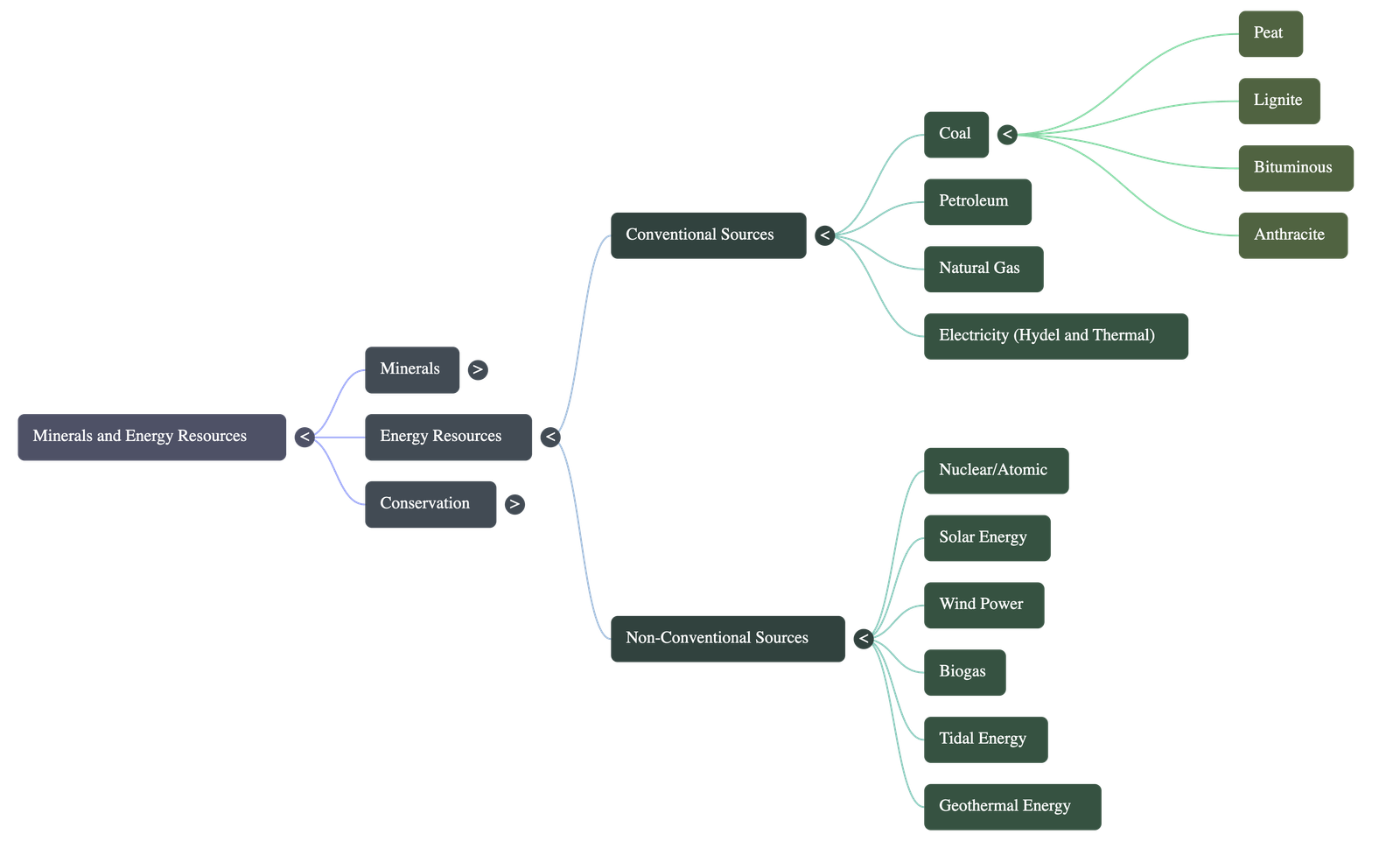
Conventional Energy Resources
- Coal: Most abundantly available fossil fuel in India.
- Types: Peat (low grade), Lignite (brown coal, soft, high moisture), Bituminous (commercial use, deep burial), Anthracite (highest quality hard coal).
- Occurrence: Gondwana (200 million years old - Damodar Valley) and Tertiary deposits (55 million years old - North East India).
- Petroleum: Second major energy source. Used for heat, lighting, lubricants, and raw material.
- Occurrence: Associated with anticlines and fault traps in tertiary rock formations.
- Major Areas: Mumbai High, Gujarat (Ankeleshwar), Assam (Digboi, Naharkatiya).
- Natural Gas: Clean energy resource found with or without petroleum. Used as industrial fuel and CNG. The HVJ pipeline is a key infrastructure.
- Electricity: Generated via Hydro (renewable, running water) and Thermal (non-renewable, burning fossil fuels).
Non-Conventional Energy Resources
Renewable sources are essential for sustainable energy development.
- Nuclear/Atomic Energy: Generated by altering the structure of atoms (Uranium and Thorium). Major reserves in Jharkhand, Rajasthan, and Kerala (Monazite sands).
- Solar Energy: Photovoltaic technology converts sunlight to electricity. fast becoming popular in rural areas to reduce dependence on firewood.
- Wind Power: Great potential in India. Largest wind farm cluster is in Tamil Nadu (Nagarcoil to Madurai). Also significant in Jaisalmer.
- Biogas: Produced from shrubs, farm waste, and animal waste. Provides energy and improved manure quality for farmers.
- Tidal Energy: Uses oceanic tides to generate electricity via floodgate dams. Ideal conditions in Gulf of Khambhat, Gulf of Kuchchh, and Gangetic delta.
- Geo-Thermal Energy: Uses heat from the earth's interior (hot springs). Experimental projects in Parvati Valley (HP) and Puga Valley (Ladakh).
Conservation of Energy
Energy is a basic requirement for economic development, but consumption is rising steadily.
- Need: Urgent need for a sustainable energy path due to limited resources and environmental impact.
- Action Plan: Promotion of energy conservation ("Energy saved is energy produced") and increased use of renewable energy sources.
- Individual Steps: Using public transport, switching off electricity when unused, and using power-saving devices.
Do checkout all questions & answers of this chapter.
Quick Navigation:
| | |
1 / 1
Quick Navigation:
| | |