RESOURCES AND DEVELOPMENT
1. Concept of Resources
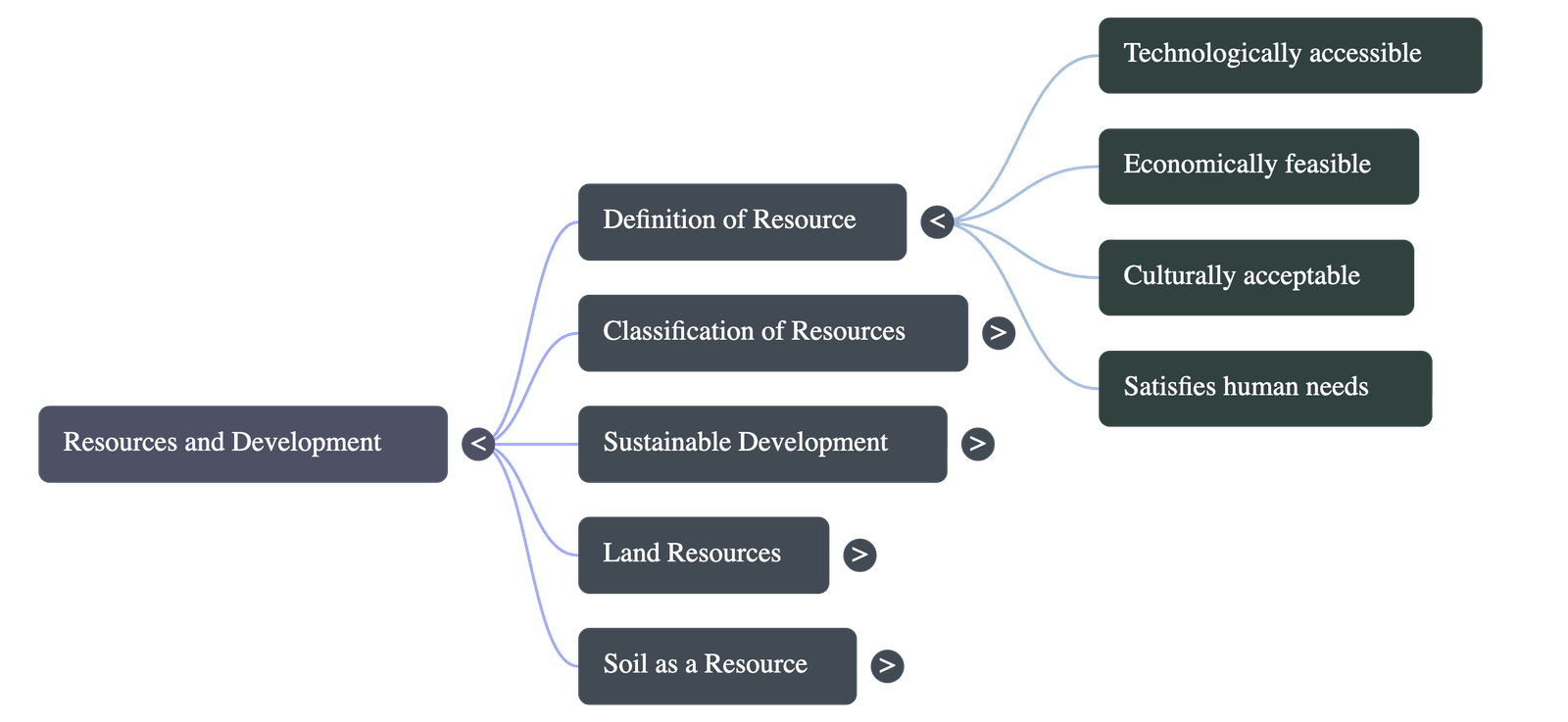
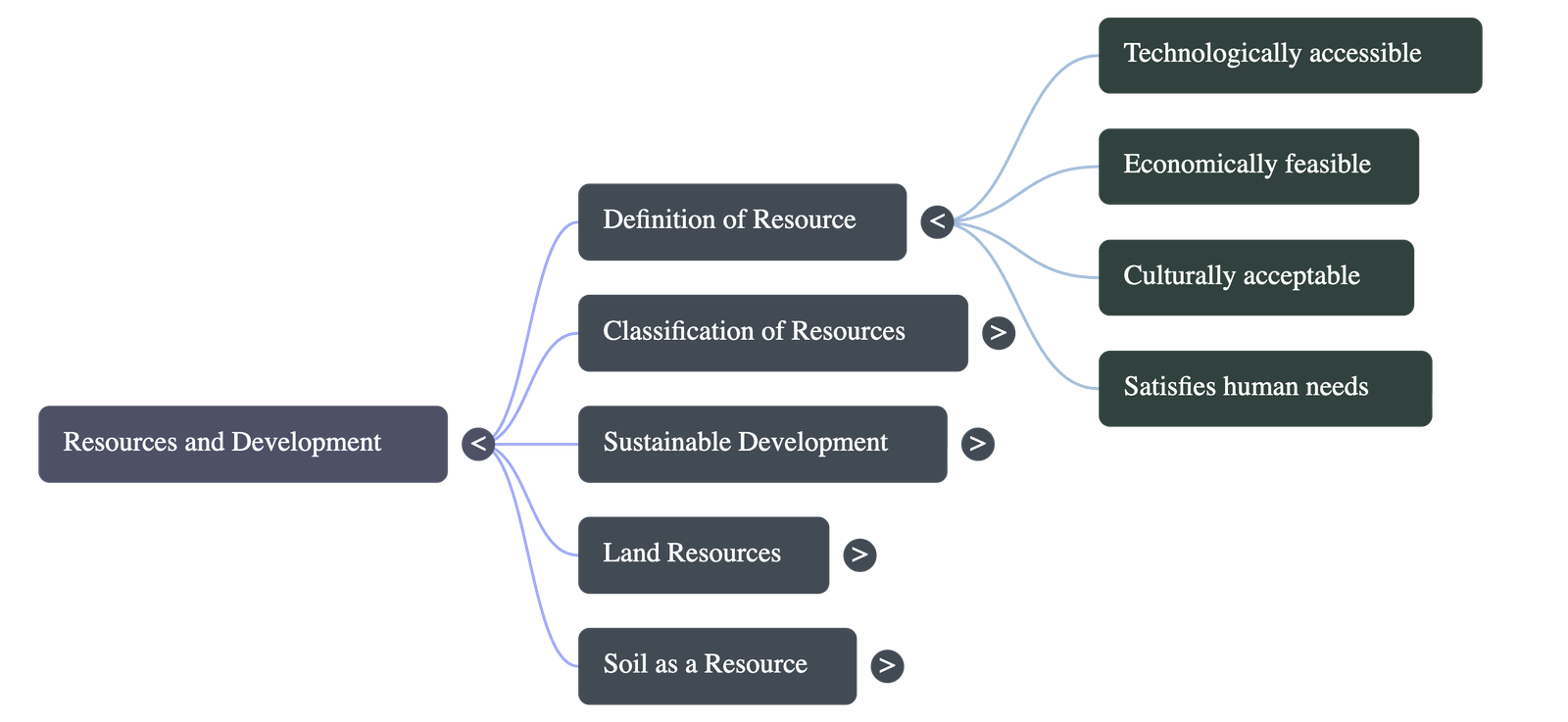
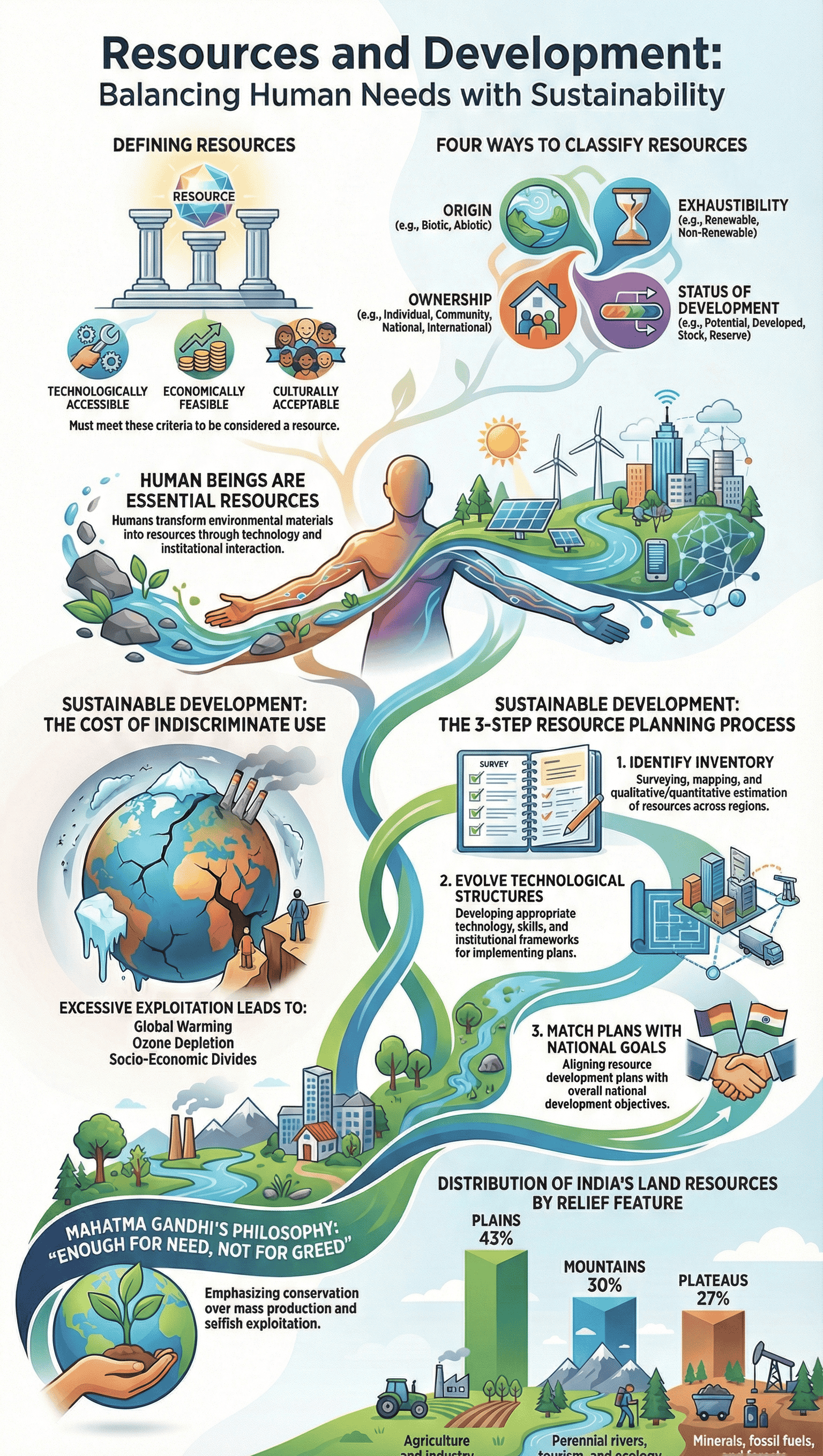
- Definition: Everything available in our environment that can be used to satisfy our needs is termed as a 'Resource', provided it is technologically accessible, economically feasible, and culturally acceptable.
- Interdependence: The transformation of things into resources involves an interactive relationship between Nature, Technology, and Institutions. Human beings interact with nature through technology to create institutions that accelerate economic development.
- Nature of Resources: Resources are not free gifts of nature; they are a function of human activities. Humans transform material available in the environment into resources.
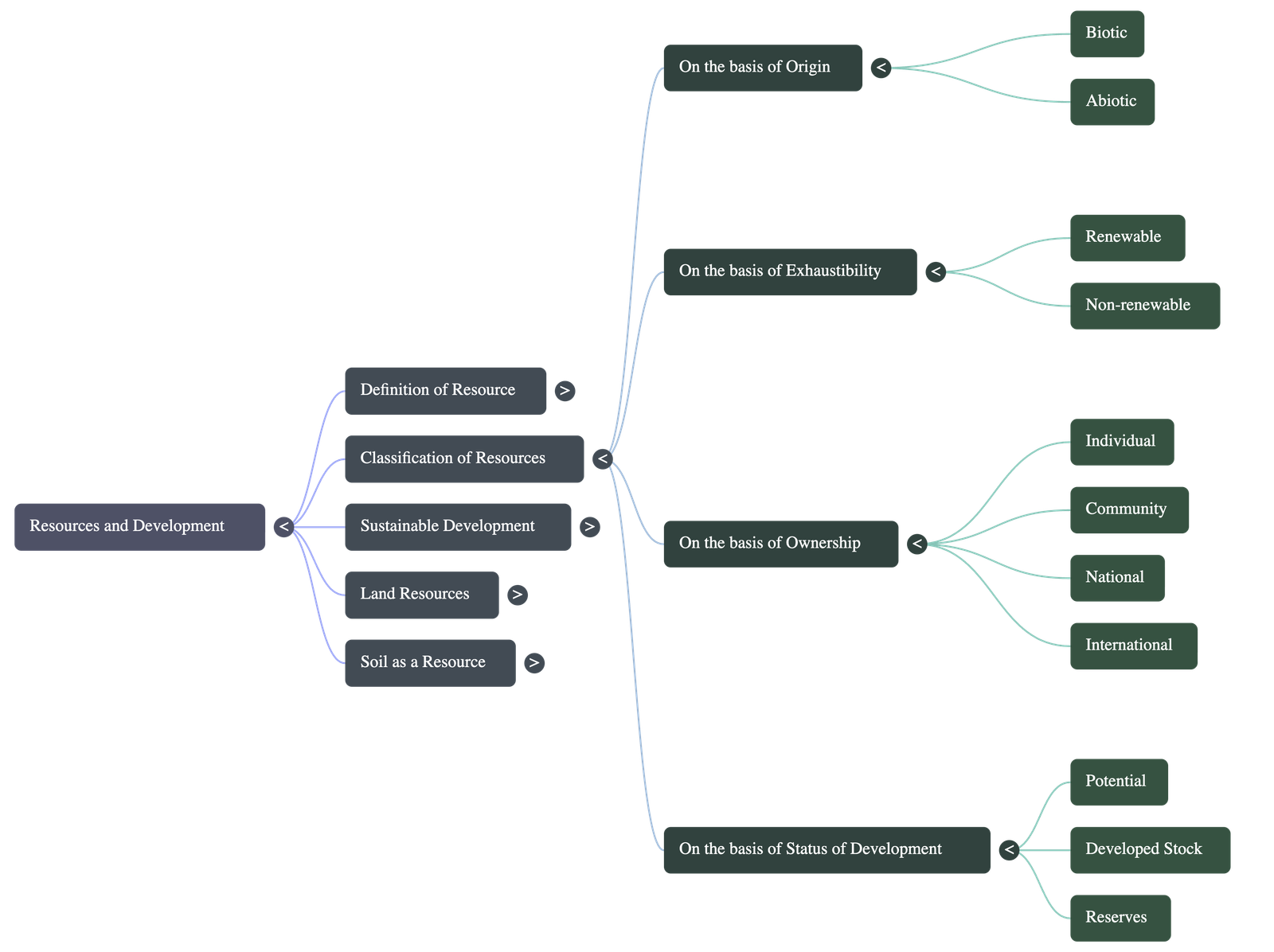
2. Classification of Resources
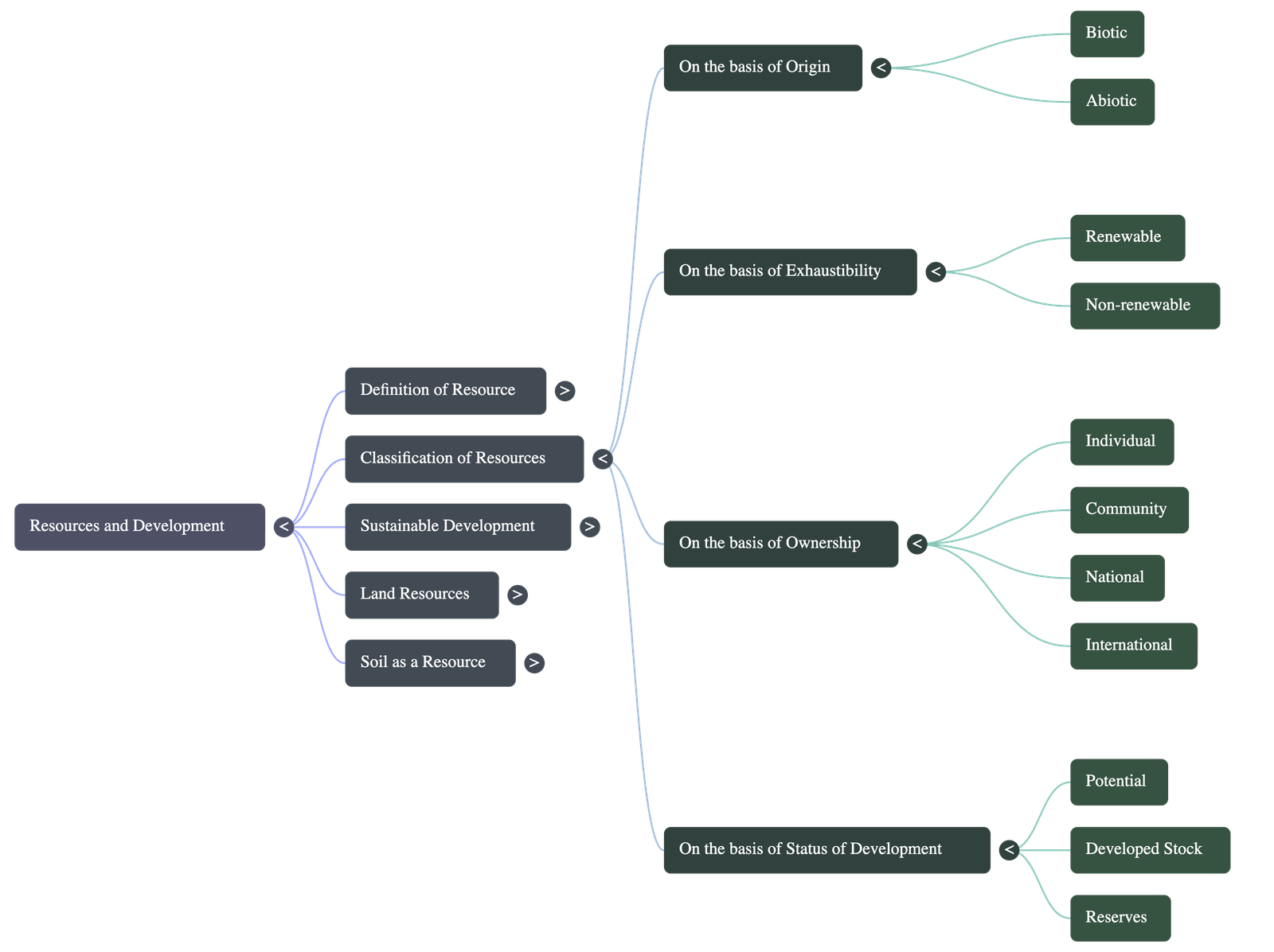
- On the basis of Origin:
- Biotic: Obtained from the biosphere and have life (e.g., human beings, flora, fauna).
- Abiotic: Composed of non-living things (e.g., rocks, metals).
- On the basis of Exhaustibility:
- Renewable: Can be reproduced by physical, chemical, or mechanical processes (e.g., solar energy, forests).
- Non-Renewable: Occur over very long geological time; take millions of years to form (e.g., minerals, fossil fuels).
- On the basis of Ownership:
- Individual: Owned privately by individuals.
- Community: Accessible to all members of the community (e.g., grazing grounds, ponds).
- National: Technically, all resources belong to the nation. The state has the power to acquire private property for public good.
- International: Regulated by international institutions (e.g., oceanic resources beyond the Exclusive Economic Zone).
- On the basis of Status of Development:
- Potential: Found in a region but not yet utilized.
- Developed: Surveyed and determined for use based on quality and quantity.
- Stock: Materials that have potential but humans lack the technology to access them.
- Reserves: A subset of stock that can be put into use with existing technology but has not been started yet.
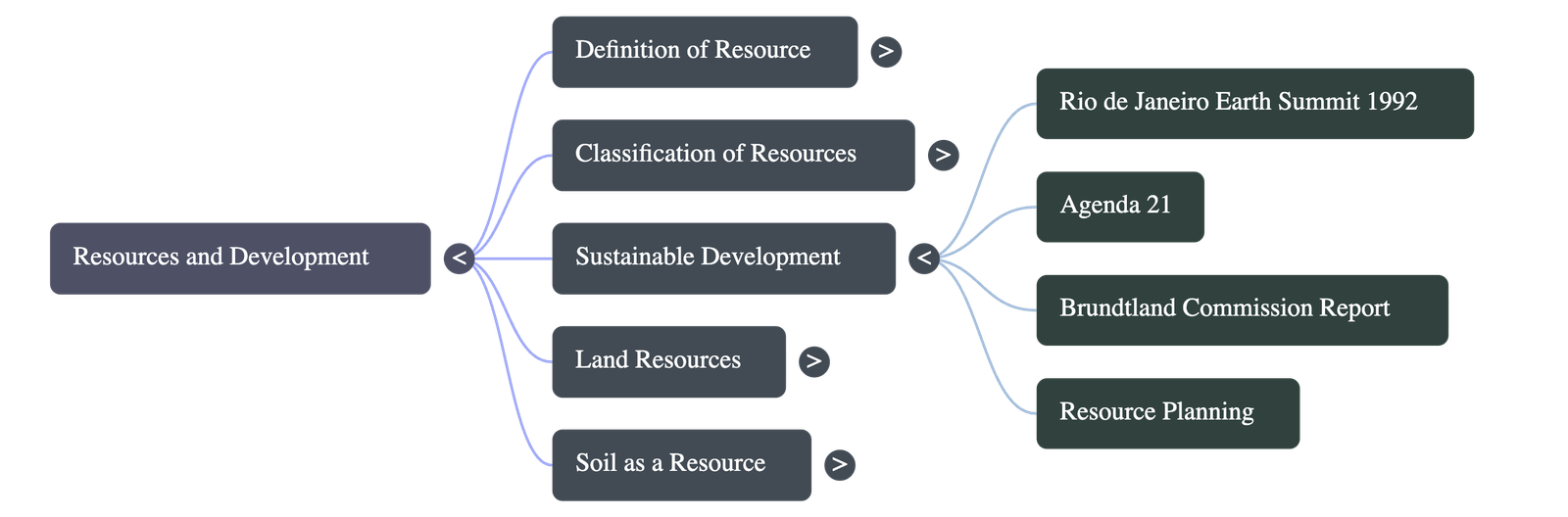
3. Development of Resources & Sustainability
Indiscriminate use of resources has led to:
- Depletion of resources for the greed of a few.
- Accumulation of resources in few hands, dividing society into rich and poor.
- Global ecological crises like global warming, ozone layer depletion, and land degradation.
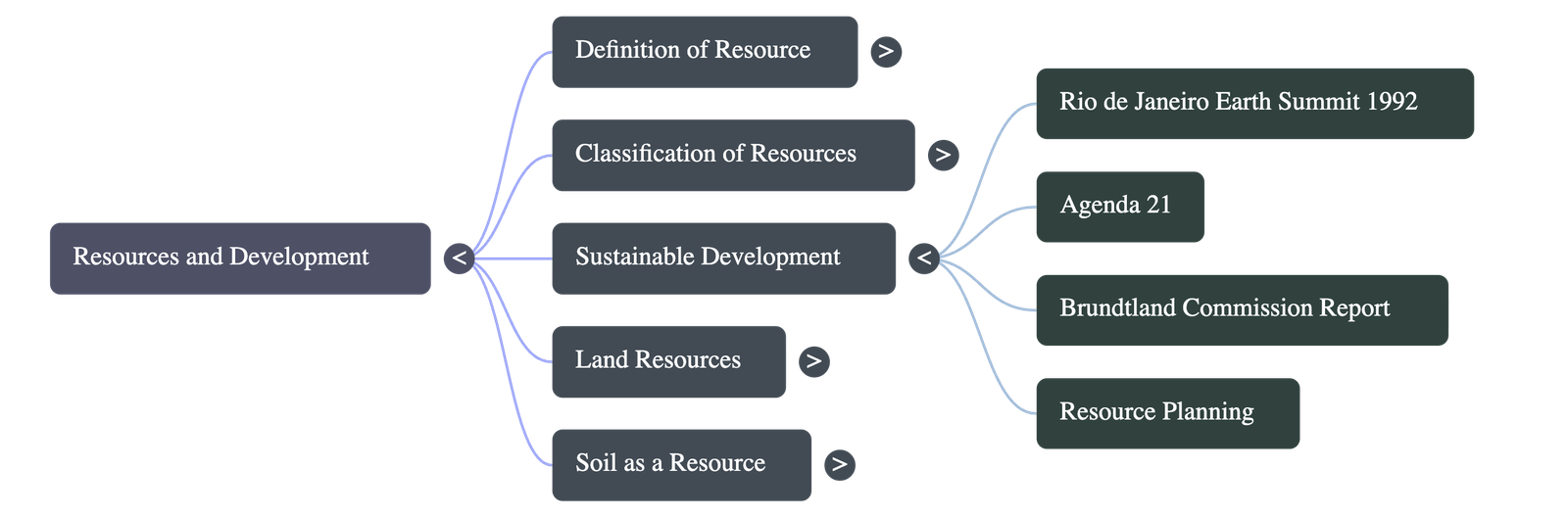
Rio de Janeiro Earth Summit (1992): Convened to address urgent problems of environmental protection. Leaders signed the Declaration on Global Climatic Change and Biological Diversity and adopted Agenda 21 for achieving Sustainable Development.
4. Resource Planning
Planning is vital for a country like India due to the enormous diversity in resource availability.
-
Process of Resource Planning in India:
- Identification and inventory of resources (surveying, mapping, estimation).
- Evolving a planning structure with appropriate technology, skill, and institutional setup.
- Matching resource development plans with overall national development plans.
- Conservation of Resources: Irrational consumption leads to socio-economic problems. Gandhiji stated, "There is enough for everybody's need and not for any body's greed." He blamed modern technology and mass production for resource depletion, advocating instead for production by the masses.
5. Land Resources
- Importance: Land supports natural vegetation, wildlife, human life, economic activities, and transport.
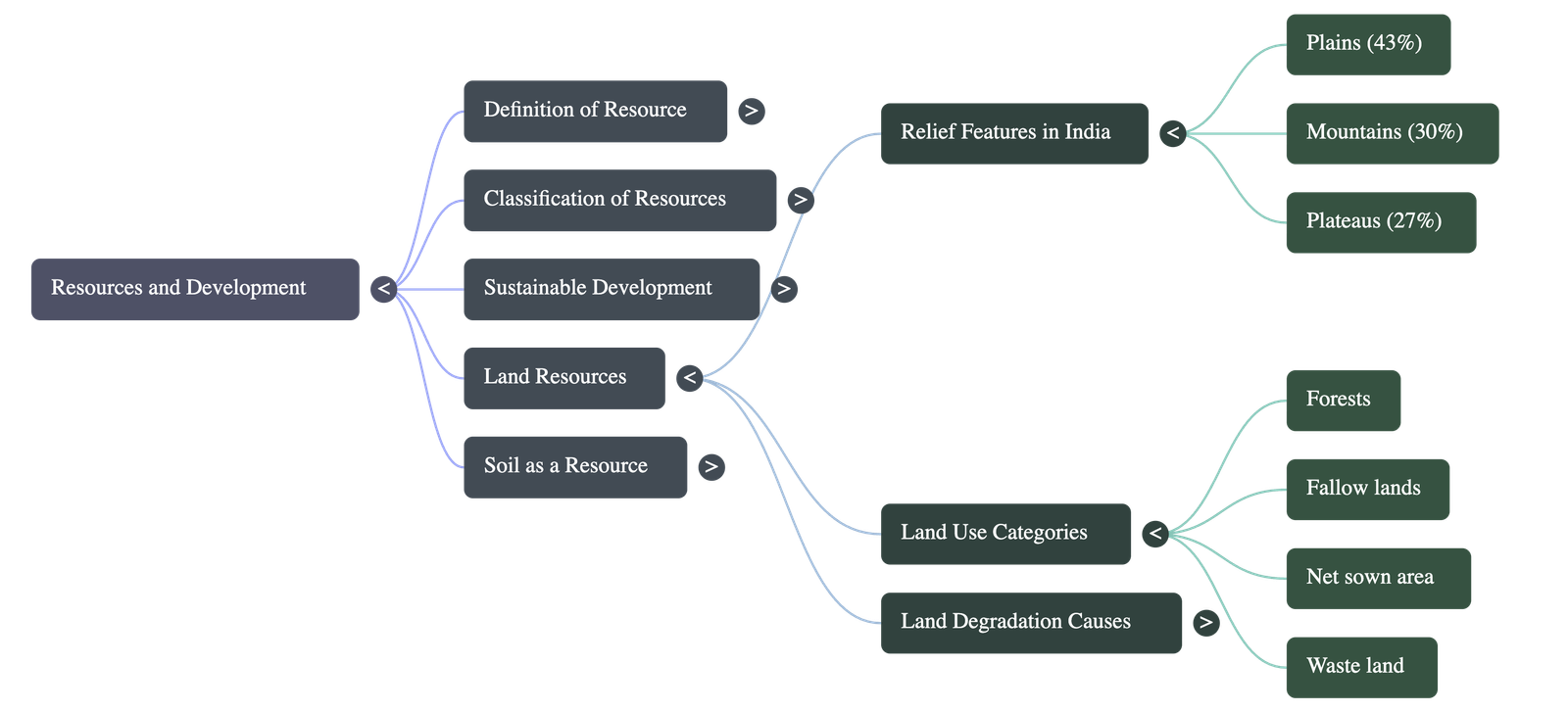
- Relief Features in India:
- Plains (43%): Provide facilities for agriculture and industry.
- Mountains (30%): Ensure perennial flow of rivers, tourism, and ecological aspects.
- Plateaus (27%): Rich reserves of minerals, fossil fuels, and forests.
6. Land Utilisation & Pattern
Land resources are used for forests, land not available for cultivation (barren/waste), other uncultivated land (pastures), fallow lands, and Net Sown Area.
- Net Sown Area (NSA): Approximately 54% of the total reporting area in India. It varies greatly by state (over 80% in Punjab/Haryana vs. less than 10% in Arunachal Pradesh/Mizoram).
- Forest Area: Far lower than the desired 33% outlined in the National Forest Policy (1952).
- Waste Land: Includes rocky, arid, and desert areas, and land used for non-agricultural purposes like settlements and roads.
7. Land Degradation and Conservation
Human activities have aggravated natural forces causing damage to land.
- Causes:
- Mining: Leaves deep scars (Jharkhand, Chhattisgarh, MP, Odisha).
- Overgrazing: Main cause in Gujarat, Rajasthan, MP, Maharashtra.
- Over-irrigation: Leads to water logging and salinity (Punjab, Haryana, Western UP).
- Industrial Effluents: Major source of land and water pollution.
- Conservation Measures: Afforestation, proper management of grazing, planting shelter belts, stabilizing sand dunes with thorny bushes, and proper discharge/disposal of industrial waste.
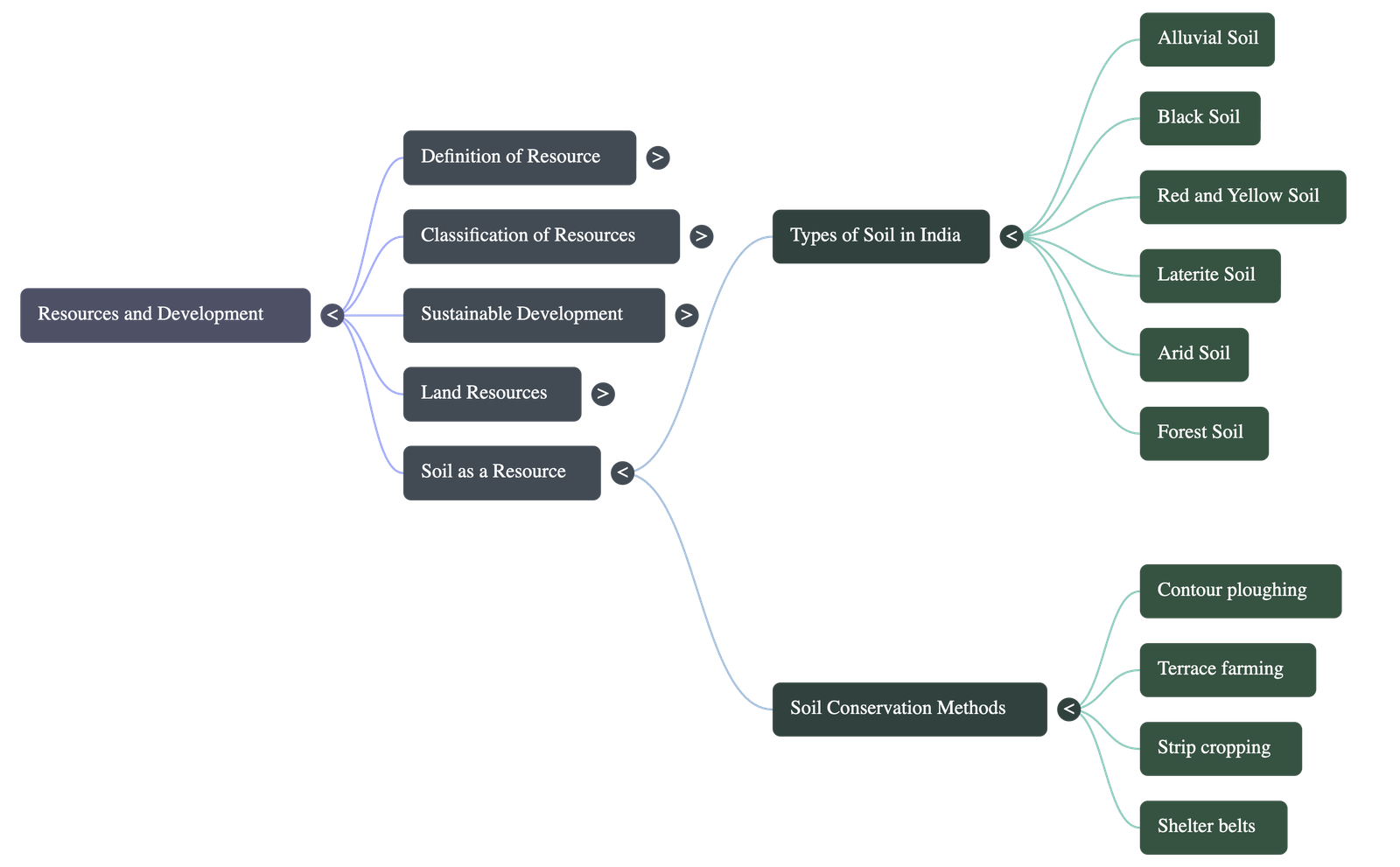
8. Soil Resources
Soil is the most important renewable natural resource. Factors affecting soil formation include relief, parent rock, climate, vegetation, and time.
Alluvial Soils
Most widely spread soil in India (Northern Plains). Deposited by Indus, Ganga, and Brahmaputra systems. Also found in eastern coastal deltas. Consists of sand, silt, and clay. Classified as Khadar (new, fertile, fine) and Bangar (old, less fertile, kankar nodules). Ideal for sugarcane, paddy, wheat.
Black Soil (Regur)
Black in color; ideal for growing cotton. Typical of the Deccan trap (Basalt) region (Maharashtra, Saurashtra, Malwa, MP, Chhattisgarh). Made of fine clayey material known for moisture-holding capacity. Rich in calcium carbonate, magnesium, potash, and lime but poor in phosphorus. Develops deep cracks in hot weather.
Red and Yellow Soils
Develops on crystalline igneous rocks in low rainfall areas (Odisha, Chhattisgarh, Southern Ganga plain). Reddish color due to diffusion of iron; looks yellow when hydrated.
Laterite Soil
Develops in high temperature and heavy rainfall areas. Result of intense leaching. Acidic and low in plant nutrients. Useful for growing tea and coffee (Karnataka, Kerala, Tamil Nadu) and cashew nut (red laterite).
Arid Soils
Sandy texture and saline nature. Lacks humus and moisture due to dry climate. Lower horizons occupied by Kankar which restricts water infiltration. Cultivable only with proper irrigation (Western Rajasthan).
Forest Soils
Found in hilly/mountainous areas. Loamy and silty in valley sides; coarse-grained in upper slopes. Acidic with low humus in snow-covered Himalayas. Fertile in lower river terraces.
9. Soil Erosion and Conservation
-
Types of Erosion:
- Gully Erosion: Running water cuts through clayey soils making deep channels (gullies), creating 'bad land' (e.g., Ravines in Chambal).
- Sheet Erosion: Top soil is washed away by water flowing as a sheet over large areas.
- Wind Erosion: Wind blows loose soil off flat or sloping land.
-
Methods of Conservation:
- Contour Ploughing: Ploughing along contour lines to decelerate water flow.
- Terrace Cultivation: Cutting steps on slopes to restrict erosion (Western/Central Himalayas).
- Strip Cropping: Dividing large fields into strips with grass left to grow between crops to break wind force.
- Shelter Belts: Planting rows of trees to stabilize sand dunes and deserts.
Do checkout all questions & answers of this chapter.