Quick Navigation:
| | |
Forest and Wildlife Resources
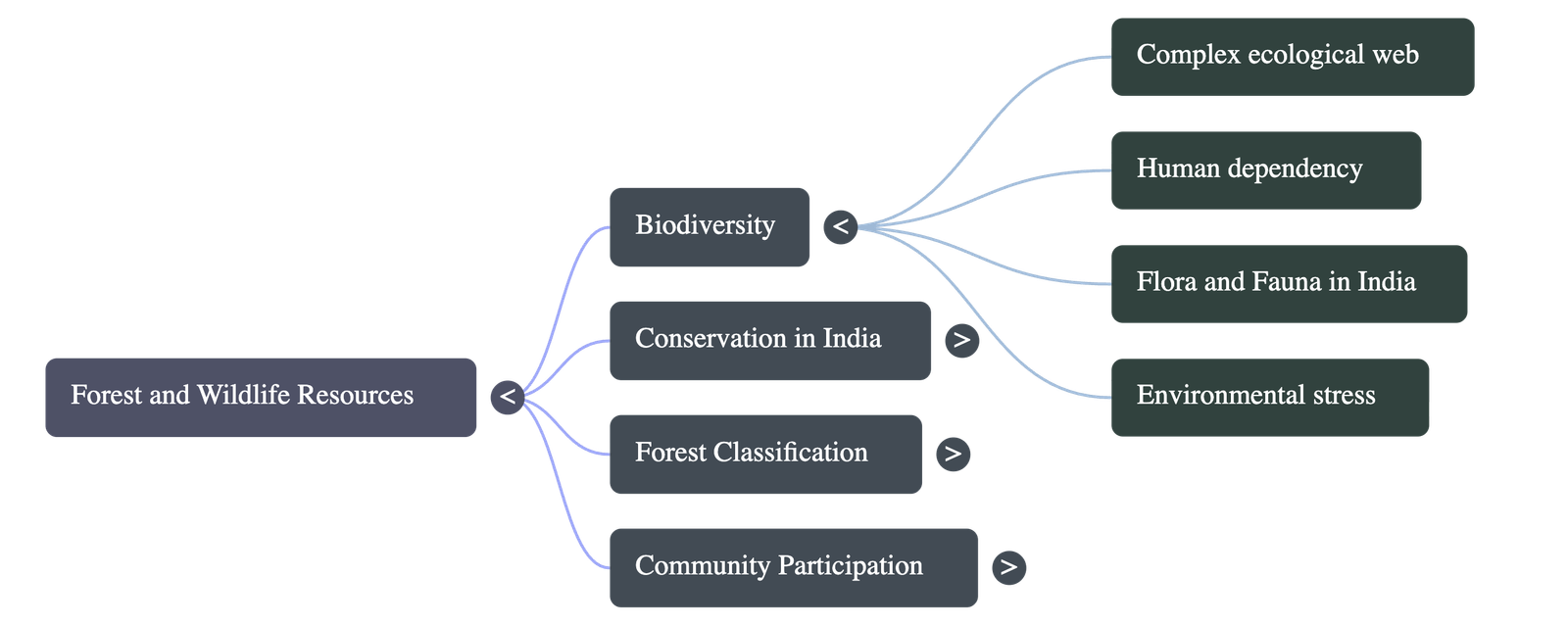
Biodiversity and the Ecological System
- Interdependence: Humans share the planet with millions of other living beings, ranging from microorganisms and bacteria to large animals like elephants and blue whales.
- Ecological Web: Human beings are part of a complex web of an ecological system. We are dependent on this system for our existence.
- Role of Nature: Plants, animals, and microorganisms recreate the quality of the air we breathe, the water we drink, and the soil that produces our food.
- Primary Producers: Forests are crucial as they are primary producers on which all other living beings depend.
Flora and Fauna in India
- Rich Diversity: India is one of the world's richest countries in terms of biological diversity. The actual numbers might be twice or thrice what has been discovered so far.
- Current Threat: These diverse resources are under great stress, primarily due to insensitivity toward the environment.
Conservation of Forest and Wildlife
Why Conserve? Conservation preserves ecological diversity and our life support systems (water, air, and soil). It also preserves the genetic diversity of plants and animals for better growth and breeding.
The Indian Wildlife (Protection) Act, 1972
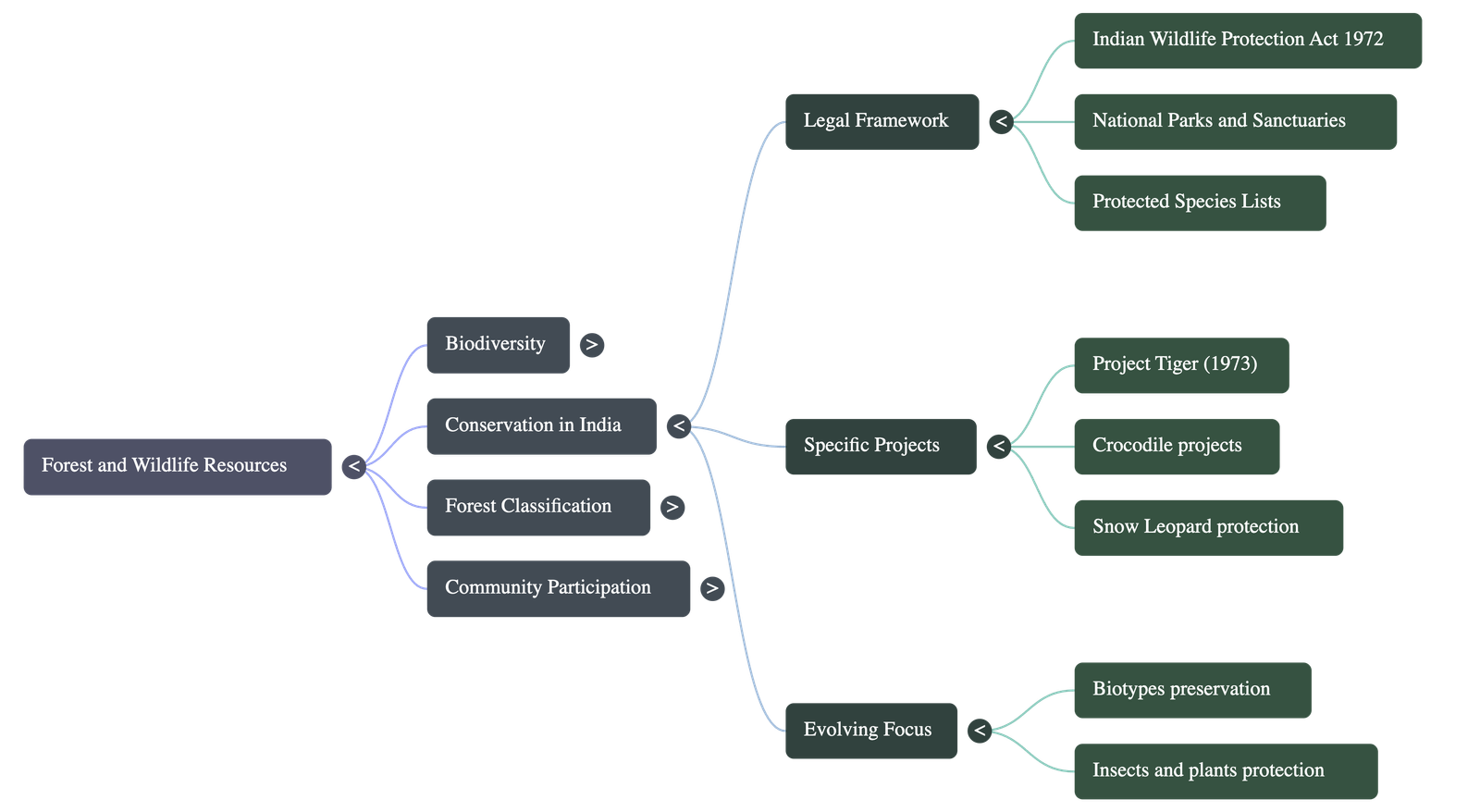
- Implementation: Implemented in 1972 to protect habitats and endangered species.
- Key Provisions: The Act banned hunting, gave legal protection to habitats, and restricted trade in wildlife.
- Protected Areas: Central and state governments established national parks and wildlife sanctuaries.
- Targeted Projects: Specific projects were announced to protect gravely threatened animals, including the tiger, the one-horned rhinoceros, the Kashmir stag (hangul), three types of crocodiles, the Asiatic lion, and others.
- New Additions: Recently, animals like the Indian elephant, black buck, and snow leopard have received legal protection. Even insects (butterflies, moths, beetles) and plants have been added to protected lists.
Project Tiger
- Launch: One of the most well-publicized wildlife campaigns, launched in 1973.
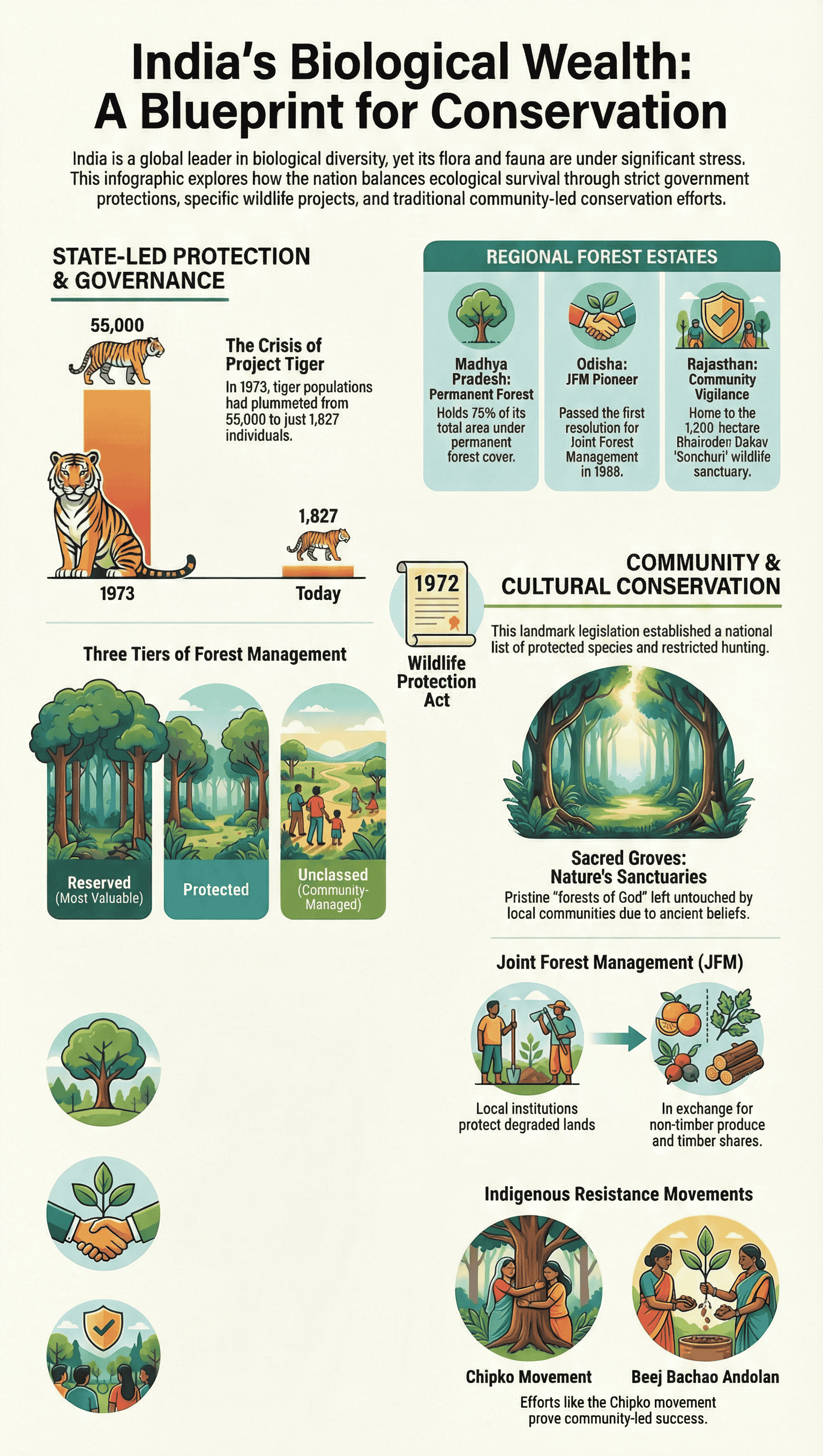
- Crisis: The tiger population had dropped from 55,000 at the turn of the century to just 1,827 in 1973.
- Threats: Poaching for trade (skins and bones for traditional medicine), shrinking habitats, depletion of prey, and growing human population.
- Significance: Tiger conservation is viewed not just as saving a species but as a means of preserving biotypes of sizeable magnitude.
Types and Distribution of Forest Resources
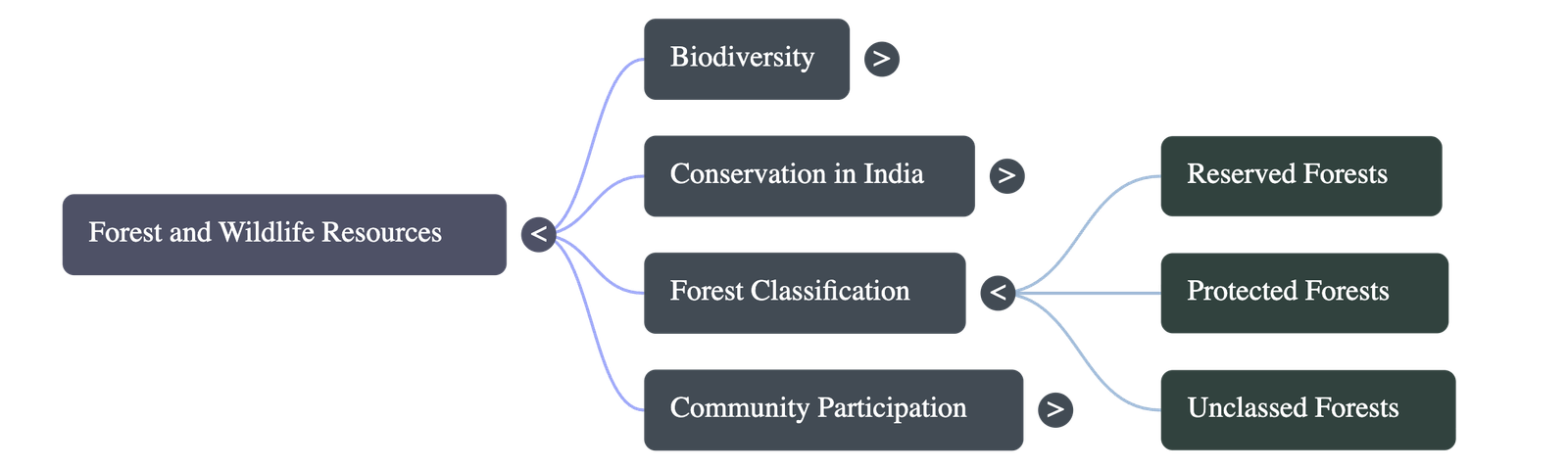
Forests in India are owned or managed by the government through the Forest Department and are classified as follows:
-
Reserved Forests:
- More than half of the total forest land.
- Regarded as the most valuable for the conservation of forest and wildlife.
-
Protected Forests:
- Almost one-third of the total forest area.
- Protected from any further depletion.
-
Unclassed Forests:
- Forests and wastelands belonging to both government and private individuals/communities.
- Common in North-eastern states and parts of Gujarat where they are managed by local communities.
Note: Reserved and Protected forests are referred to as "Permanent Forest Estates." Madhya Pradesh has the largest area under permanent forests (75% of its total forest area).
Community and Conservation
Local communities in India often struggle to conserve habitats because forests are their home and source of livelihood. Several strategies and movements highlight this bond:
-
Sacred Groves (The Forests of God and Goddesses):
Virgin forests preserved in their pristine form due to religious beliefs. Local people do not allow interference in these patches. Specific trees (Mahua, Kadamba, Tamarind, Mango) and animals (Macaques, Langurs, Blackbuck, Peacocks) are worshipped or protected by tribes like the Mundas, Santhals, and Bishnois. -
Community Resistance:
In the Sariska Tiger Reserve (Rajasthan), villagers fought against mining by citing the Wildlife Protection Act. In Alwar district, five villages declared 1,200 hectares as "Bhairodev Dakav 'Sonchuri'," creating their own rules against hunting and encroachment. -
The Chipko Movement:
Successfully resisted deforestation in the Himalayas and demonstrated that community afforestation with indigenous species can be successful. -
Farmers' Movements:
Groups like Beej Bachao Andolan (Tehri) and Navdanya have shown that adequate crop production is possible without synthetic chemicals by using diversified crop varieties.
Joint Forest Management (JFM)
- Overview: A program involving local communities in the management and restoration of degraded forests.
- Origin: Formally existed since 1988, when Odisha passed the first resolution.
- Structure: Depends on local village institutions undertaking protection activities on government-managed forest land.
- Benefits: In return for protection, community members get intermediary benefits like non-timber forest produce and a share in the timber harvested.
Do checkout all questions & answers of this chapter.
Quick Navigation:
| | |
1 / 1
Quick Navigation:
| | |