AGRICULTURE
Overview
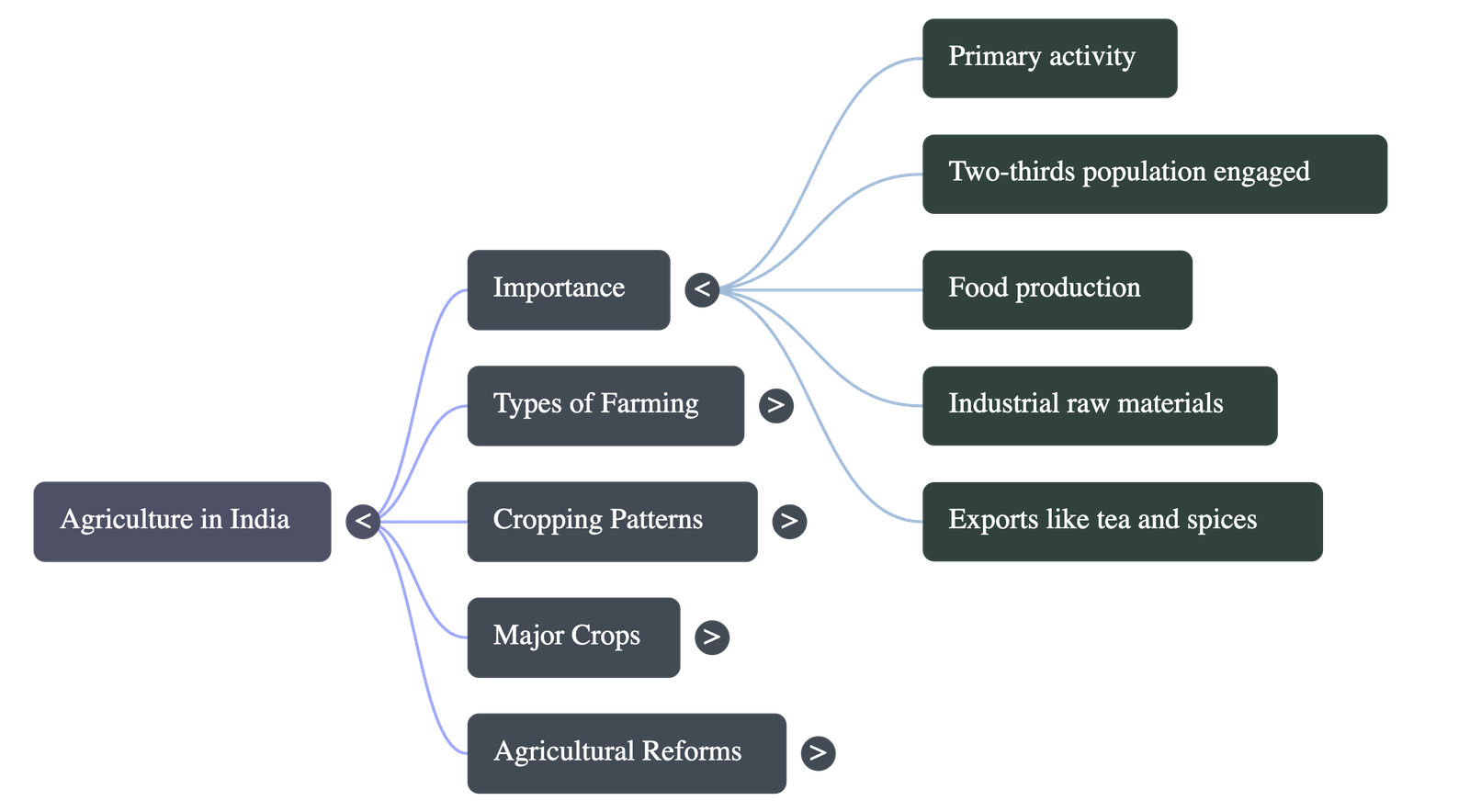
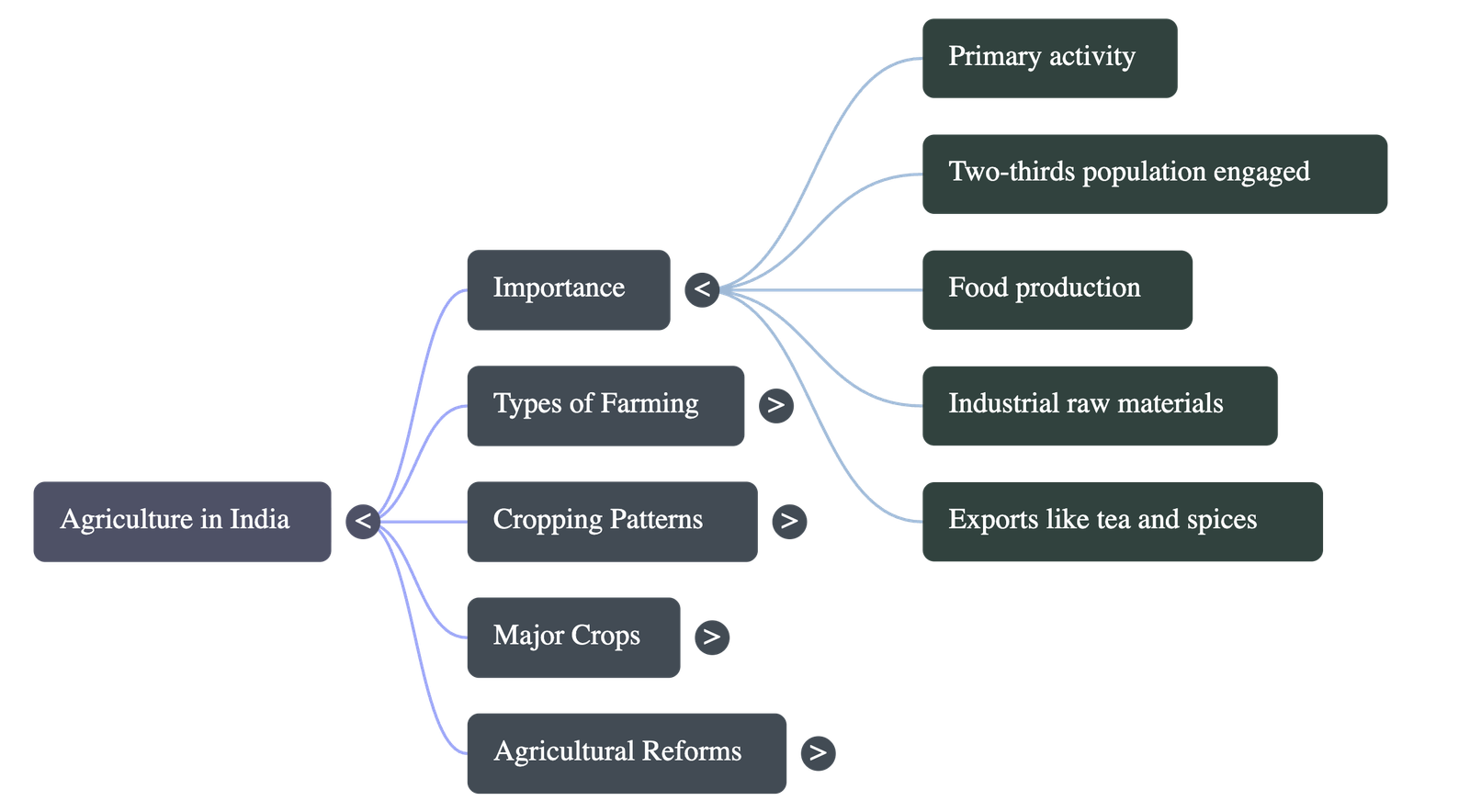
India is an agriculturally important country with two-thirds of its population engaged in agricultural activities. It produces most of the food consumed in the country and supplies raw materials for various industries.
1. Types of Farming
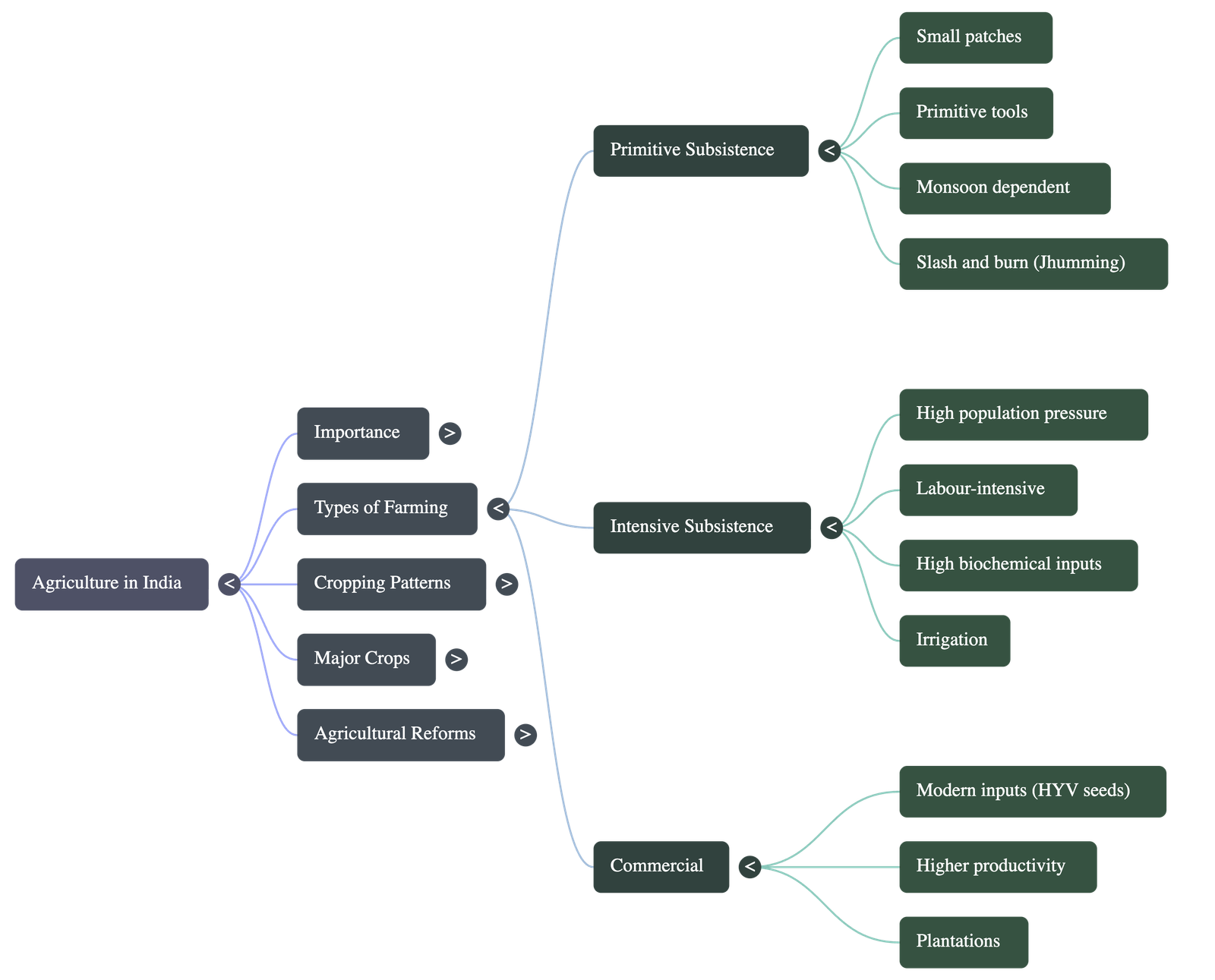
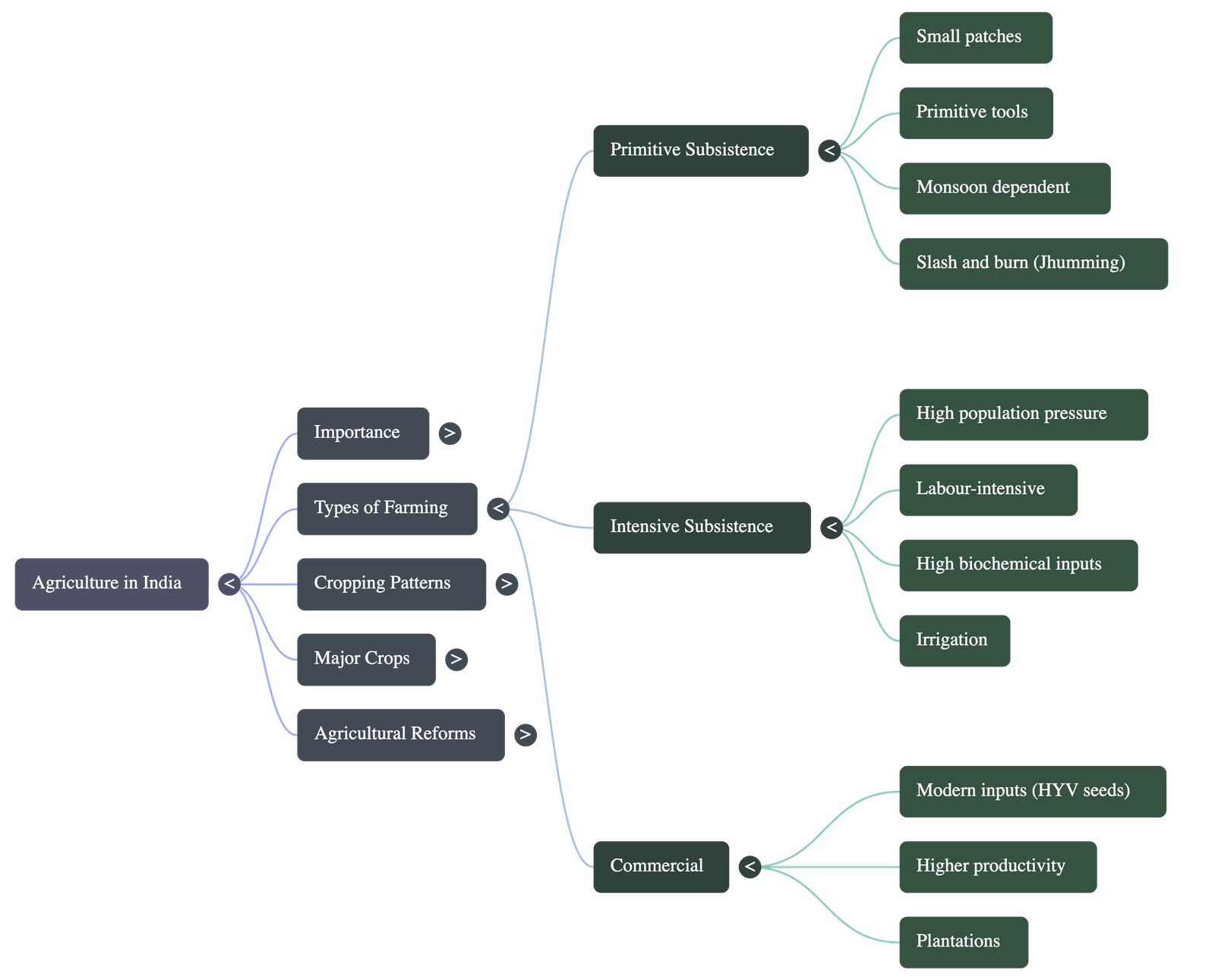
Farming methods in India have evolved based on the physical environment, technology, and socio-cultural practices.
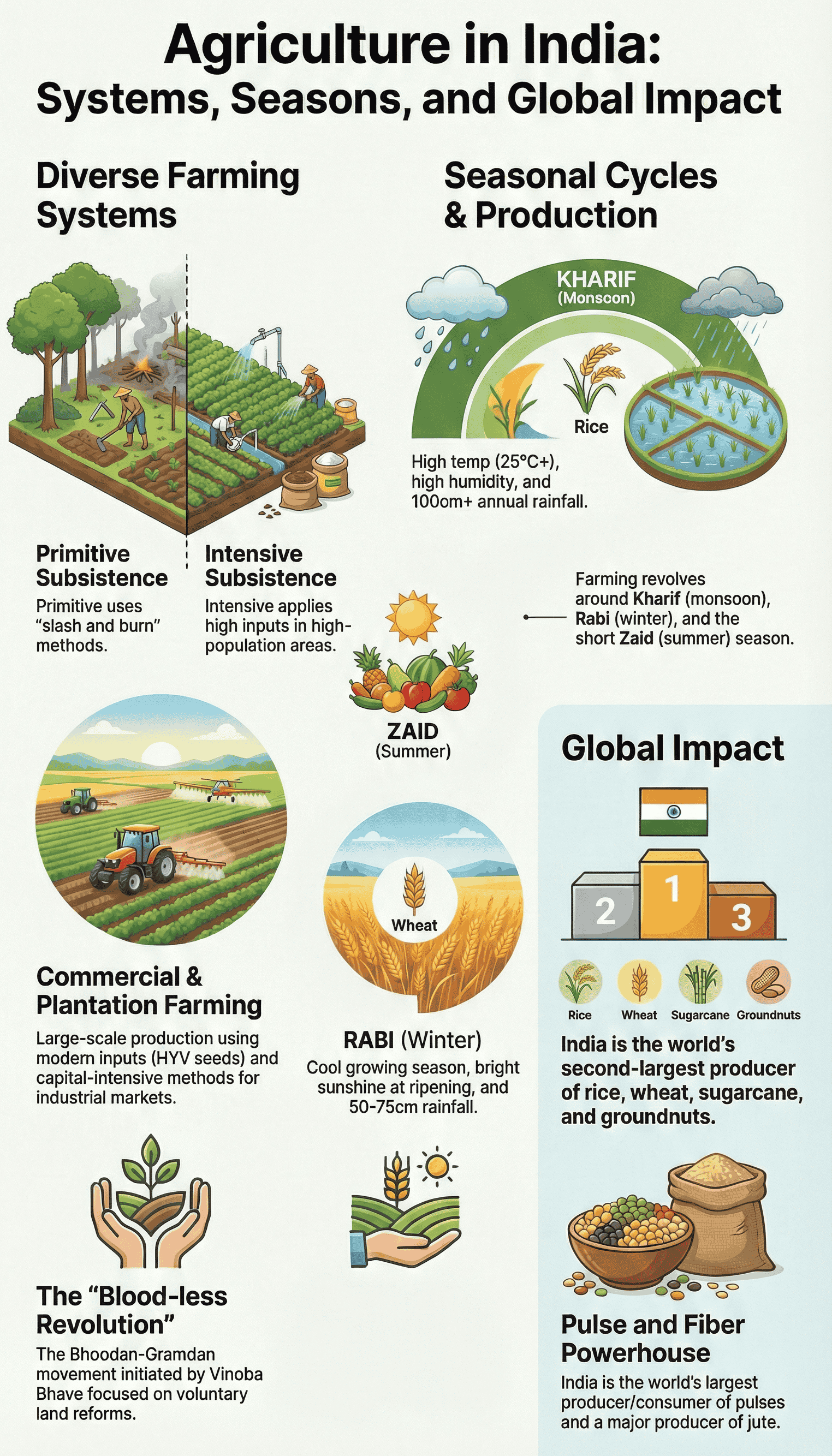
A. Primitive Subsistence Farming
- Practised on small patches of land using primitive tools like hoe, dao, and digging sticks.
- Relies on monsoon rainfall, natural soil fertility, and environmental conditions.
- Also known as Slash and Burn agriculture: Farmers clear land, burn vegetation, and grow crops. When fertility declines, they shift to a new patch, allowing nature to replenish the soil.
- Local Names for Slash and Burn:
- Jhumming in North-eastern states (Assam, Meghalaya, etc.).
- Pamlou in Manipur, Dipa in Chhattisgarh.
- Bewar/Dahiya in Madhya Pradesh, Podu/Penda in Andhra Pradesh.
- Milpa in Mexico, Roca in Brazil, Ladang in Indonesia.
B. Intensive Subsistence Farming
- Practised in areas with high population pressure on land.
- It is labour-intensive and uses high doses of biochemical inputs and irrigation to increase production.
- Landholdings are often small and uneconomical due to the right of inheritance, creating immense pressure on agricultural land.
C. Commercial Farming
- Characterized by the use of higher doses of modern inputs like High Yielding Variety (HYV) seeds, chemical fertilisers, insecticides, and pesticides.
- Commercialization varies by region (e.g., rice is a commercial crop in Punjab but a subsistence crop in Odisha).
- Plantation Agriculture: A type of commercial farming where a single crop is grown over a large area.
- Requires capital-intensive inputs and migrant labour.
- Produce is used as raw material for industries.
- Examples: Tea in Assam/North Bengal, Coffee in Karnataka.
2. Cropping Pattern
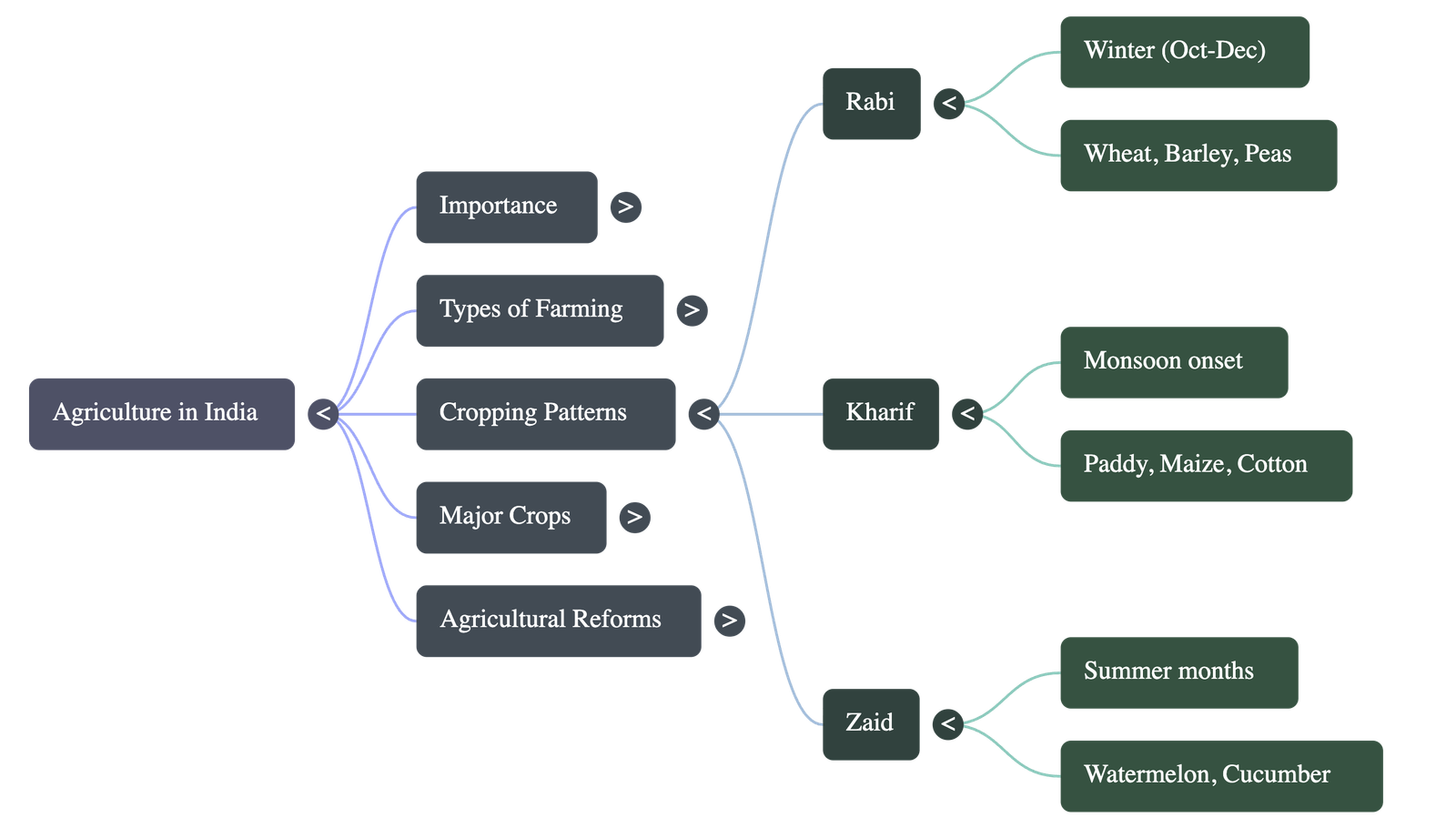
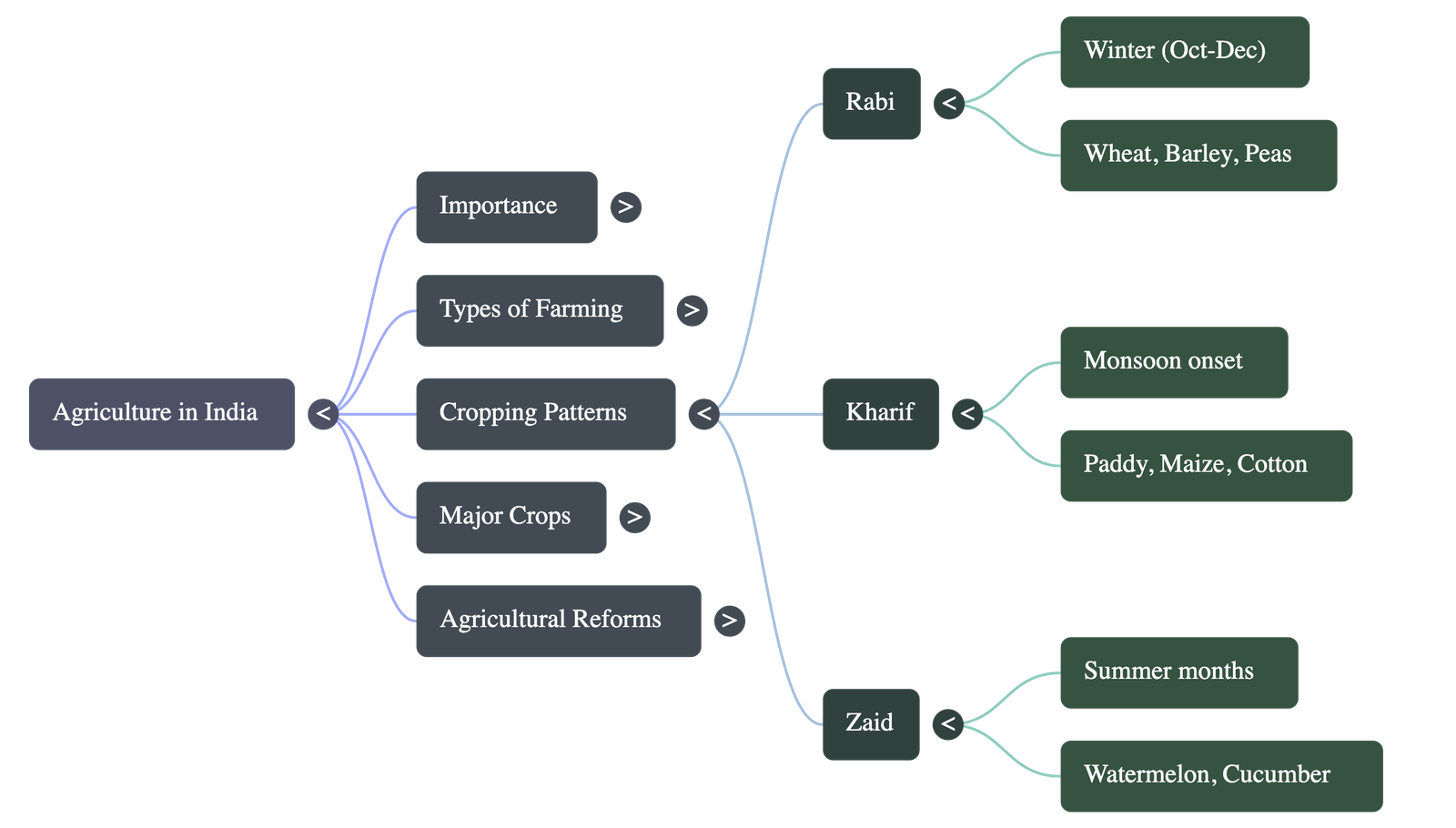
India has three major cropping seasons:
Sown in winter (Oct-Dec) and harvested in summer (Apr-Jun).
Crops: Wheat, barley, peas, gram, mustard.
Regions: North and North-western states (Punjab, Haryana, UP).
Grown with the onset of monsoon and harvested in Sept-Oct.
Crops: Paddy, maize, jowar, bajra, tur, cotton, jute, groundnut.
Regions: Assam, West Bengal, Coastal Odisha, AP, Tamil Nadu.
A short season between Rabi and Kharif (Summer months).
Crops: Watermelon, muskmelon, cucumber, vegetables, fodder.
3. Major Crops
Grains
- Rice:
Staple food for the majority of Indians. India is the 2nd largest producer after China.
Requirements: High temperature (>25°C), high humidity, annual rainfall >100cm. Can grow in low rainfall areas with irrigation (Punjab, Haryana). - Wheat:
Second most important cereal. Main food crop in the North/North-west.
Requirements: Cool growing season, bright sunshine at ripening. 50-75cm annual rainfall.
Major Zones: Ganga-Satluj plains and black soil region of the Deccan. - Millets (Coarse Grains):
Have very high nutritional value.
Jowar: 3rd most important food crop. Rain-fed, grown in moist areas (Maharashtra, Karnataka).
Bajra: Grows well on sandy and shallow black soil (Rajasthan, UP).
Ragi: Crop of dry regions, rich in iron and calcium (Karnataka, Tamil Nadu). - Maize:
Used as both food and fodder. Kharif crop. Requires temperature 21°C-27°C and old alluvial soil.
Pulses
- India is the largest producer and consumer of pulses.
- Major source of vegetarian protein.
- Types: Tur (Arhar), Urad, Moong, Masur, Peas, Gram.
- Leguminous crops (except Arhar) help restore soil fertility by fixing nitrogen from the air. Usually grown in rotation with other crops.
4. Food Crops Other Than Grains
- Sugarcane: Tropical/Subtropical crop. Needs hot and humid climate (21°C-27°C) and 75-100cm rainfall. India is the 2nd largest producer after Brazil. Main source of sugar, gur, and khandsari. Major state: Uttar Pradesh.
- Oil Seeds: India is a major producer. Covers approx. 12% of cropped area. Includes groundnut (major crop), mustard, coconut, soyabean, sunflower. Used for cooking and as raw material for soap/cosmetics.
Groundnut: Kharif crop, accounts for half of major oilseeds produced. Gujarat is a top producer. - Tea: Plantation agriculture. Beverage crop initially introduced by the British.
Requirements: Tropical/sub-tropical climate, deep fertile well-drained soil, warm and moist frost-free climate, frequent showers.
Labour: Labour-intensive industry.
States: Assam, West Bengal (Darjeeling/Jalpaiguri), Tamil Nadu, Kerala. - Coffee: India produces the Arabica variety (initially from Yemen), known for good quality. Cultivation is confined to the Nilgiris in Karnataka, Kerala, and Tamil Nadu.
- Horticulture: India is a major producer of fruits and vegetables (tropical and temperate). Important fruits include Mangoes (Maharashtra), Oranges (Nagpur), Bananas (Kerala), and Apples (J&K). India produces pea, cauliflower, onion, cabbage, tomato, brinjal, and potato.
5. Non-Food Crops
- Rubber: Equatorial crop, also grown in tropical areas. Requires moist/humid climate, >200cm rainfall, and temp >25°C. Grown in Kerala, Tamil Nadu, Karnataka. Important industrial raw material.
- Fibre Crops: Cotton, Jute, Hemp, and Natural Silk. The first three are soil-grown; Silk is obtained from cocoons (Sericulture).
- Cotton: India is believed to be the original home of cotton. 2nd largest producer.
Requirements: Drier parts of black cotton soil (Deccan), high temperature, light rainfall, 210 frost-free days, bright sunshine. Kharif crop. - Jute (Golden Fibre): Grows on well-drained fertile soils in flood plains. Requires high temperature. Used for gunny bags, mats, ropes, carpets. Losing market to synthetic fibres like nylon due to high cost. Major state: West Bengal.
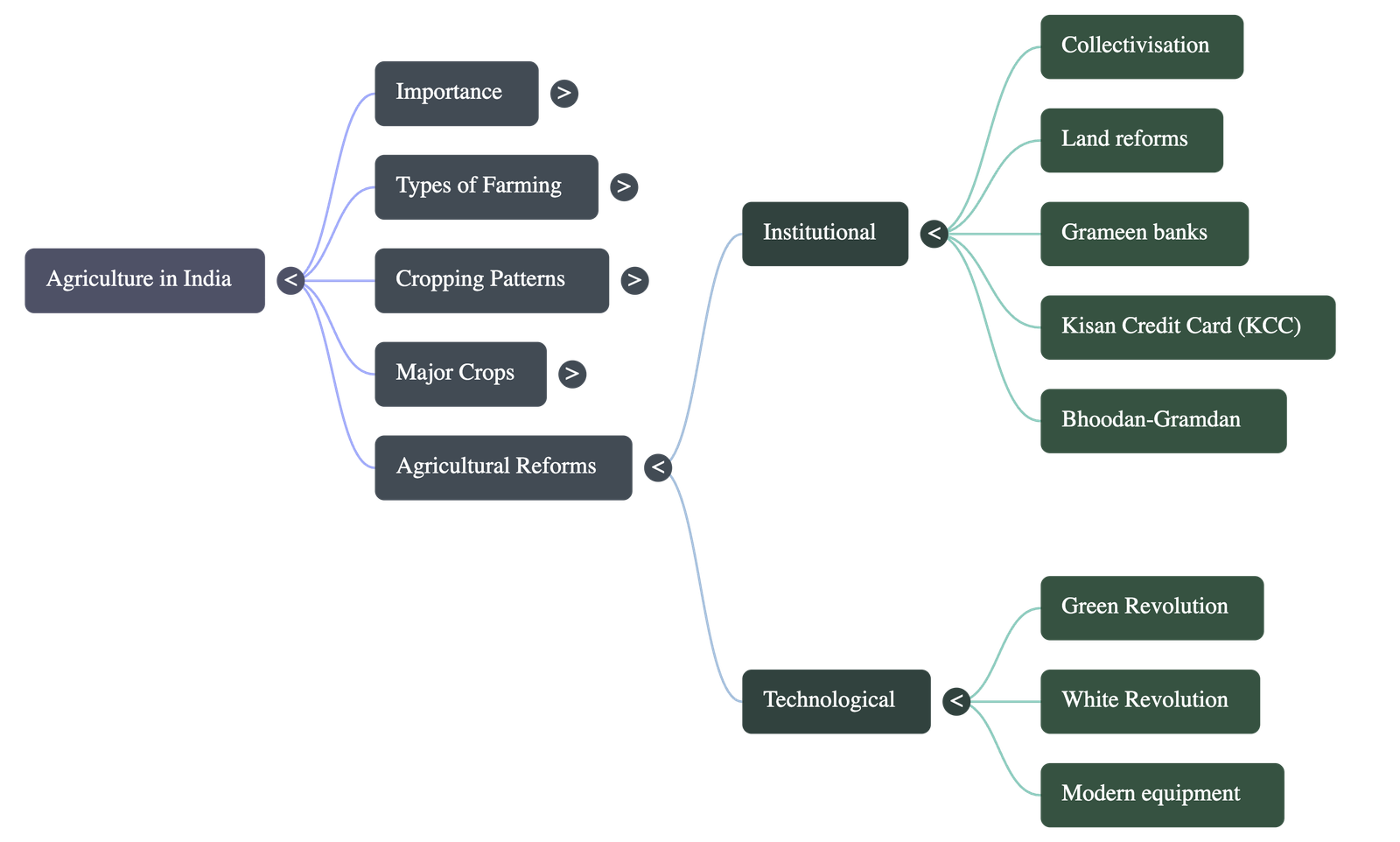
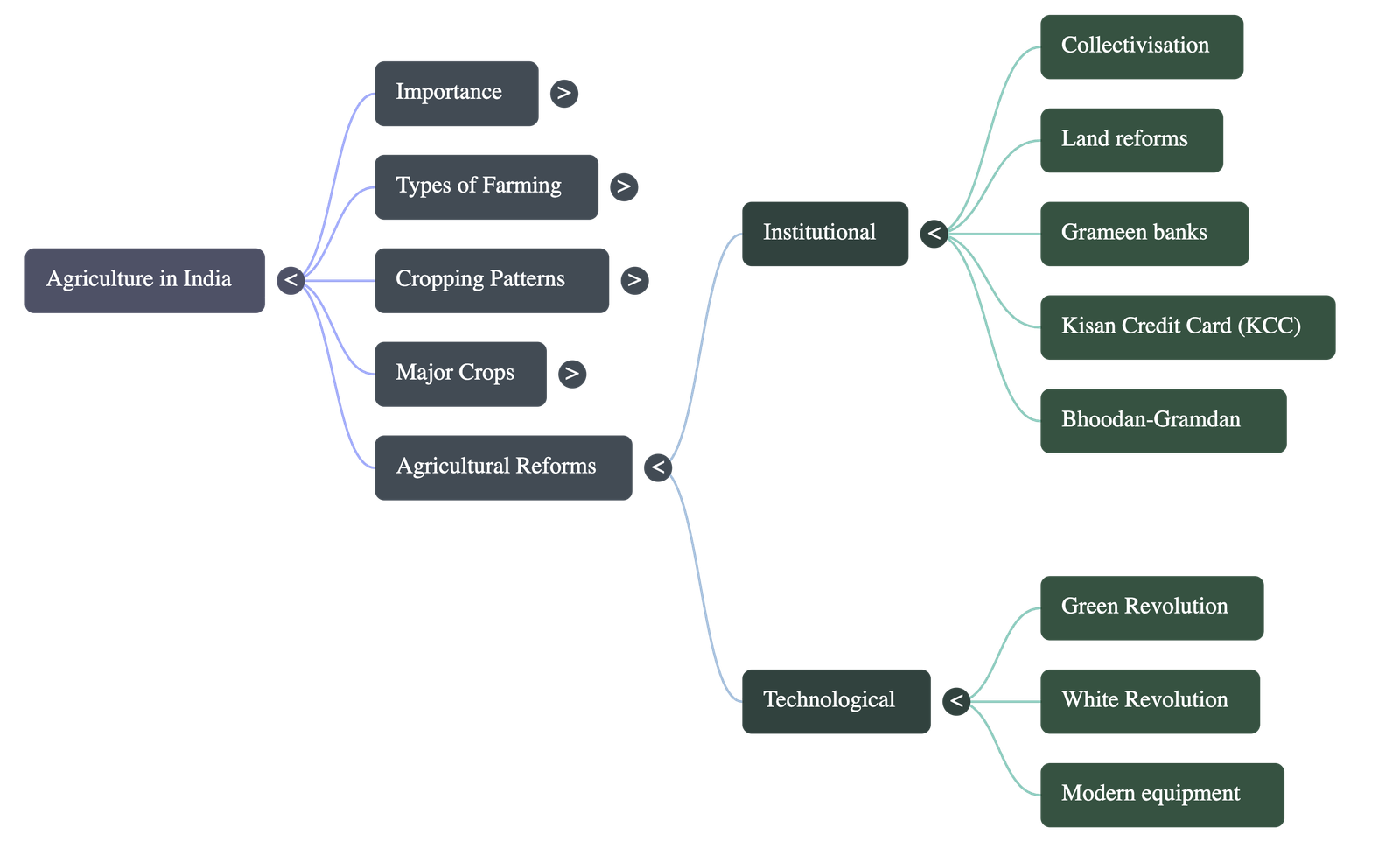
6. Technological and Institutional Reforms
Sustained land use without technological changes has hindered development. Reforms were necessary to support the growing population.
Institutional Reforms (Post-Independence)
- Collectivisation and consolidation of landholdings.
- Cooperation and abolition of Zamindari.
- "Land Reform" was the main focus of the First Five Year Plan.
Technological Reforms (1960s & 1970s)
- Green Revolution: Based on package technology to improve productivity.
- White Revolution (Operation Flood): Focused on milk production.
Comprehensive Land Development (1980s & 1990s)
- Crop insurance against drought, flood, cyclone, fire, and disease.
- Establishment of Grameen banks and cooperative societies to provide low-interest loans.
- Kisan Credit Card (KCC) and Personal Accident Insurance Scheme (PAIS).
- Special weather bulletins and agricultural programmes on radio/TV.
- Announcement of Minimum Support Price (MSP) to check exploitation by middlemen.
Bhoodan - Gramdan (The Blood-less Revolution)
Initiated by Vinoba Bhave (Gandhiji’s spiritual heir). During a lecture in Pochampalli (Andhra Pradesh), landless villagers demanded land. Shri Ram Chandra Reddy offered 80 acres to 80 landless villagers (Bhoodan). Later, some Zamindars offered to distribute villages (Gramdan). This movement aimed to reduce land inequality without violence.
Do checkout all questions & answers of this chapter.