Quick Navigation:
| | | |
The Colonial Era in India
The Age of Colonialism
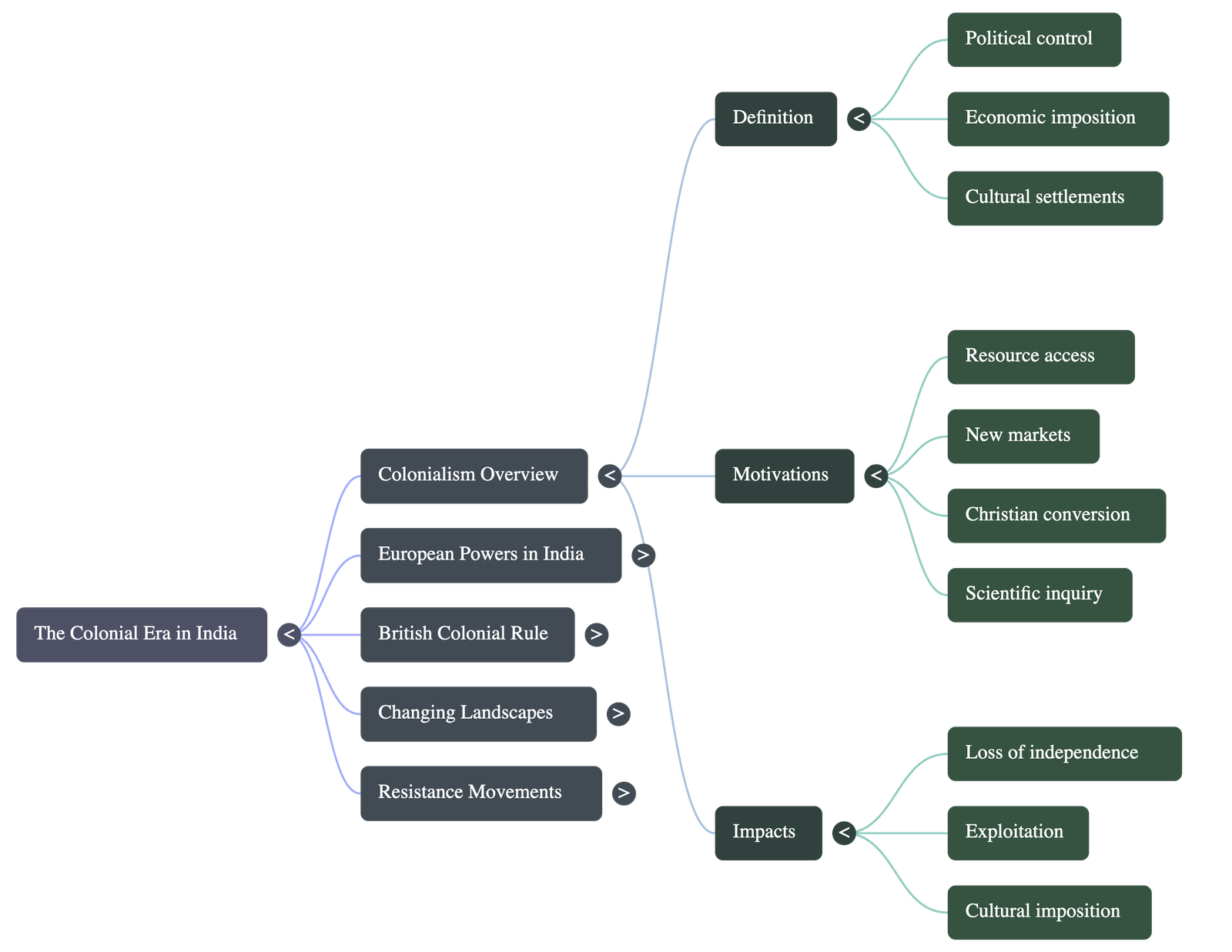
- Colonialism Defined: The practice where one country takes control of another region, establishes settlements, and imposes its own political, economic, and cultural systems.
- European Motivations: Driven by political competition, territorial expansion, the pursuit of new resources and markets, religious conversion, and scientific inquiry.
- Impact on the Colonized: Despite the colonizers' claims of a "civilizing mission," colonialism primarily resulted in a loss of independence, resource exploitation, and the destruction of traditional ways of life for native populations.
Early European Powers in India
Before the 16th century, India was an economic powerhouse, contributing at least one-fourth of the world's GDP.
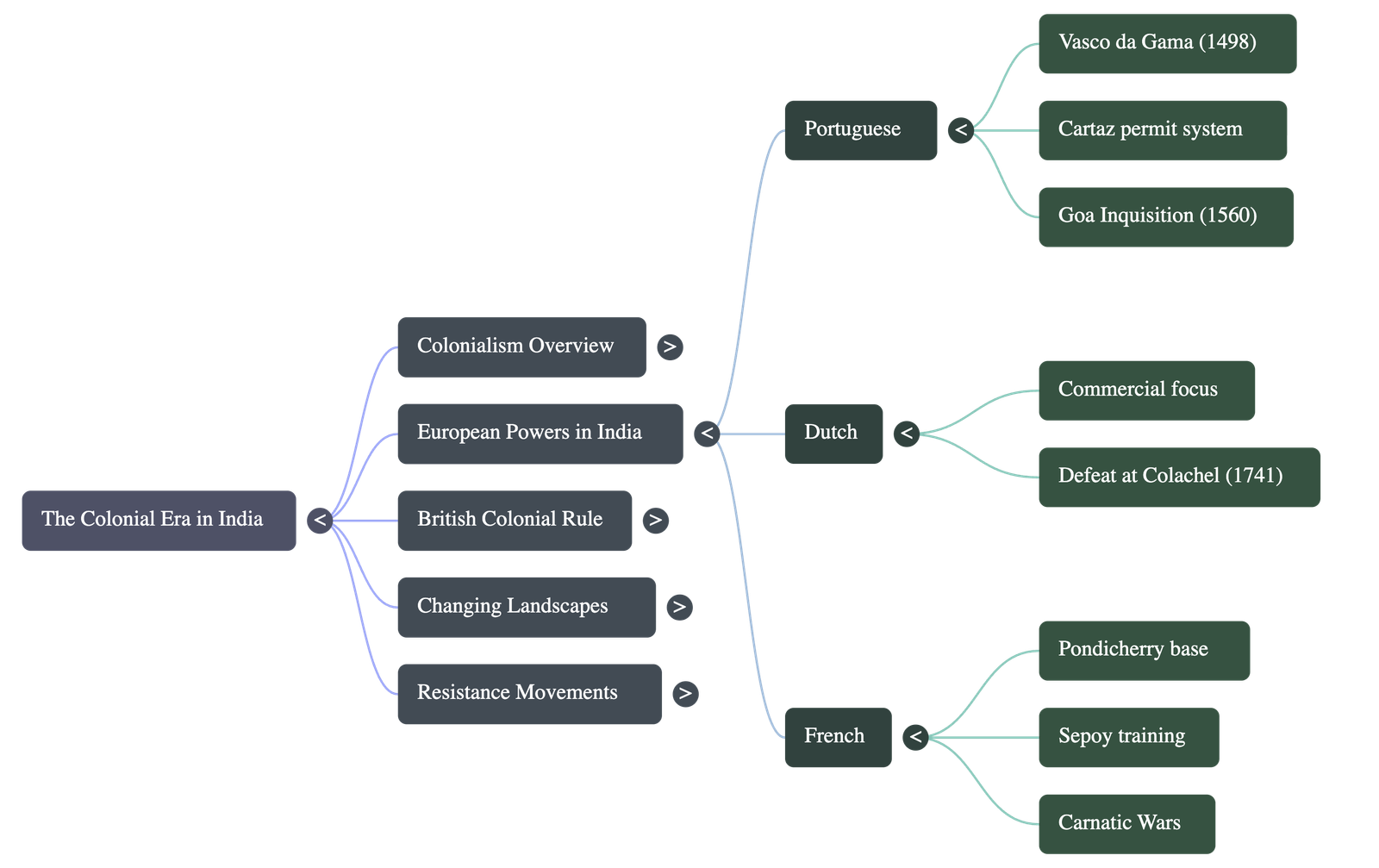
- The Portuguese: Arrived with Vasco da Gama in 1498. They focused on dominating the spice trade through naval aggression and the cartaz permit system. Their rule was heavily marked by religious persecution, including the brutal Goa Inquisition (established in 1560), though they met strong local resistance from figures like Rani Abbakka.
- The Dutch: Arrived in the early 17th century focusing on commerce. Their expansion was effectively halted when they were decisively defeated by King Marthanda Varma of Travancore at the Battle of Colachel in 1741.
- The French: Set up posts like Pondicherry starting in 1674. Governor-General Dupleix innovated colonial strategies such as training Indian sepoys and using puppet rulers, but French ambitions were largely restricted by the British during the Carnatic Wars.
The Rise of British Power
- From Traders to Rulers: The English East India Company arrived as traders but stealthily built a private army and gradually transformed into a massive imperial power.
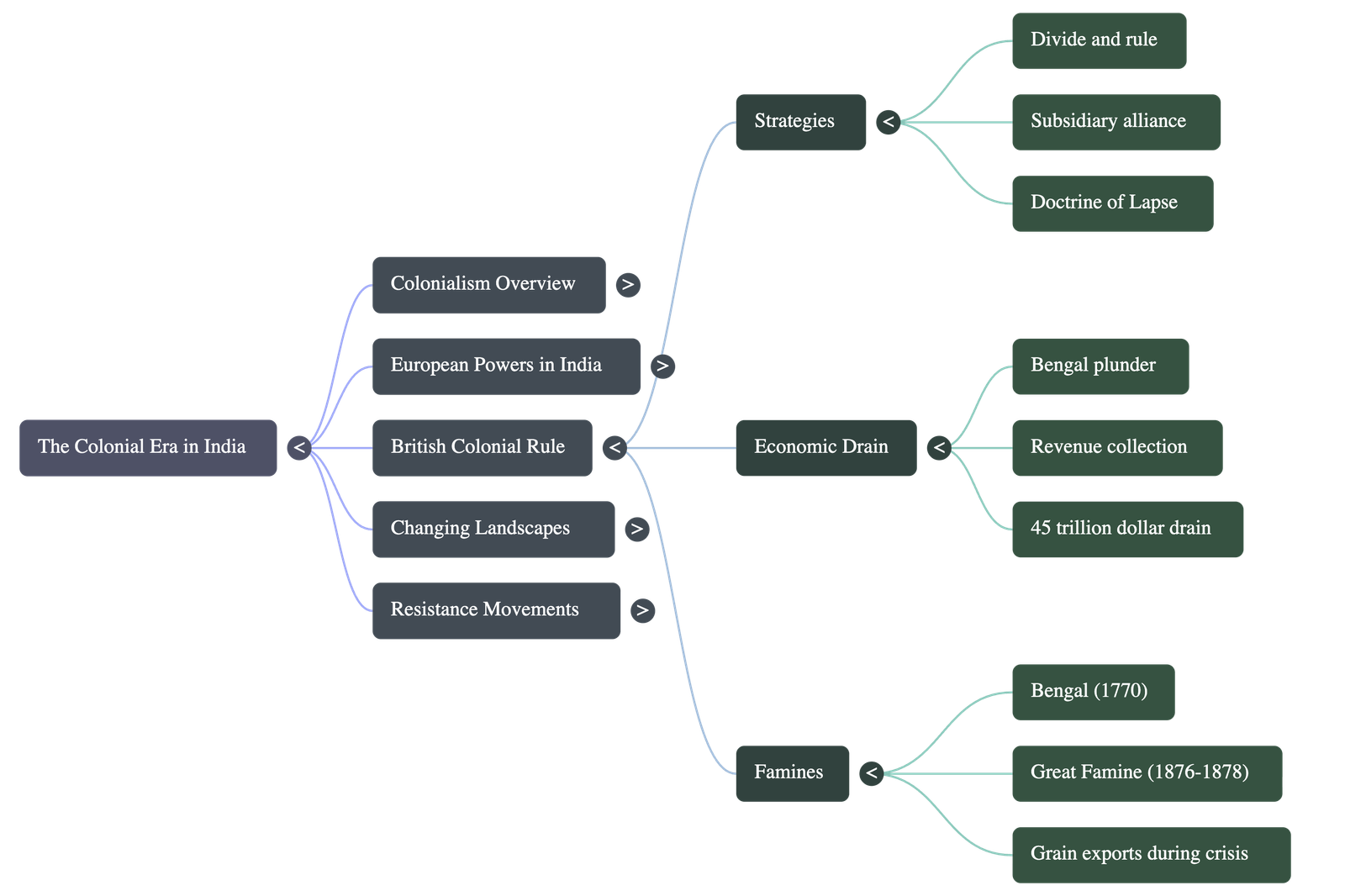
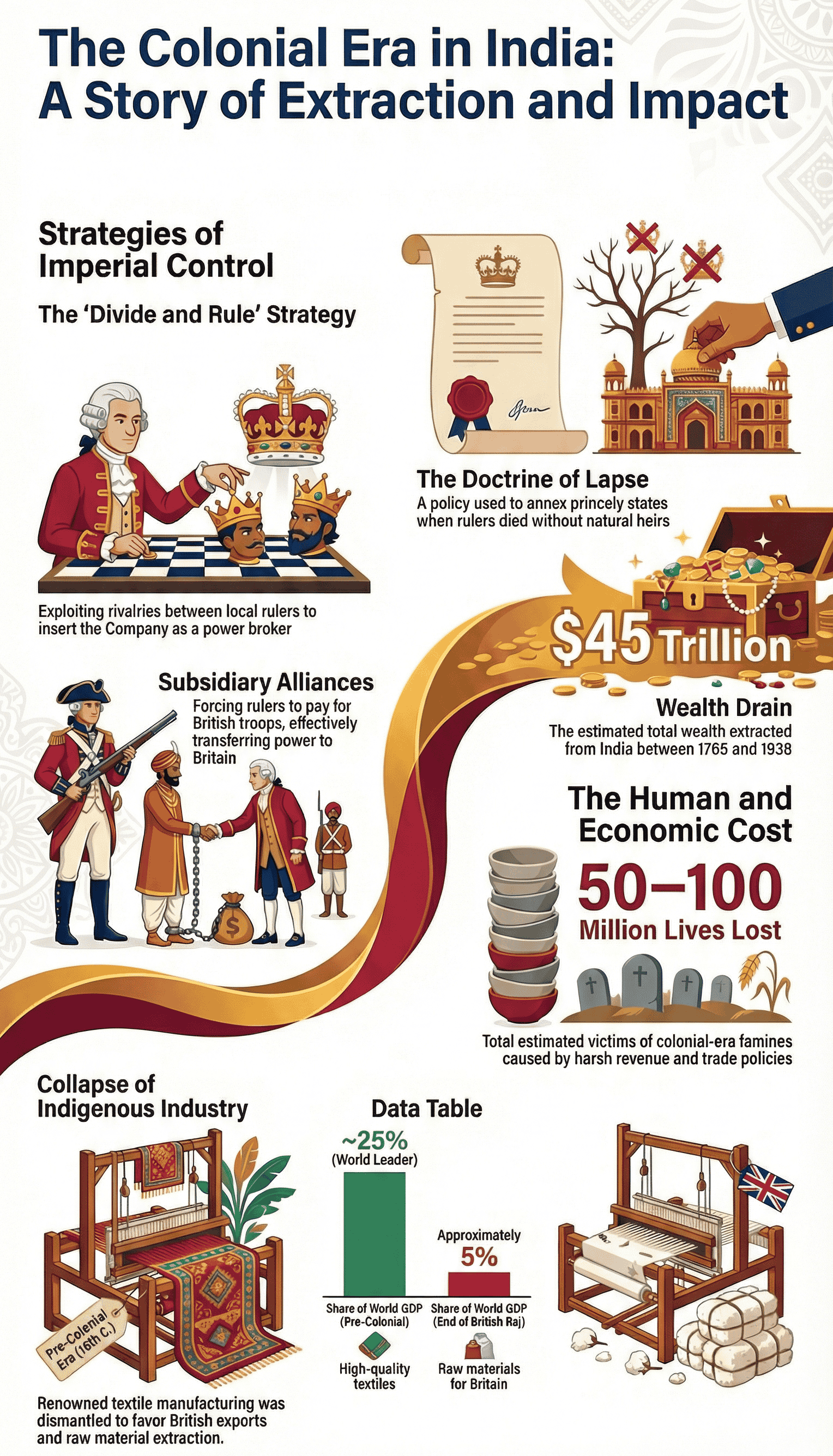
- Divide and Rule: The British actively exploited existing rivalries among Indian rulers. A prime example is the Battle of Plassey (1757), where Robert Clive conspired with military commander Mir Jafar to overthrow the Nawab of Bengal.
- Doctrine of Lapse: A policy designed to seize control of princely states whose rulers died without a natural male heir, blatantly ignoring legitimate Hindu traditions of adoption.
- Subsidiary Alliance: Indian rulers were forced to host a British "Resident" and pay for British troops, creating an "empire on the cheap" where Indians funded their own subjugation.
Economic Devastation: From Paradise to Hell
- Devastating Famines: Merciless cash-tax collections, even during crop failures, triggered massive famines. The 1770–1772 Bengal famine killed roughly 10 million people. Throughout British rule, an estimated 50 to 100 million people perished in famines.
- Callous "Free Market" Policies: During extreme famines, the British refused to control food prices and simultaneously exported millions of tonnes of Indian grain to Britain.
- The Drain of Wealth: The British Industrial Revolution was heavily subsidized by wealth plundered from India. Modern estimates suggest an equivalent of 45 trillion US dollars was drained from India during the colonial period.
Changing Landscapes: Industry, Governance, and Society
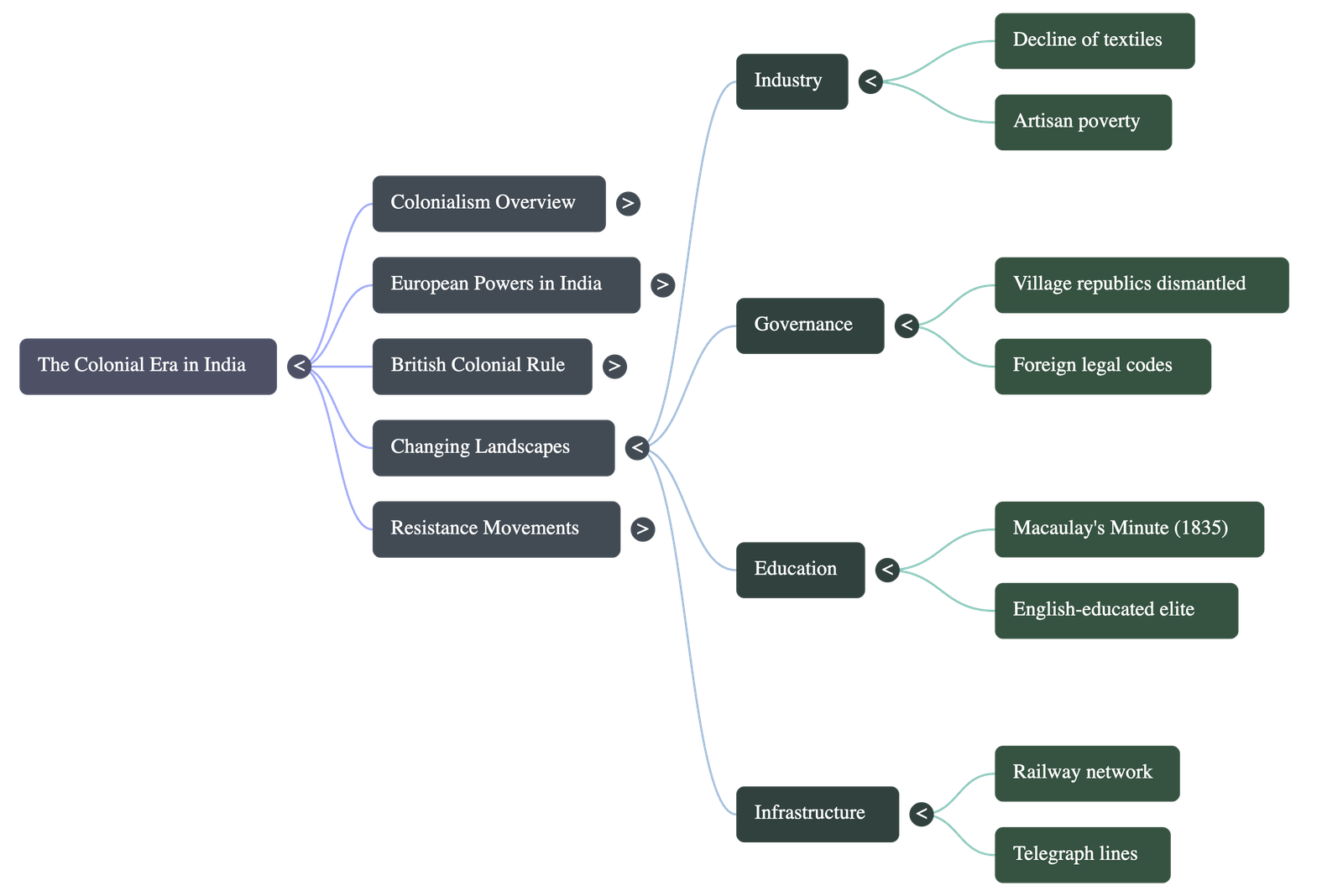
- Deindustrialization: Heavy tariffs on Indian goods and forced imports of British goods completely ruined India's globally renowned textile and manufacturing industries, pushing skilled artisans into poverty.
- Dismantling Governance: Traditional, self-sufficient village councils were scrapped and replaced by an expensive, alien, and highly centralized British bureaucratic and legal system.
- Cultural Erasure via Education: Thomas Macaulay's 1835 education policy aimed to create "brown Englishmen" to serve as cheap administrative clerks, intentionally sidelining rich Indian literary traditions and languages.
- Exploitative Infrastructure: The railways and telegraphs were built using Indian tax money, not to benefit the local population, but to rapidly export raw materials, sell British goods, and move troops.
Resistance and Rebellions
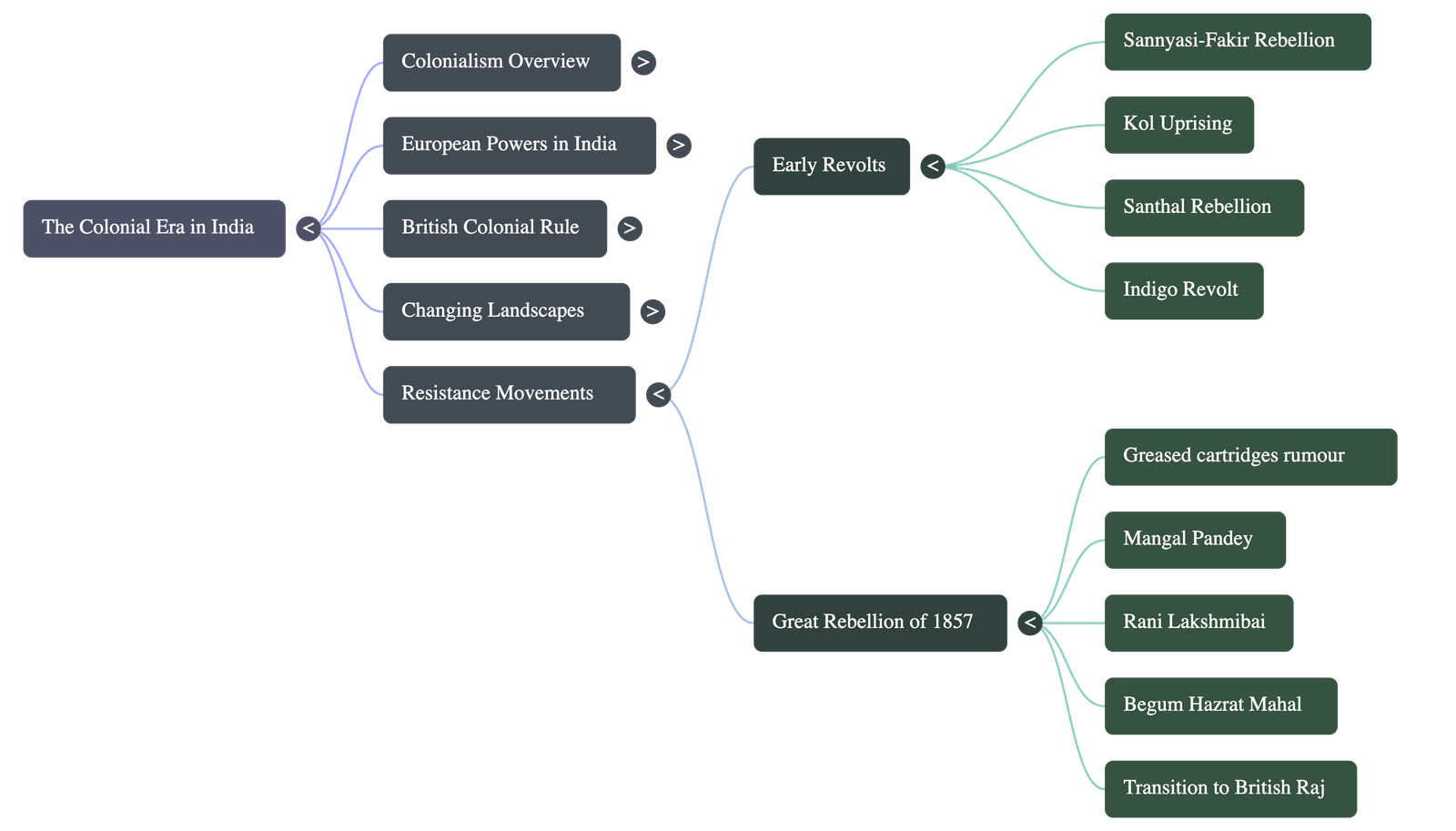
- Early Rebellions: Heavy taxation and loss of traditional rights sparked uprisings like the Sannyasi-Fakir Rebellion in Bengal, where ascetics attacked British treasuries.
- Tribal Uprisings: Disruption of forest lives and ancestral land grabs led to fierce tribal revolts, such as the Kol Uprising (1831–1832) and the massive Santhal Rebellion (1855–1856) led by the Murmu brothers.
- Peasant Uprisings: The Indigo Revolt (1859–1862) saw peasants bravely resist European planters who forced them into debt slavery to grow indigo instead of essential food crops.
- The Great Rebellion of 1857: Triggered by the use of greased rifle cartridges offending religious sensibilities, this massive uprising united Hindu and Muslim sepoys who declared Mughal emperor Bahadur Shah Zafar their leader. Heroic figures like Rani Lakshmibai of Jhansi, Tatia Tope, and Begum Hazrat Mahal fiercely fought the British. Though brutally suppressed, it marked the end of Company rule and the beginning of the British Raj (direct rule by the Crown).
The Legacy of European Colonialism
- Subjugation: The primary legacy was systematic exploitation, immense loss of life and wealth, and the socio-economic devastation of the Indian subcontinent.
- Cultural Theft and Preservation: While the British initiated systematic surveys and archaeological documentation, they also looted thousands of precious artifacts, manuscripts, and jewels for European museums.
- Global Cultural Influence: The translation of ancient Sanskrit texts into European languages had a profound, unintended reverse effect, deeply influencing European and American philosophy, literature, and art.
Do checkout all questions & answers of this chapter.
Quick Navigation:
| | | |
1 / 1
Quick Navigation:
| | | |