Asia: Climate, Natural Vegetation and Wildlife
Point-wise summary of Chapter 7, "Asia: Climate, Natural Vegetation and Wildlife":
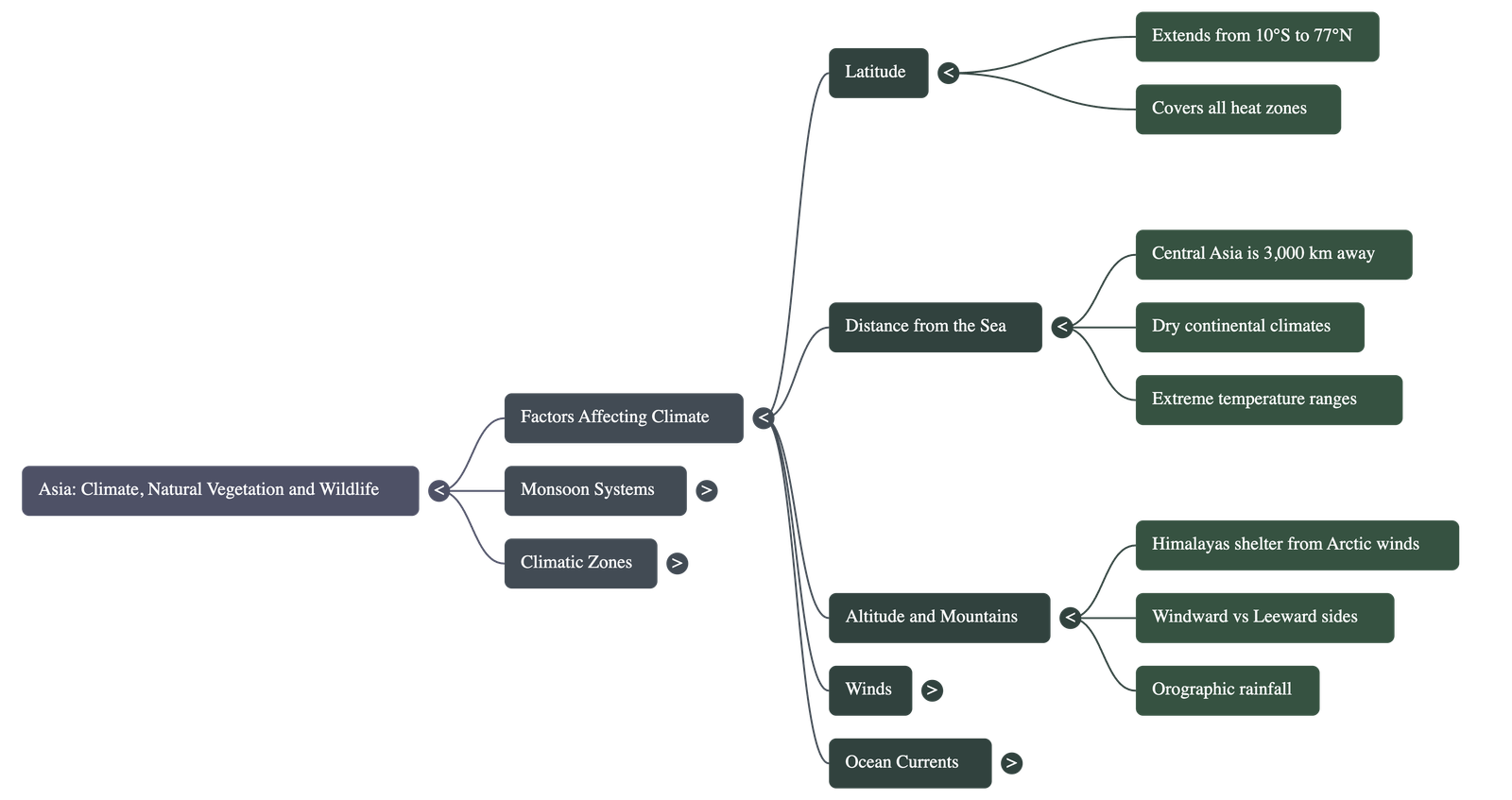
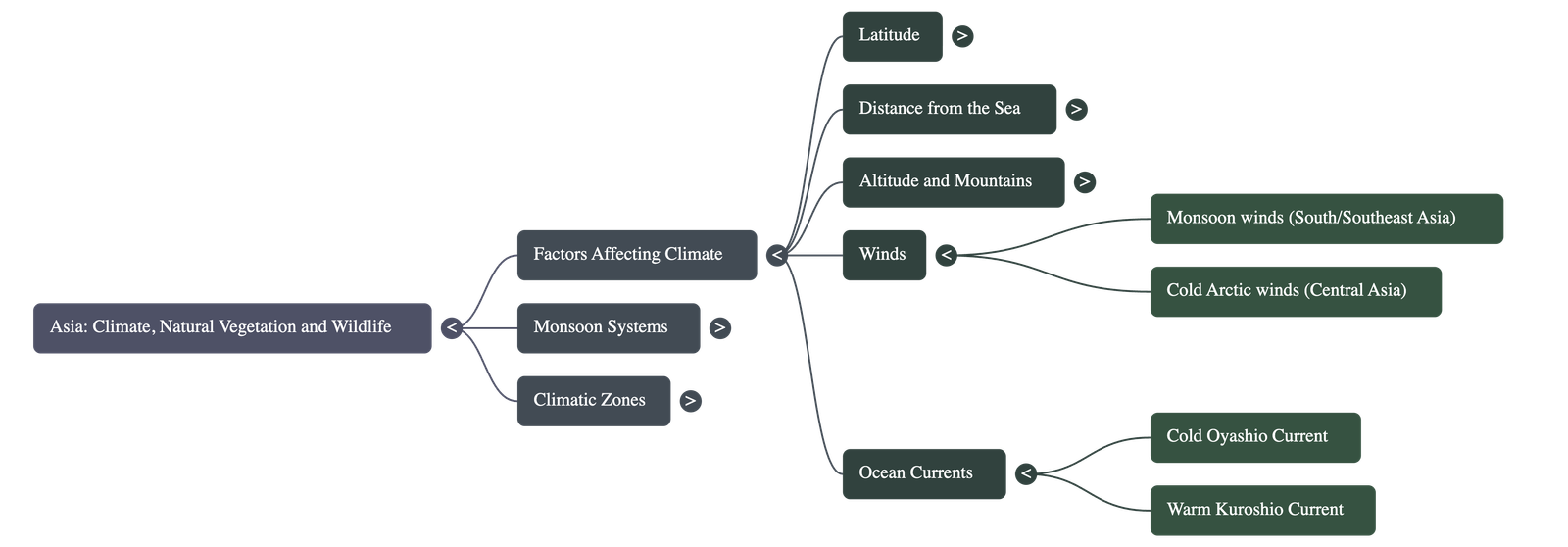
Factors Influencing Asia's Climate
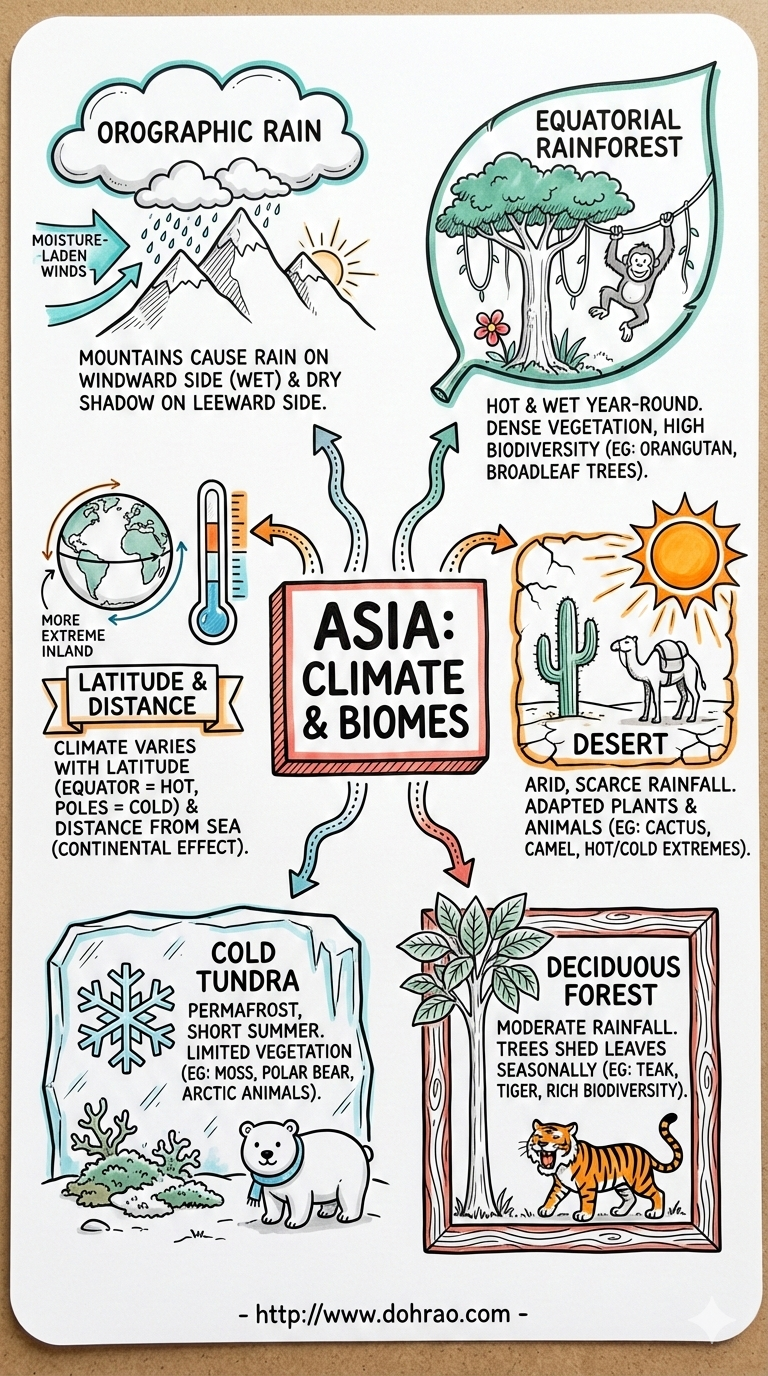
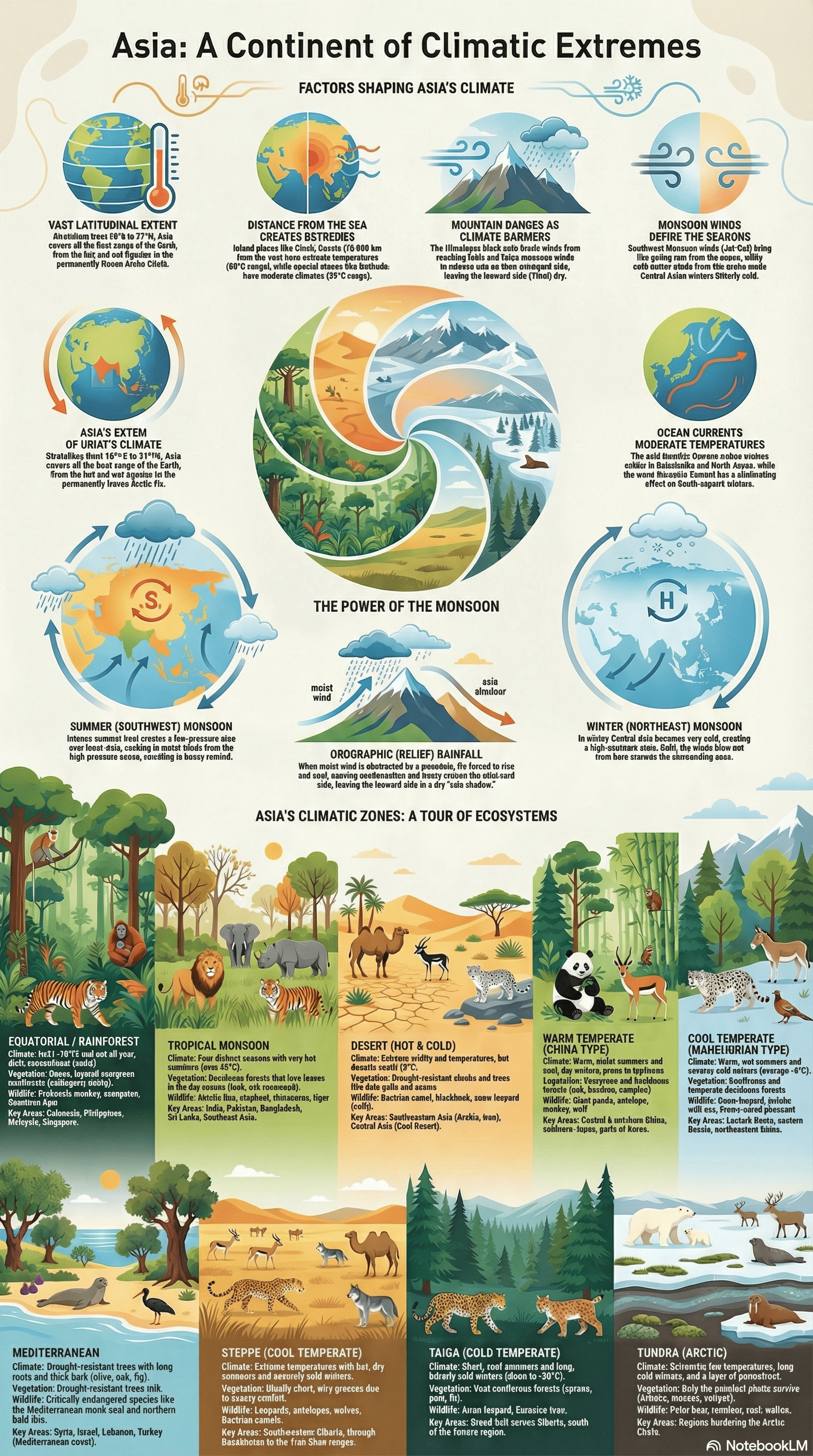
- Latitude: Asia’s vast extent (10°S to 77°N) ensures it covers all heat zones, ranging from the hot and wet Equator to the frozen Arctic Circle.
- Distance from the Sea: Coastal areas like Sakhalin experience equable climates, while interior regions (some 3,000 km from the sea) experience dry continental climates with extreme temperature ranges.
- Altitude and Mountain Ranges: Great mountain ranges like the Himalayas influence rainfall by blocking moisture-laden winds (creating a wet windward side and a dry leeward side) and protecting the continent from cold Arctic winds.
- Ocean Currents: The climate of northeast Asia is affected by the cold Oyashio Current, which makes winters bitter, and the warm Kuroshio Current, which has a moderating effect on south Japan.
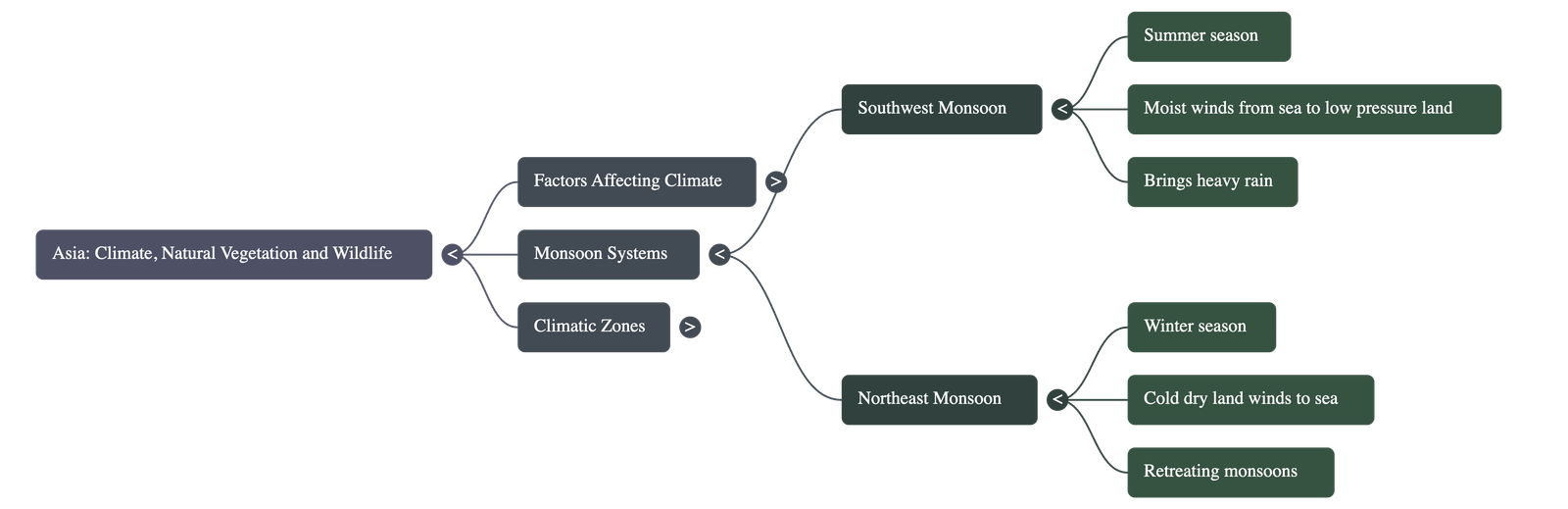
The Monsoon Phenomenon
- Southwest Monsoon (Summer): Intense heat in the interior creates a low-pressure belt that sucks in moist winds from the sea, bringing life-giving rain to South and Southeast Asia.
- Rainfall Types: Much of the Monsoon rain is orographic (relief rainfall), caused when mountains force moist winds to rise and condense. In equatorial regions, convectional rainfall occurs, often called the "4 o'clock rain" because it occurs daily in the afternoon due to intense daytime heating.
- Northeast Monsoon (Winter): In winter, conditions reverse; cold, dry winds blow from Central Asia. As they cross the sea, they pick up moisture, bringing rain to coastal areas like Tamil Nadu and Sri Lanka.
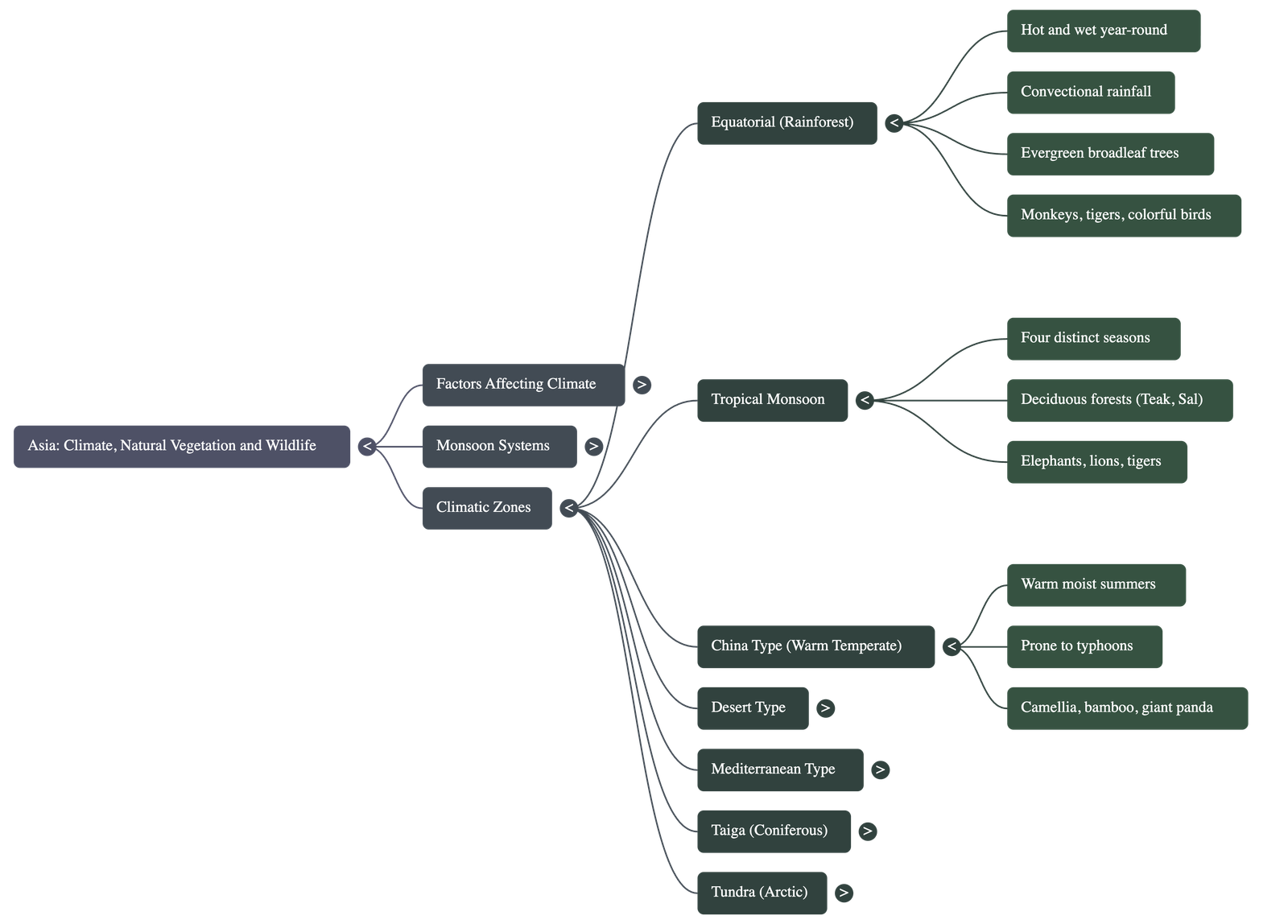
Major Climatic Zones, Vegetation, and Wildlife
The sources identify nine distinct climatic types, each supporting unique ecosystems:
- Equatorial (Rainforest) Type: Characterized by hot, wet weather year-round, supporting dense tropical evergreen rainforests (mahogany, ebony) and diverse wildlife like the proboscis monkey and Sumatran rhino.
- Tropical Monsoon Type: Experienced in regions like India and Vietnam, it features tropical deciduous forests (teak, sal) that shed leaves in the dry season. Animals include the Asiatic lion and the Indian elephant.
- Warm Temperate Eastern Margin (China Type): This region has warm, moist summers and is prone to typhoons. It is home to the giant panda and trees like camphor and bamboo.
- Cool Temperate Eastern Margin (Manchurian Type): Features warm wet summers and cold dry winters. Vegetation includes coniferous and deciduous forests (oak, maple), while wildlife includes the snow leopard.
- Desert Type: Characterized by extreme aridity and temperatures. Vegetation is limited to drought-resistant plants (cacti, acacia), and animals include the two-humped Bactrian camel and the chinkara.
- Mediterranean Type: Notable for its warm, dry summers and cool, wet winters. Trees like olive and walnut have long roots and thick bark to survive summer droughts.
- Cool Temperate Continental (Steppe) Type: Found in the interior, this region has extreme temperatures and scanty rainfall, resulting in a landscape of short, wiry grasses and animals like the saiga antelope.
- Cold Temperate Continental (Taiga) Type: Known for long, bitterly cold winters and coniferous forests (spruce, fir), which are a major source of softwood.
- Arctic or Tundra Type: The ground is permanently frozen (permafrost). Only mosses and lichens survive, and wildlife consists of fur-bearing animals like polar bears and reindeer.
Key Concept: Interdependence
The chapter emphasizes that natural vegetation and wildlife are closely dependent on climate. For example, the thick fur of Taiga animals or the waxy stems of desert plants are specific adaptations to the environmental constraints of their respective climatic zones.
Analogy for Understanding Monsoons: Think of the Asian continent in summer like a giant vacuum cleaner. The sun heats the land so much that it creates a "suction" (low pressure), which pulls in the "moist air" (water vapor) from the surrounding oceans to create rain. In winter, the vacuum is turned off and the air blows back out toward the sea.
Geography Chapter 7: Questions Answers
Dear Class 8 students, here are the answers to the questions found within your textbook chapter. Use these to help you study and understand the diverse geography of Asia.
I. Multiple Choice Questions (MCQs)
-
Omsk in central Russia has an extreme temperature range of 85°C. This is primarily due to:
A. Its high altitude
B. Its distance from the sea
C. The influence of ocean currents
D. Its latitudinal extent
Answer: B. Its distance from the sea -
Which current makes the winters of Kamchatka and North Japan very cold?
A. Kuroshio Current
B. Gulf Stream
C. Oyashio Current
D. North Atlantic Drift
Answer: C. Cold Oyashio Current -
Convectional rainfall, also known as '4 o'clock rain', is most common in which climatic zone?
A. Mediterranean
B. Desert
C. Equatorial
D. Tundra
Answer: C. Equatorial
II. Fill in the Blanks
- The Himalayas shelter India from the cold Arctic winds blowing southwards.
- Winds that blow from the southwest during summer in South Asia are called the Southwest Monsoon winds.
- The leeward side of a mountain remains dry and is also called the rain shadow region.
- The proboscis monkey is a species endemic to Borneo, known for its long nose.
- Highly destructive tropical cyclones that originate over the Pacific Ocean and hit the China coast are called typhoons.
III. True or False
- Coastal places have extreme continental climates. (False - They have moist, equable climates.)
- The Aravalli Range blocks the Southwest Monsoon winds, causing heavy rain in the Thar Desert. (False - It runs parallel to the winds, so it cannot block them.)
- Tropical evergreen rainforests shed all their leaves at the same time. (False - They do not shed all leaves at once and appear green all year.)
- The warm Kuroshio Current has a moderating effect on south Japan during winter. (True)
- The Gobi Desert is an example of a hot tropical desert. (False - It is a cold desert located in the interior of temperate Central Asia.)
IV. Short Answer Questions
1. Why is the region of South and Southeast Asia known as 'Monsoon Asia'?
The region is called 'Monsoon Asia' because the Monsoon winds are vital for the well-being of the people, bringing life-giving rain that is essential for agriculture and life in these areas.
2. What is Orographic rainfall?
Orographic rainfall, also known as relief rainfall, occurs when moist winds are obstructed by mountains and forced to rise. As they rise, they cool, condense, and form clouds, leading to heavy rainfall on the windward side of the mountain.
3. Mention two features of the Mediterranean type of climate.
The Mediterranean climate is characterized by:
- Warm, dry summers.
- Cool, wet winters with moderate rainfall brought by temperate cyclones.
4. Why do trees in the Tropical Monsoon forests shed their leaves?
Trees in these deciduous forests lose their leaves during the hot, dry summer months to prevent water loss through transpiration, giving the forests a bare look during that season.
V. Long Answer Questions
1. Explain how the distance from the sea affects the climate of Asia with examples.
Asia's vast size means many interior places are thousands of kilometers away from the sea. These places experience a dry continental climate with extreme temperatures (hot summers and very cold winters). For example, Omsk in Russia has a massive temperature range of 85°C. In contrast, coastal areas like the island of Sakhalin have a moderate or equable climate with smaller temperature ranges and higher rainfall because of the sea's moderating influence.
2. Describe the vegetation and wildlife found in the Equatorial regions of Asia.
The Equatorial regions support dense tropical evergreen rainforests consisting of broadleaf hardwoods like mahogany, ebony, and rubber. These forests are structured in layers and are green year-round. The wildlife is diverse, including monkeys, tigers, and elephants. Specific islands like Borneo and Sumatra are home to unique species like the orangutan, sun bear, pygmy elephant, and the Sumatran rhino.
3. How does the direction of mountain ranges influence the climate of India and China?
The Himalayas run west to east, blocking the Southwest Monsoon winds and forcing them to rise, which brings heavy rain to India. They also act as a shield, protecting India from cold Arctic winds. In contrast, eastern China lacks such a major west-to-east mountain range, which allows cold winds to travel further south, making their winters much colder than places in India at similar latitudes.
Do checkout all questions & answers of this chapter.