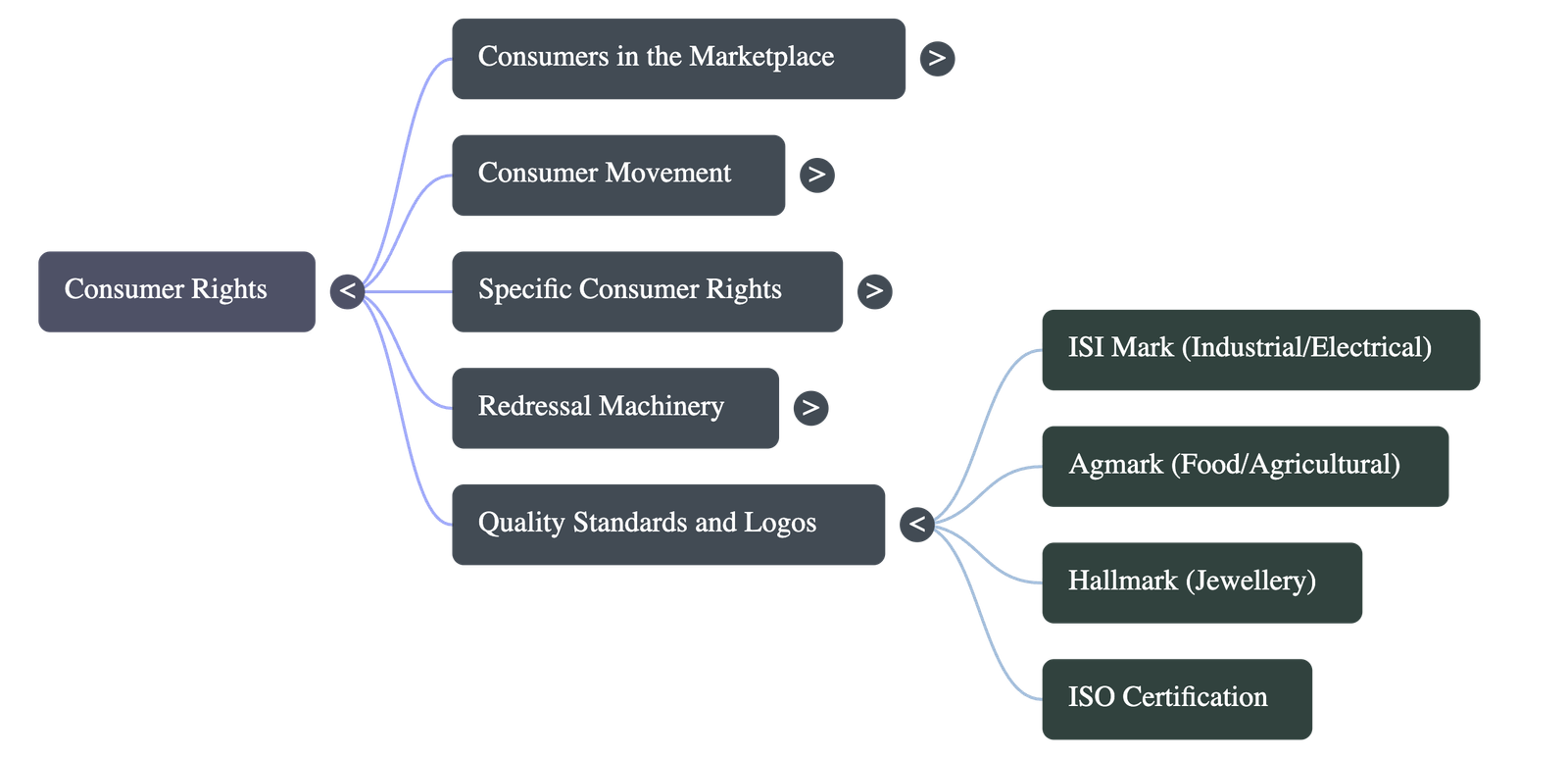
Consumer Rights
The Consumer in the Marketplace
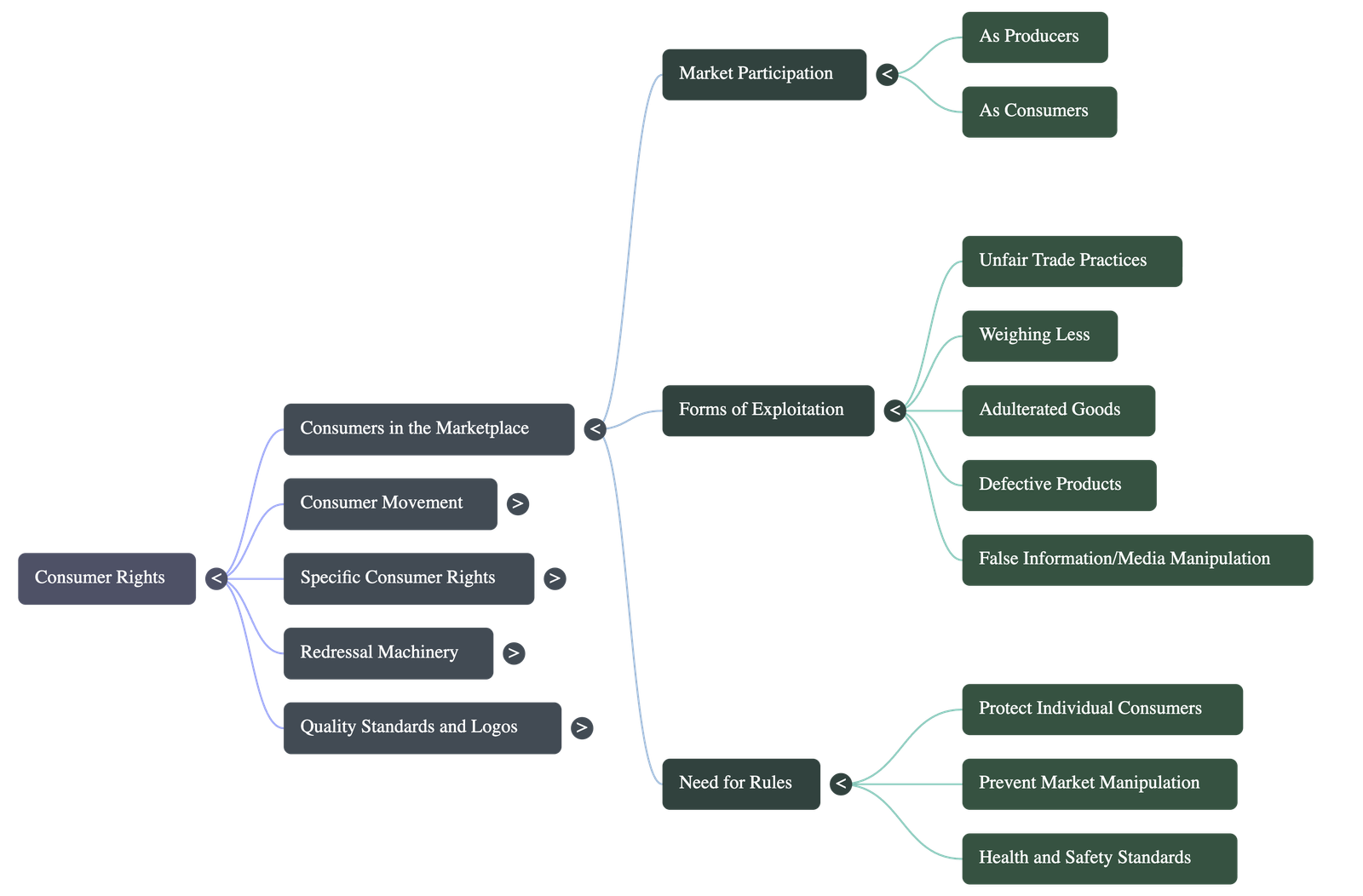
- People participate in the market in two capacities: as producers (supplying goods/services) and as consumers (purchasing goods for final use).
- Need for Rules: Rules and regulations are essential to protect consumers because they are often in a weak position. Sellers frequently shift responsibility to the buyer if a product is defective ("Let the buyer beware").
- Forms of Exploitation: Consumers are exploited through unfair trade practices such as:
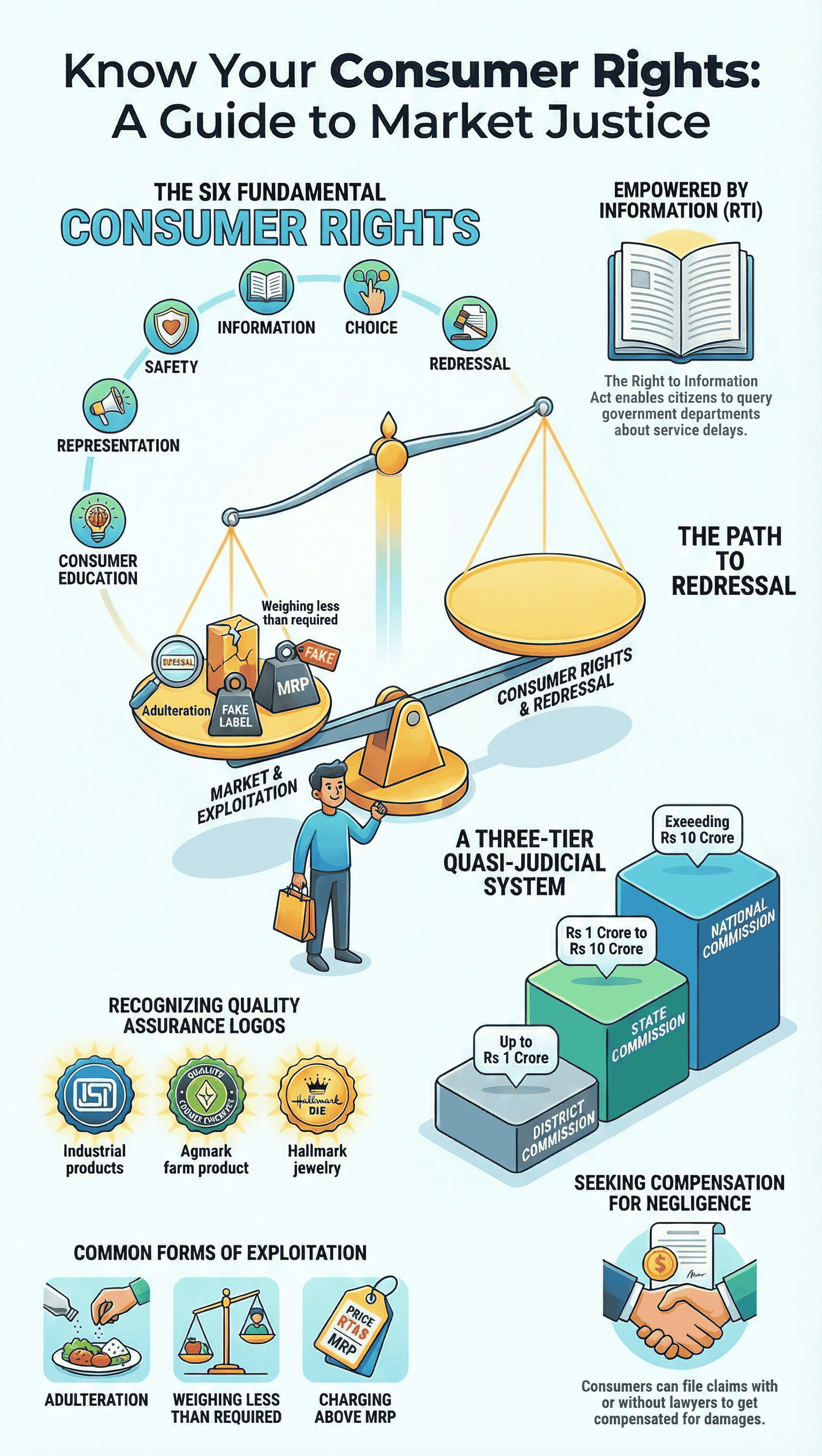
- Weighing less than the actual amount.
- Adding undisclosed charges.
- Selling adulterated or defective goods.
- Large companies using their power to manipulate markets and spread false information (e.g., the case of milk powder claimed to be better than mother’s milk).
The Consumer Movement
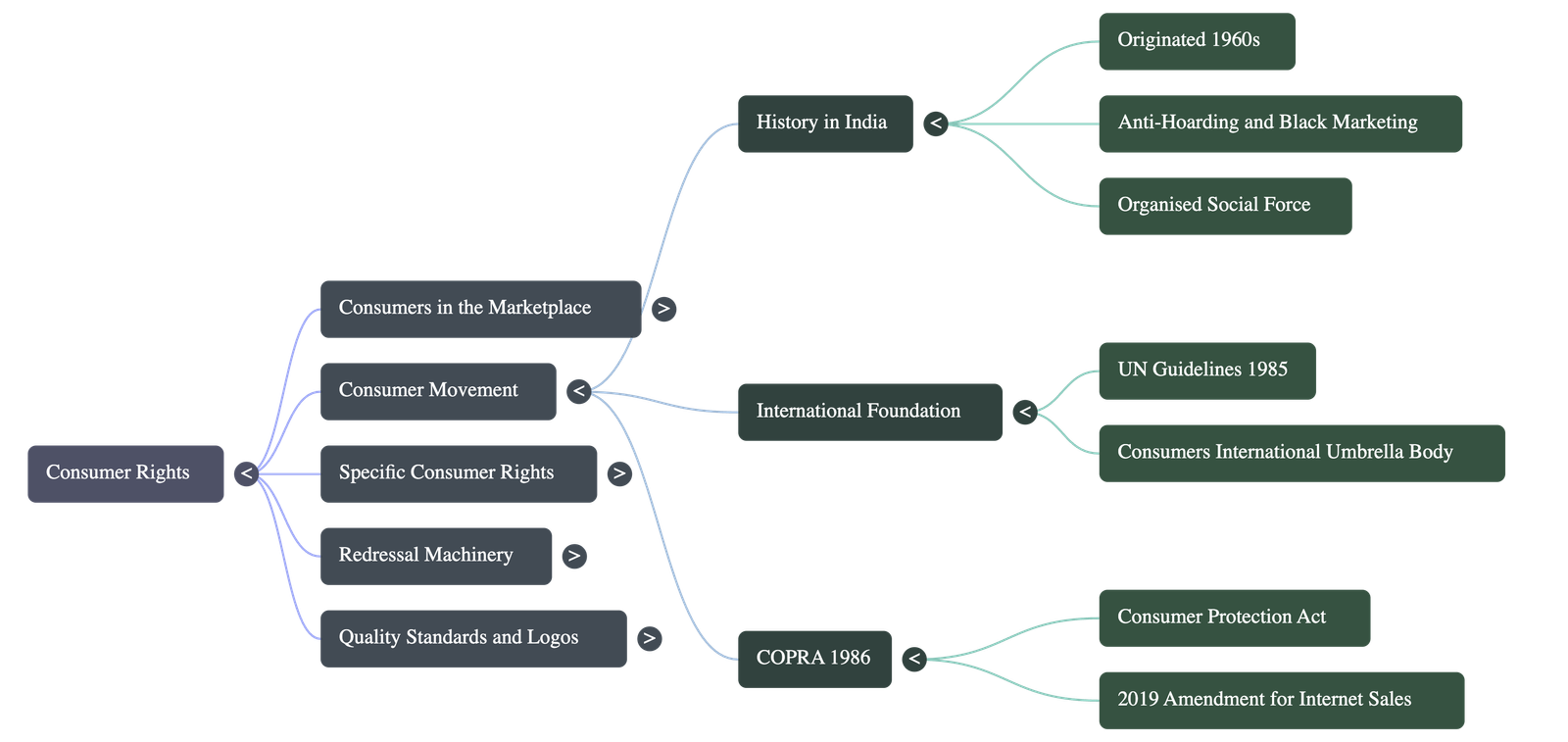
- Origins: The movement began as a "social force" to protect consumer interests against unethical practices like food shortages, hoarding, black marketing, and adulteration.
- Evolution in India: It started in the 1960s; by the 1970s, groups were writing articles and holding exhibitions. This eventually led to increased pressure on the government and businesses.
- Global Context: The UN adopted Guidelines for Consumer Protection in 1985. "Consumers International" now serves as an umbrella body for over 200 member organizations globally.
- Legal Milestone: A major step in India was the enactment of the Consumer Protection Act 1986, popularly known as COPRA.
Key Consumer Rights
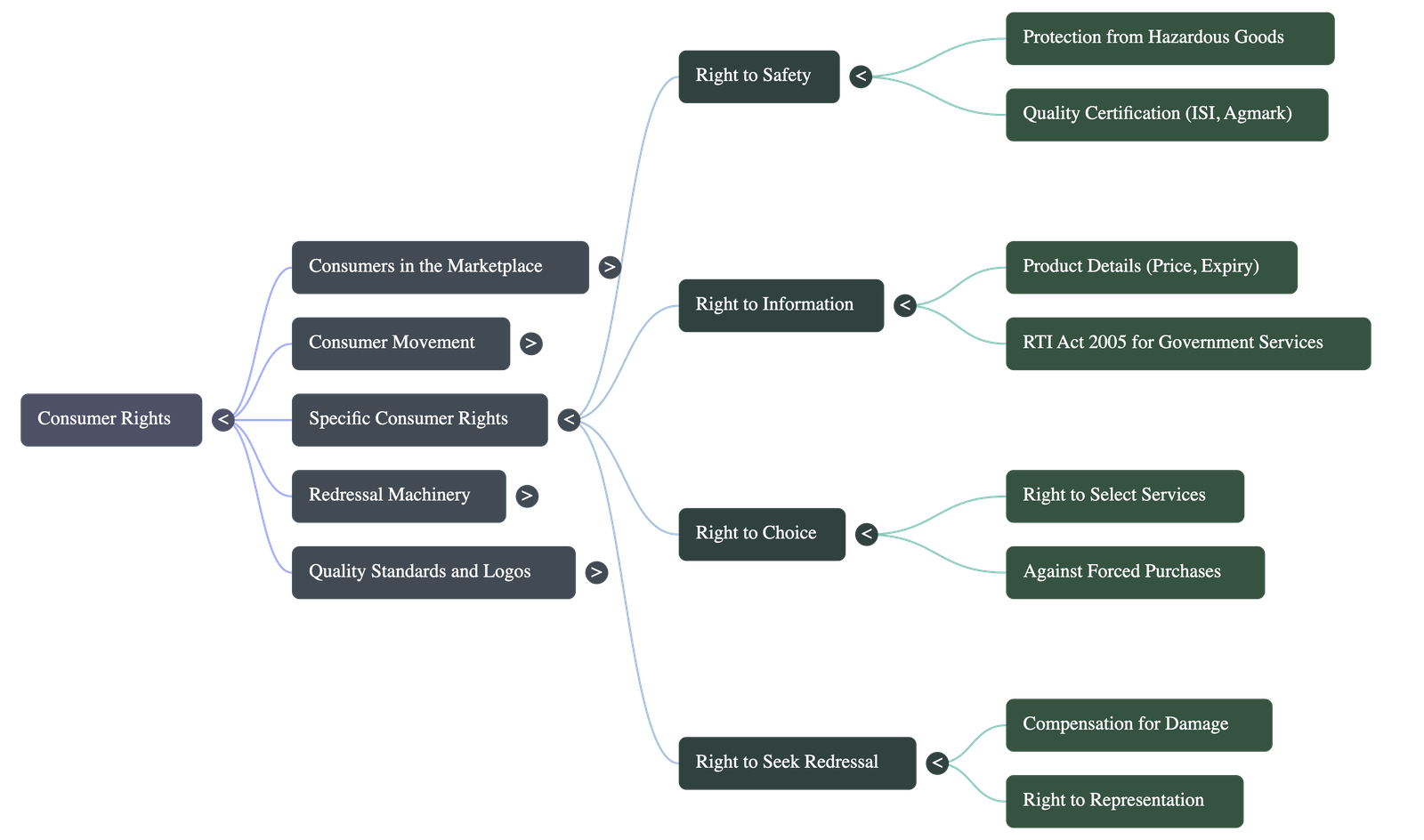
1. Right to Safety
Consumers have the right to be protected against the marketing of goods and delivery of services that are hazardous to life and property. Producers must strictly follow safety rules (e.g., safety valves in pressure cookers). Negligence can lead to severe consequences, as seen in cases of medical malpractice.
2. Right to Information
Consumers have the right to be informed about the particulars of goods and services (ingredients, date of manufacture, expiry date, MRP, manufacturer address). This allows consumers to complain or ask for replacements.
RTI Act (2005): The Right to Information Act empowers citizens to get information about the functioning of government departments.
3. Right to Choice
Any consumer who receives a service has the right to choose whether to continue receiving it. Sellers cannot force consumers to buy additional items (e.g., forcing a gas stove purchase with a new gas connection). Consumers also have the right to a refund if a service (like education) is deficient or discontinued.
4. Right to Redressal
Consumers have the right to seek redressal against unfair trade practices and exploitation. If damage is done, the consumer has the right to get compensation depending on the degree of damage.
5. Right to Representation
The Act enables consumers to represent themselves in Consumer Disputes Redressal Commissions.
6. Right to Consumer Education
Consumers must acquire the knowledge and skill to be well-informed to distinguish and make informed choices.
Consumer Justice System (COPRA)
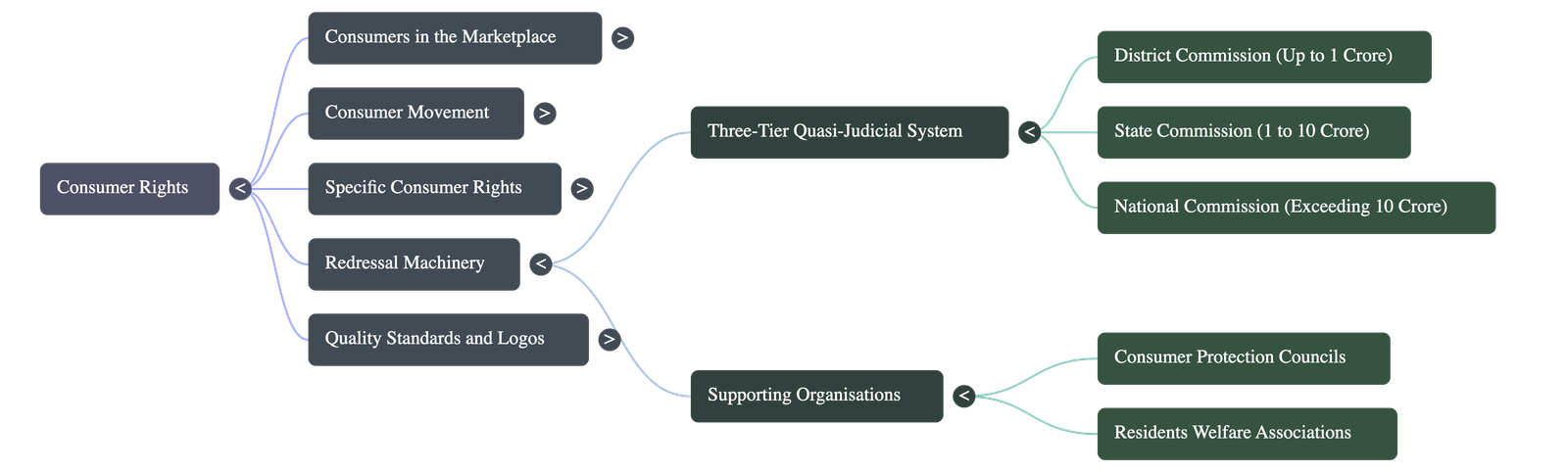
- Three-Tier Quasi-Judicial Machinery: COPRA established a three-level system for dispute resolution:
- District Commission: Deals with cases involving claims up to Rs 1 crore.
- State Commission: Deals with cases between Rs 1 crore and Rs 10 crore.
- National Commission: Deals with cases involving claims exceeding Rs 10 crore.
- Appeal System: If a case is dismissed at the district level, it can be appealed at the state level, and subsequently at the national level.
- Recent Amendments (2019):
- Inclusion of e-commerce purchases.
- Manufacturers/Service providers held responsible for defective products/services with penalties including imprisonment.
- Introduction of a neutral "mediator" for dispute settlement.
- Ability to file complaints via the internet.
Quality Standardization
- Logos such as ISI, Agmark, and Hallmark help consumers ensure quality.
- While following standards is voluntary for many products, it is mandatory for products affecting health and safety, such as:
- LPG cylinders
- Food colors and additives
- Cement
- Packaged drinking water
Current Status and Challenges
- National Consumers' Day: Observed on December 24th to mark the enactment of COPRA in 1986.
- Progress: India has exclusive courts for consumer redressal and over 2000 consumer groups (though only 50-60 are well-organized).
- Challenges:
- The redressal process can be cumbersome, expensive, and time-consuming.
- Consumers often need to engage lawyers, and cases drag on.
- Evidence gathering (cash memos) is difficult for small retail purchases.
- Enforcement of laws in the unorganized sector remains weak.
- Conclusion: Effective consumer protection requires the active involvement and voluntary effort of all consumers.
Do checkout all questions & answers of this chapter.