Quick Navigation:
| | |
Development
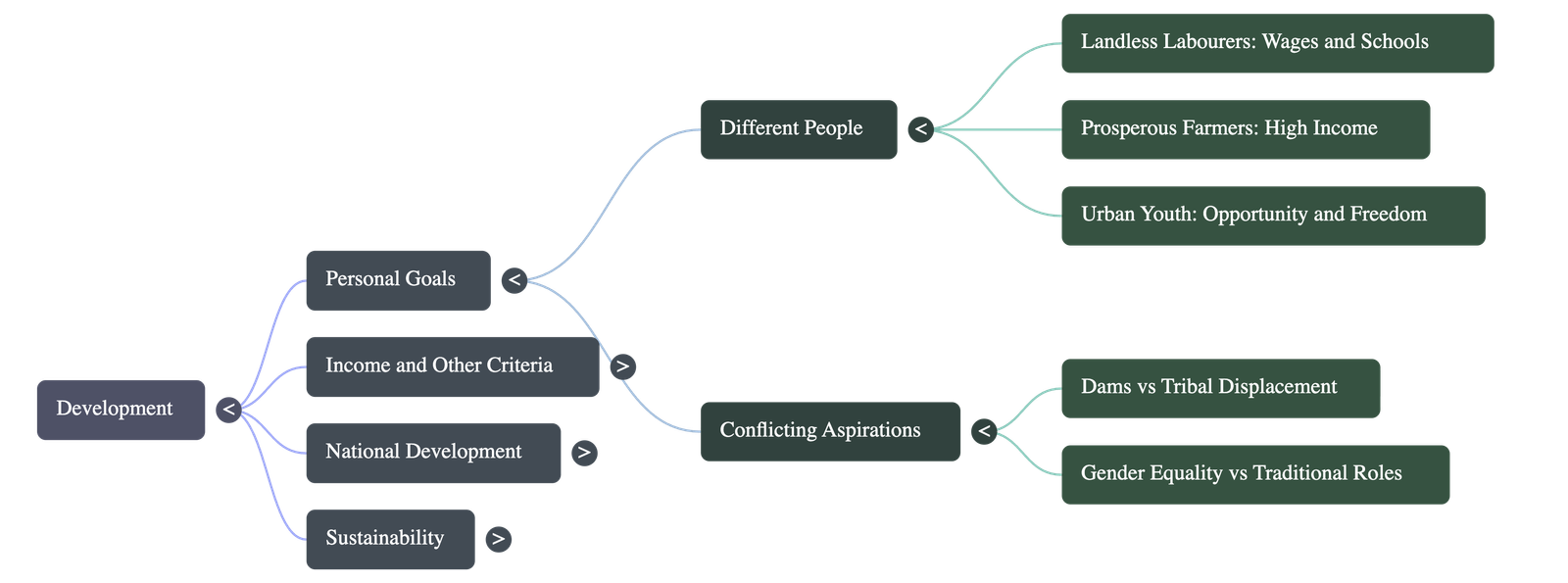
1. What Development Promises: Different People, Different Goals
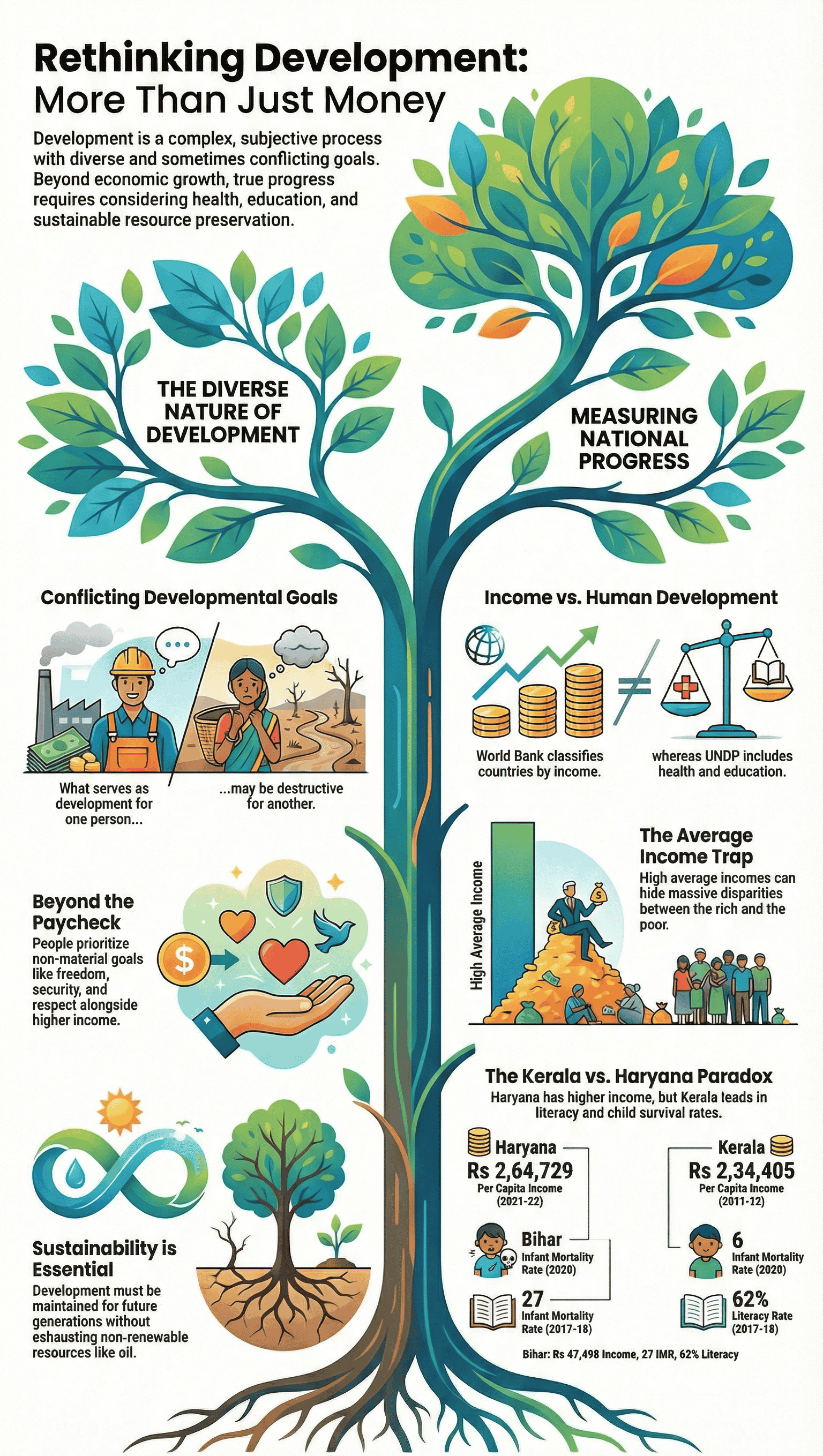
- Development is subjective: Development and progress mean different things to different people. Each individual has their own aspirations and desires based on their life situation.
- Differing Goals:
- A landless rural labourer may desire more days of work and better wages.
- A prosperous farmer may desire high family income and cheap labour.
- A girl from a rich family may desire the same freedom as her brother.
- Conflicting Goals: Sometimes, the development goals of one person may be destructive for another. For example, industrialists may want dams for electricity, but this can displace tribal people and submerge their land.
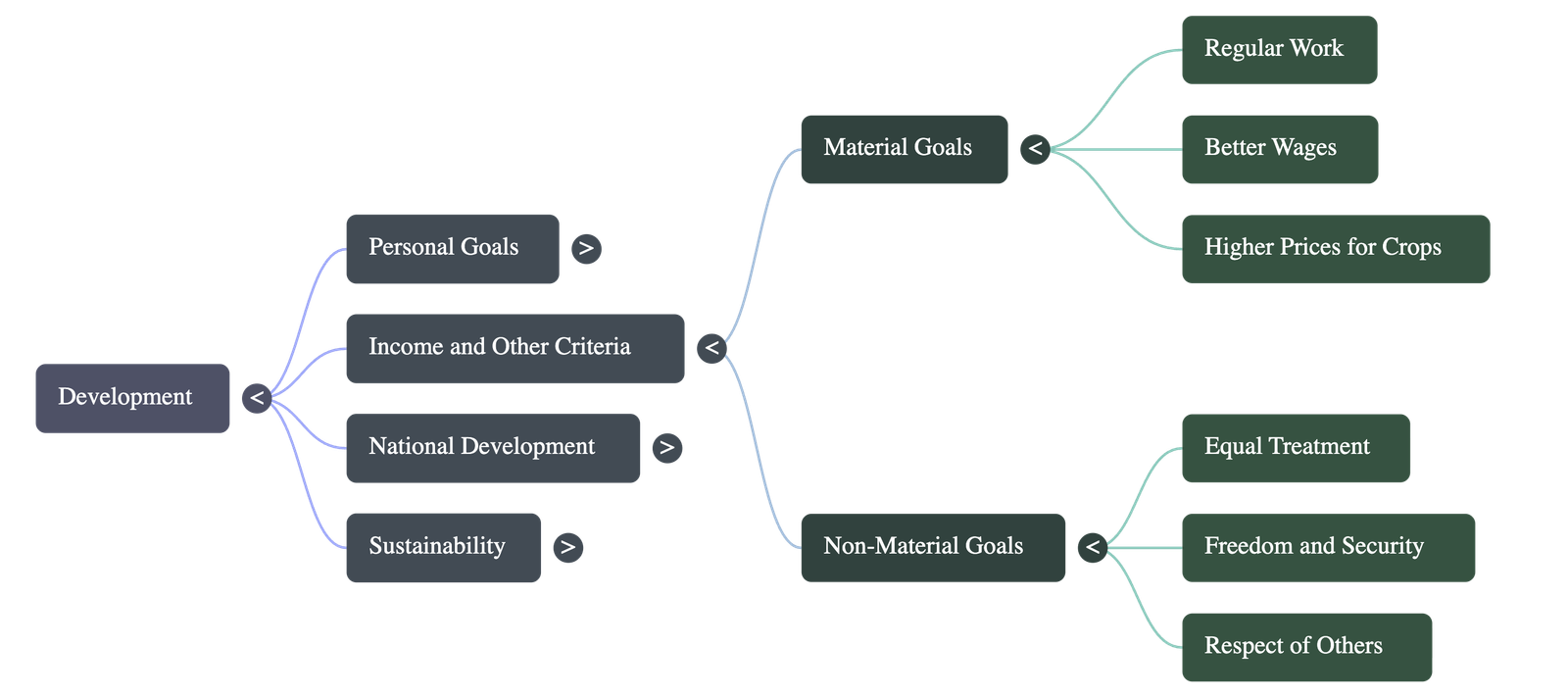
2. Income and Other Goals
- Material Goods: While income (money) is a primary goal because it allows people to buy material goods, it is not the only factor.
- Non-Material Goals: Quality of life depends heavily on non-material factors such as equal treatment, freedom, security, respect from others, and friendship.
- Mixed Goals: People look at a mix of goals. For instance, women engaged in paid work gain dignity, and a secure environment may allow more women to work. A high-paying job with no job security or time for family might be less desirable than a lower-paying job with security.
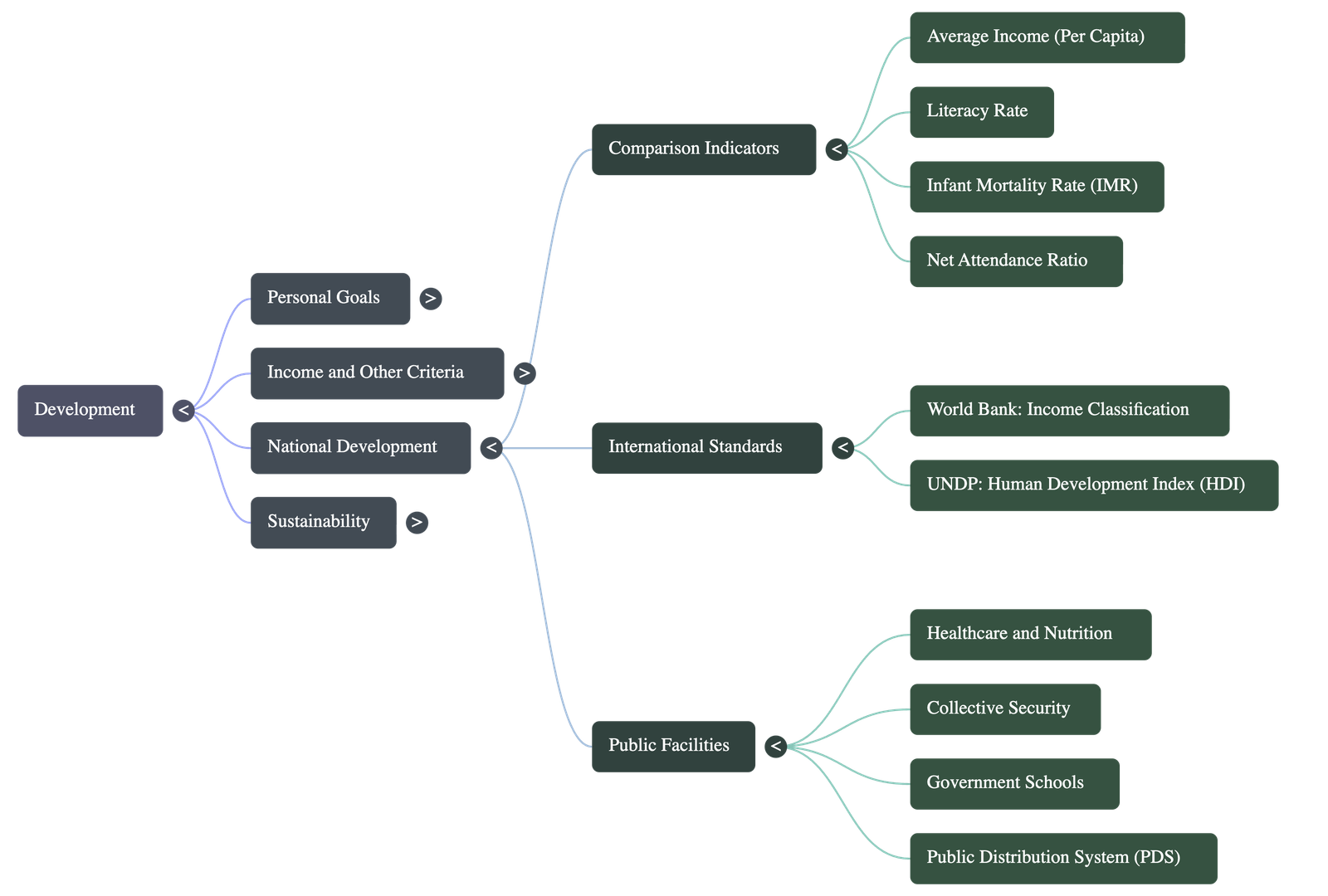
3. National Development
- Differing Notions: Just as individuals have different goals, their ideas about what a country should do for development can vary and conflict.
- Decision Making: National development involves thinking about fair and just paths for all, determining whether a plan benefits a large number of people or just a small group, and finding better ways to do things.
4. How to Compare Different Countries or States
- Average Income (Per Capita Income): Total income is not a useful measure for comparison because populations vary. Instead, Average Income (Total Income of the country divided by its Total Population) is used.
- World Bank Criteria: The World Bank classifies countries based on per capita income:
- Rich/Developed Countries: High per capita income.
- Low-Income Countries: Low per capita income.
- Limitations of Averages: While averages are useful for comparison, they hide disparities. Two countries may have the same average income, but one might have an equitable distribution of wealth while the other has a few extremely rich people and many poor people.
5. Income and Other Criteria
- Case Study (Haryana vs. Kerala vs. Bihar):
- Income: Haryana has a higher per capita income than Kerala.
- Social Indicators: Despite lower income, Kerala has much better development indices (lower Infant Mortality Rate, higher Literacy Rate) than Haryana. Bihar ranks lowest in both income and social indicators.
- Conclusion: Income alone is not an adequate indicator of development. Money cannot buy a pollution-free environment or protection from infectious diseases unless the community acts collectively.
6. Public Facilities
- Collective Provision: The cheapest and best way to provide essential goods and services is collectively. Examples include security, transportation, and education.
- Educational Impact: Children are able to study because the government and society provide schools. In some areas, girls cannot attend high school due to a lack of facilities.
- Health Impact: Kerala’s low Infant Mortality Rate is attributed to adequate public health and educational facilities. A functioning Public Distribution System (PDS) ensures better health and nutritional status.
7. Human Development Report
- Published by: United Nations Development Programme (UNDP).
- Criteria: It compares countries based on:
- Educational Levels: Mean years of schooling.
- Health Status: Life Expectancy at birth.
- Per Capita Income: Standard of living.
- Observations: Smaller countries like Sri Lanka can rank higher than India in the Human Development Index (HDI) despite India’s size, highlighting that income is not the sole measure of progress.
- BMI (Body Mass Index): Used to determine if adults are undernourished or overweight.
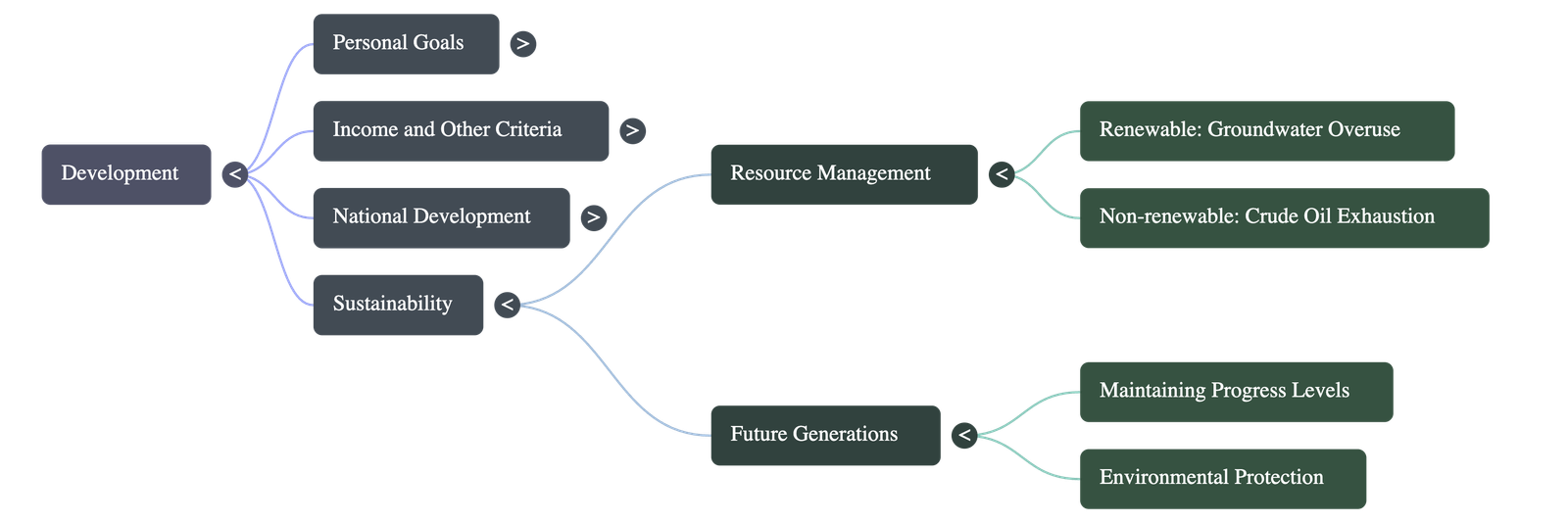
8. Sustainability of Development
- Concept: Development should not come at the cost of future generations. We have "borrowed the world from our children."
- Renewable Resources (Groundwater): Even renewable resources can be overused. In India, groundwater is being used faster than it is replenished by rain, leading to a decline in water levels.
- Non-Renewable Resources (Crude Oil): These have a fixed stock on earth. Current extraction rates suggest reserves will be exhausted in a few decades.
- Environmental Degradation: Consequences of environmental damage do not respect national or state boundaries. Sustainability is a global issue requiring cooperation between scientists, economists, and philosophers.
Do checkout all questions & answers of this chapter.
Quick Navigation:
| | |
1 / 1
Quick Navigation:
| | |