Outcomes of Democracy
Overview: Assessing Democracy
The chapter begins by questioning what democracy actually achieves. While often viewed as superior to dictatorship in principle, it presents a dilemma where it is felt to be "not so good" in practice. We assess democracy based on two types of reasons: moral and prudential.
- Promotes equality among citizens.
- Enhances the dignity of the individual.
- Improves the quality of decision-making.
- Provides a method to resolve conflicts.
- Allows room to correct mistakes.
1. Accountable, Responsive, and Legitimate Government
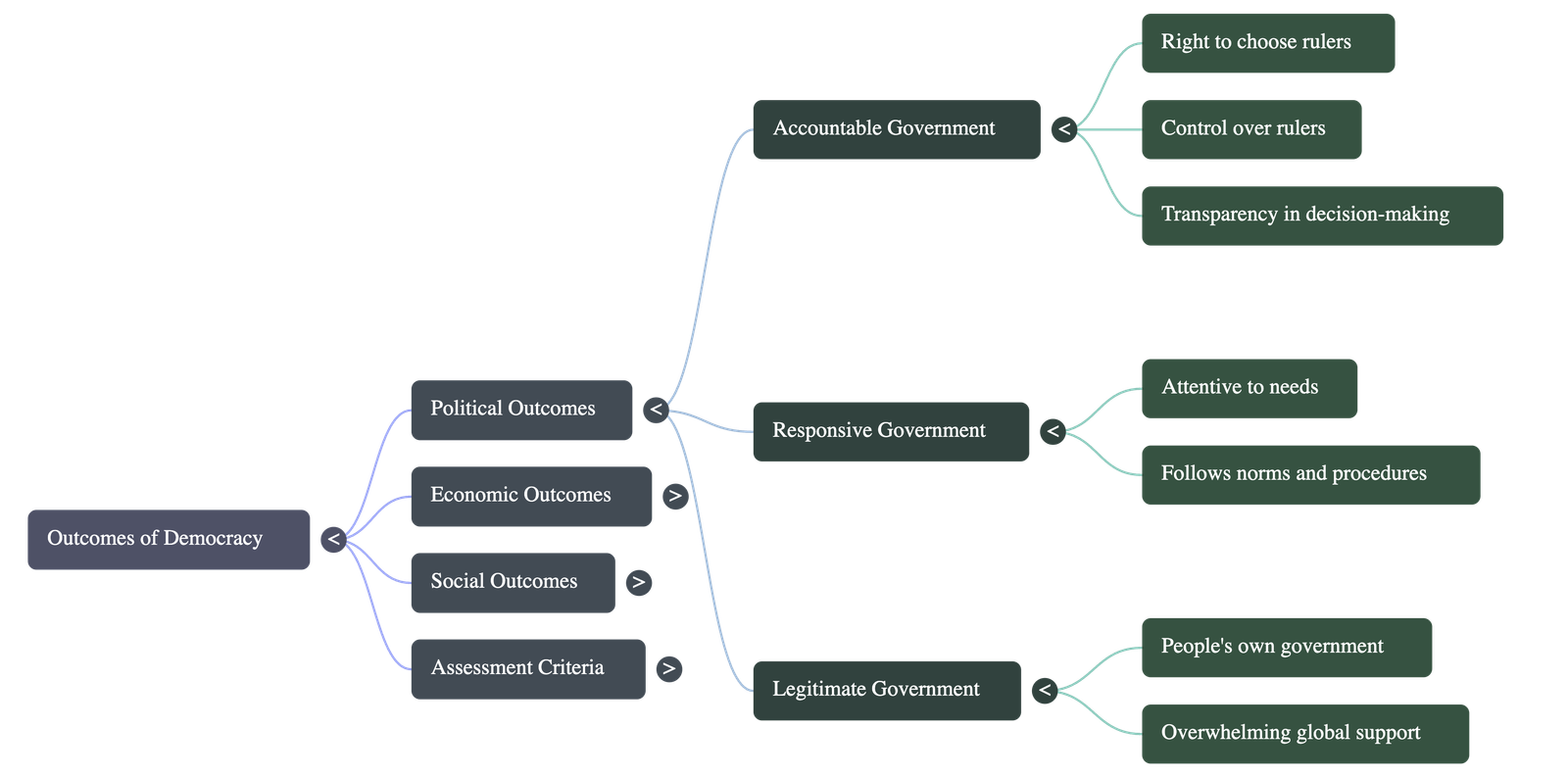
The most basic outcome of democracy is to provide a government that is accountable to citizens and responsive to their needs.
- Accountability & Transparency: Citizens have the right to choose their rulers and hold them accountable. Unlike non-democratic governments, democracies ensure decision-making is based on norms and procedures. This grants citizens the right and means to examine the process of decision-making, known as transparency.
- Efficiency vs. Effectiveness: Non-democratic rulers can make quick decisions as they do not need to deliberate in assemblies or worry about public opinion. Democracies involve negotiation and deliberation, leading to delays. However, because democratic decisions follow procedures, they are often more acceptable to the people and more effective in the long run.
- Responsiveness: The record is mixed. While better than other regimes, democracies often fall short of holding completely fair elections or sharing information with citizens. They are not always free of corruption or fully attentive to the needs of the majority.
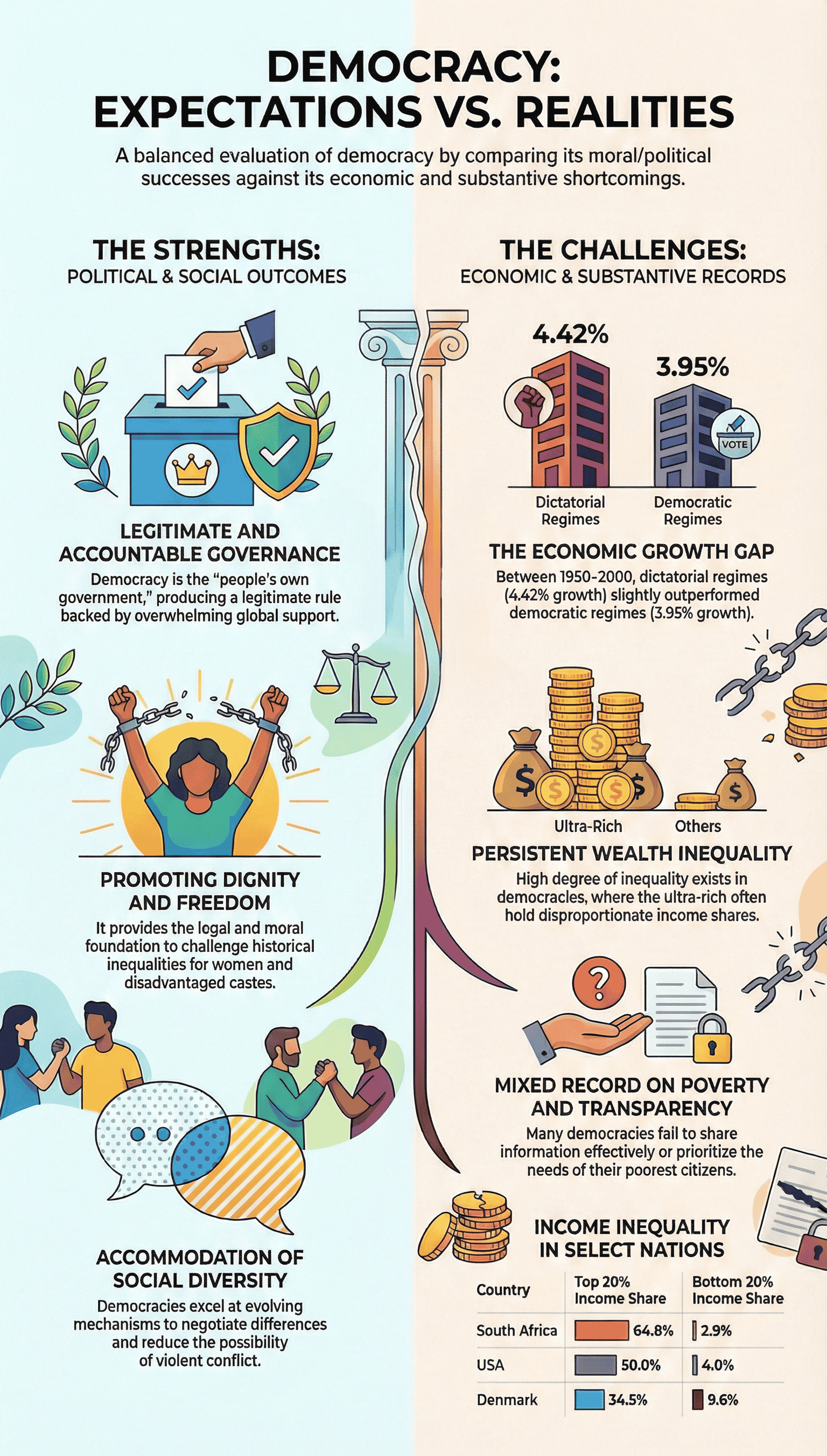
- Legitimacy: This is democracy's strongest outcome. A democratic government is the people’s own government. There is overwhelming support for the idea of democracy worldwide, even in countries without democratic regimes, as people wish to be ruled by elected representatives.
2. Economic Growth and Development
Does democracy guarantee economic prosperity? The evidence is complex.
- Growth Rates: Between 1950 and 2000, dictatorships showed a slightly higher rate of economic growth. However, in poor countries, the difference in growth between democracies and dictatorships is negligible.
- Factors of Development: Economic development depends on population size, global situation, cooperation from other countries, and economic priorities, not just the form of government.
- Conclusion: Democracy is not a guarantee of economic development, but it does not lag significantly behind dictatorships. Given its other benefits, democracy is still preferred.
3. Reduction of Inequality and Poverty
Democracies are based on political equality (one vote per person), but economic equality is harder to achieve.
- Growing Inequality: A small number of ultra-rich enjoy a disproportionate share of wealth and income, while the share of the poor is declining. In many democracies, the gap between the rich and poor is widening.
- Poverty: Although the poor constitute a large voter base, elected governments are often not keen to address poverty effectively. In many countries, like Bangladesh, a significant portion of the population lives in poverty.
4. Accommodation of Social Diversity
Democracies are generally successful in negotiating social differences and maintaining harmony.
- Conflict Resolution: No society can permanently resolve all conflicts, but democracy teaches us to respect differences and evolves mechanisms to negotiate them. It reduces the chance of tensions becoming explosive or violent.
- Majority Rule Limitations: Democracy is not simply rule by majority opinion; the majority must work with the minority so the government represents the general view.
- Avoidance of Majoritarianism: Rule by majority must not become rule by a specific religious, racial, or linguistic community. Democracy remains democratic only as long as every citizen has a chance of being in the majority at some point.
5. Dignity and Freedom of the Citizens
Democracy is superior to all other forms of government in promoting the dignity and freedom of the individual.
- Basis of Democracy: The passion for respect and freedom is the foundation of democracy. Recognition of this principle makes it easier for citizens to wage struggles against discrimination.
- Gender Equality: While women are not always treated with respect in practice, democracy provides the legal and moral basis to fight against male-dominated hierarchies—something missing in non-democratic setups.
- Caste Inequalities: In India, democracy has strengthened the claims of disadvantaged and discriminated castes for equal status and opportunity.
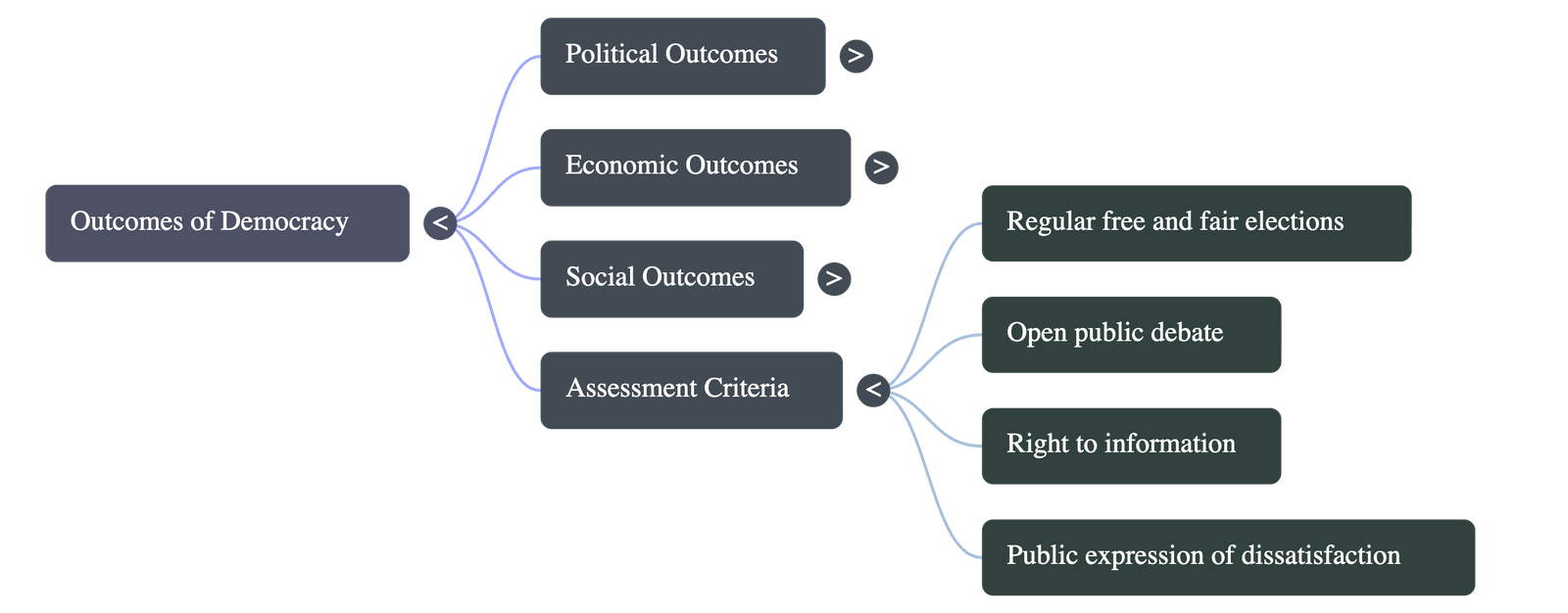
- The "Testimony" of Complaints: A distinctive feature of democracy is that its examination never ends. Public dissatisfaction and complaints are actually a sign of success; they show that people have transformed from "subjects" to "citizens" who are aware of their rights and critically examine power holders.
Do checkout all questions & answers of this chapter.