Power-sharing
1. Introduction
Democracy is not about concentrating power in one place. An intelligent sharing of power among the legislature, executive, and judiciary is crucial for the design of a democracy. This chapter contrasts how two democracies, Belgium and Sri Lanka, handled demands for power-sharing.
2. Case Study: Belgium and Sri Lanka
Belgium's Complex Ethnicity
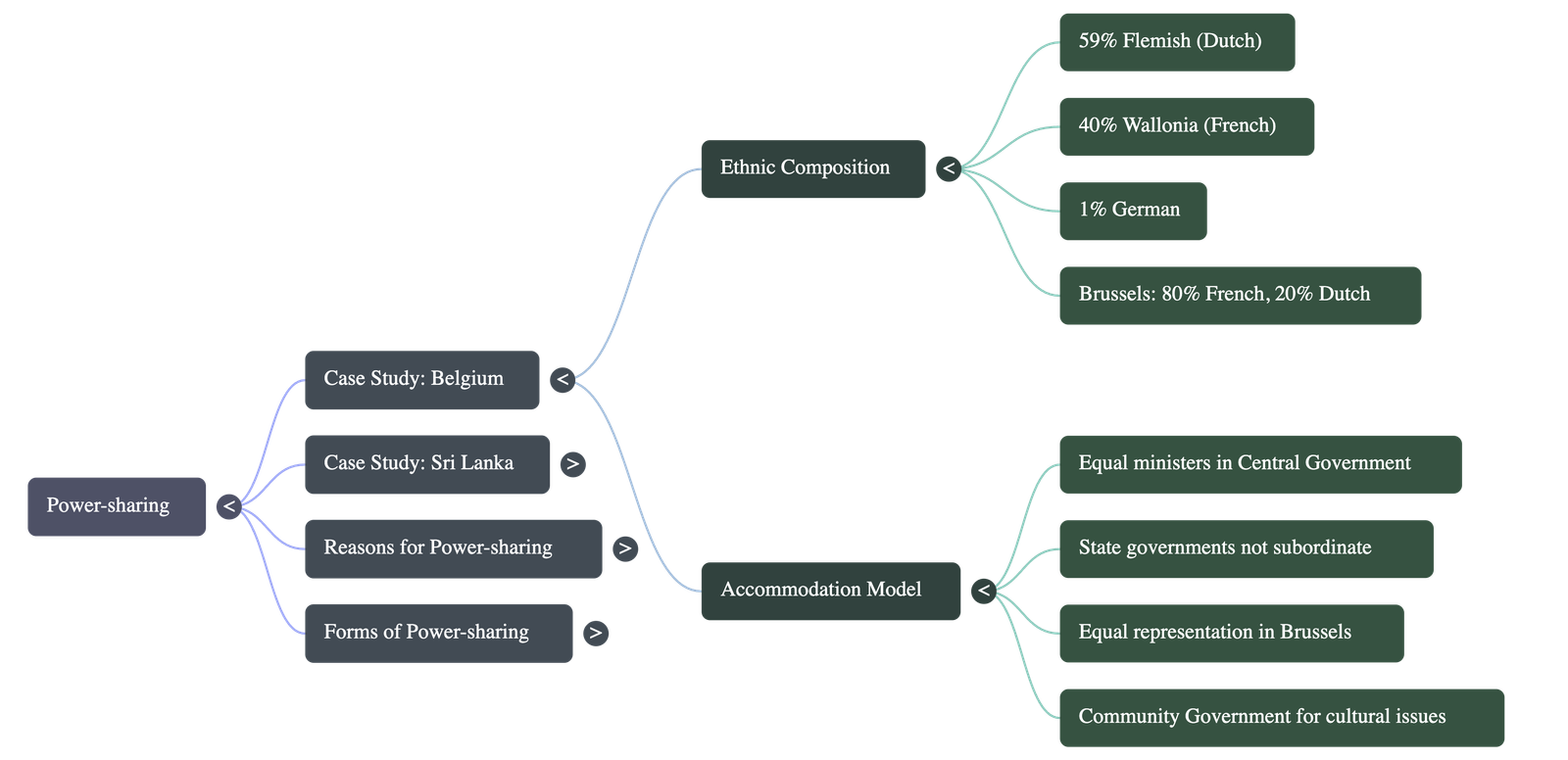
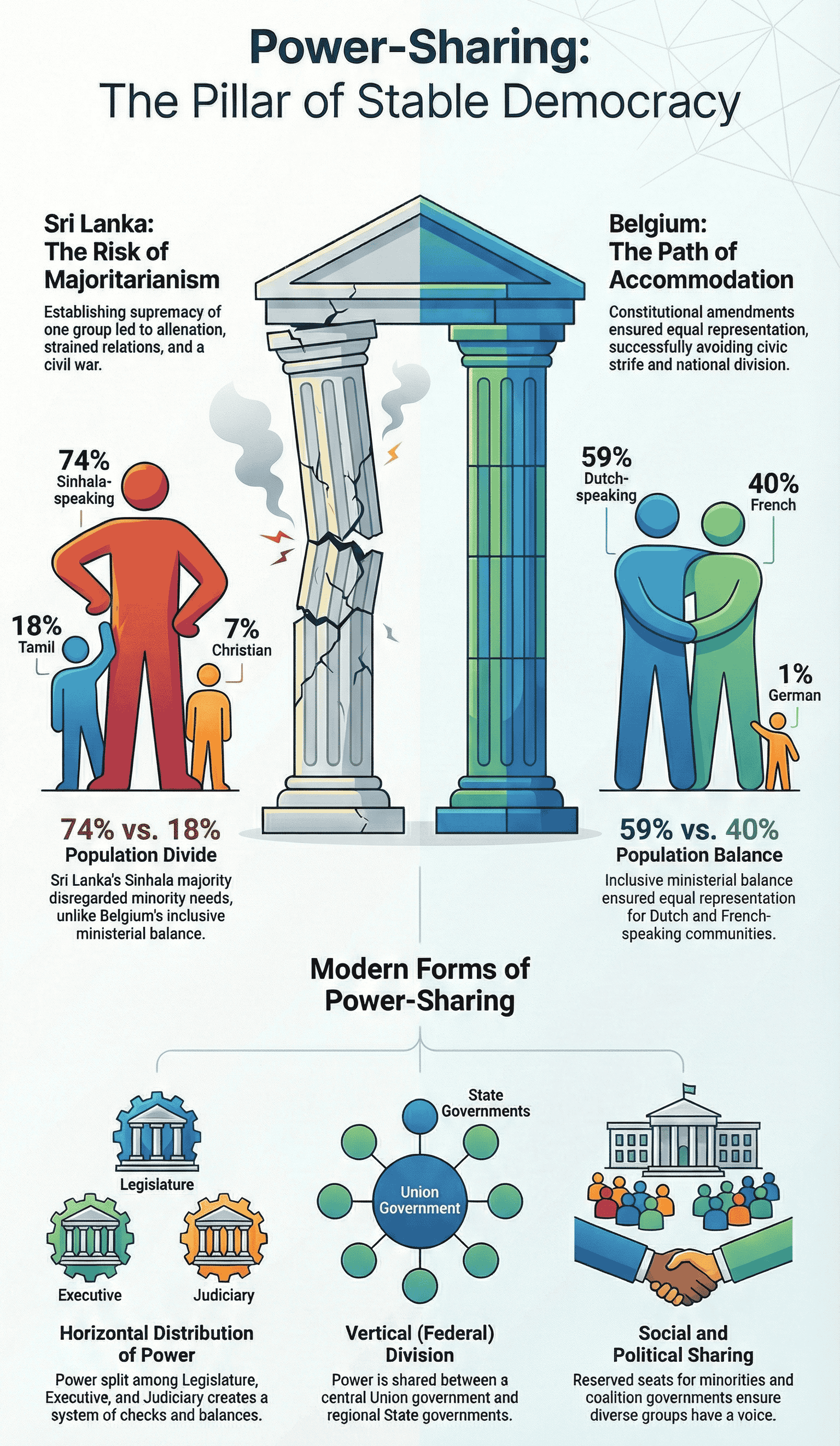
- Composition: A small European country where 59% speak Dutch (Flemish region), 40% speak French (Wallonia region), and 1% speak German.
- The Capital (Brussels): In the capital, the situation is reversed: 80% speak French and 20% speak Dutch.
- The Conflict: The minority French-speaking community was richer and more powerful. This caused resentment among the Dutch-speaking community, leading to tensions in the 1950s and 1960s.
Sri Lanka's Majoritarianism
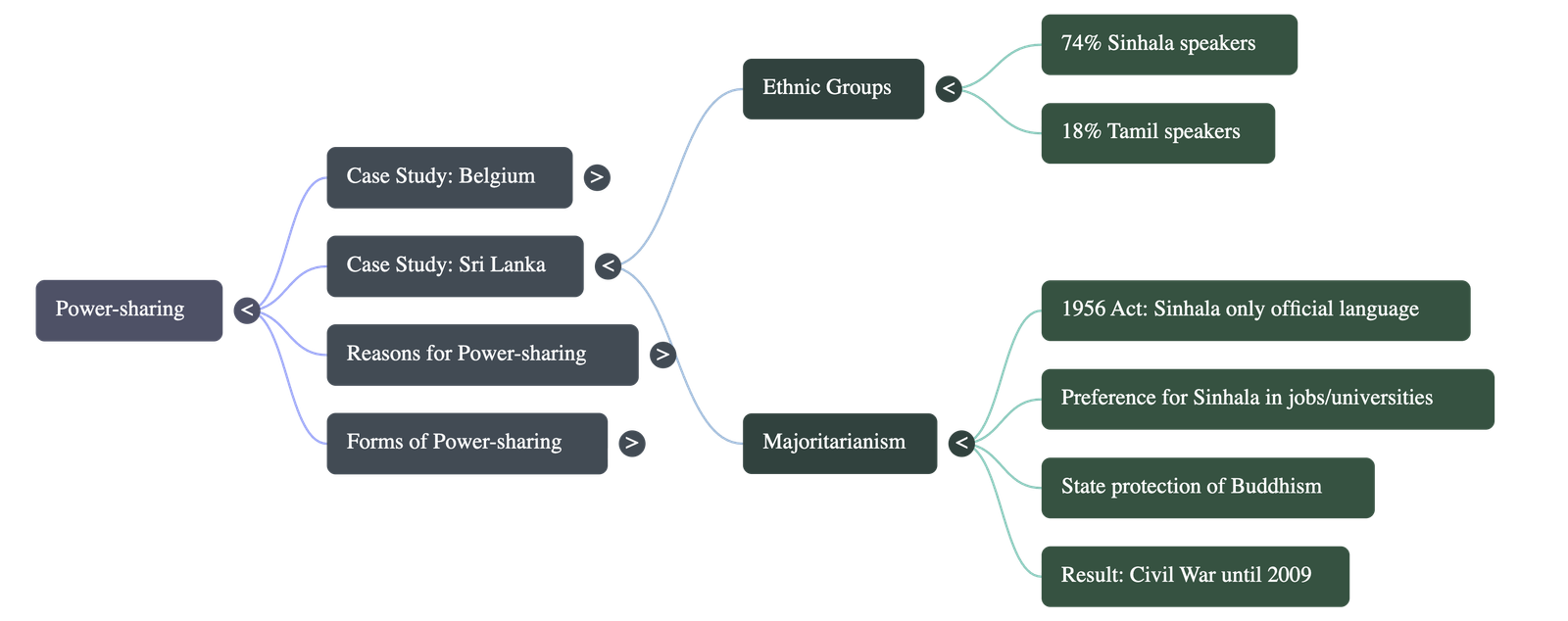
- Composition: An island nation with 74% Sinhala-speakers (mostly Buddhist) and 18% Tamil-speakers (Hindus or Muslims). Tamils are divided into Sri Lankan Tamils (natives) and Indian Tamils (colonial plantation workers).
- The Policy: After independence in 1948, leaders sought Sinhala dominance.
- 1956 Act: Made Sinhala the only official language.
- Preferential Policies: Favoured Sinhala applicants for university and government jobs.
- State Religion: The state constitutionally protected and fostered Buddhism.
- The Result: Tamils felt alienated and demanded equality and regional autonomy. The conflict escalated into a Civil War, killing thousands and causing economic setbacks.
3. Accommodation in Belgium
Unlike Sri Lanka, Belgian leaders recognized cultural diversities. Between 1970 and 1993, they amended their constitution four times to work out a unique power-sharing arrangement:
- Equal Ministers: The number of Dutch and French-speaking ministers is equal in the central government. Special laws require majority support from each linguistic group, preventing unilateral decisions.
- State Power: Powers were devolved to State Governments of the two regions, which are not subordinate to the Central Government.
- Brussels Government: A separate government exists for Brussels with equal representation for both communities. The French accepted this because the Dutch accepted equal representation in the central government despite being a majority.
- Community Government: A third level of government elected by people belonging to one language community (Dutch, French, and German), regardless of where they live. It handles culture, education, and language issues.
Outcome: This prevented civic strife and division. Brussels became the headquarters of the European Union.
4. Why is Power-sharing Desirable?
There are two sets of reasons supporting power-sharing:
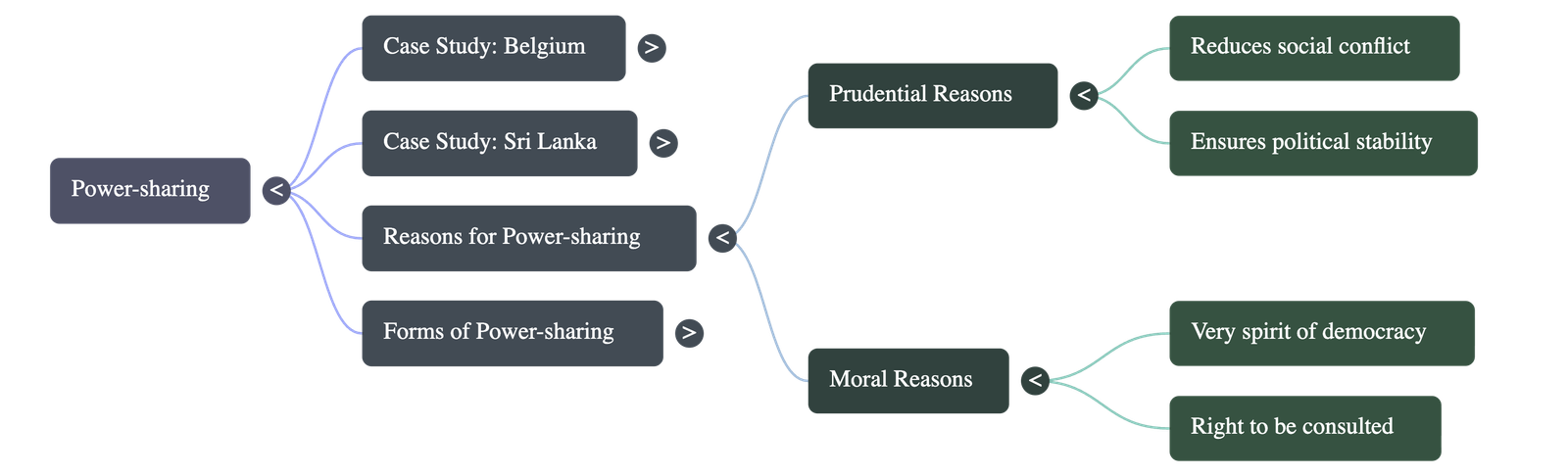
- Prudential Reasons (Practical):
- It reduces the possibility of conflict between social groups.
- It ensures political stability.
- Imposing the will of the majority undermines national unity in the long run. Tyranny of the majority ruins the minority and often the majority as well.
- Moral Reasons (Ethical):
- Power-sharing is the very spirit of democracy.
- People have a right to be consulted on how they are governed.
- A legitimate government is one where citizens acquire a stake in the system through participation.
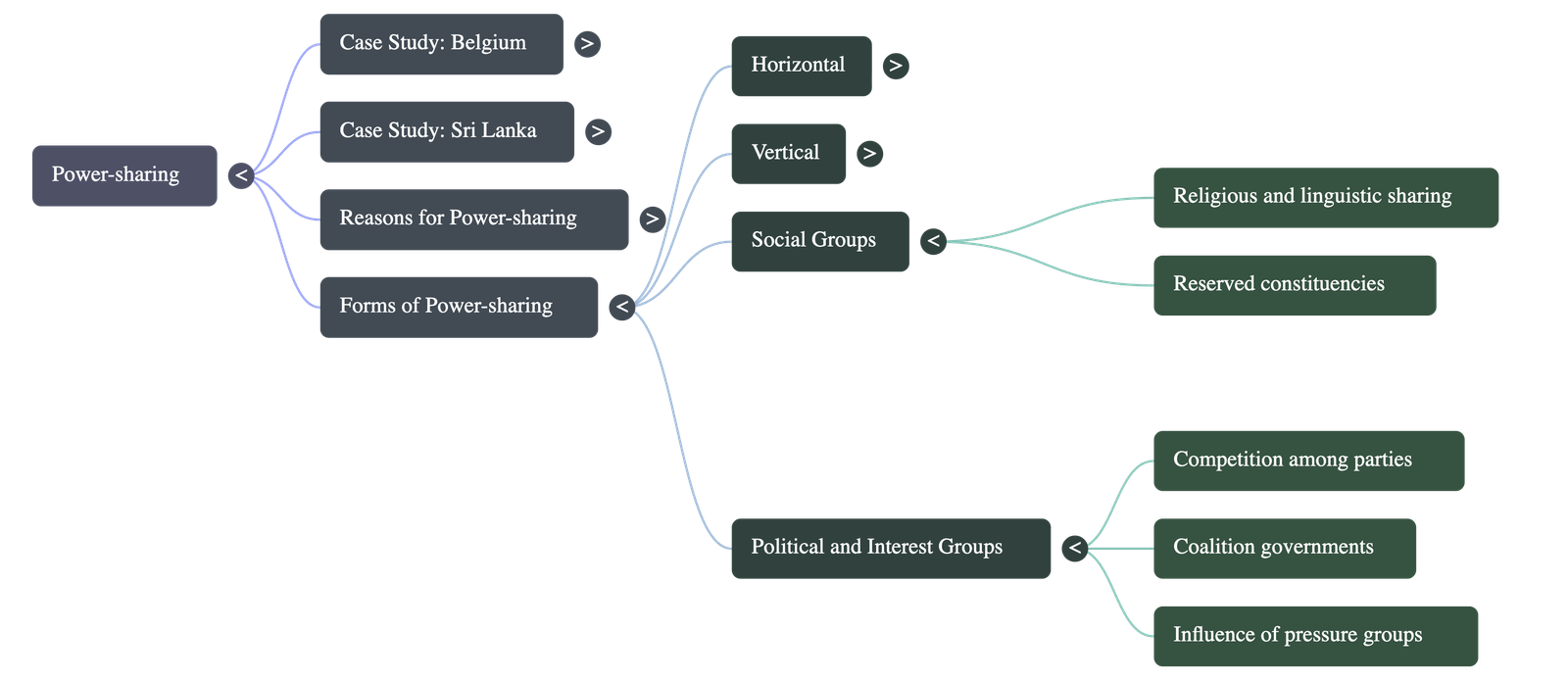
5. Forms of Power-sharing
In modern democracies, power-sharing takes several forms:
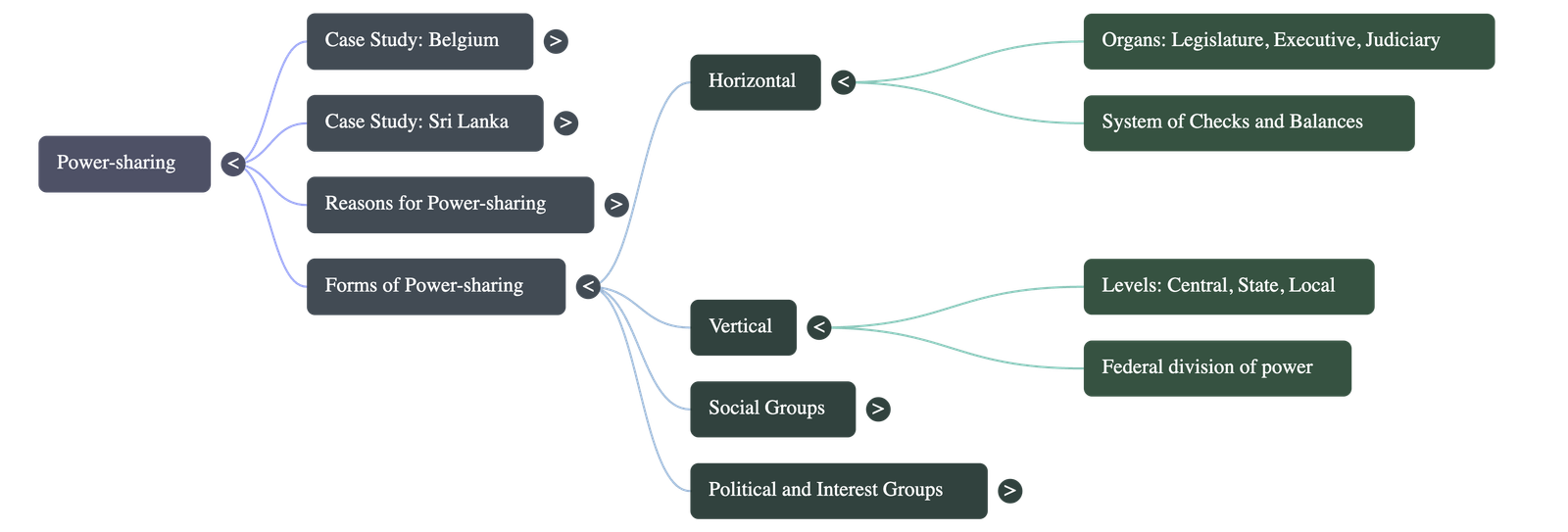
Power is shared among different organs of government (Legislature, Executive, Judiciary) placed at the same level.
- Ensures no single organ has unlimited power.
- Each organ checks the others, creating a balance of power.
Power is shared among governments at different levels.
- A general government for the entire country (Federal/Central/Union Government).
- Governments at the provincial or regional level (State Governments).
- Can extend lower to municipality and panchayat levels. Constitution clearly lays down powers for each level.
Power is shared among religious or linguistic groups.
- Example: "Community government" in Belgium.
- Example: Reserved constituencies in India.
- Used to give minority communities a fair share in power and prevent alienation.
Power sharing is seen in the way parties, pressure groups, and movements influence those in power.
- Competition among parties ensures power doesn't remain in one hand.
- Coalition Government: When two or more parties form an alliance to contest elections and win, they share power directly.
- Interest groups (traders, farmers, industrial workers) share power through participation in committees or by influencing decisions.
Do checkout all questions & answers of this chapter.