Quick Navigation:
| | |
Gender, Religion and Caste
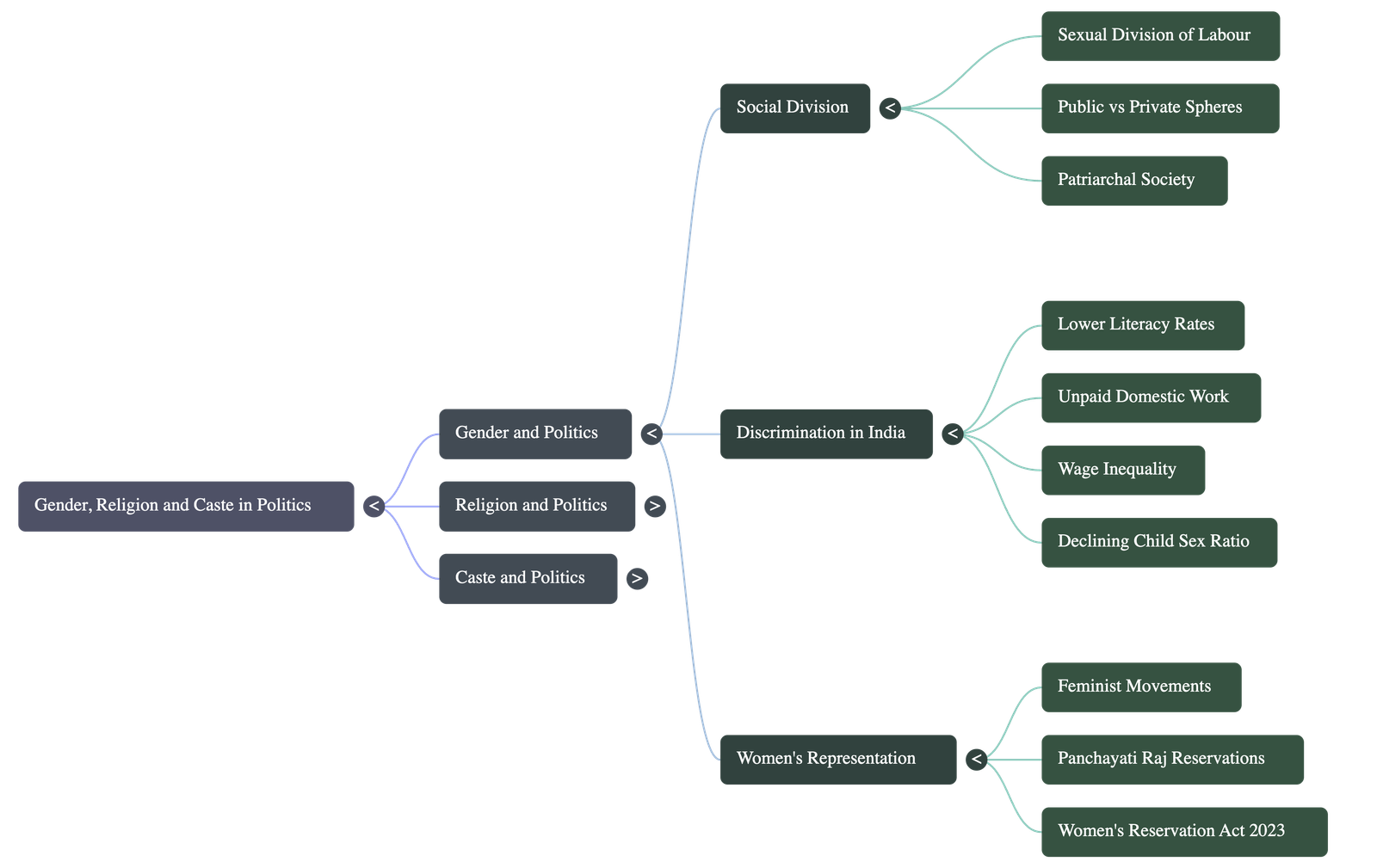
1. Gender and Politics
The Public/Private Division
- Sexual Division of Labour: A system where work is divided based on gender stereotypes. Women are expected to handle domestic work (cooking, cleaning, child-rearing) inside the home, while men work outside.
- Nature of Division: This division is not based on biology but on social expectations. When domestic jobs (like cooking or tailoring) are paid, men are willing to do them.
- Invisible Labour: Although women constitute half of humanity, their role in public life is minimal. Their domestic work is unpaid and often not valued.
Feminist Movements
- Definition: Movements organized by women (and men) aimed at achieving equality in personal and family life, as well as in public affairs.
- Goals: Extension of voting rights, enhancing political and legal status, and improving educational and career opportunities.
- Impact: These movements have improved women's roles in public life. In countries like Sweden, Norway, and Finland, women's participation is very high.
Status of Women in India
India remains a male-dominated, patriarchal society where women face disadvantage and discrimination:
- Literacy Rate: Lower among women (54%) compared to men (76%).
- Education: Parents often prefer spending resources on sons, leading to higher dropout rates for girls.
- Employment: Women are under-represented in highly paid jobs. Even with the Equal Remuneration Act, 1976, women are often paid less than men for the same work.
- Sex Ratio: Preference for sons has led to sex-selective abortion, resulting in a decline in the child sex ratio to 919 girls per thousand boys.
- Violence: Reports of harassment, exploitation, and domestic violence are common.
Women's Political Representation
- Low Numbers: Representation in India's legislature is low. Women constitute less than 15% of the Lok Sabha (as of 2019) and less than 5% in State Assemblies.
- Local Government Success: The Panchayati Raj system has successfully reserved one-third of seats for women, resulting in over 10 lakh elected women representatives.
- Recent Legislation: The Nari Shakti Vandan Adhiniyam (Women's Reservation Act, 2023) has been passed to provide 33% reservation for women in the Lok Sabha and State Legislative Assemblies.
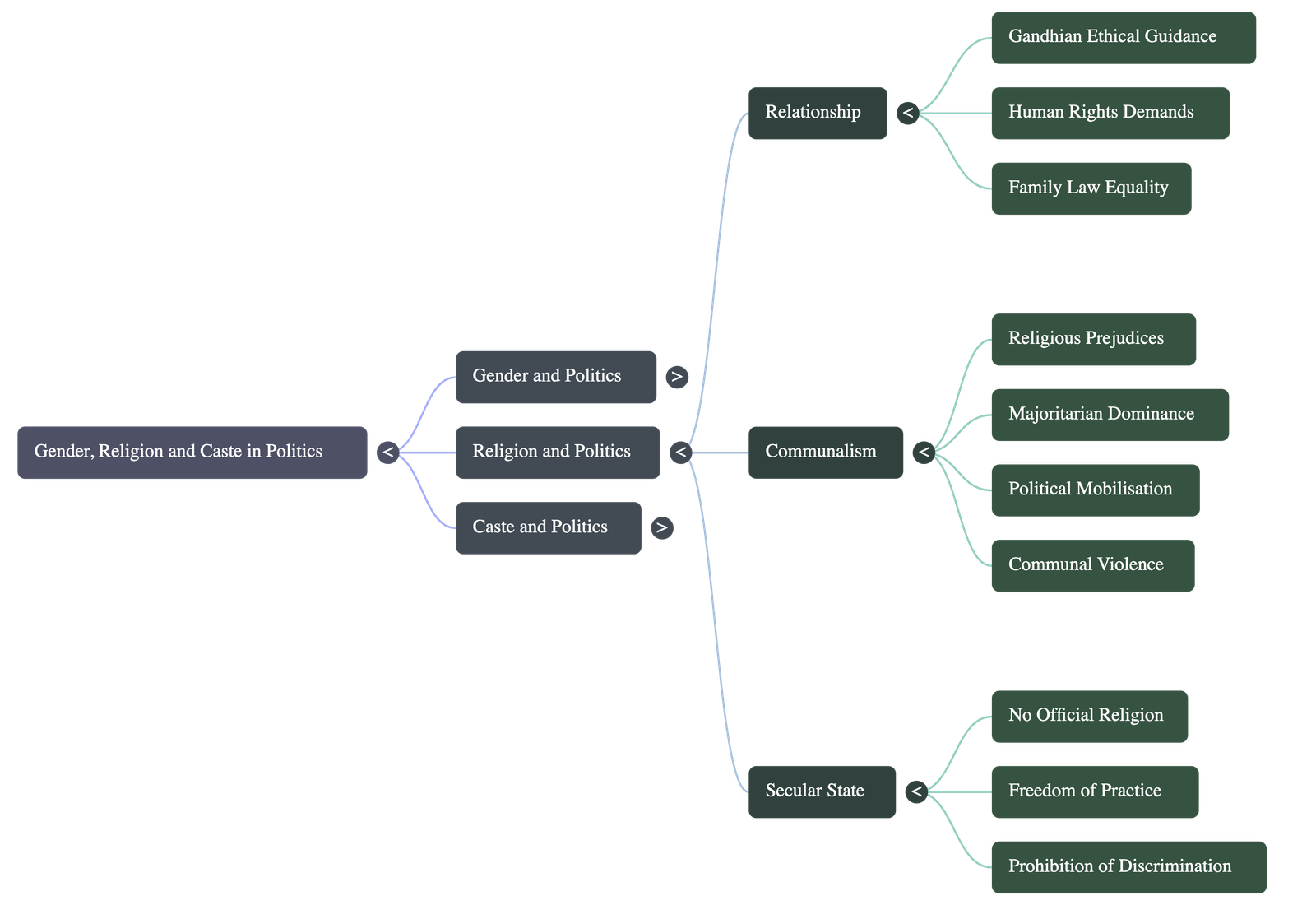
2. Religion, Communalism and Politics
Religion in Politics
- Positive View: Gandhi believed politics should be guided by ethics drawn from religion. Human rights groups demand protection for minorities. Women's movements challenge discriminatory family laws.
- General Principle: Political acts are not wrong if they treat every religion equally and allow people to express their needs as members of a community.
Communalism
- Definition: When religion is used as the principal basis of social community, pitting one group against another. It assumes followers of one religion have the same interests which conflict with others.
- Forms of Communalism in Politics:
- Everyday Beliefs: Religious prejudices, stereotypes, and belief in the superiority of one's own religion.
- Political Dominance: The majority community seeks majoritarian dominance, while minorities may desire a separate political unit.
- Mobilization: Use of sacred symbols, religious leaders, emotional appeals, and fear to gather votes.
- Violence: Communal riots and massacres (e.g., during the Partition of India and Pakistan).
The Secular State (India)
The Constitution of India chose the model of a secular state to combat communalism:
- No Official Religion: Unlike Sri Lanka (Buddhism) or Pakistan (Islam), India has no official state religion.
- Freedom of Religion: All individuals have the freedom to profess, practice, and propagate any religion, or none at all.
- Non-Discrimination: The Constitution prohibits discrimination on the grounds of religion.
- State Intervention: The state can intervene in religious matters to ensure equality (e.g., banning untouchability).
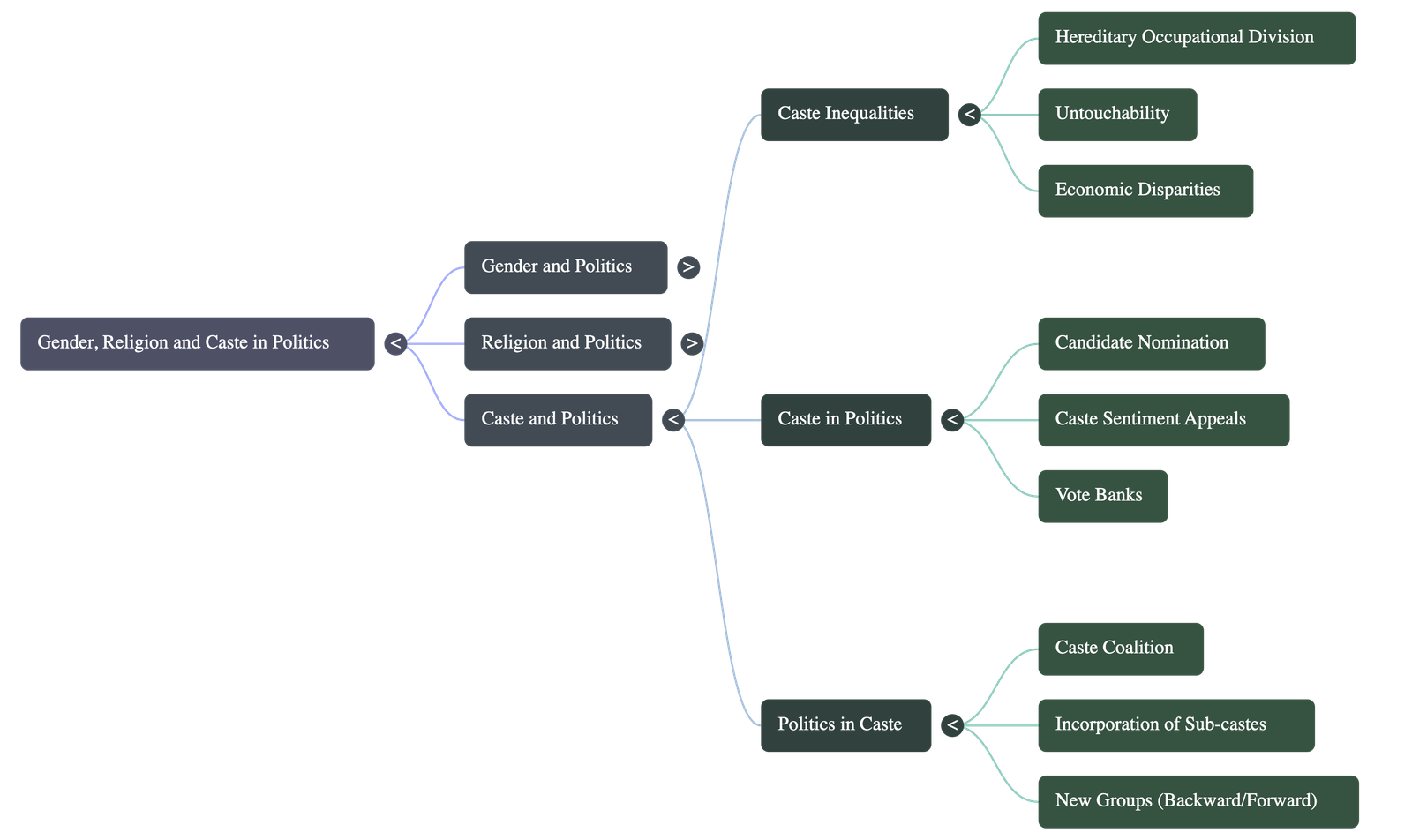
3. Caste and Politics
Caste Inequalities
- Unique Feature: Unlike gender and religion, caste division is specific to India, based on hereditary occupational division sanctioned by rituals.
- Changes: The caste hierarchy is breaking down due to economic development, urbanization, literacy, and occupational mobility.
- Persistence: Despite changes, caste has not disappeared. Most people marry within their caste, and untouchability persists in some forms. Caste remains closely linked to economic status, with "upper" castes generally being better off.
Caste in Politics
Politics is not just about caste, but caste affects politics in several ways:
- Candidate Selection: Parties choose candidates based on the caste composition of the electorate to win support.
- Representation: Governments try to ensure representatives from different castes find a place in ministries.
- Appeals: Parties appeal to caste sentiments to muster support.
- "Vote Bank" Myth: No single caste acts as a monolithic "vote bank" or constitutes a majority in a constituency. Parties must win support from multiple groups.
Politics in Caste
Politics also influences the caste system (politicization of caste):
- Expansion: Caste groups grow bigger by incorporating neighboring castes or sub-castes.
- Coalitions: Different caste groups enter into coalitions and negotiations.
- New Identities: New political groups like "Backward" and "Forward" castes have emerged.
Conclusion on Caste
- Positive: It has allowed disadvantaged groups (Dalits, OBCs) to demand a share in power and resources.
- Negative: Exclusive attention to caste can divert focus from poverty, corruption, and development, and may lead to tension or violence.
Do checkout all questions & answers of this chapter.
Quick Navigation:
| | |
1 / 1
Quick Navigation:
| | |