Quick Navigation:
| | |
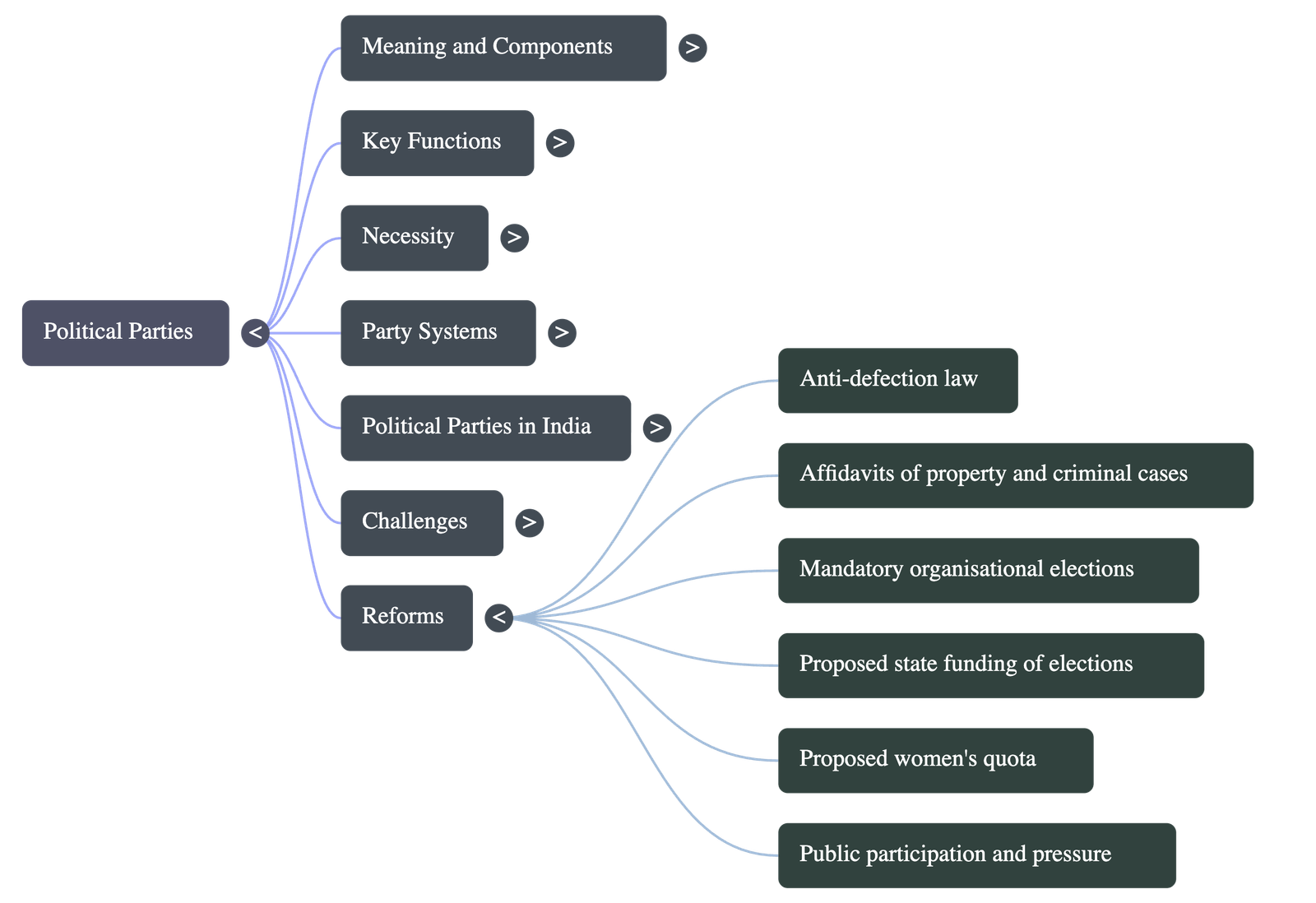
Political Parties
1. Meaning and Necessity
What is a Political Party?
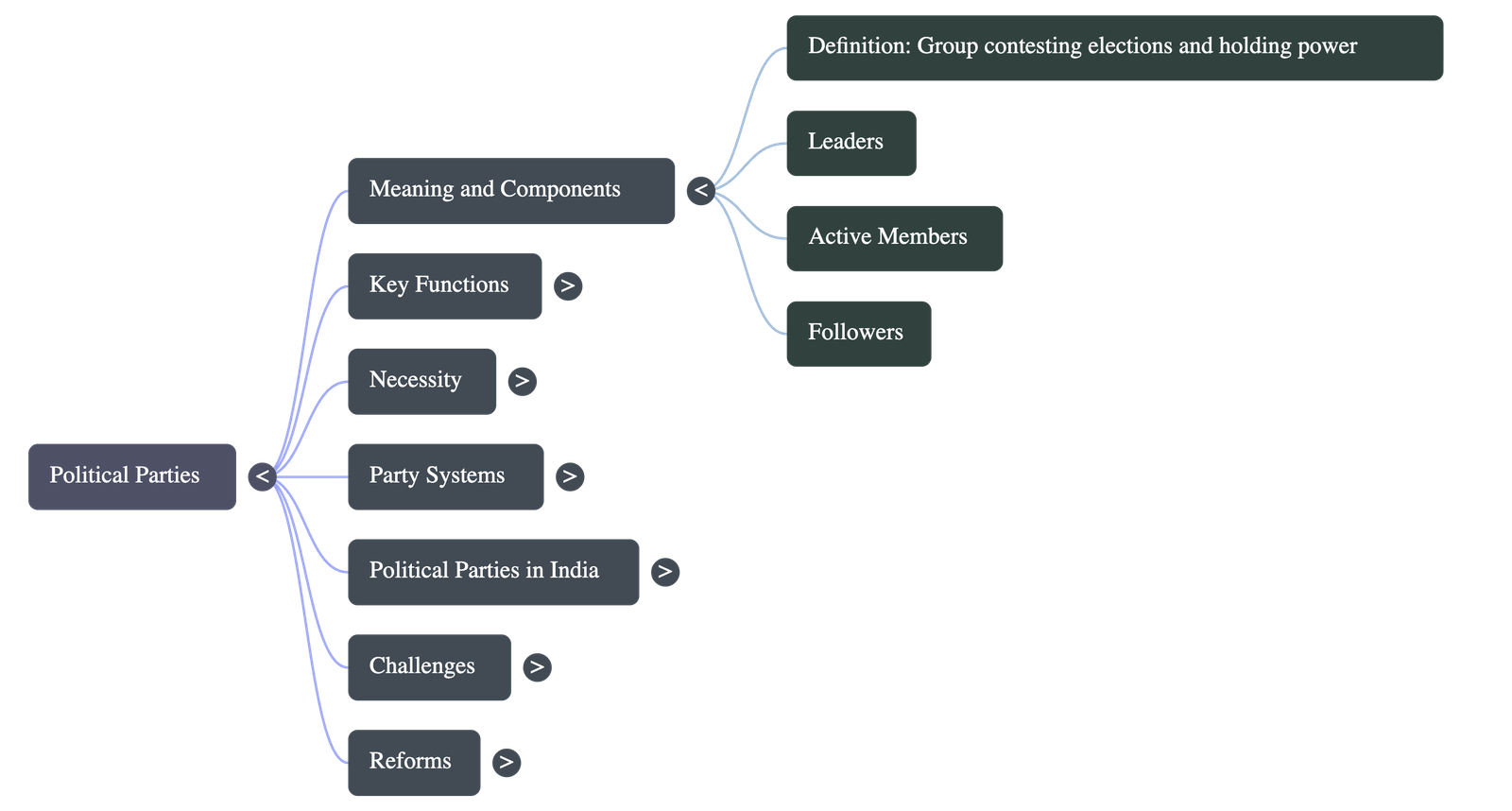
- A political party is a group of people who come together to contest elections and hold power in the government.
- They agree on specific policies and programmes to promote the collective good of society.
- Parties reflect fundamental political divisions in a society and involve partisanship (support for a specific part/view).
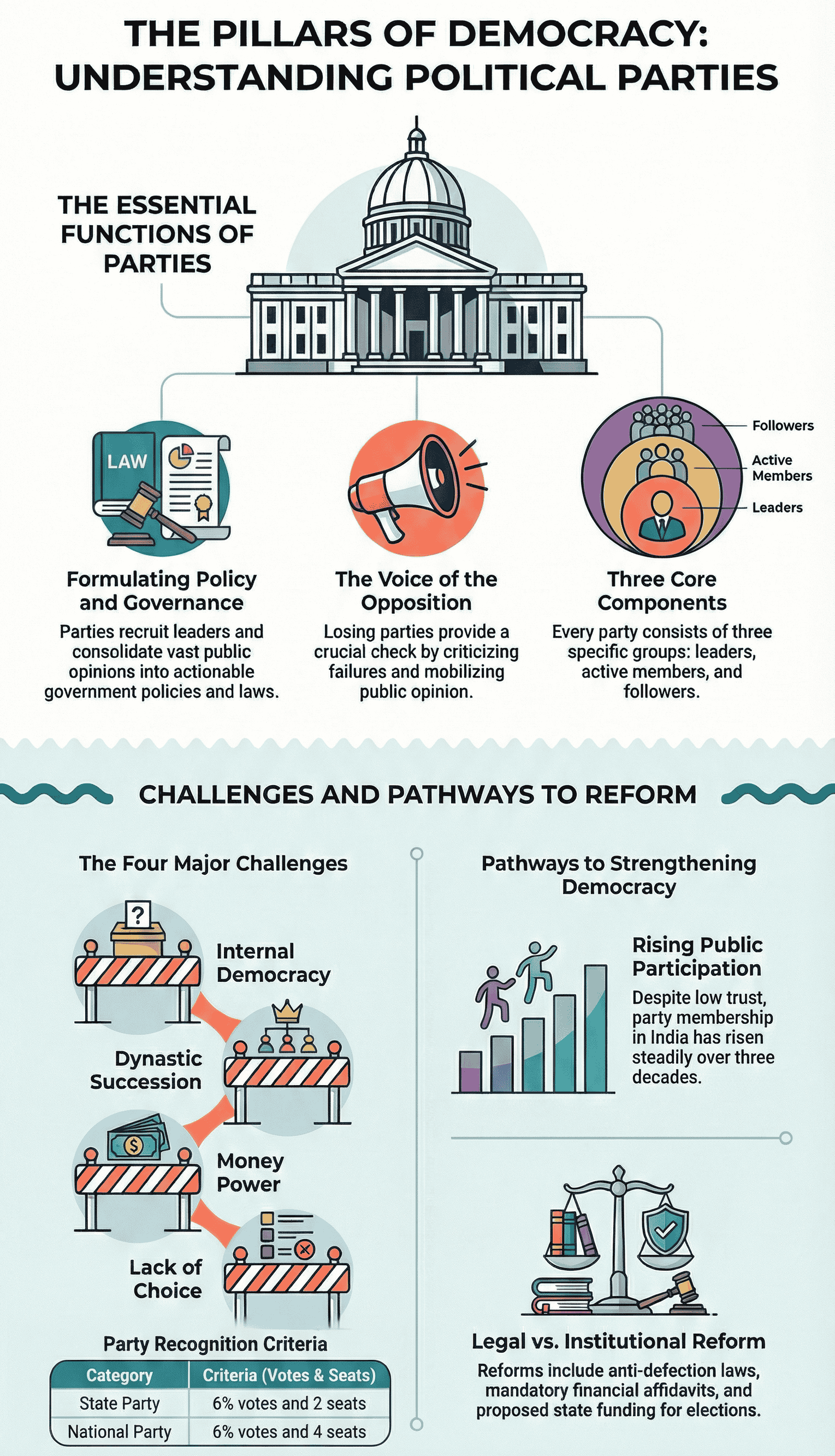
- A political party has three main components:
- The leaders
- The active members
- The followers
Why do we need them? (Necessity)
- Representation: As societies become large and complex, they need an agency to gather different views on various issues and present them to the government.
- Governance: They provide a mechanism to support or restrain the government, make policies, and justify or oppose them.
- Accountability: While independent candidates are accountable only to their constituency, political parties are responsible for how the entire country is run.
2. Functions of Political Parties
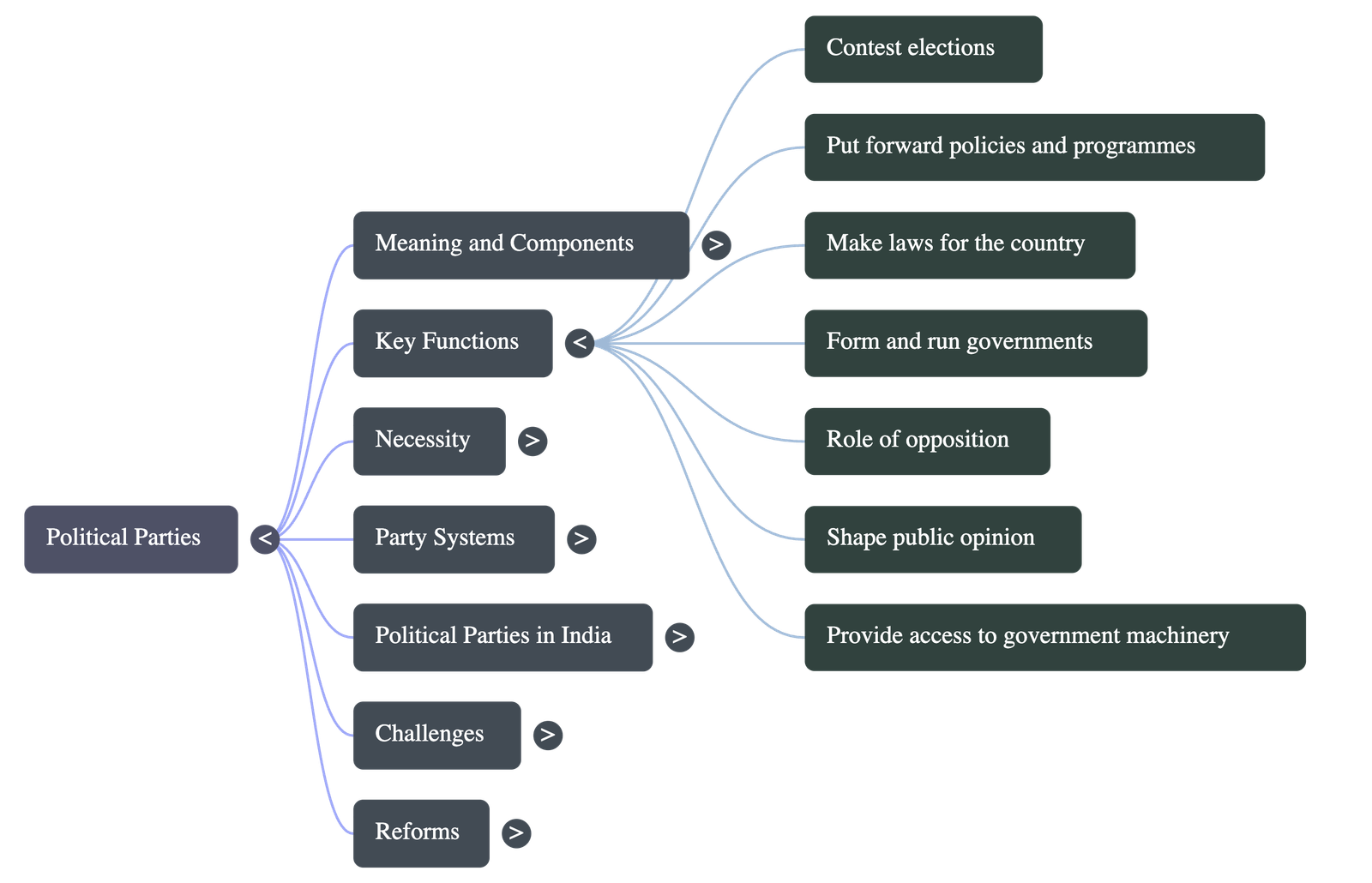
Political parties fill political offices and exercise power by performing the following functions:
- Contesting Elections: Parties select candidates to fight elections (either chosen by members/supporters or by top party leaders).
- Putting Forward Policies: Parties reduce a vast multitude of opinions into a few basic positions that the government can support. Voters choose from these policies.
- Making Laws: Parties play a decisive role in making laws; members usually vote according to the direction of the party leadership.
- Forming Government: Parties recruit leaders, train them, and make them ministers to run the government.
- Role of Opposition: Losing parties voice different views, criticise the government for failures, and mobilise opposition to the ruling party.
- Shaping Public Opinion: They highlight issues, launch movements, and utilize activists spread across the country.
- Access to Welfare Schemes: For ordinary citizens, local party leaders serve as a link to government machinery and welfare schemes.
3. Party Systems
- One-Party System: Only one party is allowed to control and run the government (e.g., China). This is not considered a democratic option.
- Two-Party System: Power usually changes between two main parties, though others may exist (e.g., USA, UK).
- Multi-Party System: Several parties compete for power, and more than two have a reasonable chance of coming to power, often through coalitions (e.g., India).
- Note: When several parties join hands to contest elections, it is called an Alliance or Front (e.g., NDA, UPA, Left Front).
4. National and State Parties in India
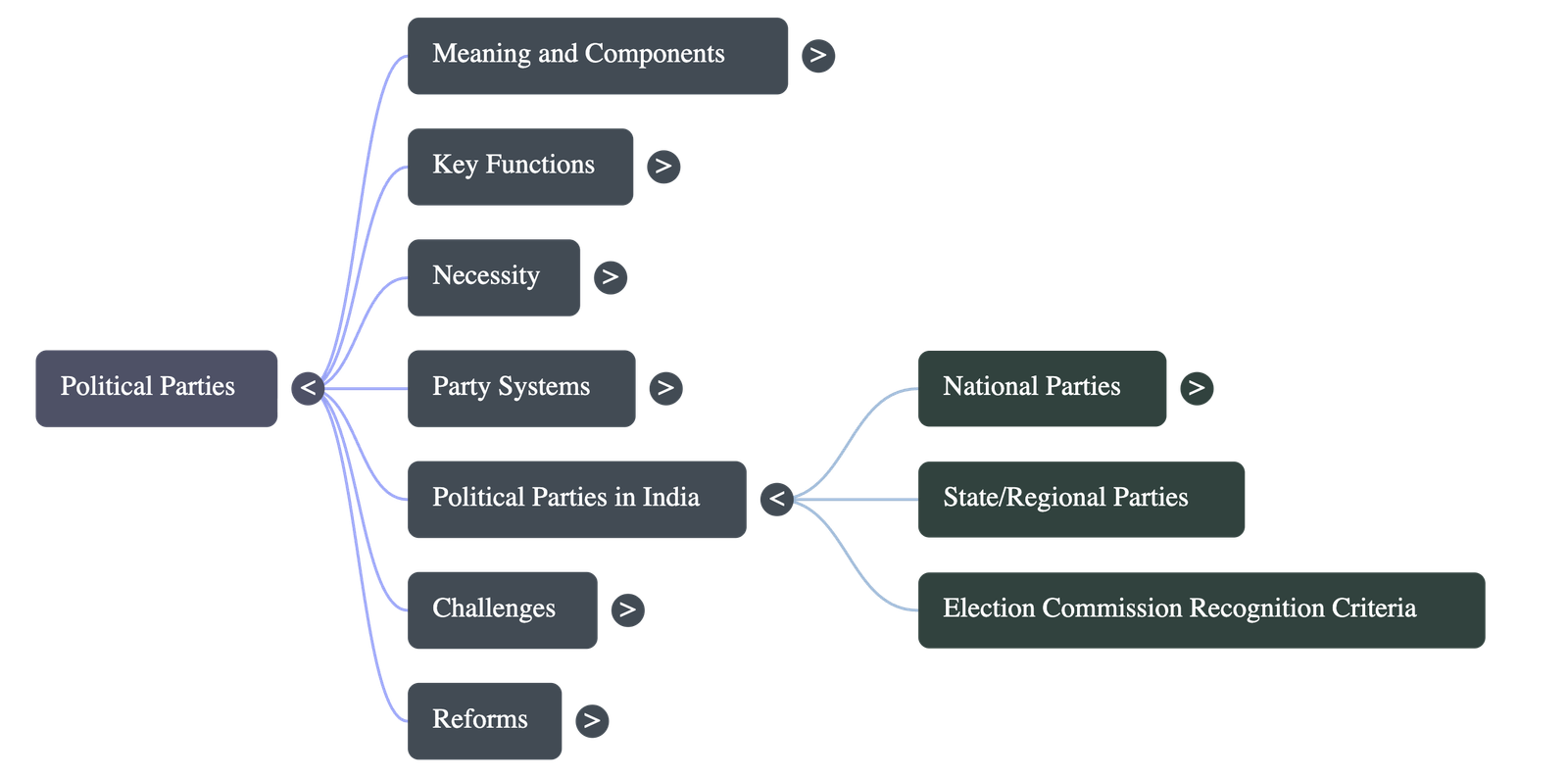
Recognition Criteria
- State Party: Secures at least 6% of total votes in an election to the Legislative Assembly of a State and wins at least 2 seats.
- National Party: Secures at least 6% of total votes in Lok Sabha elections OR Assembly elections in four States and wins at least 4 seats in the Lok Sabha.
Major National Parties (as of 2019/recent data)
- Bharatiya Janata Party (BJP): Founded in 1980. Inspires from India’s ancient culture and values. Core concepts include cultural nationalism (Hindutva) and integral humanism. Leads the NDA.
- Indian National Congress (INC): One of the oldest parties (founded 1885). Supports secularism and welfare of weaker sections. Centrist ideology. Leads the UPA.
- Bahujan Samaj Party (BSP): Formed in 1984. Represents the Bahujan Samaj (Dalits, Adivasis, OBCs, religious minorities). Inspired by Ambedkar, Phule, and Periyar.
- Communist Party of India - Marxist (CPI-M): Founded in 1964. Believes in Marxism-Leninism, socialism, and secularism. Opposes imperialism and communalism. Strong in West Bengal, Kerala, Tripura.
- Aam Aadmi Party (AAP): Formed in 2012 following the anti-corruption movement. Focuses on accountability, transparency, and good governance.
- National People’s Party (NPP): The first national party from North East India. Focuses on the specific challenges of the region.
State Parties
Also known as regional parties. They may be all-India parties that only succeed in specific states (like Samajwadi Party) or parties conscious of state identity (like Biju Janata Dal). The rise of state parties has strengthened federalism in India.
5. Challenges to Political Parties
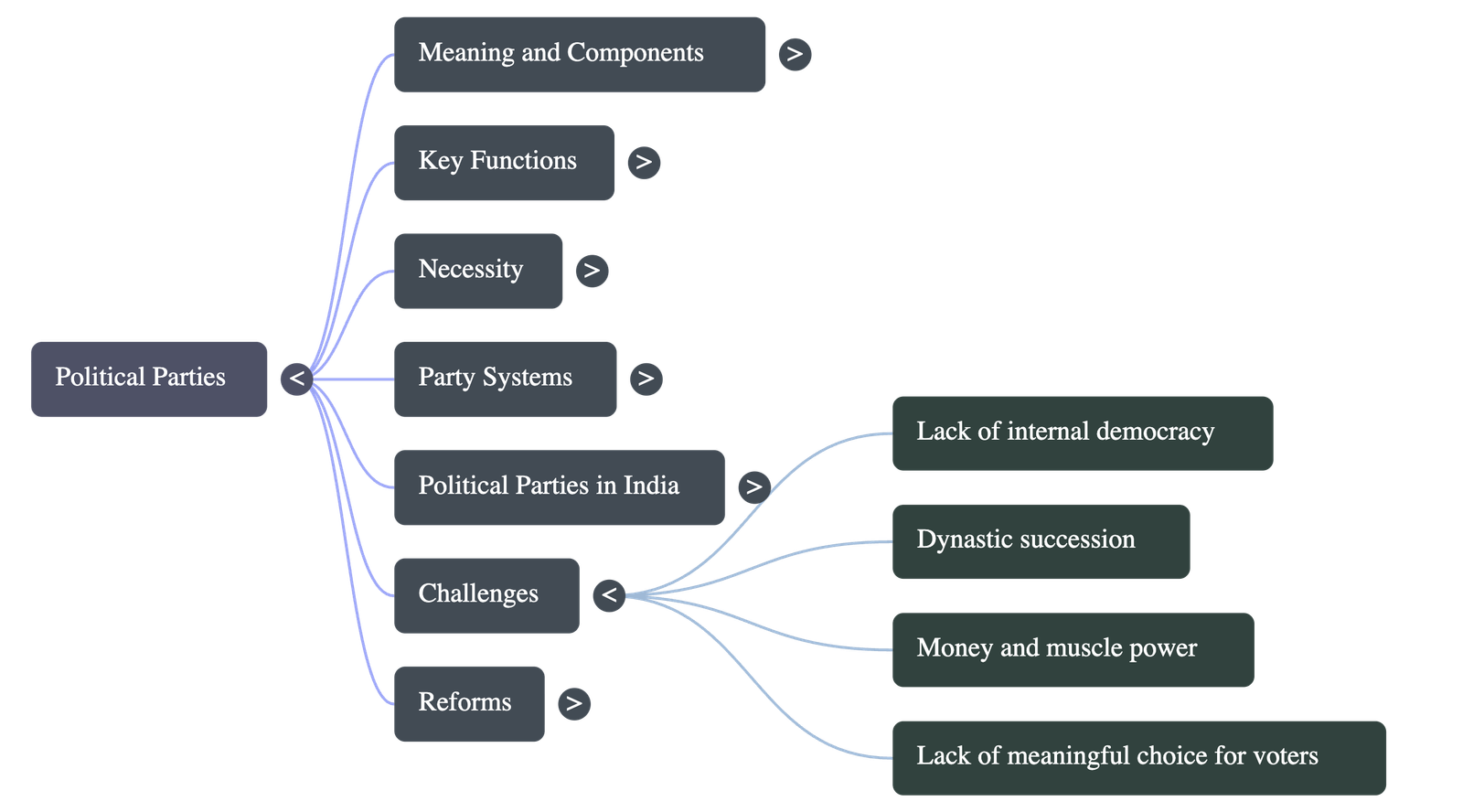
- Lack of Internal Democracy: Power is concentrated in a few top leaders. Ordinary members do not have information or influence. Internal elections are rarely held.
- Dynastic Succession: Top positions are often controlled by members of one family, making it difficult for ordinary workers to rise. This leads to leaders without adequate experience or popular support.
- Money and Muscle Power: Parties focus on winning elections by nominating rich candidates or those with criminal records. Corporate funders may influence policy.
- Lack of Meaningful Choice: Ideological differences between parties have declined globally. Voters often have no distinct options regarding policies or leaders.
6. Reforming Political Parties
Recent Efforts
- Anti-Defection Law: Prevents elected MLAs and MPs from changing parties to stop defection for money or ministries.
- Supreme Court Order: Mandatory for candidates to file an affidavit regarding property and criminal cases.
- Election Commission Order: Mandatory for parties to hold organizational elections and file income tax returns.
Suggestions for Future Reforms
- Internal Affairs Law: Regulate internal affairs, maintain member registers, and hold open elections for top posts.
- Women’s Reservation: Mandatory quota (about one-third) for women in ticket distribution and decision-making bodies.
- State Funding of Elections: Government should provide support (cash or kind) to reduce the influence of big money.
- Public Participation: Ordinary citizens, pressure groups, and media can force parties to reform through petitions, publicity, and agitations.
Do checkout all questions & answers of this chapter.
Quick Navigation:
| | |
1 / 1
Quick Navigation:
| | |