Quick Navigation:
| | |
Federalism
1. What is Federalism?
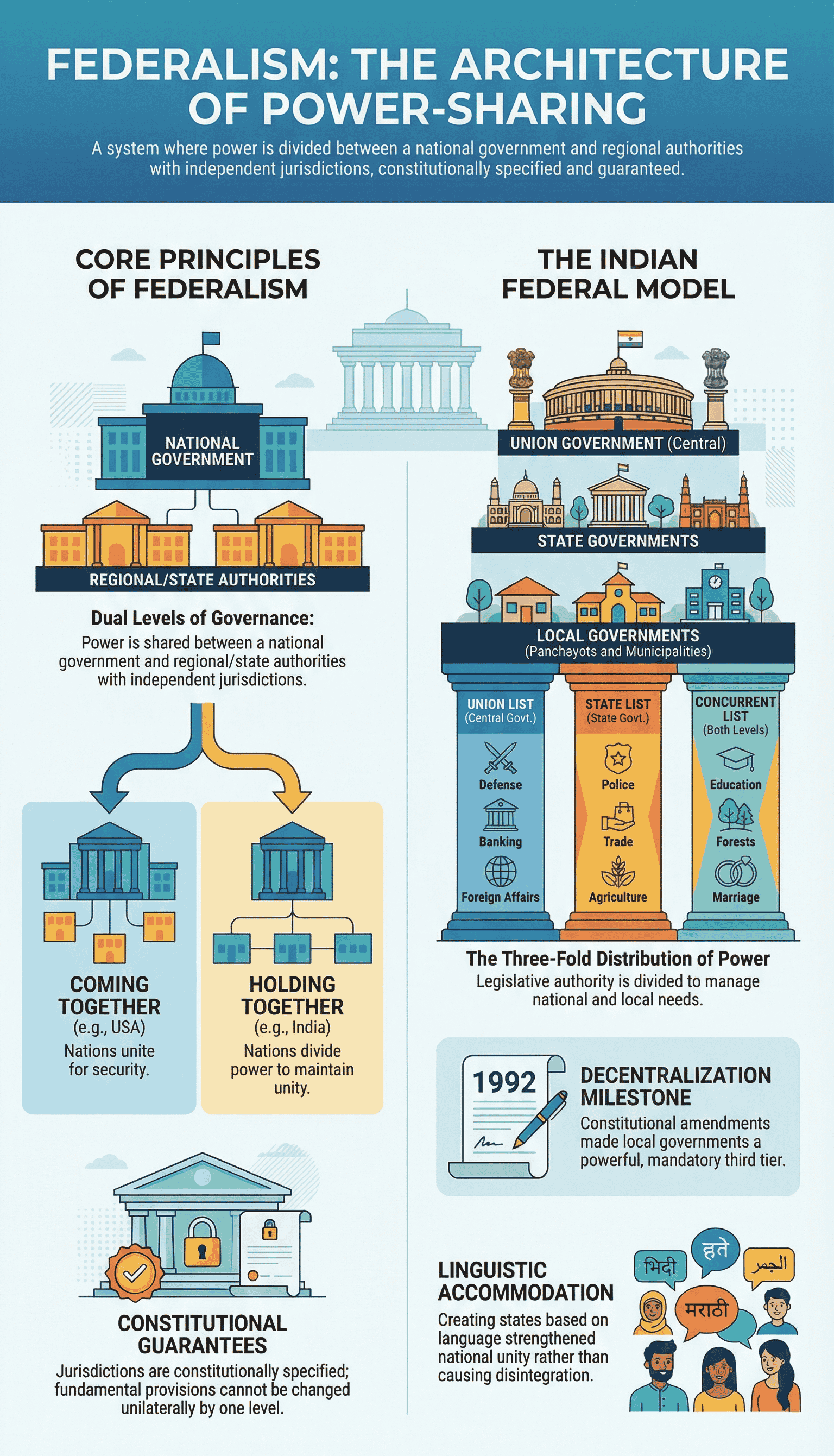
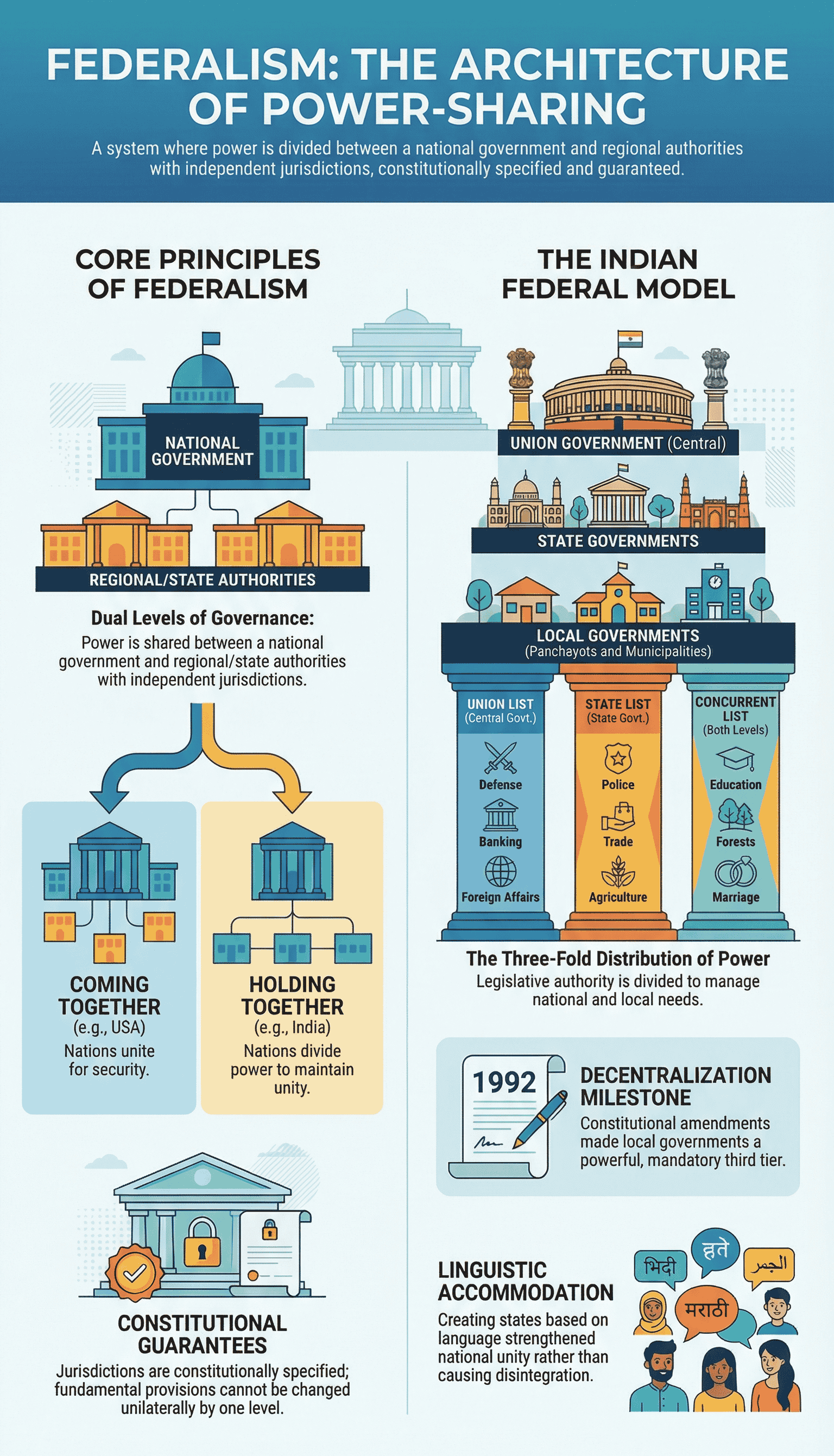
- Definition: Federalism is a system of government where power is divided between a central authority and various constituent units of the country.
- Levels of Government: usually consists of two levels:
- One government for the entire country responsible for subjects of common national interest.
- Governments at the level of provinces or states that look after day-to-day administration.
- Autonomy: Both levels of government enjoy their power independent of the other.
- Contrast with Unitary System: In a unitary system, there is one level of government or sub-units are subordinate. The central government can order the local government. In a federal system, the central government cannot order the state government to do something; the state has its own powers and answers to the people, not the centre.
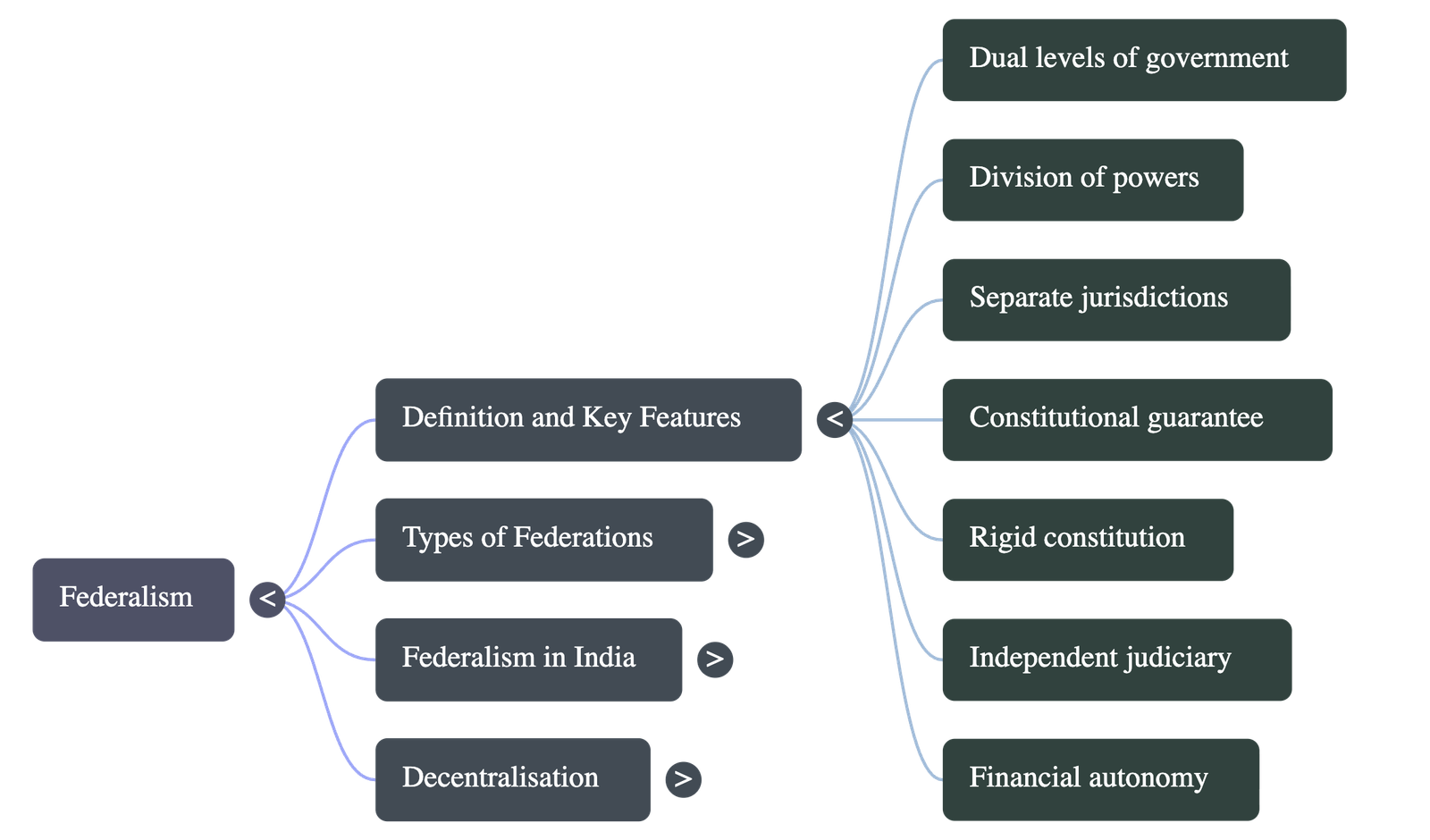
2. Key Features of Federalism
- There are two or more levels (or tiers) of government.
- Different tiers govern the same citizens, but each has its own jurisdiction in legislation, taxation, and administration.
- The existence and authority of each tier are constitutionally guaranteed.
- Fundamental constitutional provisions cannot be unilaterally changed by one level of government; they require the consent of both levels.
- Courts have the power to interpret the constitution and powers of different levels. The highest court acts as an umpire in disputes.
- Sources of revenue for each level are clearly specified to ensure financial autonomy.
- Dual Objectives: To safeguard and promote the unity of the country while accommodating regional diversity.
3. Types of Federations
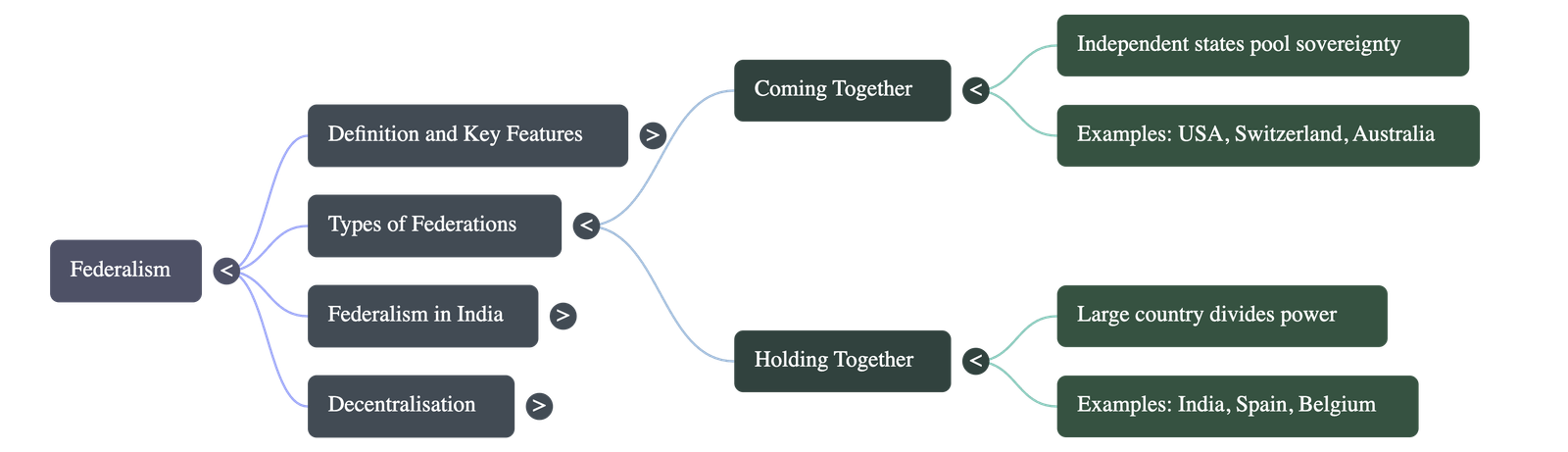
- Coming Together Federations:
- Independent states come together on their own to form a bigger unit.
- They pool sovereignty and retain identity to increase security.
- Constituent states usually have equal power and are strong vis-à-vis the federal government.
- Examples: USA, Switzerland, Australia.
- Holding Together Federations:
- A large country decides to divide its power between the constituent states and the national government.
- The central government tends to be more powerful vis-à-vis the states.
- Constituent units often have unequal powers; some are granted special powers.
- Examples: India, Spain, Belgium.
4. What Makes India a Federal Country?
- Union of States: The Constitution declared India a Union of States based on federal principles.
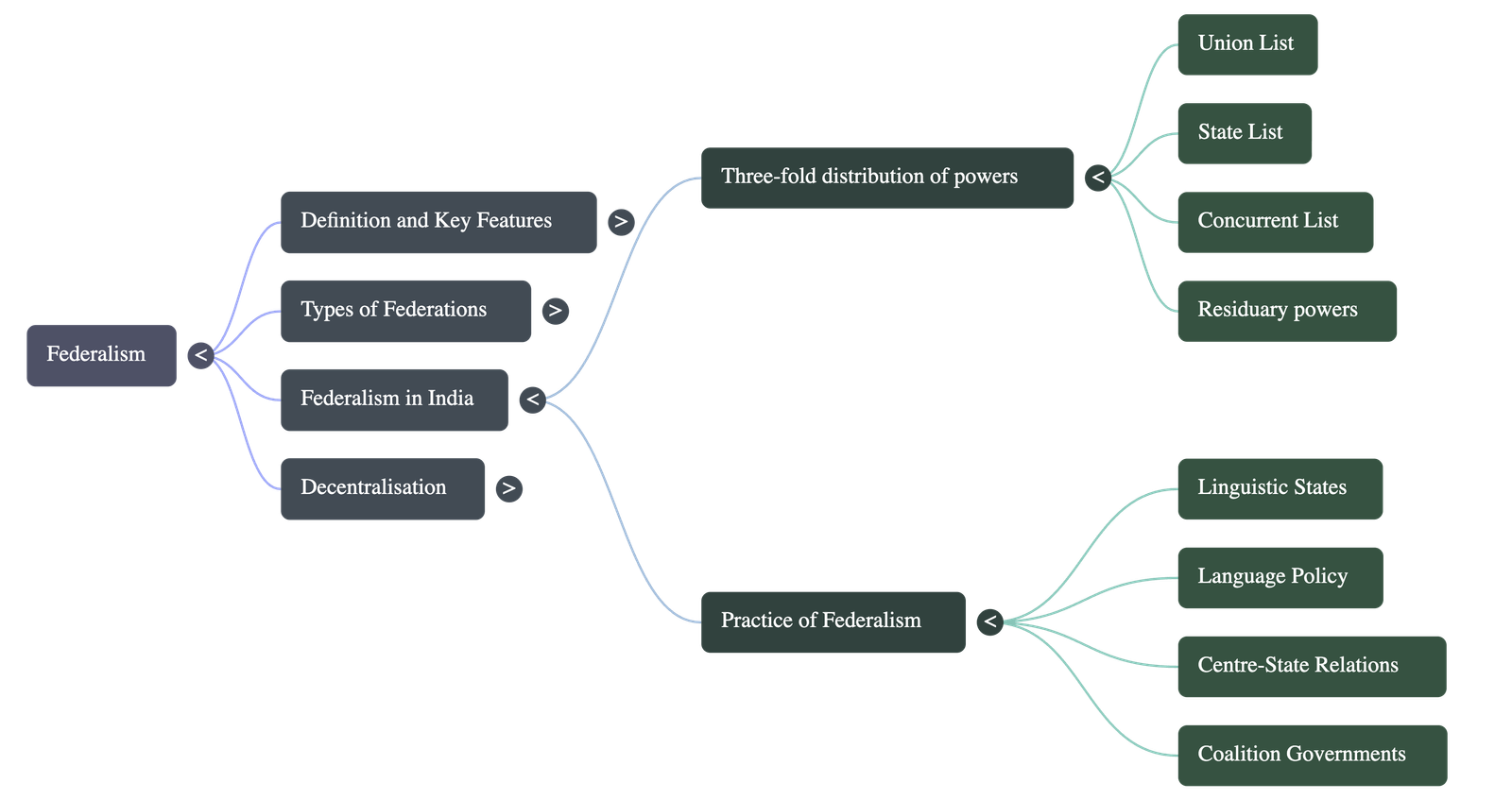
- Three-fold Distribution of Legislative Powers:
- Union List: Subjects of national importance (defence, foreign affairs, banking, currency). The Union Government alone can make laws.
- State List: Subjects of state and local importance (police, trade, agriculture, irrigation). State Governments alone can make laws.
- Concurrent List: Subjects of common interest (education, forest, marriage, trade unions). Both can make laws, but if they conflict, the Union law prevails.
- Residuary Subjects: Subjects not in any list (e.g., computer software) fall under the Union Government's jurisdiction.
- Special Status: Some states (e.g., Assam, Nagaland, Mizoram, Arunachal Pradesh) enjoy special powers under Article 371 regarding land rights, culture, and employment due to historical circumstances.
- Union Territories: Areas too small to be independent states but not merged with existing states (e.g., Chandigarh, Lakshadweep, Delhi). These are run by the Central Government.
- Rigid Power Sharing: Changes to this arrangement require a two-thirds majority in Parliament and ratification by at least half of the state legislatures.
- Role of Judiciary: The High Courts and Supreme Court oversee constitutional implementation and resolve disputes.
5. How is Federalism Practised in India?
The success of federalism in India is attributed to the nature of democratic politics.
- Linguistic States:
- Boundaries of old states were changed to create new states based on language, culture, ethnicity, or geography.
- Examples: Nagaland, Uttarakhand, Jharkhand.
- Experience has shown this policy has made the country more united and administration easier.
- Language Policy:
- No single language has the status of a national language.
- Hindi: Identified as the official language but is the mother tongue of only about 40% of Indians.
- Scheduled Languages: The Constitution recognizes 22 languages (including Hindi). Candidates for central exams can opt for any of these.
- English: Its use for official purposes was continued after 1965 due to demands from non-Hindi speaking states (like Tamil Nadu).
- The policy is one of flexibility to avoid conflicts like those in Sri Lanka.
- Centre-State Relations:
- Pre-1990: The same party often ruled both Centre and States. Central Government often misused the Constitution to dismiss State governments controlled by rival parties.
- Post-1990: Rise of regional political parties and the era of Coalition Governments at the Centre.
- Major national parties had to ally with regional parties, leading to a new culture of power-sharing and respect for state autonomy.
- Supreme Court judgments made arbitrary dismissal of state governments difficult.
6. Decentralisation in India
- Definition: Taking power from Central and State governments and giving it to local governments.
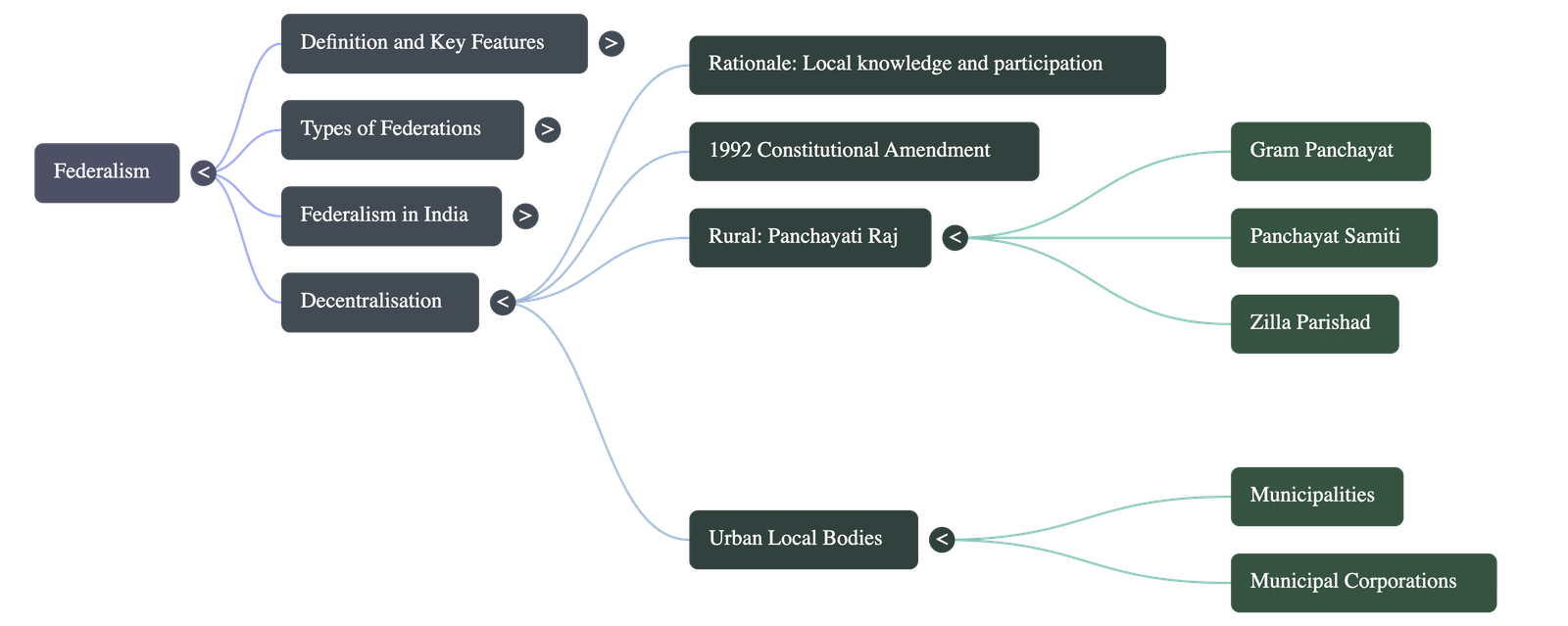
- Rationale: Large states with huge populations and internal diversity; local issues are best settled at the local level with direct people's participation.
- 1992 Constitutional Amendment: A major step that made the third tier of democracy powerful and effective.
- Mandatory regular elections.
- Reservation of seats for SC, ST, and OBCs.
- Reservation of at least one-third of positions for women.
- Creation of State Election Commission.
- Mandatory sharing of powers and revenue by State governments with local bodies.
- Structure of Local Government (Panchayati Raj):
- Village Level: Gram Panchayat (council of ward members/panch and President/Sarpanch). Works under the supervision of Gram Sabha (all voters in the village).
- Block Level: Panchayat Samiti (or Block/Mandal). Elected by panchayat members in the area.
- District Level: Zilla Parishad. Constituted by all Panchayat Samitis in a district. Members include MPs, MLAs, and officials. Chairperson is the political head.
- Urban Local Bodies:
- Municipalities: Set up in towns. Headed by a Municipal Chairperson.
- Municipal Corporations: Set up in big cities. Headed by a Mayor.
- Outcome: It is the largest experiment in democracy in the world, deepening democracy and increasing women's voice. However, challenges remain such as irregular Gram Sabha meetings and lack of adequate resources/powers transferred by states.
Do checkout all questions & answers of this chapter.
Quick Navigation:
| | |
1 / 1
Quick Navigation:
| | |