Quick Navigation:
| | |
Working of Institutions
Overview
Democracy involves more than just electing rulers; it requires rulers to follow established rules and work within institutions. This chapter examines how major policy decisions are taken and implemented through the Legislature, Executive, and Judiciary.
1. How is a Major Policy Decision Taken?
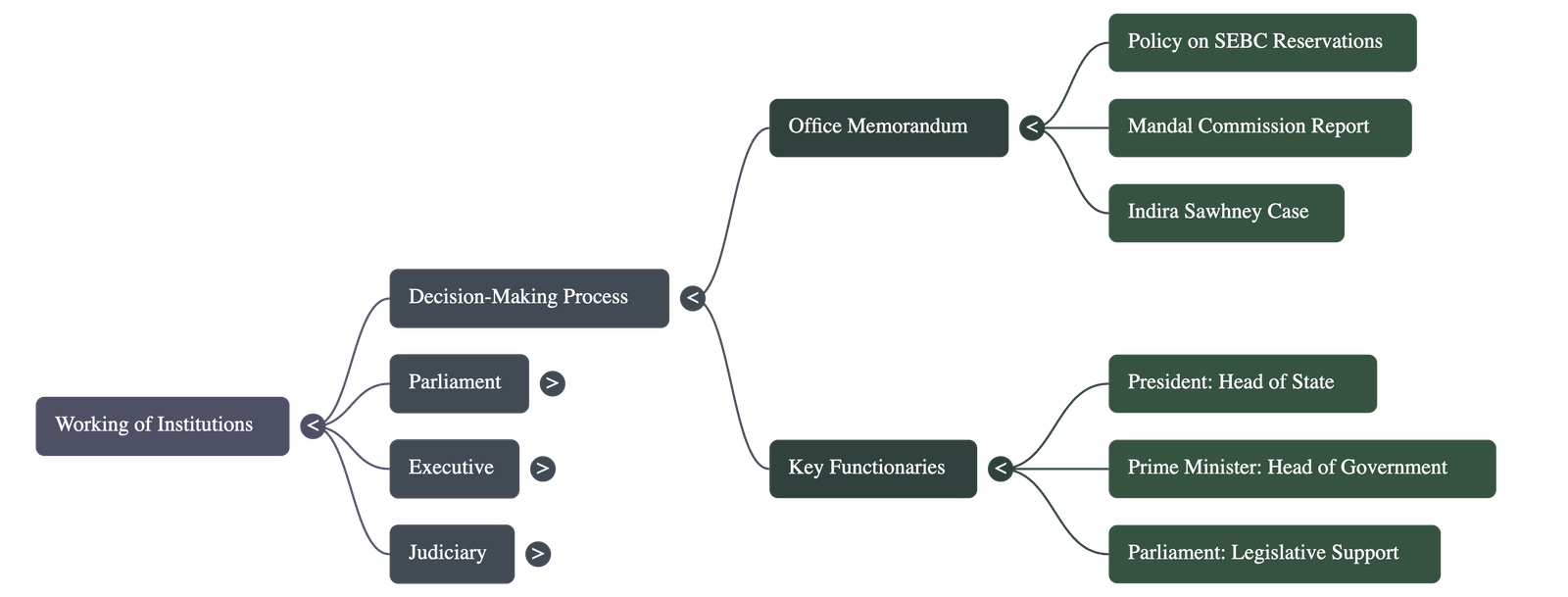
- The Government Order (Office Memorandum): The chapter begins with an example of an Office Memorandum issued on August 13, 1990. It announced a 27% reservation in civil posts and services for Socially and Educationally Backward Classes (SEBC).
- The Mandal Commission: The order was the culmination of the Second Backward Classes Commission, headed by B.P. Mandal (appointed in 1979). The commission recommended reserving 27% of government jobs for backward classes.
- Political Implementation: The Janata Dal party promised to implement these recommendations in their 1989 election manifesto. Upon forming the government, Prime Minister V.P. Singh announced the decision to Parliament, leading to the issuance of the order.
- Conflict and Resolution: The decision sparked widespread protests and debate. Opponents challenged it in court. The Supreme Court, in the Indira Sawhney and others Vs Union of India case, upheld the validity of the order but directed the government to exclude well-to-do persons (the "creamy layer") from the benefits.
2. The Need for Political Institutions
- Functions of Government: The government is responsible for security, education, health, and development. To manage these tasks, specific arrangements called "institutions" are made.
- Role of Institutions:
- The Prime Minister and Cabinet: Take important policy decisions.
- Civil Servants: Implement the decisions.
- Supreme Court: Settles disputes between citizens and the government.
- Democratic Spirit: While institutions (meetings, committees, rules) can cause delays, they are essential for democracy because they prevent decision-making by a single person and allow for wider consultation to avoid bad decisions.
3. Parliament
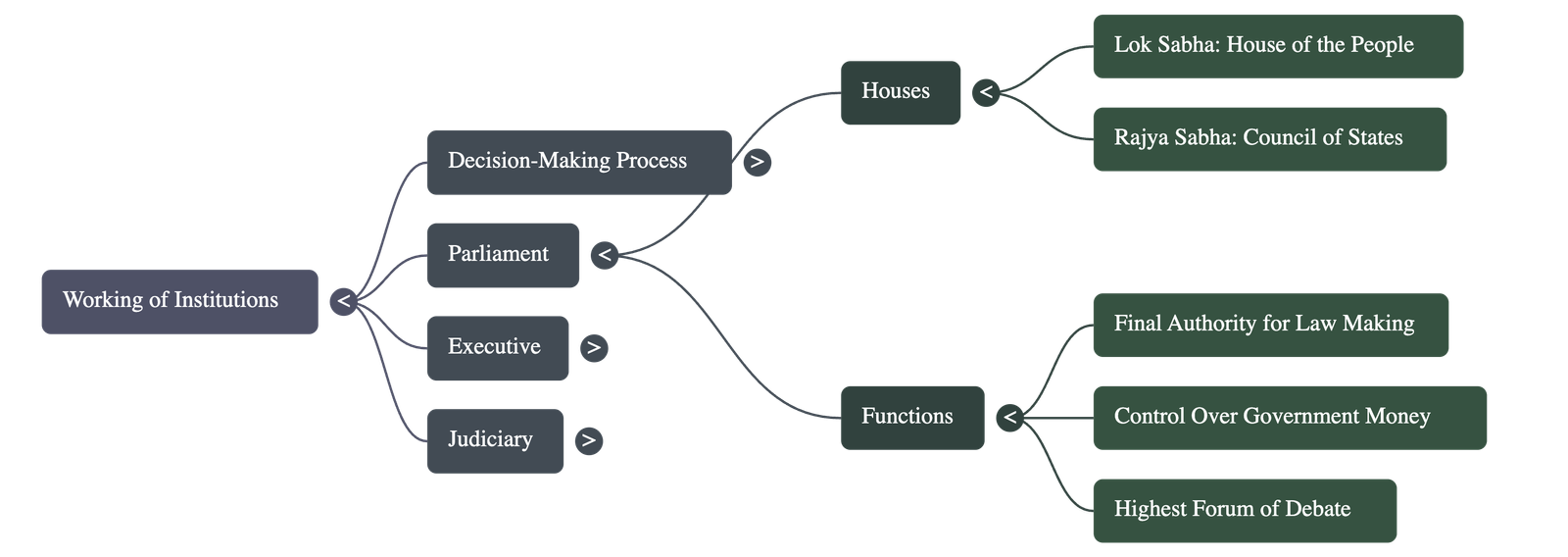
Parliament is the assembly of elected representatives that exercises supreme political authority.
- Functions:
- Law Making: Final authority for making, changing, or abolishing laws.
- Control Government: Those running the government can only stay in power with Parliament's support.
- Financial Control: Public money can only be spent with Parliament's sanction.
- Discussion Forum: Highest forum for debating public issues.
- Two Houses:
- Rajya Sabha (Council of States): Represents the interests of states. Elected indirectly.
- Lok Sabha (House of the People): Directly elected by the people and exercises real power.
- Supremacy of Lok Sabha:
- In a joint session (used to resolve differences), the Lok Sabha usually prevails due to its larger size.
- Lok Sabha controls the money (budget); Rajya Sabha can only delay money bills by 14 days.
- Lok Sabha controls the Council of Ministers through "No Confidence" motions.
4. Political Executive
The executive consists of functionaries who take day-to-day decisions but do not exercise supreme power.
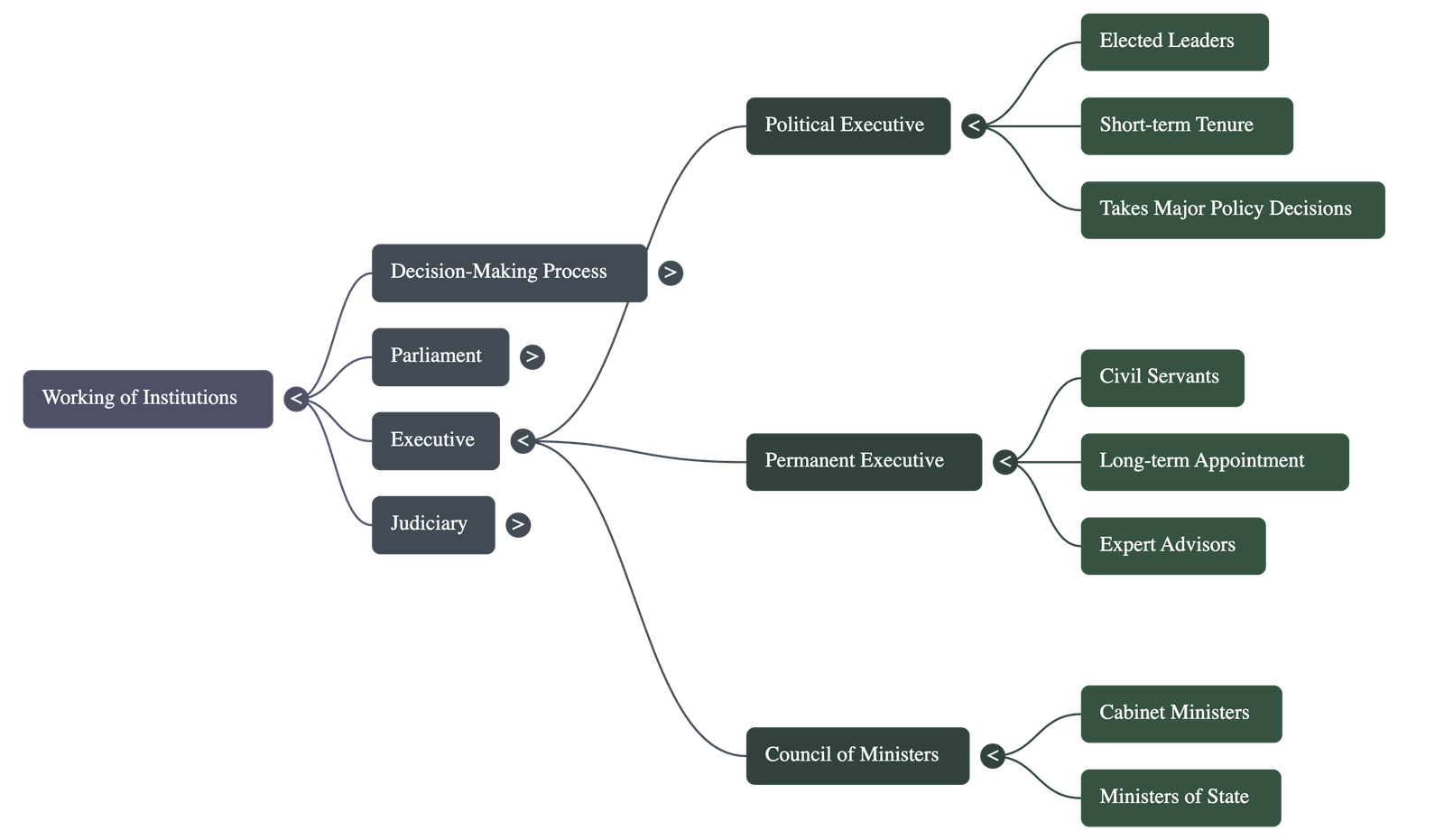
- Political Executive: Elected by the people for a specific period (Ministers). They make the big policy decisions and are answerable to the people.
- Permanent Executive (Civil Services): Appointed on a long-term basis. They are experts who assist the political executive in day-to-day administration.
- Why Ministers Decide: Even though civil servants may be more expert, the Minister decides because they are elected representatives empowered to exercise the will of the people. They decide the destination; experts decide the route.
5. Prime Minister and Council of Ministers
- Appointment: The President appoints the leader of the majority party (or coalition) in the Lok Sabha as the Prime Minister. Other ministers are appointed on the PM's advice.
- Structure of Council of Ministers:
- Cabinet Ministers: Top-level leaders in charge of major ministries; the inner ring that takes key decisions.
- Ministers of State (Independent Charge): In charge of smaller ministries.
- Ministers of State: Assist Cabinet Ministers.
- Powers of the Prime Minister: The PM chairs Cabinet meetings, coordinates work across departments, supervises ministries, and distributes work. If the PM quits, the entire ministry quits.
- Coalition Constraints: In recent times, coalition politics has forced Prime Ministers to accommodate views of alliance partners, limiting their individual authority.
6. The President
- Head of State: The President is the nominal executive, supervising the overall functioning of institutions. The role is largely ceremonial, similar to the Queen of Britain.
- Election: Elected indirectly by Members of Parliament (MPs) and Members of Legislative Assemblies (MLAs).
- Powers: All laws and major policy decisions are issued in the President's name. They appoint the Prime Minister, Chief Justice, Governors, and Election Commissioners. However, these powers are exercised on the advice of the Council of Ministers.
- Discretionary Power: The President can appoint the Prime Minister when no party has a clear majority, choosing the person most likely to secure majority support.
7. The Judiciary
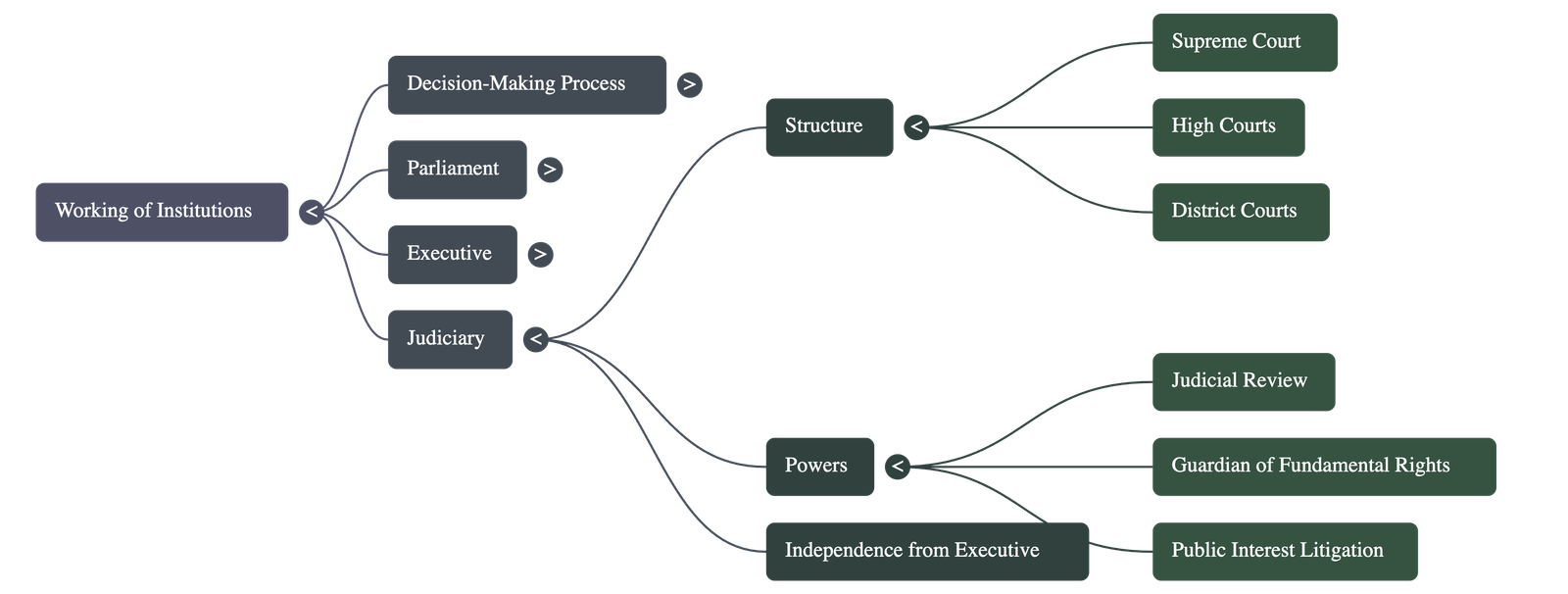
- Structure: India has an integrated judiciary consisting of the Supreme Court (national level), High Courts (state level), District Courts, and local courts. The Supreme Court controls judicial administration.
- Independence: The judiciary is independent of the legislature and executive. Judges are appointed by the President on the advice of the PM and the Chief Justice (senior judges of the Supreme Court). Removal is extremely difficult and requires an impeachment motion.
- Key Powers:
- Dispute Resolution: Between citizens, citizens and government, or different state governments.
- Judicial Review: Can declare any law or executive action invalid if it violates the Constitution.
- Guardian of Rights: Protects Fundamental Rights. Citizens can approach courts via Public Interest Litigation (PIL) if public interest is harmed.
Do checkout all questions & answers of this chapter.
Quick Navigation:
| | |
1 / 1
Quick Navigation:
| | |