Quick Navigation:
| | |
Democratic Rights
1. Introduction: Life Without Rights
To understand the value of rights, the chapter begins by examining real-world situations where citizens lacked basic democratic rights.
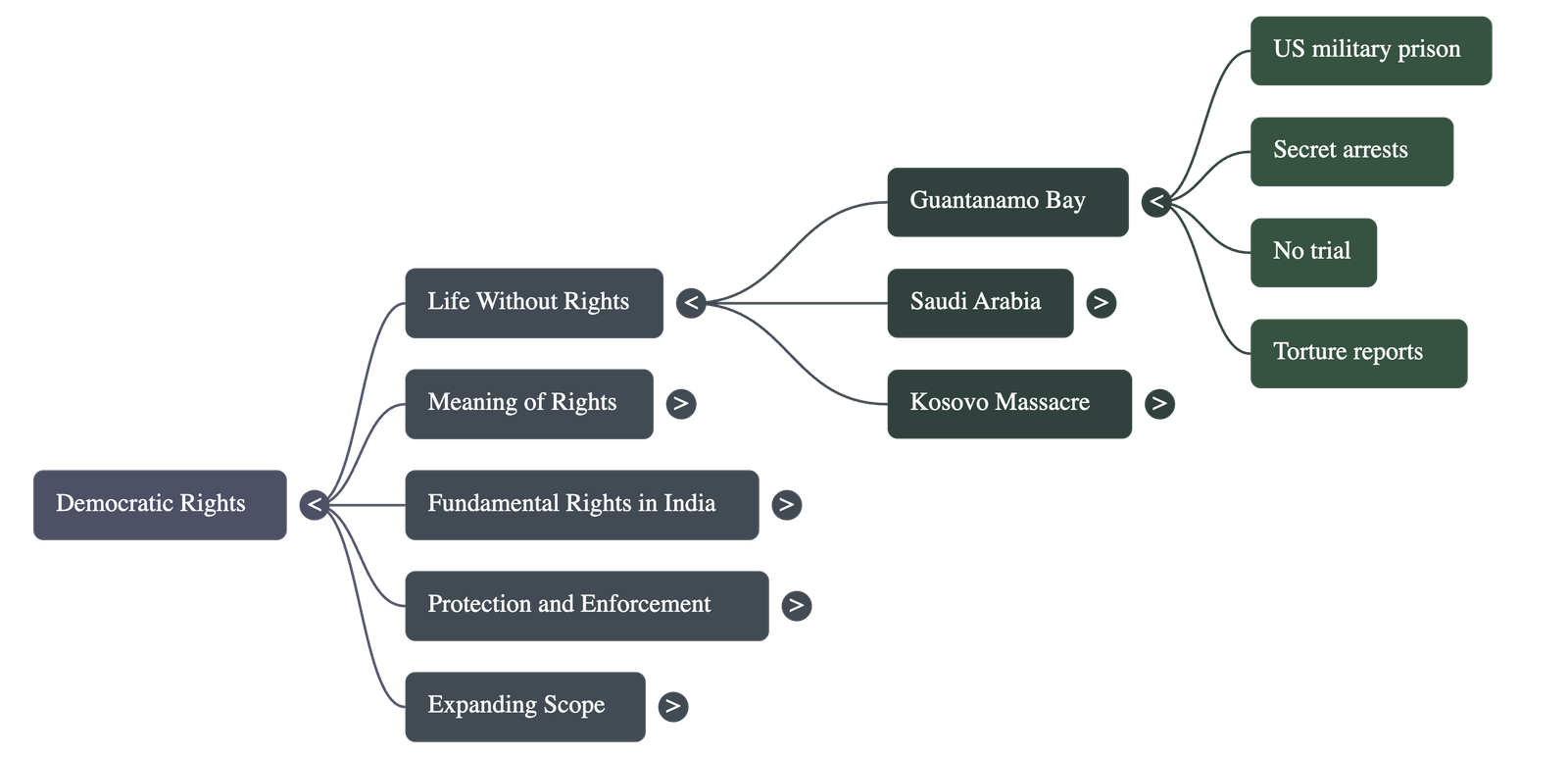
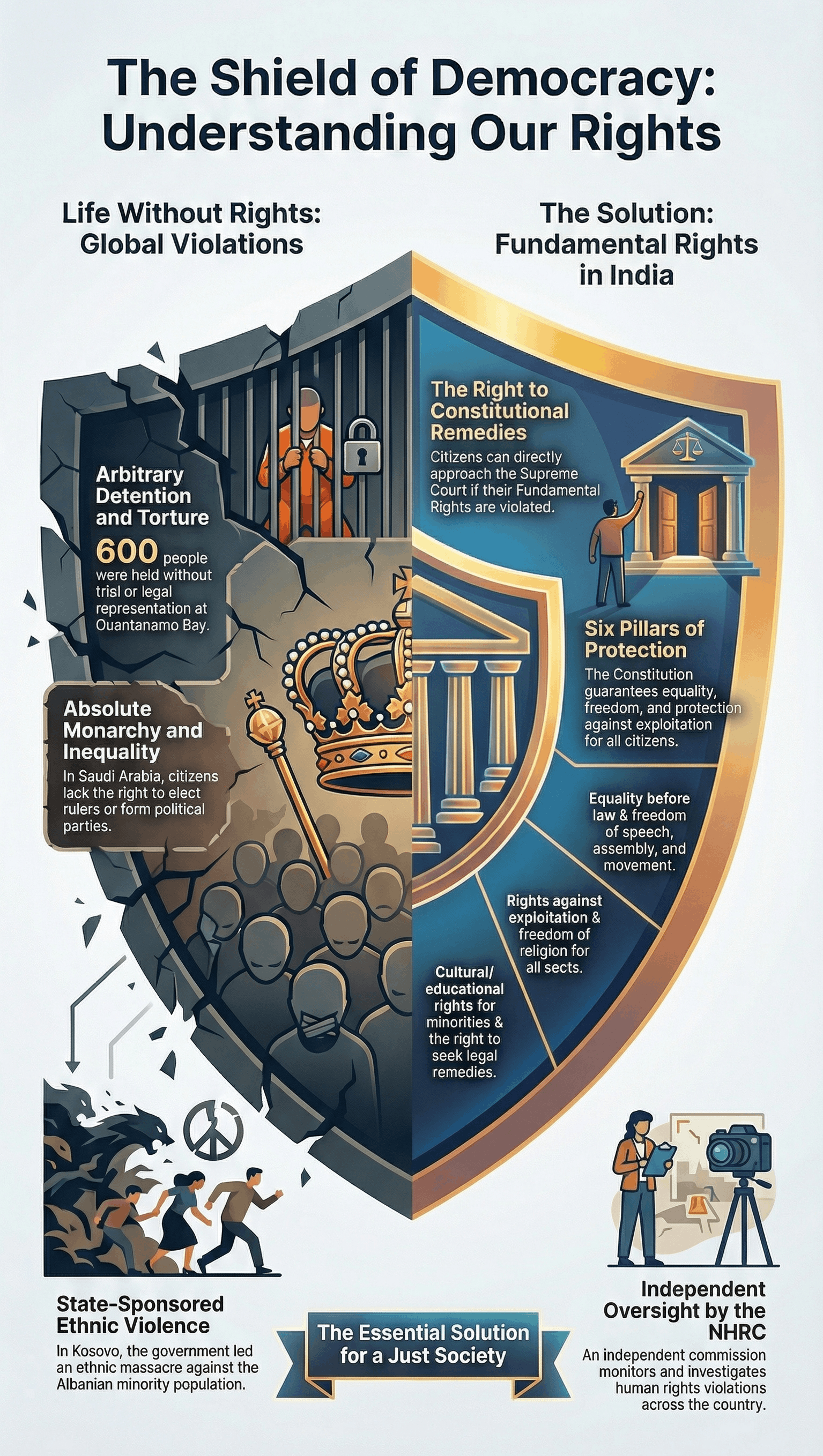
A. Prison in Guantanamo Bay
- Arbitrary Detention: The US forces secretly picked up about 600 people from all over the world and imprisoned them in Guantanamo Bay, Cuba.
- No Legal Recourse: Prisoners were declared "enemies" linked to the 9/11 attacks without trial. Governments of their home countries were often not informed.
- Violation of Rights: There was no trial before a magistrate, and prisoners could not approach courts in the US or their own countries. International organizations like Amnesty International reported torture and violations of international treaties, but the US government refused to close the prison.
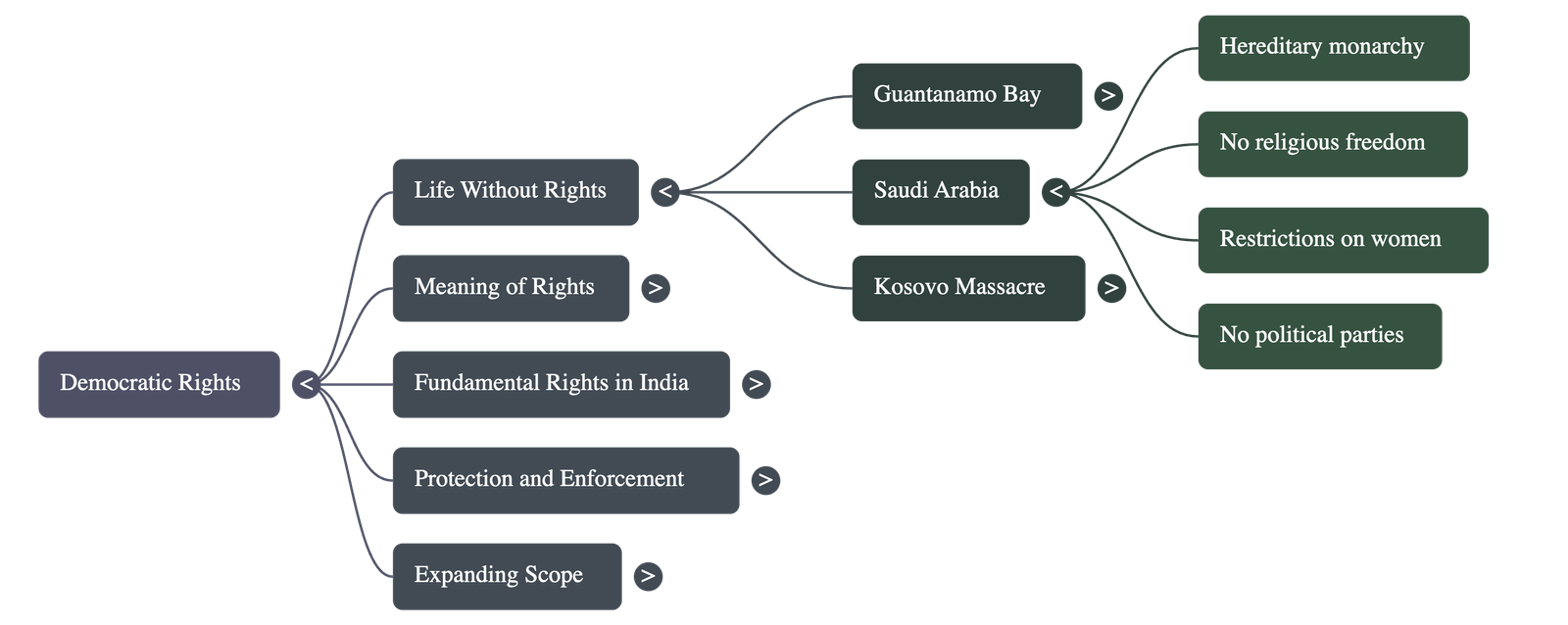
B. Citizens’ Rights in Saudi Arabia
- Lack of Political Rights: The country is ruled by a hereditary king; people have no role in electing rulers. The king appoints the legislature, executive, and judges.
- Restrictions on Civil Liberties: Citizens cannot form political parties. The media acts under censorship.
- Religious Restrictions: There is no freedom of religion; all citizens must be Muslim. Non-Muslims can only practice in private.
- Gender Inequality: Women face severe public restrictions, and the testimony of one man is considered equal to that of two women.
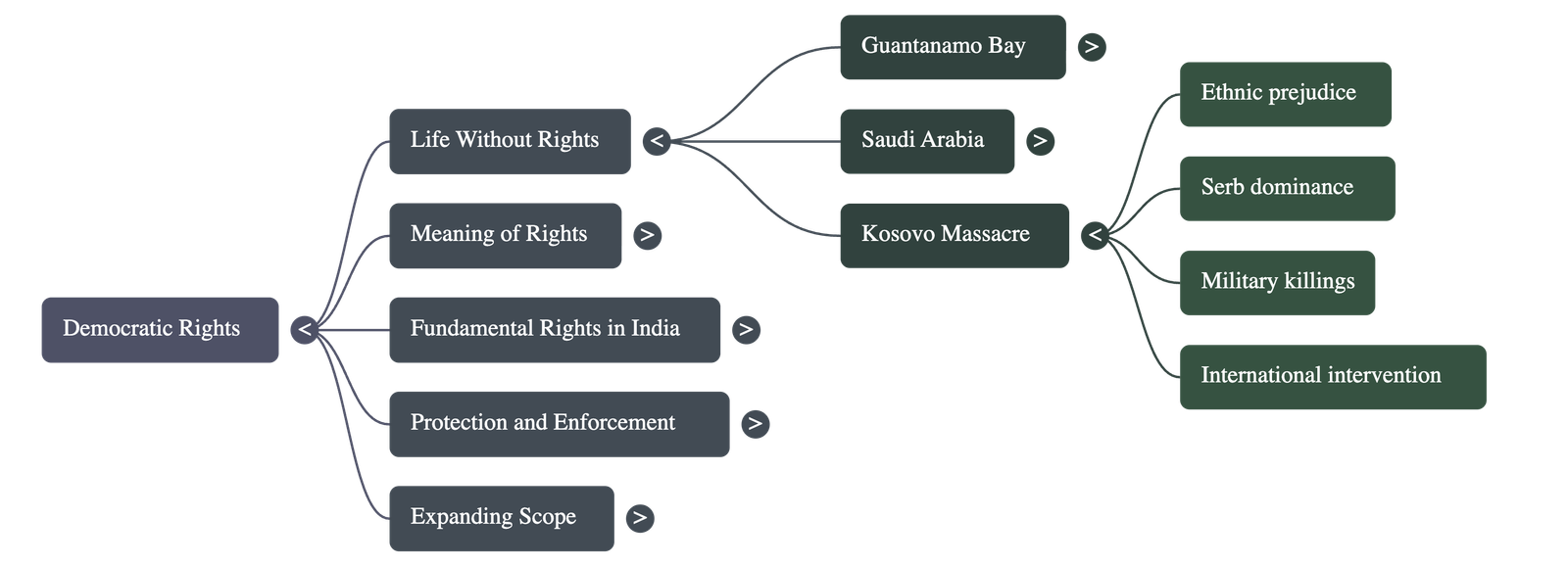
C. Ethnic Massacre in Kosovo
- Majority Tyranny: In the former Yugoslavia, the Serb majority government under Milosevic was hostile toward the ethnic Albanian minority in the province of Kosovo.
- State-Sponsored Violence: The army killed thousands of Albanians to establish Serb dominance. This demonstrates how a democratically elected leader can violate the rights of a minority group.
2. What Are Rights?
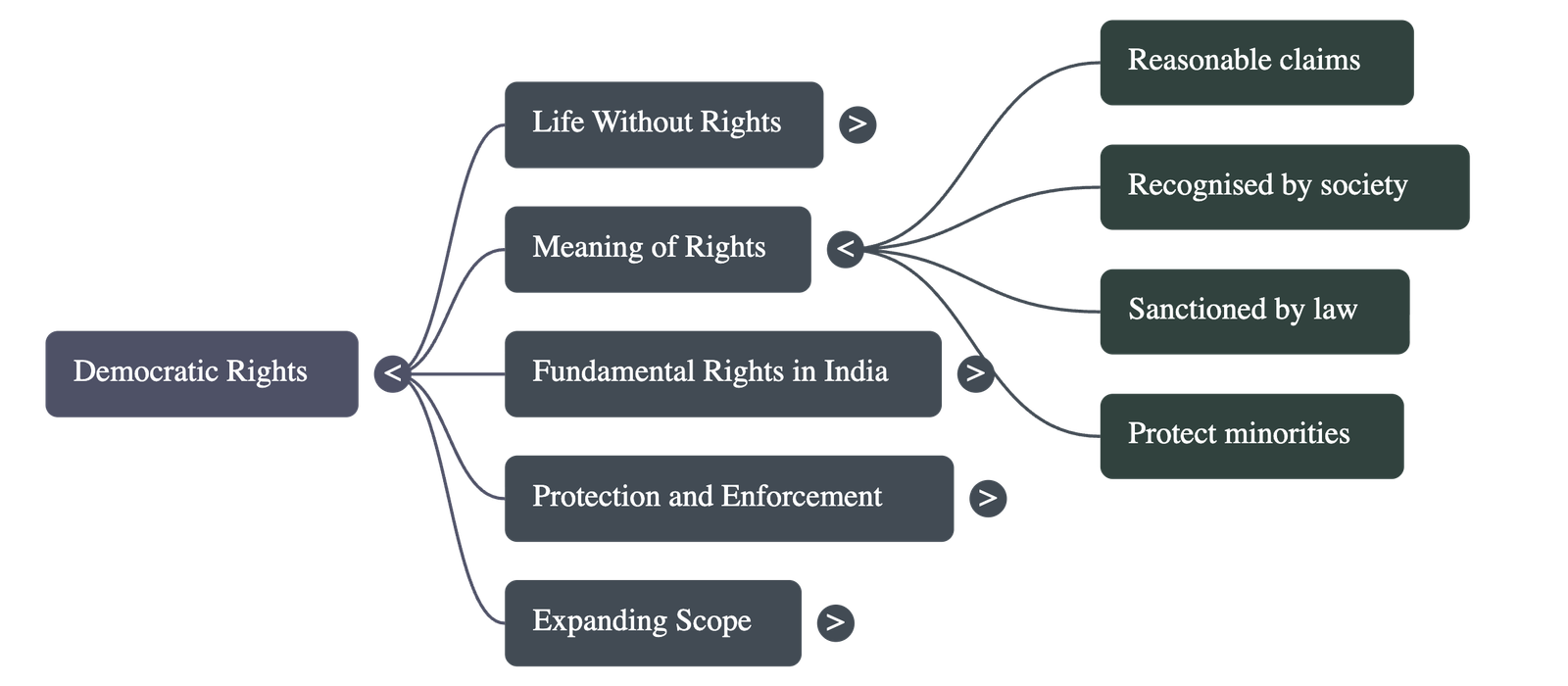
- Definition: Rights are claims of a person over other fellow beings, over the society, and over the government.
- Requirements for a Right:
- Reasonable Claim: The claim must be reasonable and possible for others to also have (e.g., one cannot have a right that harms others).
- Social Recognition: The claim must be recognized by society as rightful.
- Legal Sanction: The claim must be sanctioned by law to be enforceable.
- Role in Democracy: Rights are necessary to sustain democracy (e.g., right to vote, right to express opinions). They protect minorities from the oppression of the majority and serve as a "guarantee" against government excesses.
3. Fundamental Rights in the Indian Constitution
The Indian Constitution provides six Fundamental Rights that act as the bedrock of democracy.
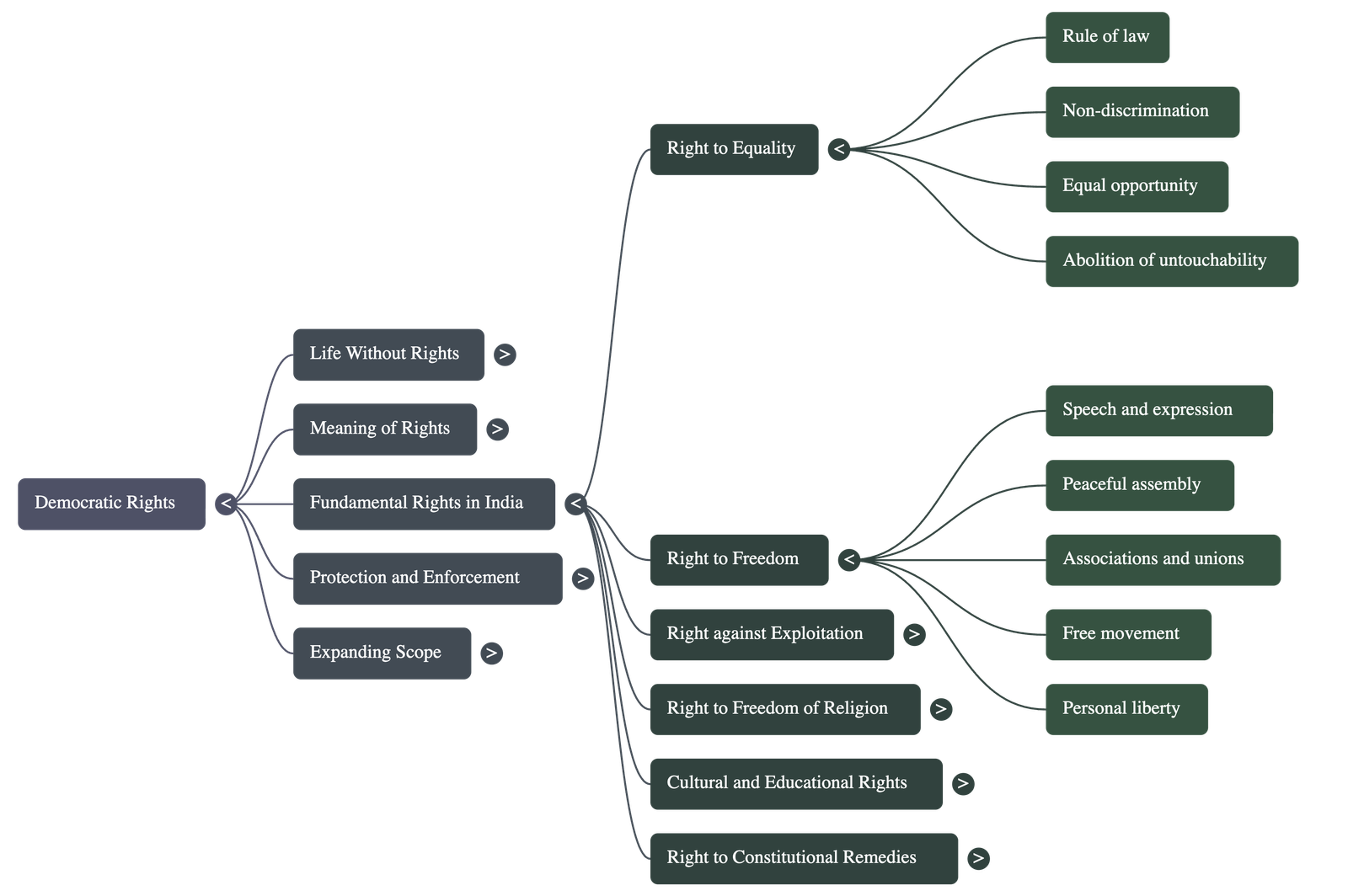
I. Right to Equality
- Rule of Law: Laws apply in the same manner to all, regardless of status. No one is above the law.
- Non-Discrimination: The government cannot discriminate against any citizen on grounds only of religion, race, caste, sex, or place of birth.
- Access to Public Places: All citizens have equal access to shops, hotels, wells, roads, etc.
- Equality of Opportunity: Equal opportunity in public employment. (Note: Reservations for SC, ST, and OBCs are not considered a violation of this right as they aim to ensure equal opportunity).
- Abolition of Untouchability: The practice of untouchability is forbidden in any form and is a punishable offense.
II. Right to Freedom
Freedom implies the absence of constraints. Citizens have the right to:
- Freedom of speech and expression.
- Assembly in a peaceful manner.
- Form associations and unions.
- Move freely throughout the country.
- Reside in any part of the country.
- Practice any profession, trade, or business.
Note: These freedoms are not unlimited; the government can impose reasonable restrictions in the interest of society. Also, no person can be deprived of life or personal liberty except according to the procedure established by law.
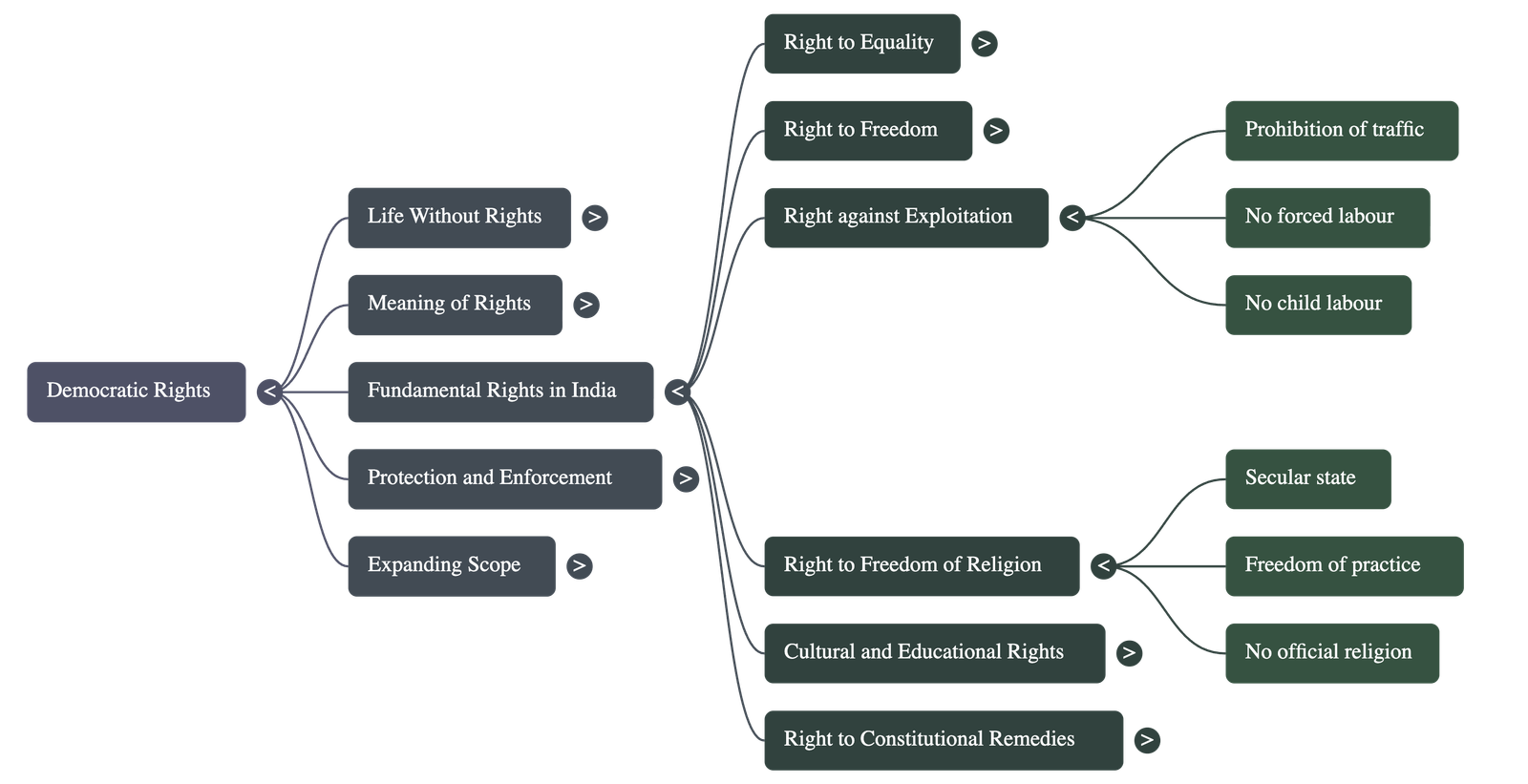
III. Right against Exploitation
- Prohibition of Human Trafficking: Buying and selling of human beings is illegal.
- Prohibition of Forced Labour (Begar): Forcing workers to work without payment or against their will is banned.
- Prohibition of Child Labour: No child below the age of 14 can be employed in factories, mines, or hazardous work.
IV. Right to Freedom of Religion
- Secularism: India is a secular state, meaning it does not establish any official religion.
- Freedom to Practice: Every person has the right to profess, practice, and propagate the religion of their choice.
- No Forcible Conversion: The right to propagate does not include the right to force conversions through fraud or inducement.
- No Religious Instruction in State Schools: Government educational institutions cannot provide religious instruction.
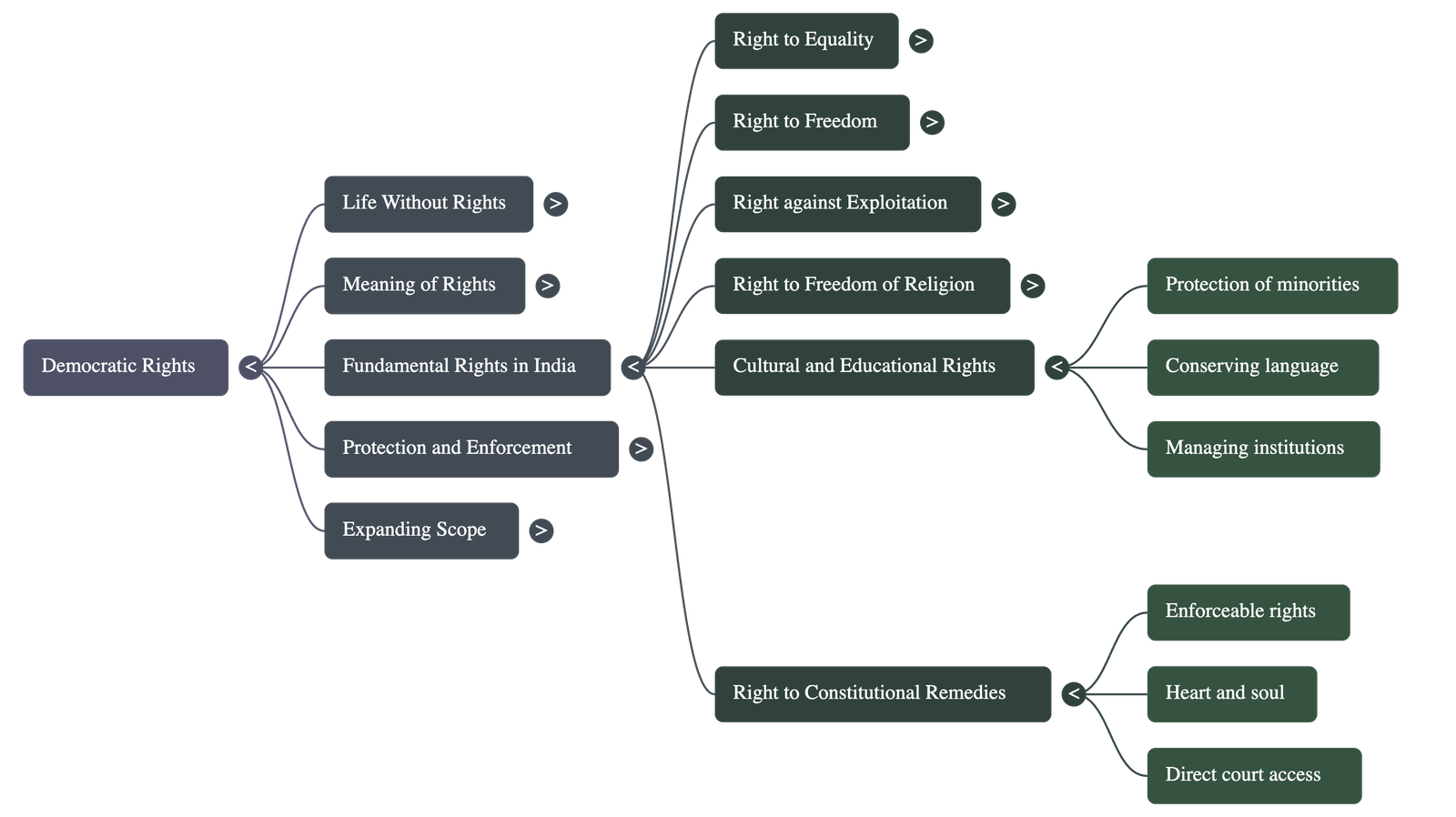
V. Cultural and Educational Rights
Minorities need special protection to preserve their identity.
- Protection of Culture: Any section of citizens with a distinct language or culture has the right to conserve it.
- Educational Institutions: Minorities (religious or linguistic) have the right to establish and administer their own educational institutions.
- Non-Discrimination in Admission: Government-aided institutions cannot deny admission based on religion or language.
VI. Right to Constitutional Remedies
- Enforcement: This right makes other rights effective. If a Fundamental Right is violated, a citizen can approach the High Court or Supreme Court directly.
- Heart and Soul: Dr. B.R. Ambedkar called this the "heart and soul" of the Constitution.
- Writs: Courts can issue writs (orders) to enforce rights.
- Public Interest Litigation (PIL): Any citizen or group can approach the court on behalf of others if the public interest is harmed by a violation of rights.
4. Institutions Protecting Rights
National Human Rights Commission (NHRC):
- Independent Body: Set up in 1993, independent of the government.
- Role: Inquires into violations of human rights (including rights in the Constitution and international treaties).
- Powers: Can summon witnesses, question officials, and visit prisons. It cannot punish the guilty but makes recommendations to the government or courts.
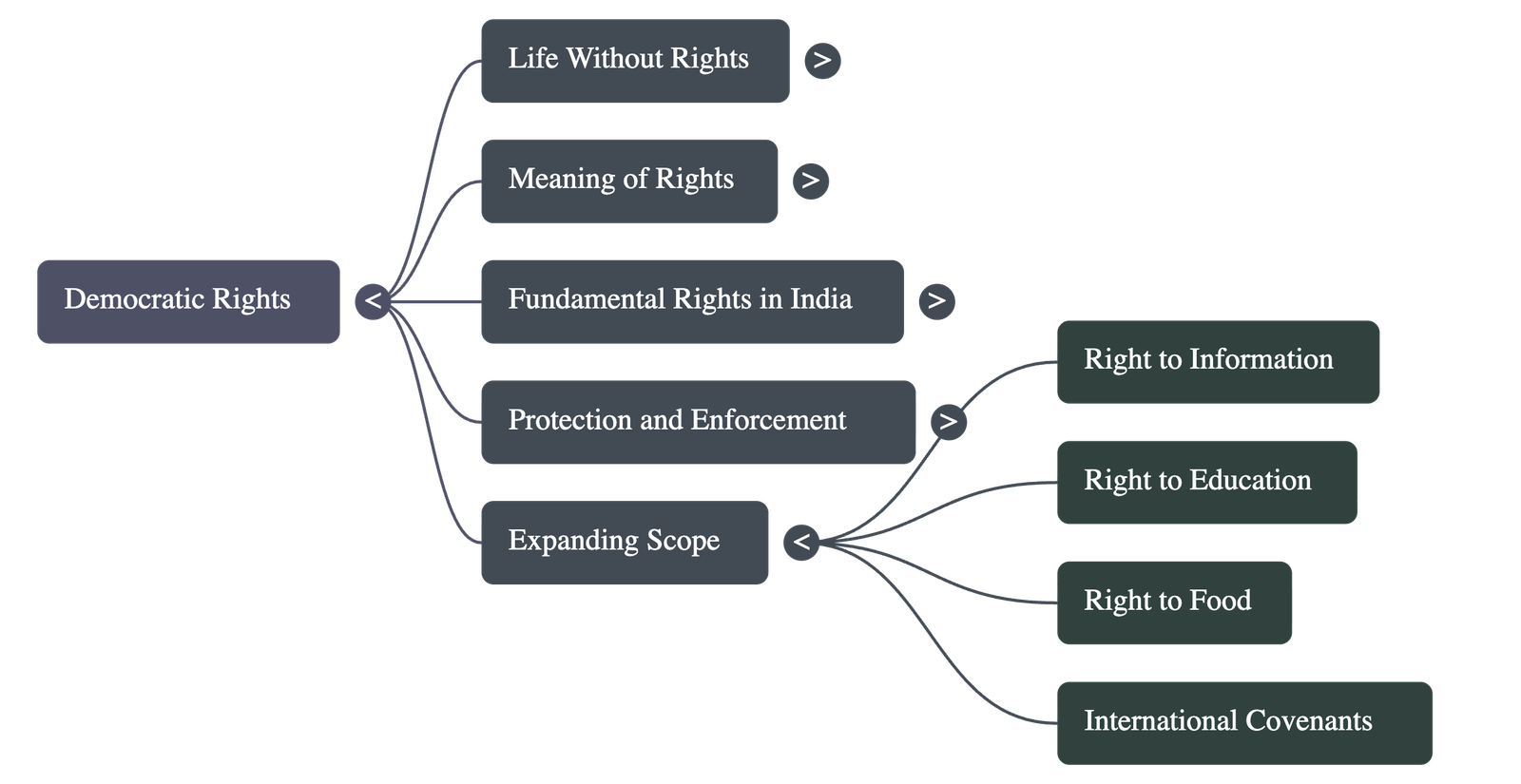
5. Expanding Scope of Rights
The definition of rights is not static; it evolves over time.
- Derived Rights: Courts have derived new rights from Fundamental Rights, such as the Right to Freedom of Press, Right to Information (RTI), and Right to Education.
- Right to Life Expansion: The Supreme Court has interpreted the Right to Life to include the Right to Food.
- Constitutional Rights (Non-Fundamental): Some rights, like the Right to Property and the Right to Vote, are constitutional rights but not Fundamental Rights.
- International Standards: International Covenants (like the Covenant on Economic, Social and Cultural Rights) recognize rights such as the right to work, health, and adequate standard of living, which puts pressure on governments to expand legal rights.
- New Rights: New constitutions (like South Africa's) guarantee newer rights, such as the right to privacy, a healthy environment, and adequate housing.
Do checkout all questions & answers of this chapter.
Quick Navigation:
| | |
1 / 1
Quick Navigation:
| | |