Quick Navigation:
| | |
Chapter 2: Constitutional Design
Overview
In a democracy, rulers are not free to do whatever they like. There are basic rules that citizens and the government must follow. These rules constitute the Constitution. It determines the rights of citizens, the powers of the government, and how the government should function.
1. Democratic Constitution in South Africa
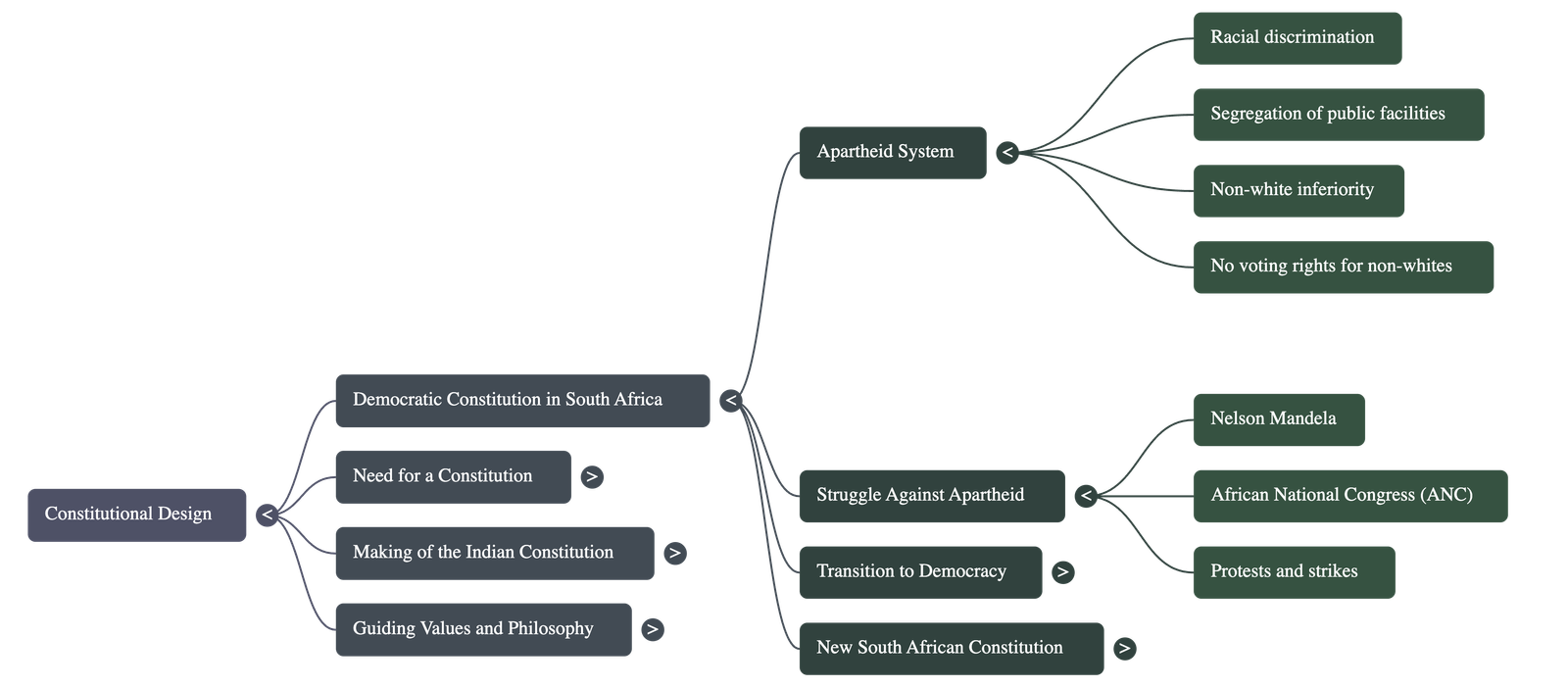
The Struggle Against Apartheid
- Apartheid System: A system of racial discrimination unique to South Africa imposed by white Europeans. It divided people based on skin colour into Whites, Blacks (natives), Coloured (mixed race), and Indians.
- Oppression: The system was particularly oppressive for blacks. They were forbidden from living in white areas, had no voting rights, and public facilities were segregated (a policy called segregation).
- Resistance: Since 1950, the African National Congress (ANC) led the struggle against segregation. Nelson Mandela and seven other leaders were sentenced to life imprisonment in 1964 for opposing the regime.
The Transition to Democracy
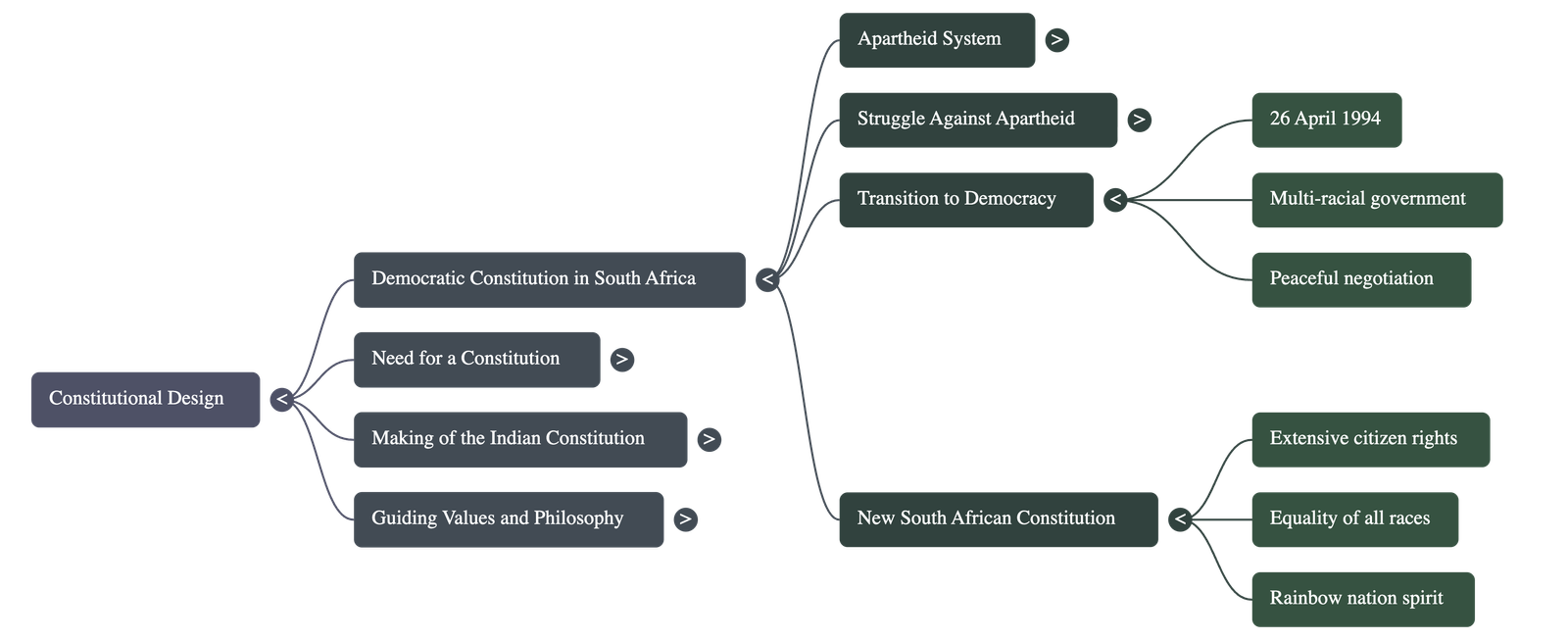
- As protests increased, the white regime realized it could no longer rule through repression. Discriminatory laws were repealed, and Nelson Mandela was released after 28 years in jail.
- Birth of a New Nation: On 26 April 1994, the new national flag of the Republic of South Africa was unfurled, marking the birth of a new democracy.
- Compromise: Black leaders appealed to fellow blacks to forgive the whites. Both sides sat together to draw up a constitution. The whites agreed to majority rule and one-person-one-vote; the blacks agreed that majority rule would not be absolute and would protect minority property rights.
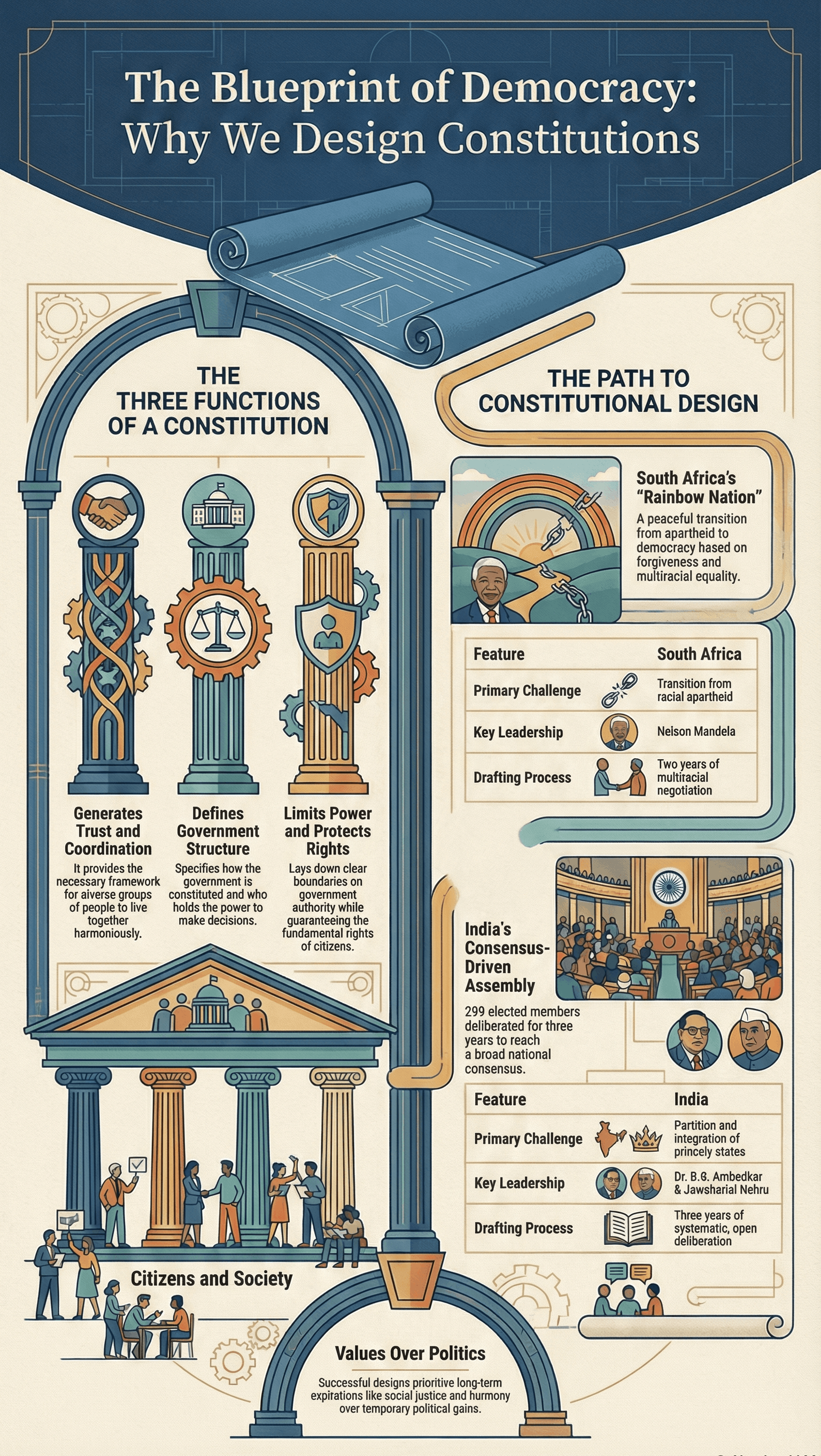
- Rainbow Nation: The new constitution inspired the world by transforming a state denounced for undemocratic practices into a model of democracy.
2. Why Do We Need a Constitution?
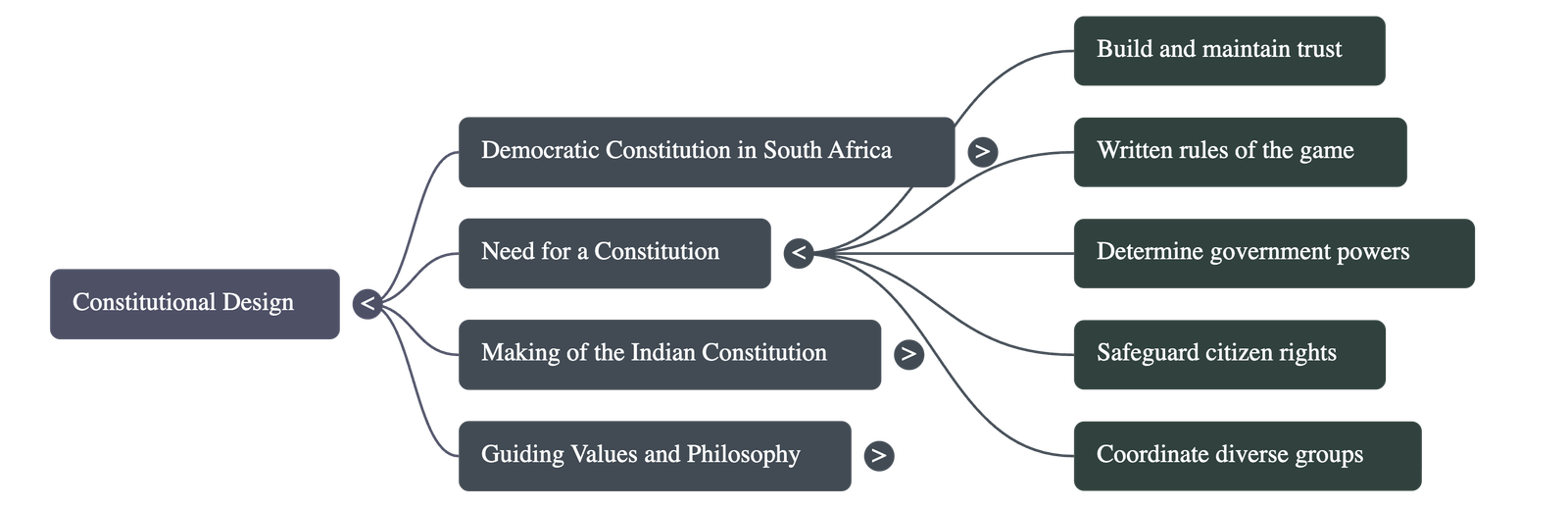
A constitution is a set of written rules accepted by all people living together in a country. It is necessary for the following reasons:
- Trust and Coordination: It generates the degree of trust and coordination necessary for different kinds of people to live together.
- Government Formation: It specifies how the government will be constituted and who will have the power to take which decisions.
- Limits on Power: It lays down limits on the powers of the government and defines the rights of the citizens.
- Aspirations: It expresses the aspirations of the people about creating a good society.
Note: All countries that have constitutions are not necessarily democratic, but all democratic countries will have constitutions.
3. Making of the Indian Constitution
Context and Challenges
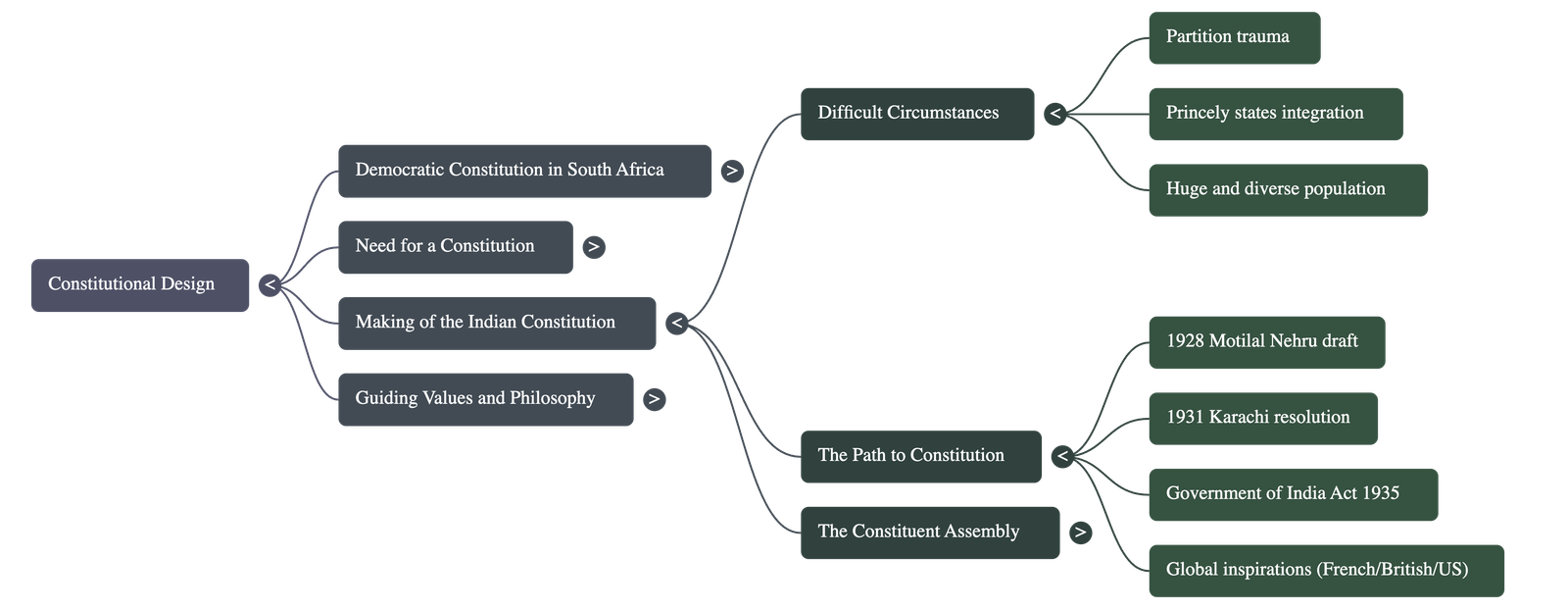
- The constitution was drawn up under difficult circumstances. The country was born through a partition based on religious differences, resulting in traumatic violence (at least 10 lakh deaths).
- The British left the princely states free to decide whether to merge with India or Pakistan or remain independent, creating uncertainty about the country's unity.
The Path to the Constitution
- Prior Consensus: Unlike South Africa, Indian leaders had already agreed on basic values during the freedom struggle. Motilal Nehru (1928) and the Karachi session of the Congress (1931) had drafted constitutional documents committing to universal adult franchise, freedom, equality, and minority rights.
- Institutional Learning: The experience of working with legislative institutions under the British (e.g., Government of India Act, 1935) helped in designing the new institutions.
- Global Inspiration: Leaders were inspired by the French Revolution, British parliamentary democracy, the US Bill of Rights, and the socialist revolution in Russia, but adapted these ideals to suit Indian conditions.
The Constituent Assembly
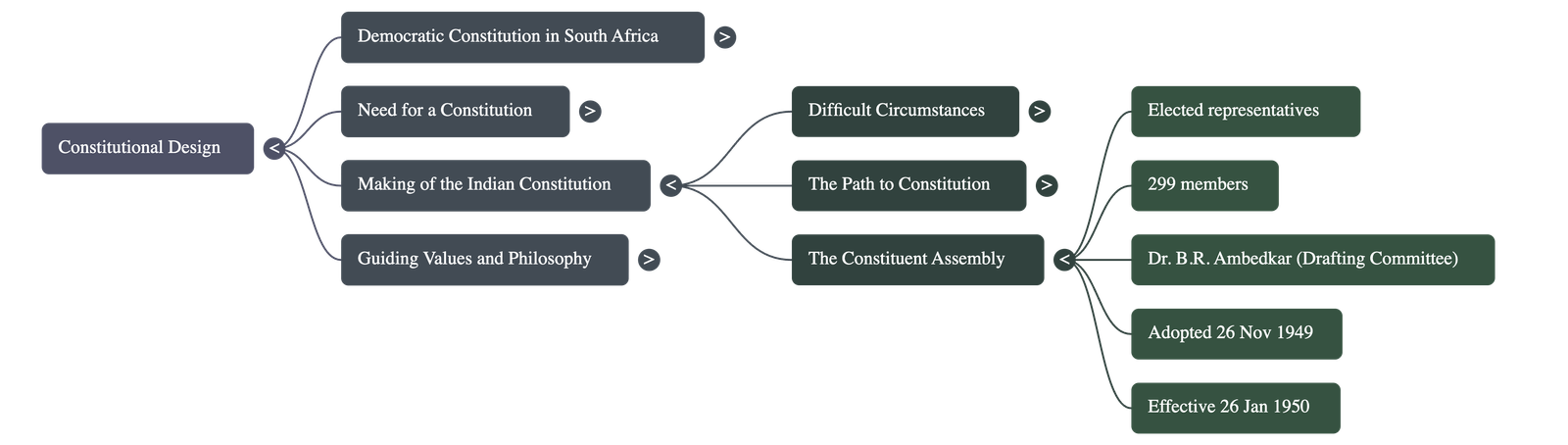
- The Constitution was drafted by an assembly of elected representatives called the Constituent Assembly.
- Elections: Held in July 1946. Members were elected mainly by the members of the existing Provincial Legislatures.
- Composition: After the partition, the Assembly had 299 members. It was dominated by the Congress but represented diverse language groups, castes, classes, religions, and occupations.
- Process: The Drafting Committee was chaired by Dr. B.R. Ambedkar. The Assembly debated for 114 days over three years. Every word spoken was recorded in the "Constituent Assembly Debates".
- Adoption: Adopted on 26 November 1949 and came into effect on 26 January 1950 (Republic Day).
4. Guiding Values of the Indian Constitution
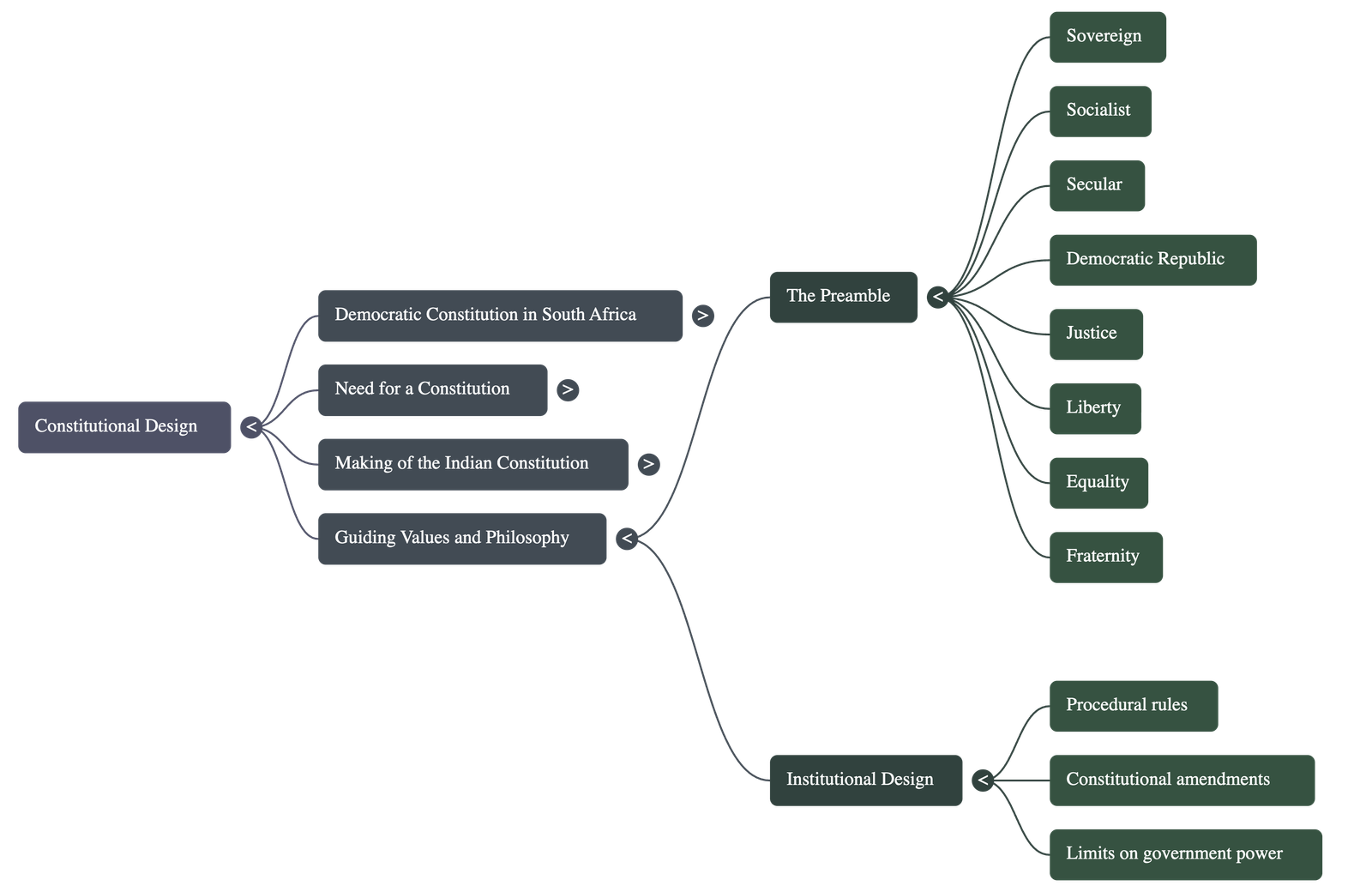
The philosophy of the Constitution is found in the Preamble, which serves as the soul of the document.
The Preamble: Key Terms
We, The People of India: The Constitution is drawn up and enacted by the people through their representatives, not handed down by a king or outside power.
Sovereign: People have the supreme right to make decisions on internal and external matters. No external power can dictate to the government.
Socialist: Wealth is generated socially and should be shared equally. The government should regulate land and industry ownership to reduce inequalities.
Secular: Citizens have complete freedom to follow any religion. There is no official religion; the government treats all beliefs with equal respect.
Democratic: A form of government where people enjoy equal political rights, elect their rulers, and hold them accountable.
Republic: The head of the state is an elected person and not a hereditary position.
Justice: No discrimination on grounds of caste, religion, and gender. Social inequalities must be reduced.
Liberty: No unreasonable restrictions on citizens regarding what they think, how they express thoughts, and how they follow up on them.
Equality: All are equal before the law. The government should ensure equal opportunity for all.
Fraternity: All should behave as if they are members of the same family. No one should treat a fellow citizen as inferior.
5. Institutional Design
- The Constitution is not a static document; it is a living document. The drafters realized it needed to be amended to keep it updated with changes in society.
- Constitutional Amendments: Provisions made to incorporate changes from time to time are called constitutional amendments.
- The document defines the institutional arrangements:
- Procedure for choosing rulers (Elections).
- Definition of who has the power to take which decisions.
- Limits on government power (Rights of Citizens).
Summary based on NCERT "Democratic Politics - I", Chapter 2.
Do checkout all questions & answers of this chapter.
Quick Navigation:
| | |
1 / 1
Quick Navigation:
| | |