Quick Navigation:
| | |
The Making of a Global World
1. The Pre-modern World
Globalisation is not just a modern phenomenon; human societies have been interlinked throughout history via travelers, traders, priests, and pilgrims carrying goods, money, ideas, skills, and even germs.
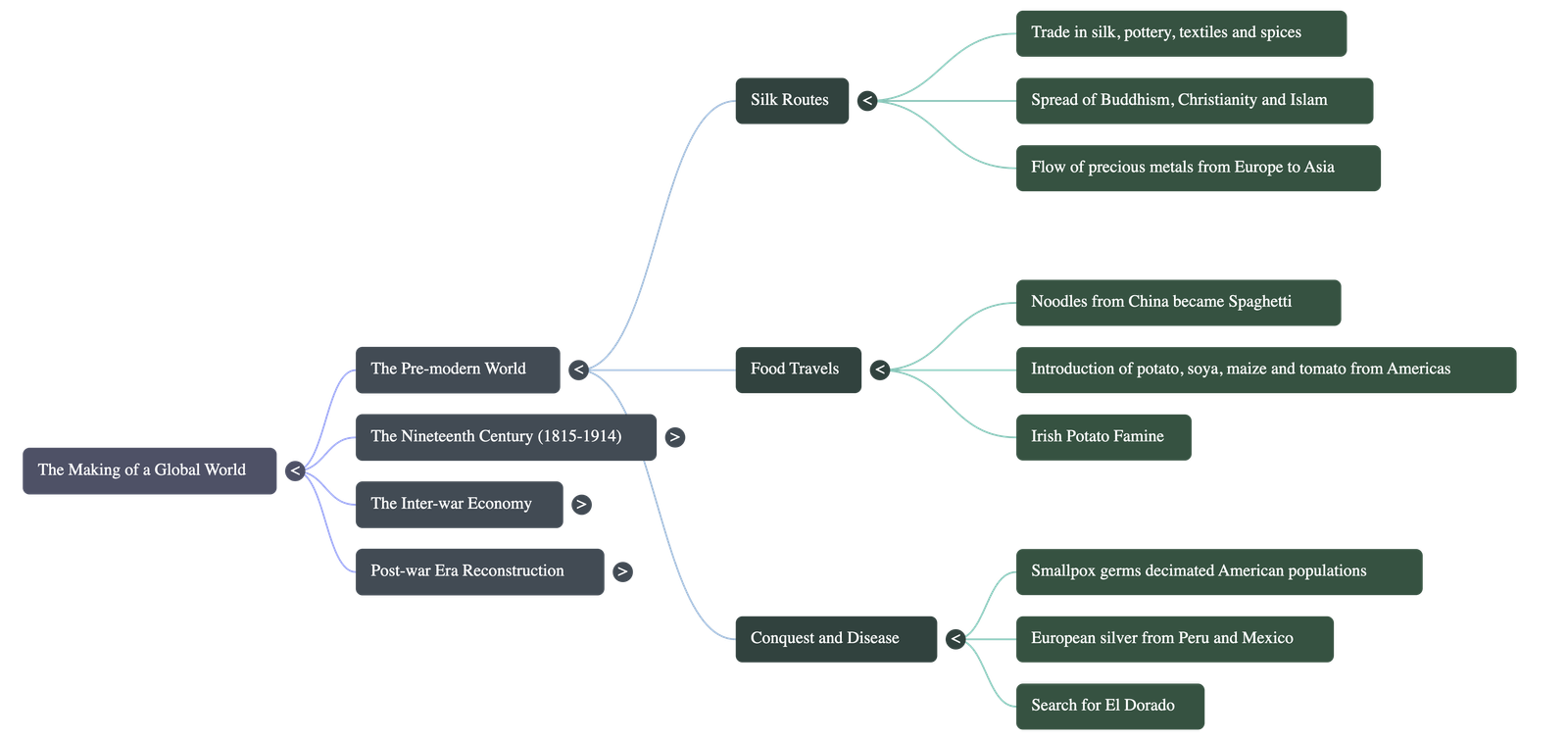
- Silk Routes Link the World: The "silk routes" connected vast regions of Asia with Europe and northern Africa. They facilitated the exchange of Chinese silk and pottery, Indian textiles and spices, and European precious metals (gold and silver). These routes also served as conduits for cultural and religious exchanges, including Buddhism, Christianity, and Islam.
- Food Travels: Food offers examples of long-distance cultural exchange. Noodles travelled from China to become spaghetti in the West. Common foods like potatoes, soya, maize, tomatoes, and chillies were introduced to Europe and Asia only after Columbus discovered the Americas. The introduction of the potato significantly improved the diet of Europe's poor, though reliance on it led to the Irish Potato Famine when crops failed.
- Conquest, Disease and Trade: The European discovery of sea routes to Asia and the Americas shrank the pre-modern world. European conquest of the Americas was aided not just by firepower but by biological warfare; smallpox, carried by Europeans, decimated indigenous American populations who had no immunity, paving the way for colonization.
2. The Nineteenth Century (1815-1914)
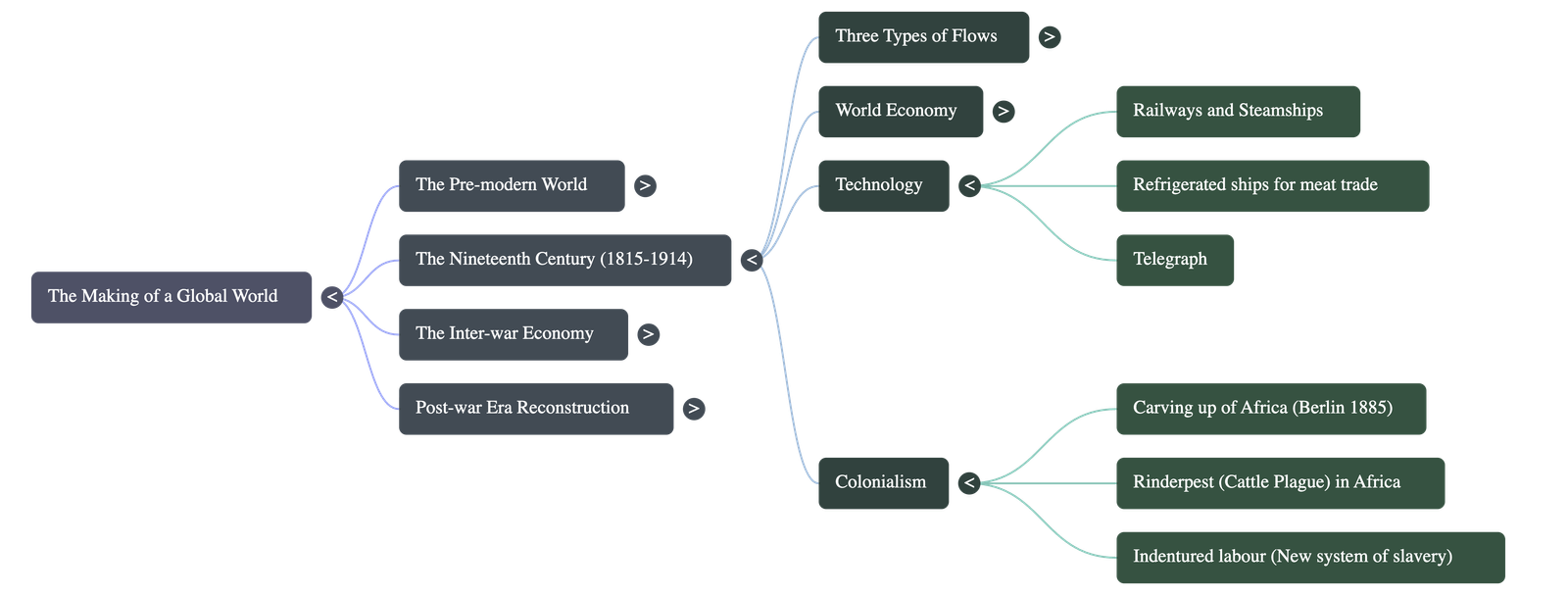
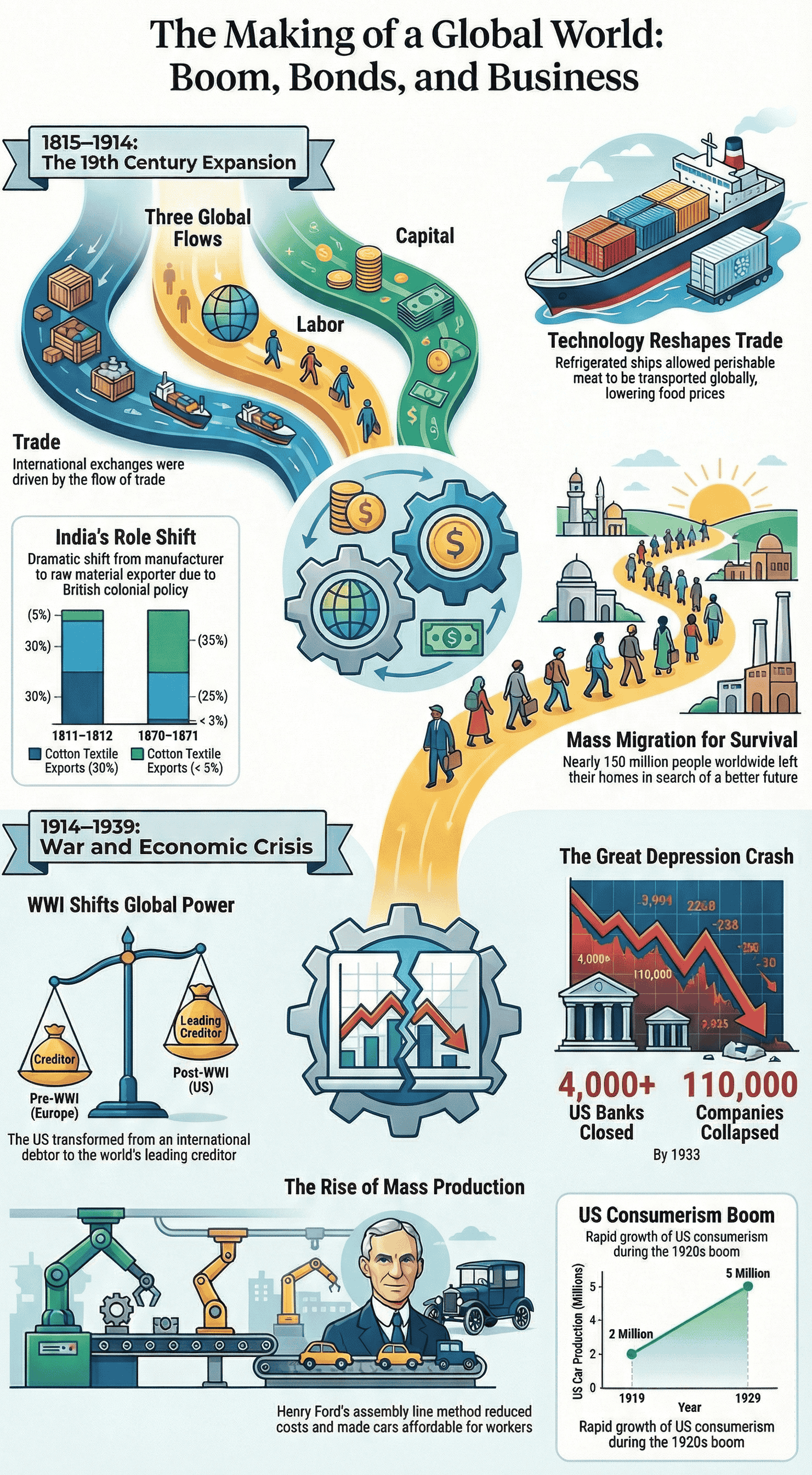
Economic, political, social, and technological factors transformed the world, characterized by three types of flows: trade (goods), labour (migration), and capital (investment).
2.1 A World Economy Takes Shape
- Corn Laws: Population growth in Britain increased food demand. The government restricted corn imports (Corn Laws), leading to high prices. Industrialists and urban dwellers forced the abolition of these laws.
- Impact of Abolition: Food could be imported cheaper than produced domestically. British agriculture declined, leading to unemployment and migration.
- Global Agriculture: Lands in Eastern Europe, Russia, America, and Australia were cleared to feed Britain. This required railways and harbours, funded by capital from London and built by labour from Europe (nearly 50 million emigrated).
2.2 Role of Technology
- Technological inventions like railways, steamships, and the telegraph linked the world.
- Refrigerated Ships: This technology allowed perishable meat to be transported over long distances. Animals could be slaughtered in America, Australia, or New Zealand and shipped as frozen meat to Europe, lowering prices and improving the European diet.
2.3 Late Nineteenth-century Colonialism
- Trade expansion and prosperity had a dark side: the loss of freedom for colonized people.
- Partition of Africa: European powers met in Berlin in 1885 to carve up Africa among themselves, drawing borders with little regard for local realities.
2.4 Rinderpest, or the Cattle Plague
- In the 1890s, Rinderpest, a cattle disease brought by infected cattle from British Asia, swept through Africa.
- It killed 90% of the cattle, destroying African livelihoods. This forced Africans into the labour market, allowing European colonizers to conquer and subdue the continent.
2.5 Indentured Labour Migration from India
- Indentured labour was a "new system of slavery." labourers were hired under contract for five years to work on plantations (Caribbean, Mauritius, Fiji).
- Workers faced harsh conditions but developed new cultural forms, such as "Chutney music" and the "Hosay" carnival (Trinidad).
- Most workers stayed on after contracts ended, creating large Indian communities abroad. The system was abolished in 1921 due to nationalist opposition.
2.6 Indian Trade and the Global System
- With industrialisation, British tariffs reduced the inflow of Indian cotton textiles. India shifted to exporting raw materials (raw cotton, indigo, opium).
- Trade Surplus: Britain had a trade surplus with India (selling more than buying). Britain used this surplus to balance its trade deficits with other countries and to pay "home charges" (remittances, debt interest, pensions).
3. The Inter-war Economy
The First World War (1914-18) destabilized the global economy for decades.
3.1 Wartime Transformations
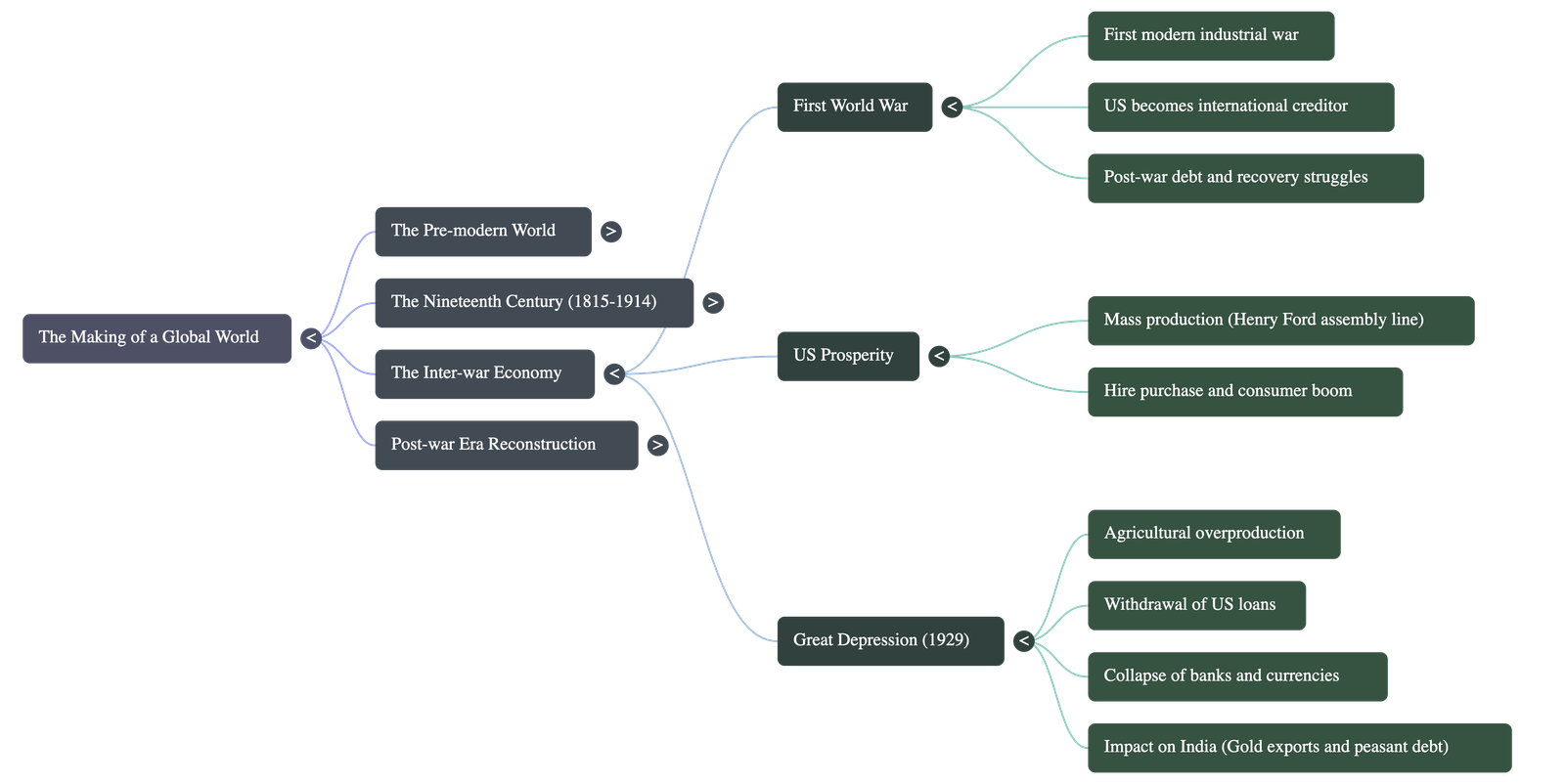
- It was the first modern industrial war involving machine guns, tanks, and chemical weapons.
- The war transformed the US from an international debtor to an international creditor.
3.2 Rise of Mass Production and Consumption
- Mass Production: Pioneered by Henry Ford in the US using the assembly line method (Model T Ford). This increased output and allowed for higher wages (after initial worker resistance).
- Mass Consumption: Higher wages and hire-purchase (credit) systems fuelled a boom in consumer goods like cars, refrigerators, and radios.
3.3 The Great Depression
- Beginning around 1929, the Depression caused catastrophic declines in production, employment, and trade.
- Causes:
- Agricultural overproduction led to falling prices.
- Withdrawal of US loans panic among overseas lenders.
- Collapse of US banks and doubling of import duties.
- Impact on India: India's trade was hit hard. Exports and imports halved. Wheat prices fell by 50%. Peasants were devastated as revenue demands remained high, leading to increased debt and the sale of gold savings. Urban dwellers with fixed incomes fared better due to falling prices.
4. Rebuilding a World Economy: The Post-war Era
The Second World War caused immense devastation. Reconstruction was shaped by the dominance of the US and the Soviet Union.
4.1 The Bretton Woods Institutions
- Aim: To preserve economic stability and full employment.
- Conference: Held in 1944 at Bretton Woods, USA.
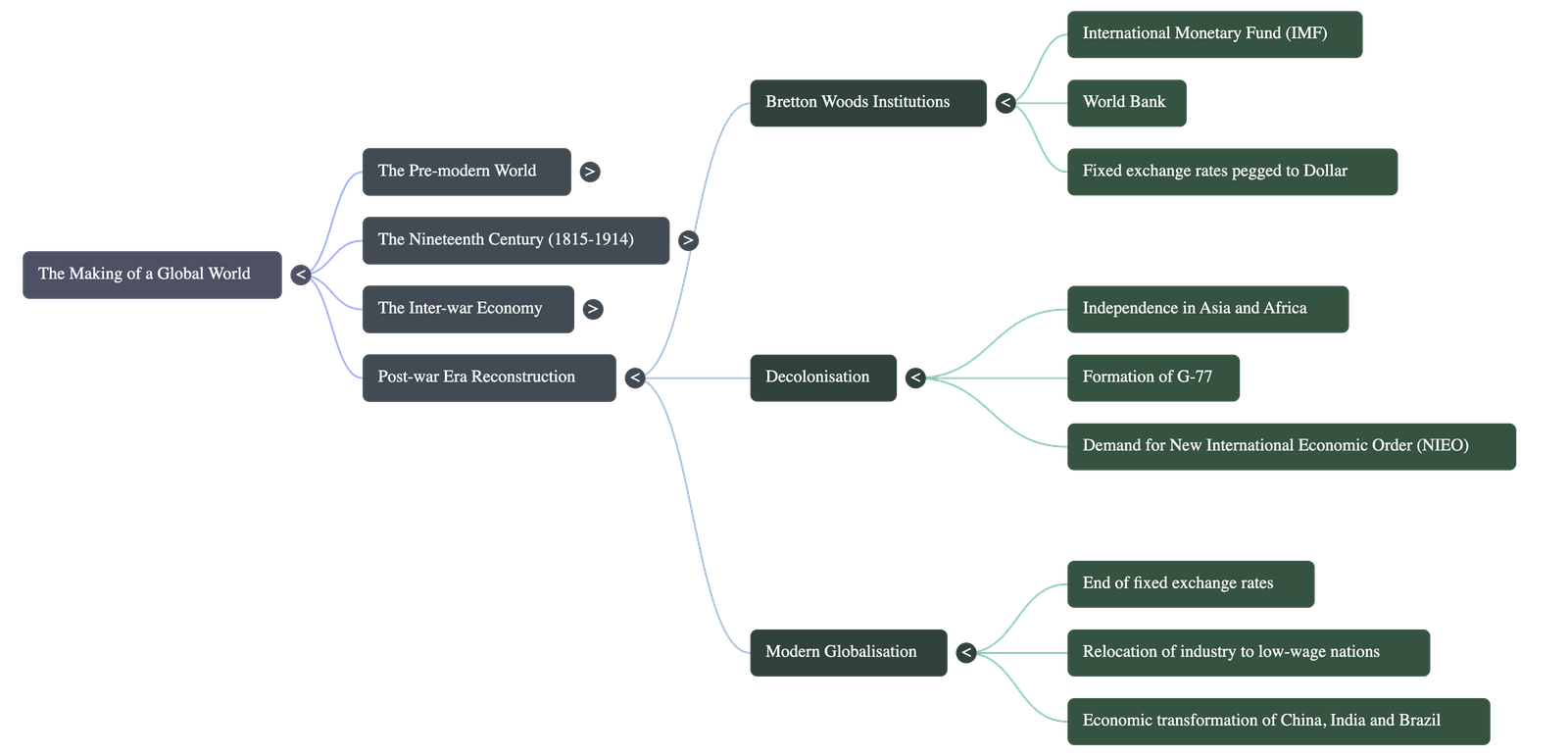
- Institutions: Established the IMF (to deal with external surpluses/deficits) and the World Bank (to finance reconstruction). Known as the "Bretton Woods twins."
- System: Based on fixed exchange rates pegged to the US dollar, which was anchored to gold.
4.2 Decolonisation and Independence
- Newly independent nations in Asia and Africa faced poverty and lack of development.
- The IMF and World Bank shifted focus to developing countries from the late 1950s.
- G-77 and NIEO: Developing countries organised as the Group of 77 to demand a New International Economic Order (NIEO) for fairer trade, control over resources, and development assistance.
4.3 End of Bretton Woods and Globalisation
- In the 1960s, the US dollar weakened, leading to the collapse of fixed exchange rates and the rise of floating exchange rates.
- Relocation of Industry: MNCs began shifting production to low-wage Asian countries.
- China's Rise: China's integration into the world economy and its low-wage structure made it a destination for foreign investment.
- This relocation stimulated world trade and transformed the economic geography, bringing countries like India, China, and Brazil to the forefront.
Do checkout all questions & answers of this chapter.
Quick Navigation:
| | |
1 / 1
Quick Navigation:
| | |