Quick Navigation:
| | |
Print Culture and the Modern World
1. The First Printed Books
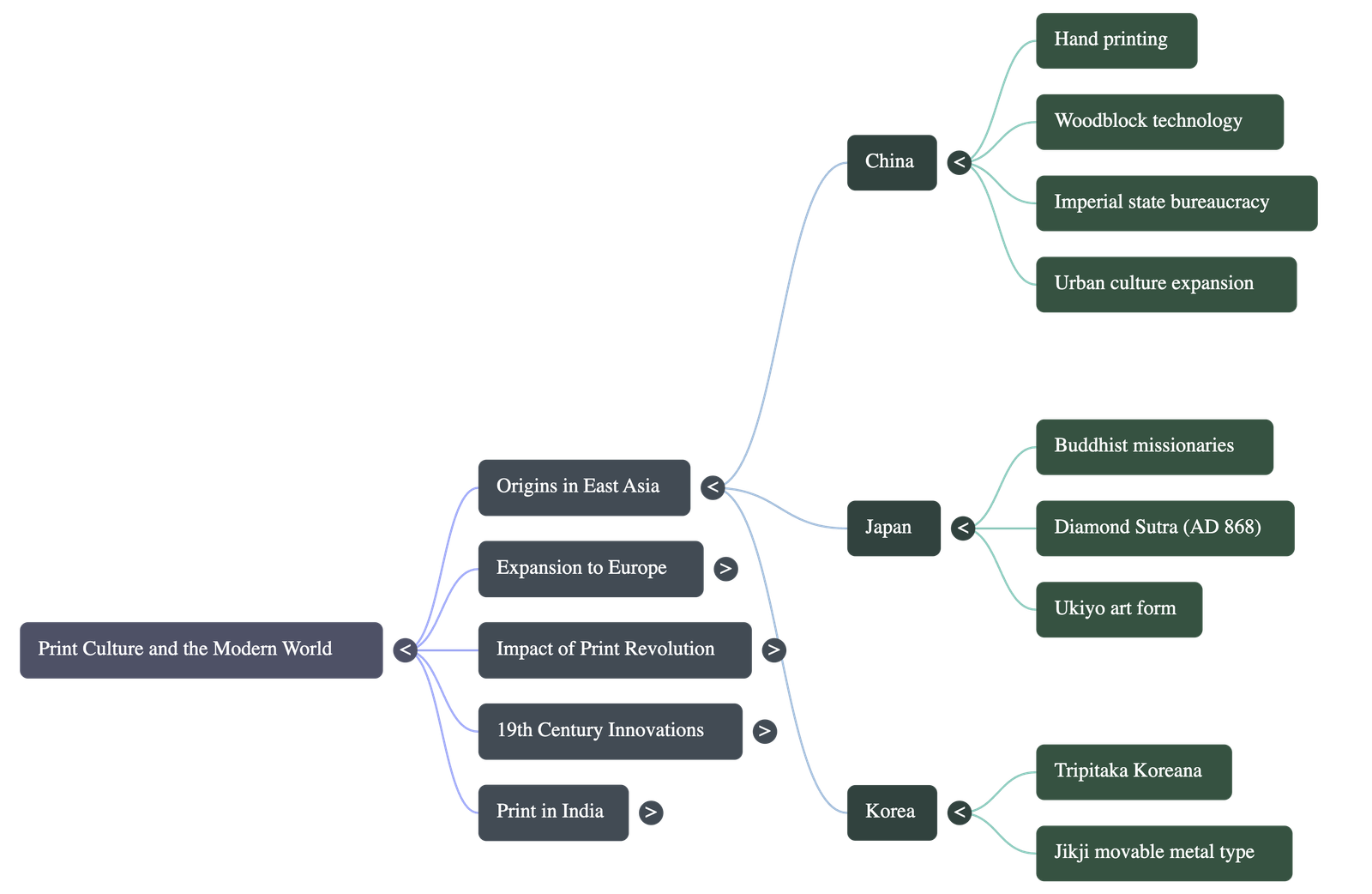
- Origins in East Asia: The earliest print technology was developed in China, Japan, and Korea as a system of hand printing.
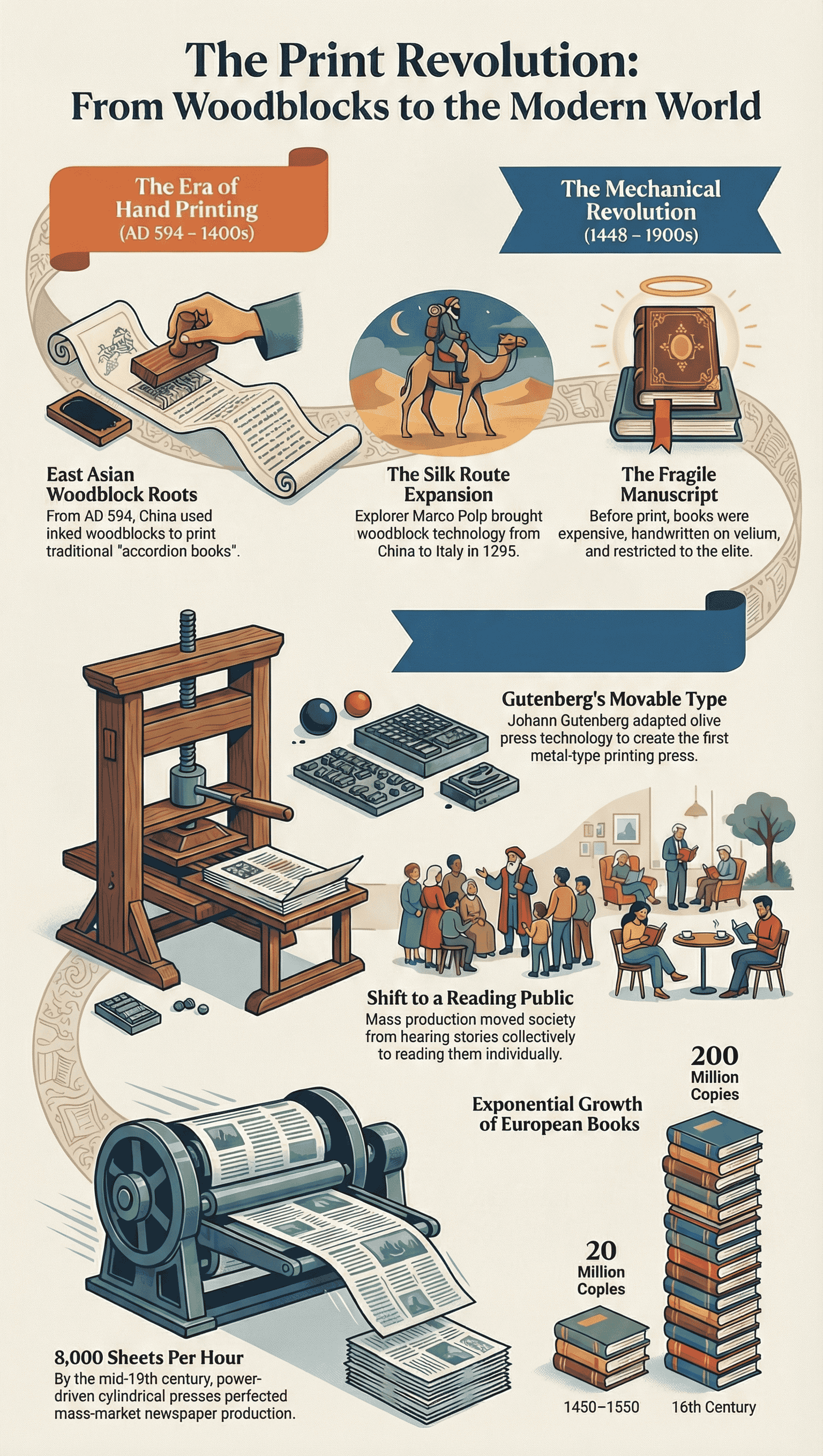
- Chinese Woodblocks: From AD 594, books in China were printed by rubbing paper against inked woodblocks. Because the paper was thin and porous, it was folded and stitched at the side (accordion book).
- Imperial Sponsorship: The Chinese imperial state was the major producer of printed material for a long time, printing vast numbers of textbooks for civil service examinations.
- Diversification: By the seventeenth century, print culture in China bloomed as merchants used it for trade information and reading became a leisure activity. Women began publishing poetry and plays.
- Print in Japan: Buddhist missionaries introduced hand-printing to Japan around AD 768-770. The oldest Japanese book is the Buddhist Diamond Sutra (AD 868).
- Ukiyo: In the late eighteenth century, the art form 'ukiyo' (pictures of the floating world) developed, depicting ordinary urban experiences. Artists like Kitagawa Utamaro were famous for this style.
2. Print Comes to Europe
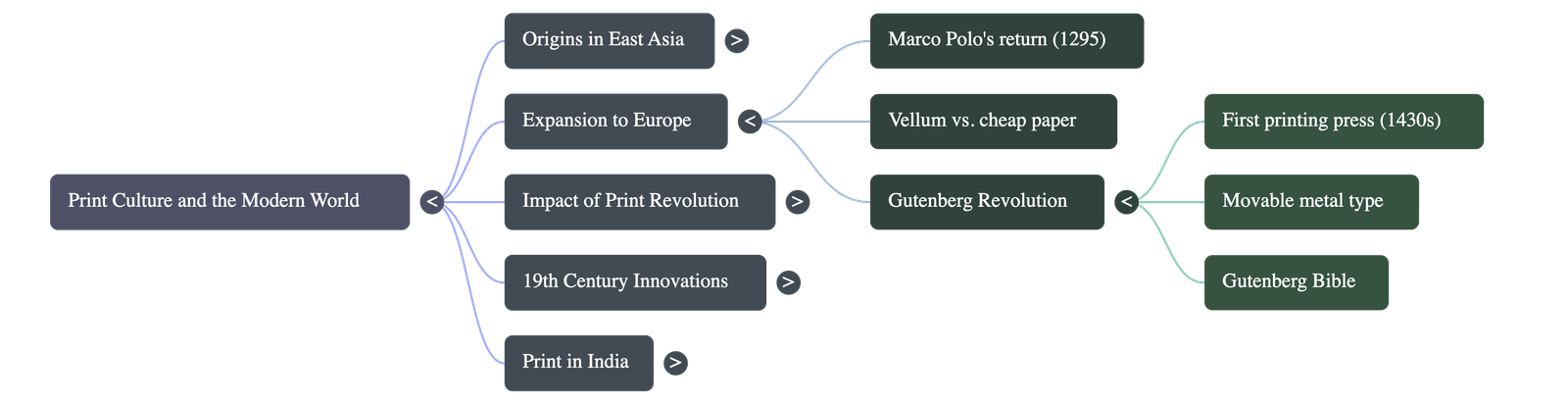
- Role of the Silk Route: Paper reached Europe from China via the silk route in the eleventh century.
- Marco Polo: In 1295, Marco Polo returned to Italy from China, bringing the knowledge of woodblock printing. This technology then spread to other parts of Europe.
- Limitations of Manuscripts: Handwritten manuscripts were expensive, labor-intensive, fragile, and awkward to handle, failing to meet the growing demand for books.
- Gutenberg’s Innovation: Johann Gutenberg developed the first printing press in Strasbourg, Germany, in the 1430s. He adapted the olive press model and used moulds for casting metal types.
- The First Printed Book: By 1448, Gutenberg perfected the system. The first book he printed was the Bible (180 copies in three years).
- The Print Revolution: The shift from hand printing to mechanical printing reduced the cost of books and increased production speed, leading to a flood of books in the market.
3. The Print Revolution and Its Impact
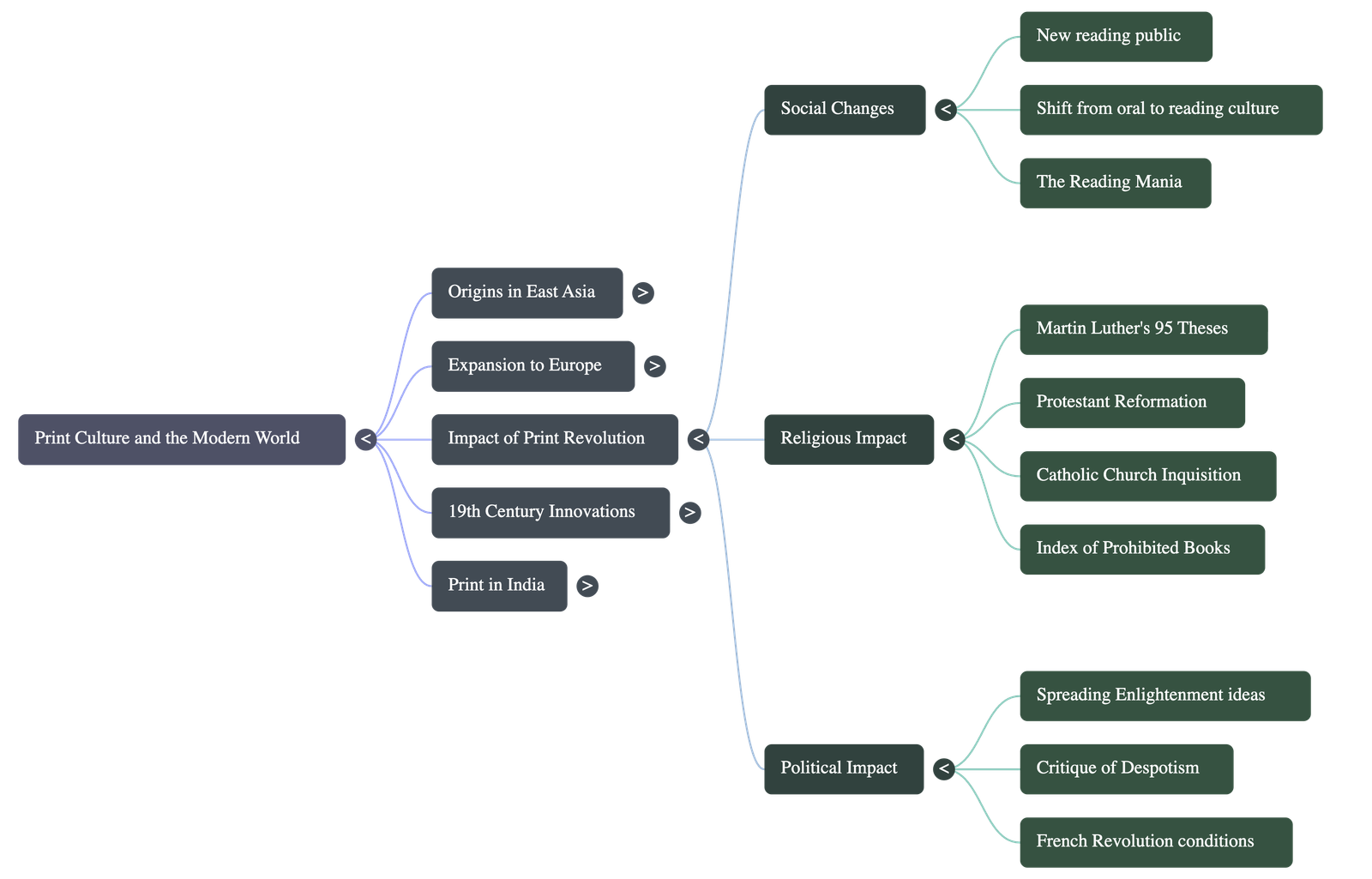
- A New Reading Public: Access to books created a new culture of reading. Previously, oral culture dominated, where people heard texts read out. Print allowed knowledge to reach wider sections of society, blurring the line between oral and reading cultures.
- Religious Debates: Print introduced a new world of debate and discussion. Martin Luther’s Ninety Five Theses (1517) criticised the Roman Catholic Church and were reproduced in vast numbers, leading to the Protestant Reformation.
- Luther on Print: Deeply grateful for the medium, Luther famously said, "Printing is the ultimate gift of God and the greatest one."
- Fear of Print: Religious authorities and monarchs feared that unregulated print would spread rebellious and irreligious thoughts.
- Print and Dissent: Menocchio, a miller in Italy, reinterpreted the Bible, which enraged the Roman Catholic Church. This led to the Church imposing severe controls over publishers and maintaining an Index of Prohibited Books from 1558.
4. The Reading Mania
- Rise in Literacy: Literacy rates went up in Europe during the seventeenth and eighteenth centuries, leading to a "reading mania."
- New Forms of Literature: New formats emerged to target diverse audiences, including almanacs, ballads, folktales, and penny chapbooks (sold by pedlars). In France, the low-priced Bibliotheque Bleue became popular.
- Periodicals and Science: Newspapers and journals developed, carrying news of wars and trade. Scientific texts by figures like Isaac Newton became accessible to a wider audience.
- Print and the Enlightenment: Thinkers like Voltaire and Rousseau were widely read. Their writings argued for the rule of reason and criticised the despotism of the Church and State.
- "Tremble, Tyrants!": Novelist Louise-Sebastien Mercier proclaimed that the printing press was the most powerful engine of progress that would sweep away despotism.
- French Revolution: Historians argue that print culture created the conditions for the French Revolution by popularising Enlightenment ideas, creating a culture of debate, and mocking the morality of royalty.
5. The Nineteenth Century
- Children: Primary education became compulsory, making children an important category of readers. A children's press was set up in France in 1857. The Grimm Brothers collected and edited folk tales for children.
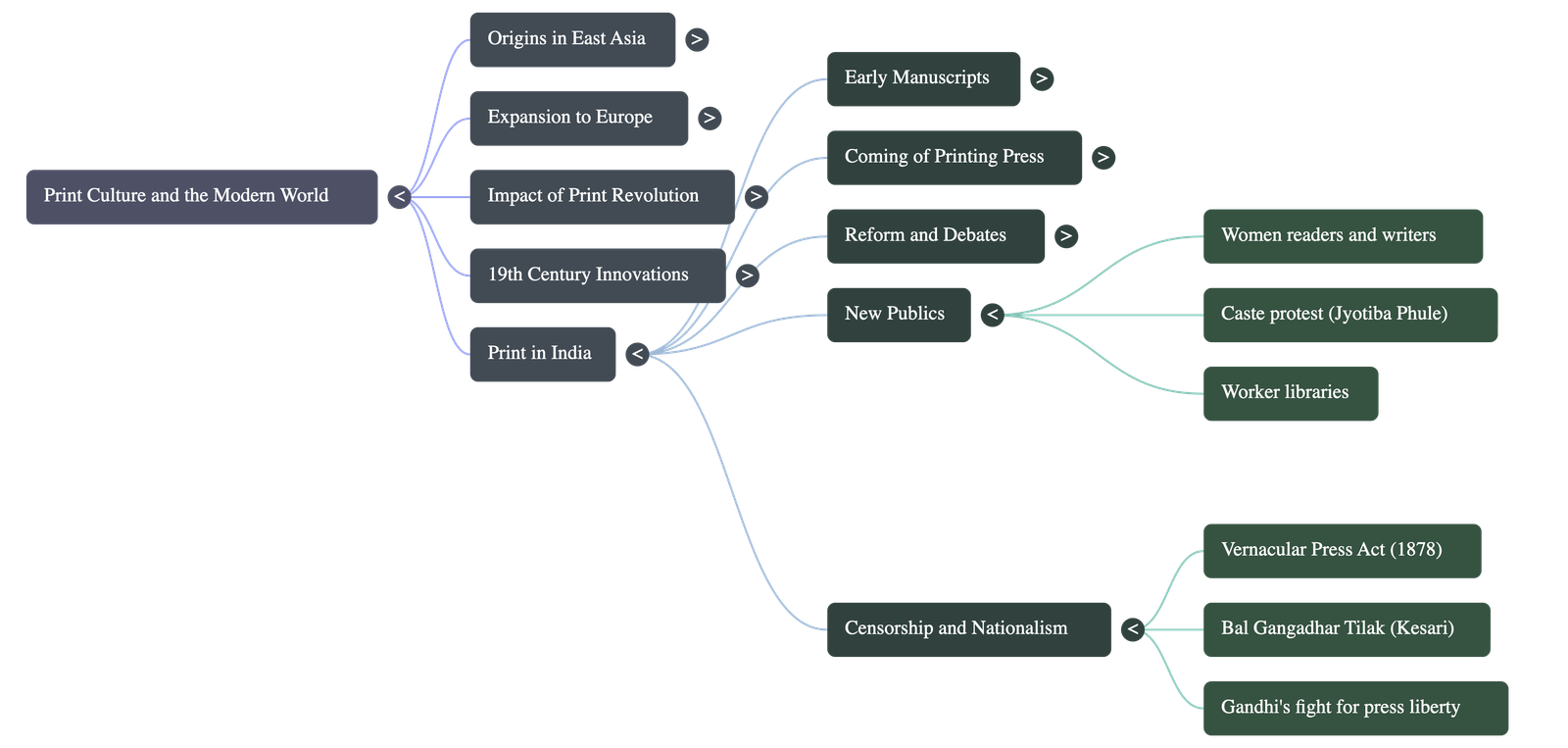
- Women: Women became important readers and writers. Penny magazines taught behaviour and housekeeping. Novelists like Jane Austen, the Bronte sisters, and George Eliot defined a new type of woman with personality and will.
- Workers: Lending libraries and shorter working hours allowed white-collar workers and artisans to educate themselves and write political tracts and autobiographies.
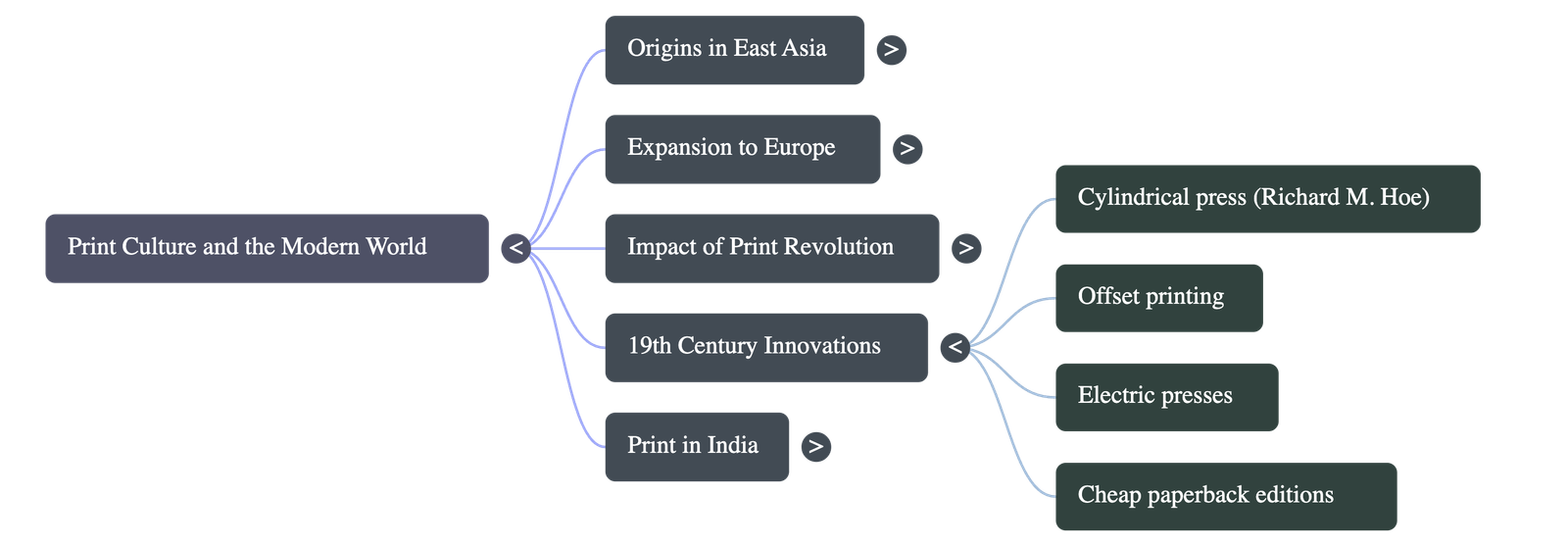
- Technological Innovations:
- Richard M. Hoe perfected the power-driven cylindrical press (8,000 sheets per hour).
- The offset press was developed to print up to six colours at a time.
- Electrically operated presses and paper-feeding improvements accelerated production.
6. India and the World of Print
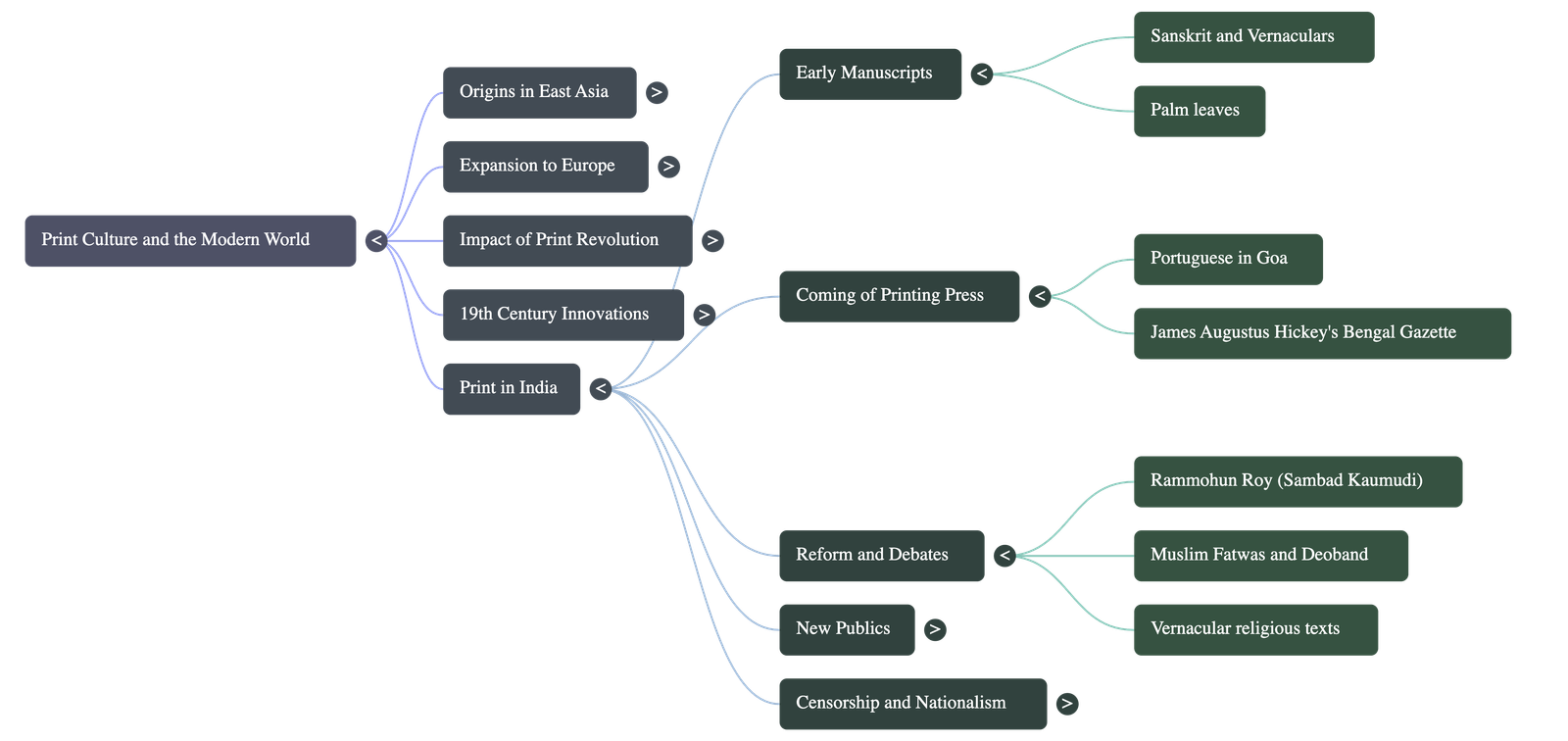
- Manuscript Tradition: India had a rich tradition of handwritten manuscripts in Sanskrit, Arabic, Persian, and vernaculars. However, they were expensive, fragile, and not suitable for everyday use.
- Arrival of the Press: The printing press was brought to Goa by Portuguese missionaries in the mid-sixteenth century. Books were printed in Konkani, Kanara, Tamil, and Malayalam.
- English Printing: English printing began late. In 1780, James Augustus Hickey began editing the Bengal Gazette, a private enterprise independent of colonial influence.
- Growth of Newspapers: By the end of the eighteenth century, numerous newspapers appeared. The first Indian-owned weekly was the Bengal Gazette brought out by Gangadhar Bhattacharya.
7. Religious Reform and Public Debates
- Public Debate: Print shaped the nature of intense controversies between social/religious reformers and orthodoxy. Ideas were printed in the spoken language of ordinary people.
- Hindu Reforms: Rammohun Roy published the Sambad Kaumudi (1821) to criticize practices like sati and idolatry. The Hindu orthodoxy countered with the Samachar Chandrika.
- Muslim Anxiety: The ulama feared the collapse of Muslim dynasties and colonial influence. They used cheap lithographic presses to publish translations of scriptures and fatwas (e.g., from the Deoband Seminary) to guide Muslim conduct.
- Vernacular Texts: The Ramcharitmanas of Tulsidas was published in 1810. The Naval Kishore Press and Shri Venkateshwar Press published numerous religious texts, making them accessible to the faithful.
8. New Forms of Publication
- Literary Forms: The novel catered to the need for reading about human lives and relationships. Other forms included lyrics, short stories, and essays.
- Visual Culture: By the late nineteenth century, visual images were mass-produced. Raja Ravi Varma created images for mass circulation. Cheap prints and calendars decorated the homes of even the poor.
- Caricatures: Cartoons and caricatures in journals commented on social and political issues, ridiculing Western tastes or criticising imperial rule.
- Women and Print:
- Liberal families began educating women.
- Rashsundari Debi wrote Amar Jiban (1876), the first full-length autobiography in Bengali, learning to read in secrecy.
- Tarabai Shinde and Pandita Ramabai wrote passionately about the miserable lives of upper-caste Hindu women, especially widows.
- In Punjab, Ram Chaddha published Istri Dharm Vichar to teach women how to be obedient wives.
- Print and the Poor:
- Cheap small books were sold at crossroads. Public libraries were set up.
- Jyotiba Phule wrote Gulamgiri (1871) exposing the injustices of the caste system.
- B.R. Ambedkar and E.V. Ramaswamy Naicker (Periyar) wrote powerfully on caste in the twentieth century.
- Millworkers like Kashibaba (Chhote Aur Bade Ka Sawal) and Sudarshan Chakr published poems and tracts about class and caste exploitation.
9. Print and Censorship
- Early Regulations: Initially, the East India Company was not concerned with censorship but later controlled the press to prevent criticism of its officials.
- Post-1857: After the revolt of 1857, the colonial government's attitude changed, and they demanded a clampdown on the 'native' press.
- Vernacular Press Act (1878): Modelled on Irish Press Laws, this act gave the government extensive rights to censor reports and editorials in vernacular newspapers. Presses could be confiscated if warnings were ignored.
- Nationalist Resistance: Despite repression, nationalist newspapers grew. Balgangadhar Tilak’s writings in Kesari about Punjab revolutionaries led to his imprisonment in 1908, provoking widespread protests.
- Wartime Censorship: Severe controls were imposed during the World Wars, such as under the Defence of India Act. Gandhi famously stated that the fight for Swaraj was a fight for liberty of speech and the press.
Do checkout all questions & answers of this chapter.
Quick Navigation:
| | |
1 / 1
Quick Navigation:
| | |