Quick Navigation:
| | | |
The Vedic Period
Introduction and Chronology
- The period is named after the Vedic texts which form the basis of its culture.
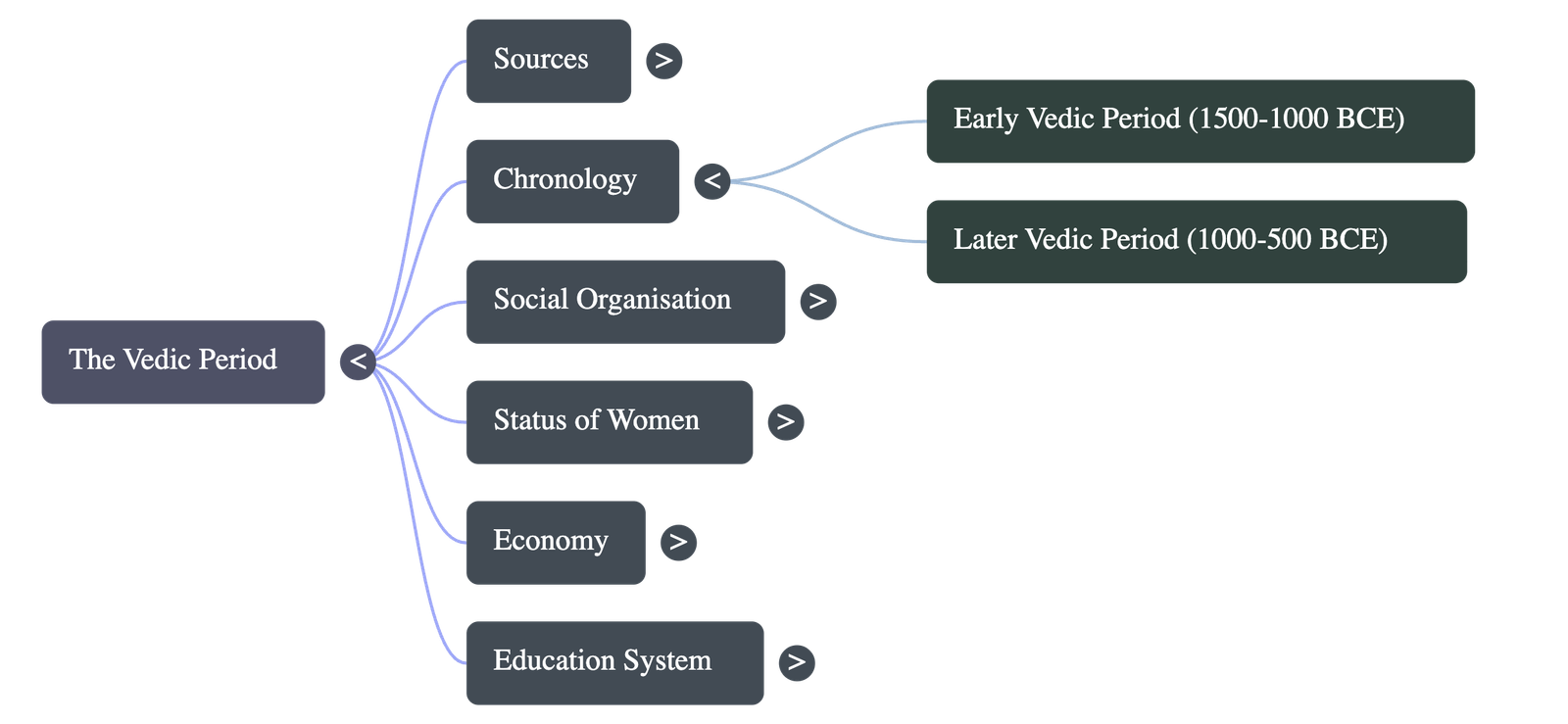
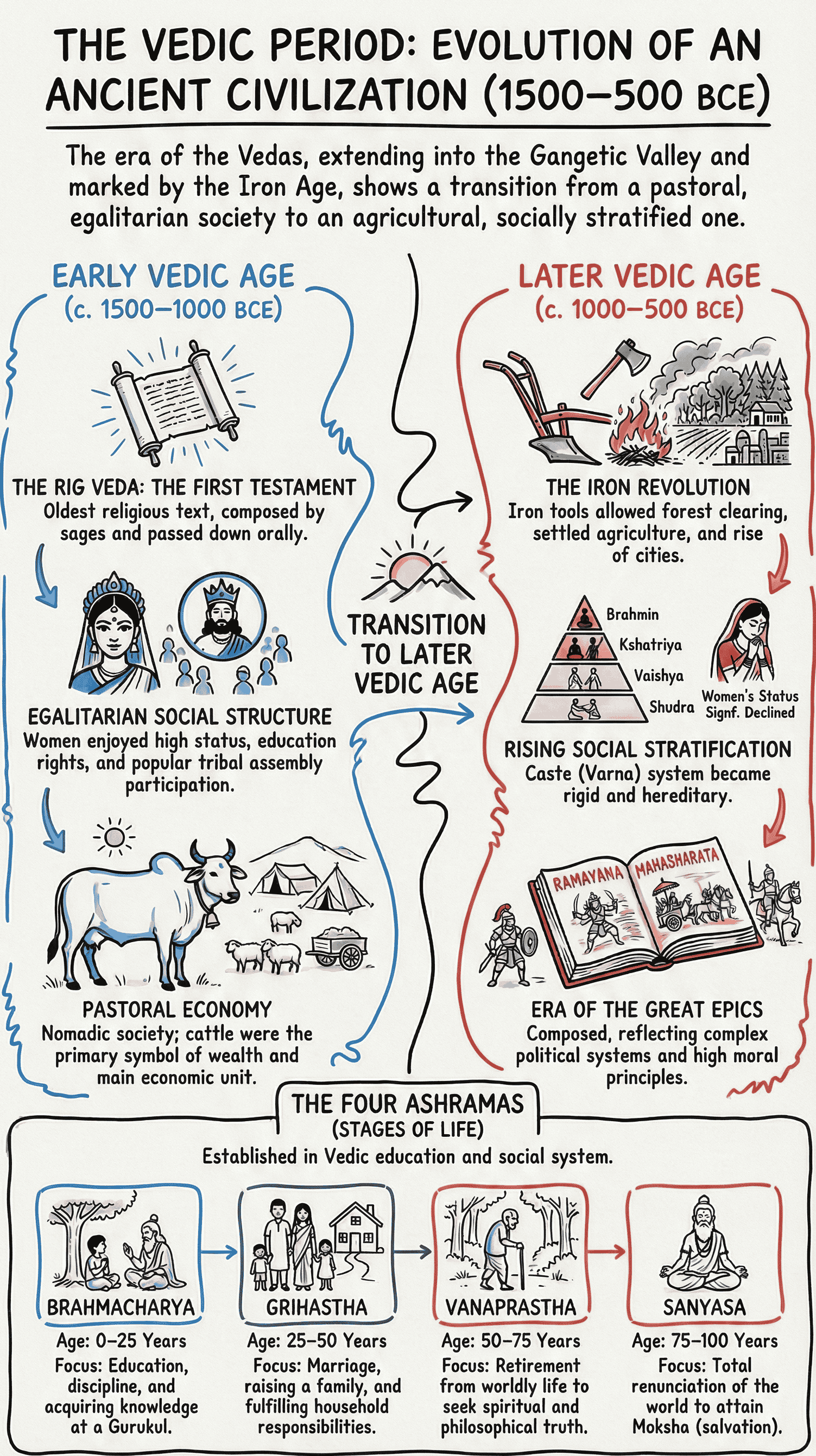
- Early Vedic Period (1500–1000 BCE): Aryans initially settled in the north-western part of the Indian subcontinent.
- Later Vedic Period (1000–500 BCE): Characterized by the discovery of iron tools, which allowed the Aryans to clear dense forests and migrate eastward and south-eastward to settle in the Gangetic valley.
A. Literary Sources
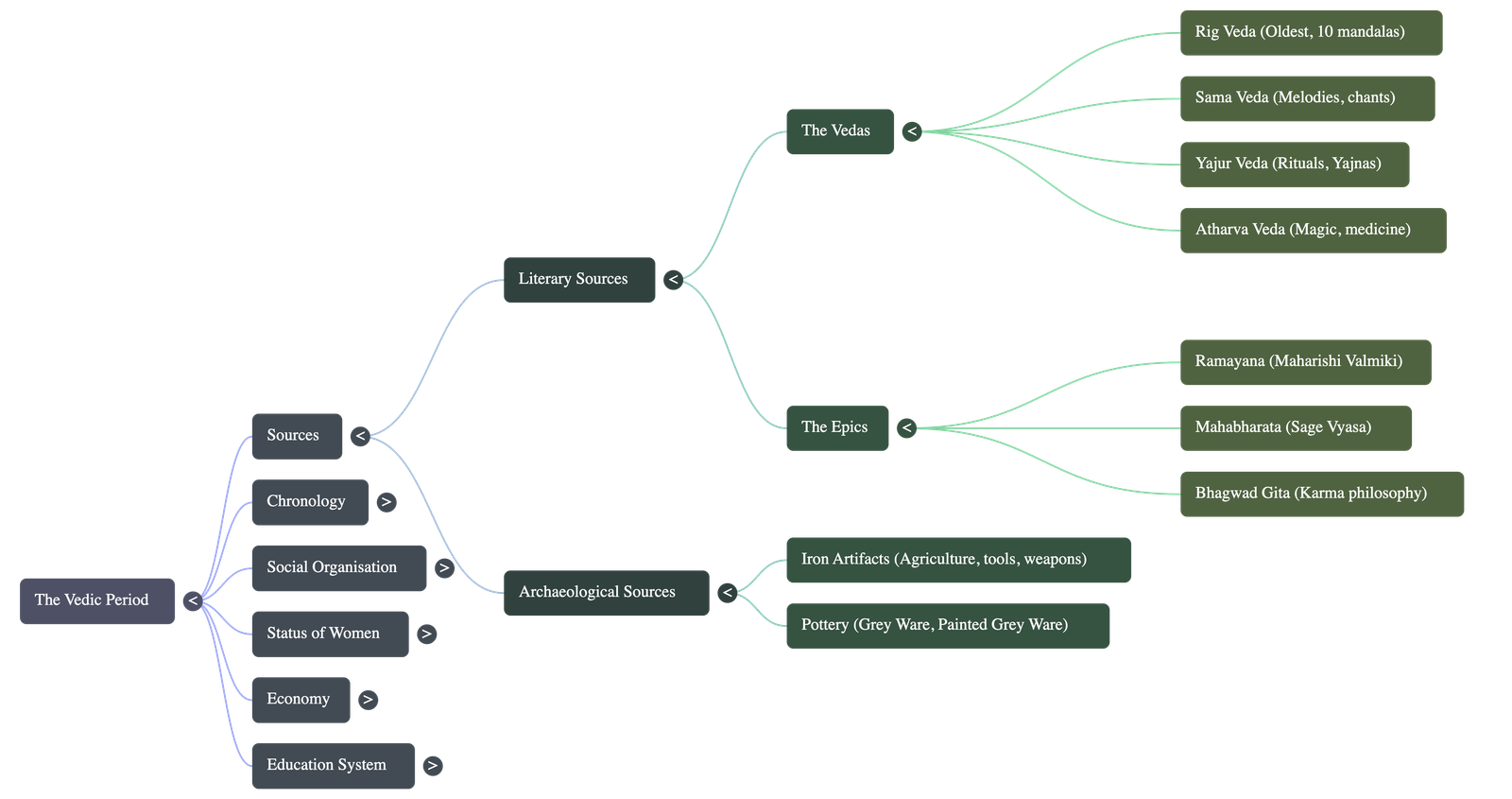
1. The Vedas
- The term 'Veda' comes from the Sanskrit word 'vid', meaning knowledge. Vedic literature is divided into Shruti (revealed to sages by God, passed down orally) and Smriti (composed by Rishis).
- The Rig Veda: The oldest religious text in the world, known as 'The First Testament of Mankind'. Composed during the Early Vedic Period, it is divided into 10 mandalas and contains the famous 'Gayatri Mantra'.
- The Sama Veda: Means 'Sweet Song' or 'melody'. Many hymns are borrowed from the Rig Veda and were meant to be sung by priests during sacrifices.
- The Yajur Veda: Deals with hymns recited during Yajnas. It has two recensions: Black (Krishna) and White (Shukla), detailing public and individual rituals.
- The Atharva Veda: Contains magic and charms to ward off evil spirits and diseases, along with hymns on knowledge, action, invocation, and medicinal treatments.
- Importance: The Vedas are primary repositories of social, economic, political, and religious knowledge of the era, and provide insights into early Indian music, medicine, astronomy, and philosophy.
2. The Epics
- Ramayana: Composed in Sanskrit by Maharishi Valmiki. It revolves around Rama, the eldest son of King Dashratha of Ayodhya, his exile, the abduction of his wife Sita by Ravana, and the resulting battle highlighting duty, devotion, and love.
- Mahabharata: Written by Sage Vyasa, originally called Jaya or Bharata. It details the 18-day war between the Kauravas and Pandavas.
- Bhagwad Gita: A crucial part of the Mahabharata containing Lord Krishna's discourse to Arjuna. It teaches immortality of the soul and the philosophy of Karma.
- Importance: Epics serve as main sources on political institutions, military strategies, and societal organisation. They showcase high ideals of family life and moral principles.
B. Archaeological Sources
- Iron Artifacts: The Iron Age in India began around 1000 BCE. Iron (known as Shyama or Krishna ayas) replaced softer metals like copper/bronze.
- Agriculture: Iron axes cleared dense rain forests; iron plough-heads expanded cultivation, producing surpluses of wheat, rice, and barley.
- Occupation: Durable implements (saws, chisels, nails) spurred new trades like carpentry, weaving, spinning, and tanning.
- Defence: Used extensively for swords, armours, and shields.
- Pottery: The Early Vedic and Early-Later Vedic sites feature Painted Grey Ware (PGW)—a glossy, smooth pottery painted with geometric, floral, and sun patterns. The subsequent phase is known as Northern Black Polished Ware (NBPW).
Geographical Settlements
- Early Vedic Period: Settled in the north-western subcontinent known as Sapta Sindhu (Land of Seven Rivers, including the Indus, Ravi, Beas, Sutlej, Jhelum, Chenab, and Saraswati), also referred to as Brahmavarta (Land of the Gods).
- Later Vedic Period: The populace moved to the fertile Ganga-Yamuna doab, evolving from a nomadic pastoral lifestyle into an agriculturally stable society.
Social Organisation
Family & Administration
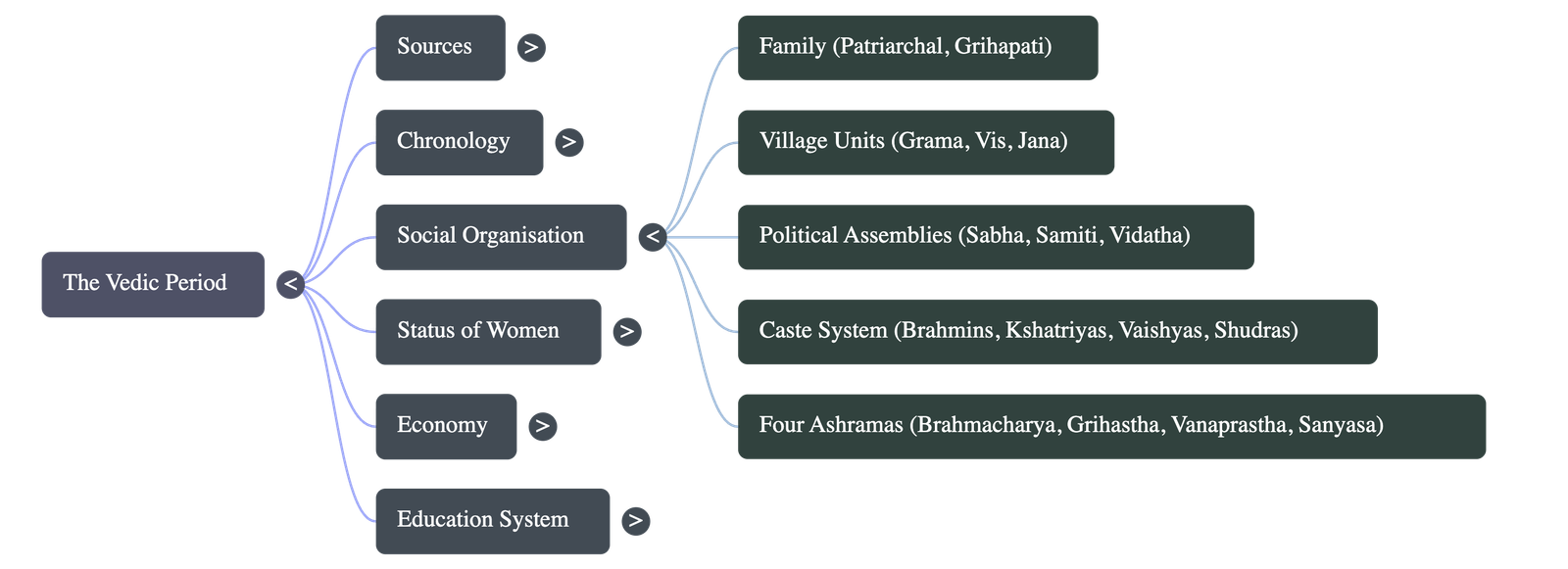
- Family Structure: Patriarchal society. The oldest male, the Grihapati or Kulapati, was the head. Marriages occurred at maturity; monogamy was normal, but chiefs practiced polygamy. In the Later Vedic age, joint families prevailed.
- Hierarchy: Families formed a village (Grama, headed by a Gramini) → Villages formed a Visha (headed by a Vishapati) → Vishas formed a tribe or Jana (headed by a Rajan or King).
Position of the King
- Early Vedic: The King was an elected tribal leader. He had no regular army, and organized tribal groups during wars. He was assisted by the Purohita (religious official) and Senani (military commander).
- Later Vedic: Kingship became hereditary and divine. Absolute authority was established through elaborate rituals (e.g., Rajasuya). A regular taxation system emerged with taxes like bali, shulka, and bhaga.
Assemblies
- Vidatha: The earliest assembly for economic, military, and religious functions, with active female participation.
- Sabha: A council of elders providing advisory and judicial functions.
- Samiti: The general assembly of the people.
- Later Vedic Change: The power of popular assemblies waned as they were dominated by chiefs and nobles, and the King's authority grew supreme.
Position of Women
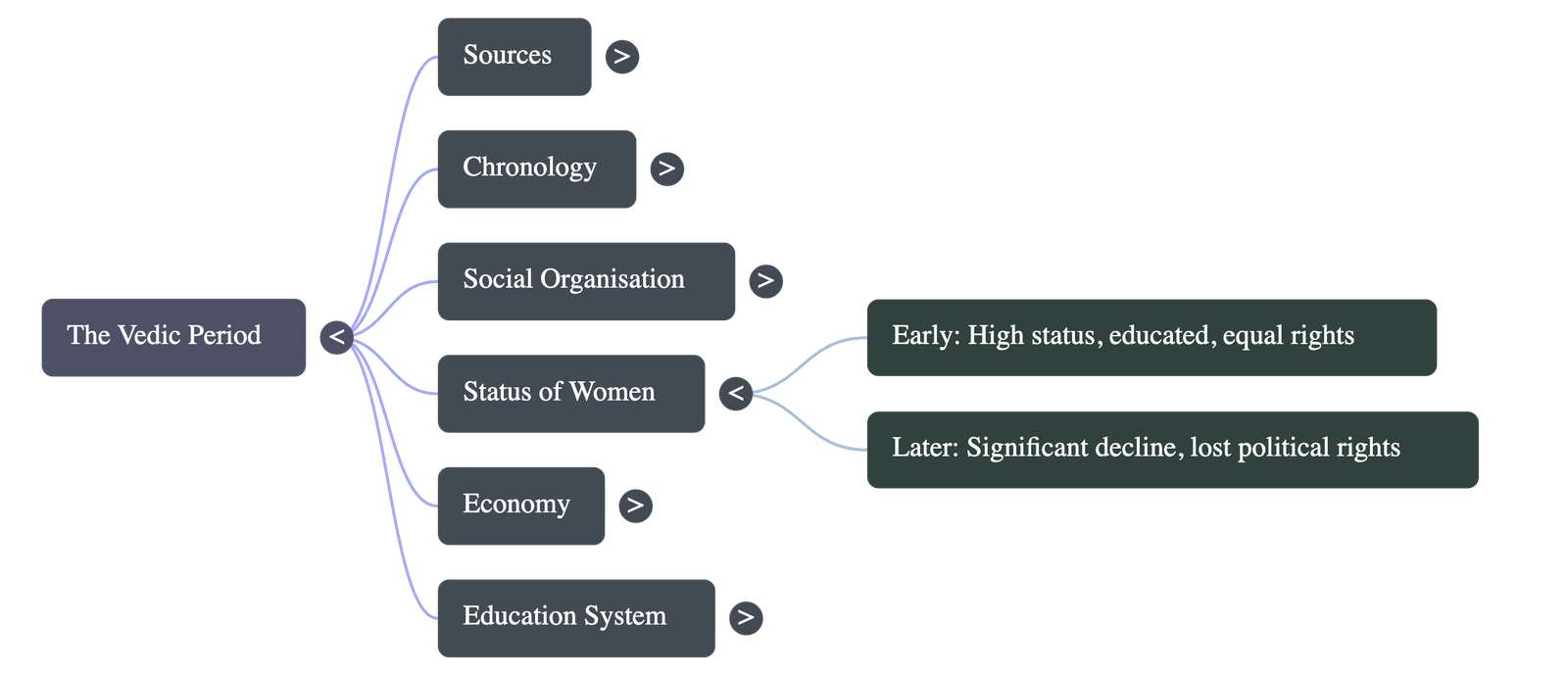
- Early Vedic: Women enjoyed a high status, equal rights, and received education (Upanayana ceremony). Highly educated women were called Brahmavadinis (e.g., Ghosha, Apala, Gargi, Maitreyi). There was no child marriage or Sati; women could choose husbands, remarry if widowed, and freely participated in assemblies and religious rituals alongside their husbands.
- Later Vedic: A significant decline in status occurred. Women were denied the right to Upanayana, religious participation without husbands, and attendance at tribal assemblies. Freedom to choose husbands was curtailed, and practices like child-marriage and the Sati system began to emerge.
Economy and Trade
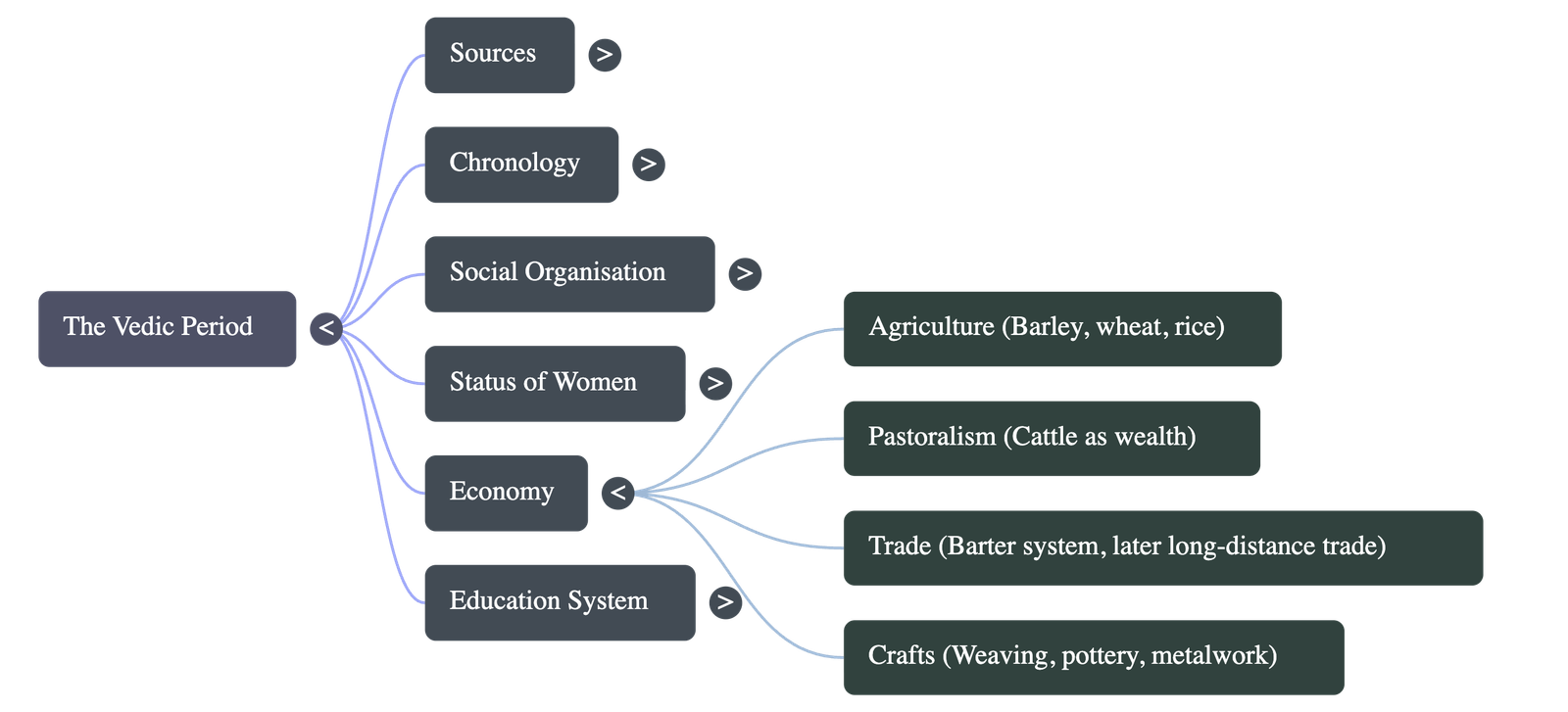
- Early Vedic Economy: Primarily pastoral. Wealth was measured in cattle (a wealthy man was a gomat). Agriculture was primitive (shifting cultivation), with barley (yava) as the main grain. Trade was managed via a limited barter system.
- Later Vedic Economy: Shifted to settled agriculture using fertile alluvial land and iron tools. Rice (vrihi) and wheat were introduced. Agriculture generated a surplus, leading to specialized crafts, the formation of trader guilds, and the rise of urban centers and long-distance trade.
- Occupations: Flourished to include chariot-makers, blacksmiths, carpenters, weavers, tanners, physicians, and musicians. Women were heavily involved in spinning, weaving, and dyeing.
Daily Life: Food, Dress & Amusements
- Food: Evolved from mainly barley in the Early Vedic age to include rice and wheat in the Later Vedic age. Milk, curd, butter, and ghee were staples. Soma, an intoxicating drink, was consumed during festivals.
- Dress & Ornaments: Simple clothing consisting of an undergarment (Nivi), an upper piece (Vasa), and an overgarment (Adhivasa). Both men and women wore jewelry made of gold, silver, and precious stones.
- Amusement: Included chariot-racing, horse-racing, hunting, gambling, and music (drum, flute, lute).
Social Divisions & The Ashramas
The Four Class Divisions (Varnas)
- Early Vedic: Society was divided flexibly based on an individual's profession, not birth. A person could easily choose or change their profession.
- Later Vedic: The division solidified into a rigid, hereditary caste system comprising four Varnas:
- Brahmins: Priests who performed religious rituals; came to be revered as earthly gods.
- Kshatriyas: Warriors and the ruling class.
- Vaishyas: Engaged in business, trade, and agriculture.
- Shudras: The class designated to serve the upper three classes.
The Four Ashramas (Stages of Life)
- Developed fully in the Later Vedic Period, dividing an Aryan's 100-year lifespan into four 25-year segments:
- Brahmacharya (Up to 25 years): Time spent in a gurukul acquiring knowledge and practicing strict discipline.
- Grihastha (25 to 50 years): The life of a householder, focusing on marriage, raising a family, and worldly responsibilities.
- Vanaprastha (50 to 75 years): Retirement from worldly affairs to acquire spiritual and philosophical knowledge.
- Sanyasa (75 to 100 years): Complete renunciation of worldly ties, spent in deep meditation seeking moksha (salvation).
Education System
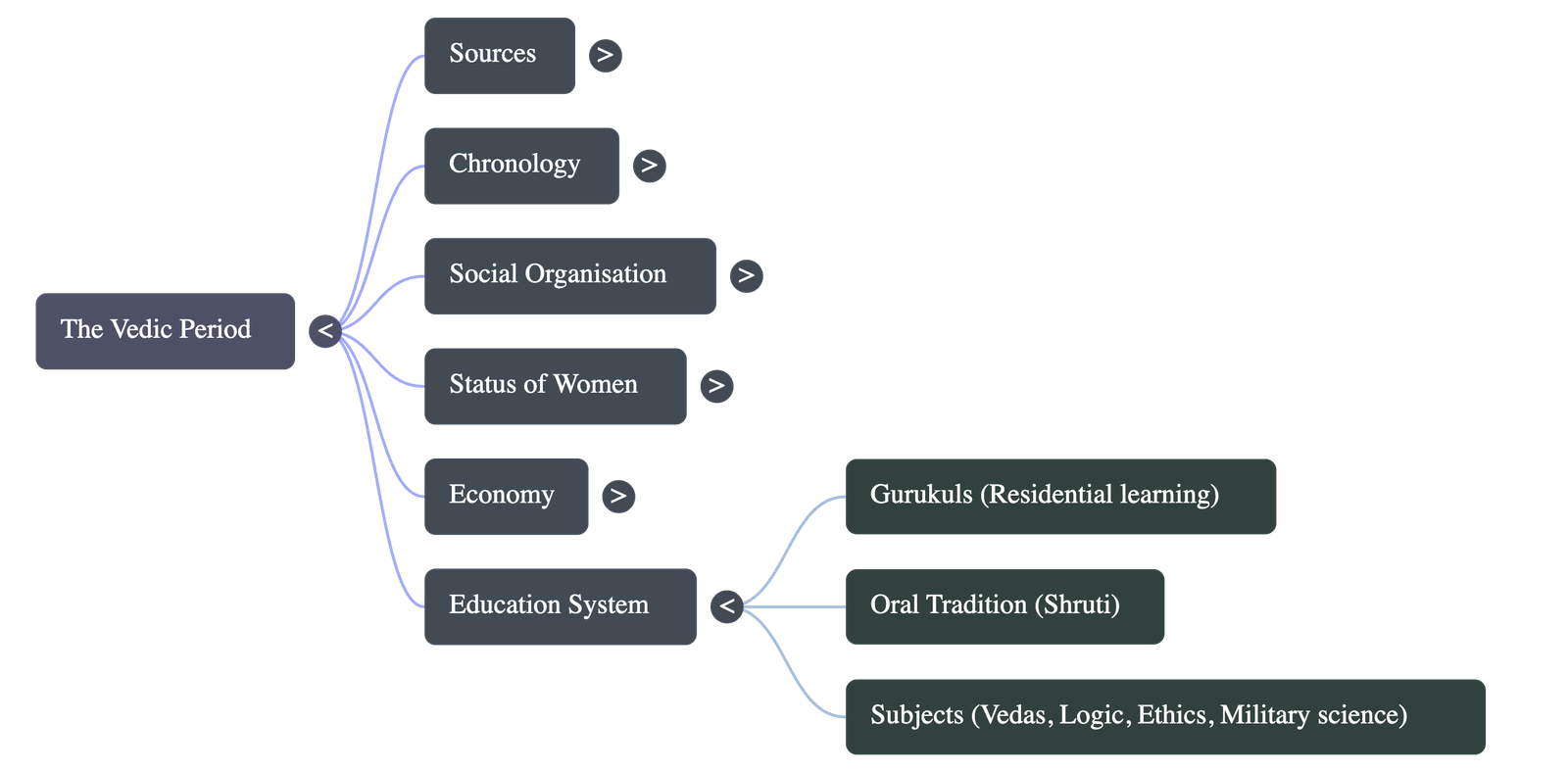
- Imparted strictly through the Gurukul system (residence of the guru), typically situated in forests or city outskirts.
- Education was oral and focused on the holistic (physical, mental, and spiritual) development of the student.
- Subjects included the Vedas, Puranas, grammar, mathematics, ethics, logic, and military science.
- Students lived as part of the guru's family, performed household chores, maintained discipline, and offered Guru dakshina upon completing their education.
Do checkout all questions & answers of this chapter.
Quick Navigation:
| | | |
1 / 1
Quick Navigation:
| | | |