Quick Navigation:
| | |
People as Resource
Introduction: Population as an Asset
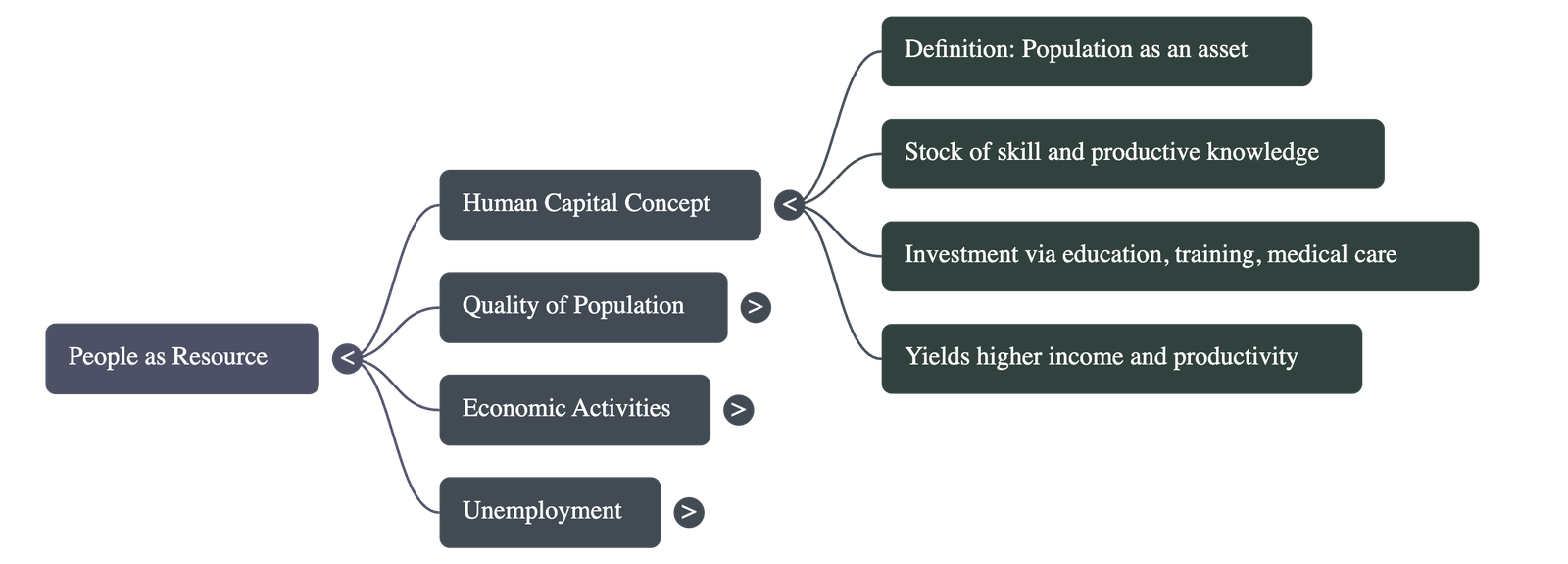
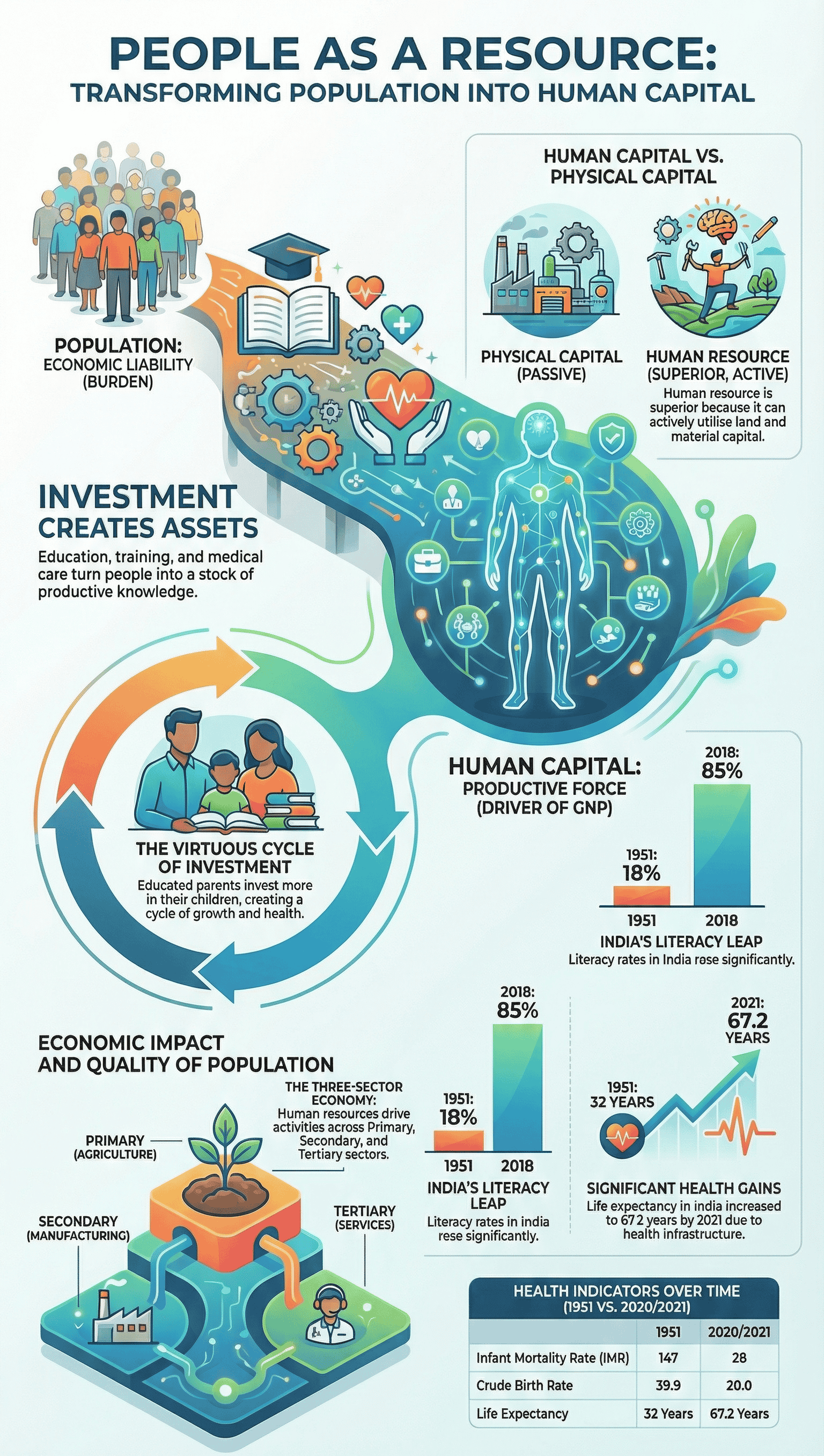
- Concept: "People as Resource" refers to a country's working population in terms of their existing productive skills and abilities. It emphasizes the ability of the population to contribute to the Gross National Product (GNP).
- Asset vs. Liability: Population should be viewed as an asset for the economy rather than a liability. It becomes Human Capital when investments are made in education, training, and medical care.
- Return on Investment: Just like physical capital, investment in human capital yields returns through higher income and higher productivity.
- Societal Benefits: A healthier and more educated population benefits society indirectly, as advantages spread even to those not directly educated or given health care. Human capital is superior to land and physical capital because it can make use of other resources, whereas other resources cannot become useful on their own.
Economic Activities by Men and Women
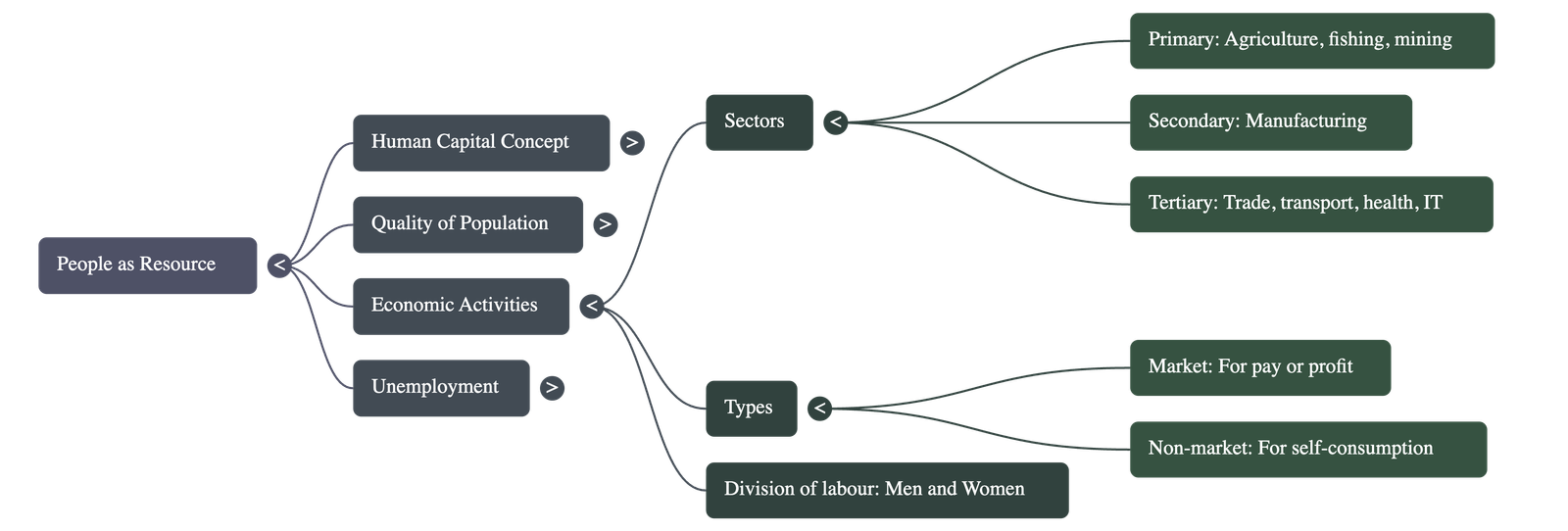
Activities are classified into three main sectors:
- Primary Sector: Includes agriculture, forestry, animal husbandry, fishing, poultry farming, mining, and quarrying.
- Secondary Sector: Includes manufacturing.
- Tertiary Sector: Includes trade, transport, communication, banking, education, health, tourism, services, and insurance. These activities add value to the national income.
Types of Economic Activities:
- Market Activities: Performed for pay or profit (remuneration), including government service.
- Non-Market Activities: Production for self-consumption, such as processing primary products and own-account production of fixed assets.
Division of Labour:
- Historically and culturally, a division of labour exists between men and women. Women generally look after domestic chores while men work in the fields.
- Domestic work performed by women is not recognized in the National Income unless they enter the labour market.
- In the unorganized sector, women are often paid less than men and lack job security and legal protection. However, women with high education and skills are paid at par with men.
Quality of Population
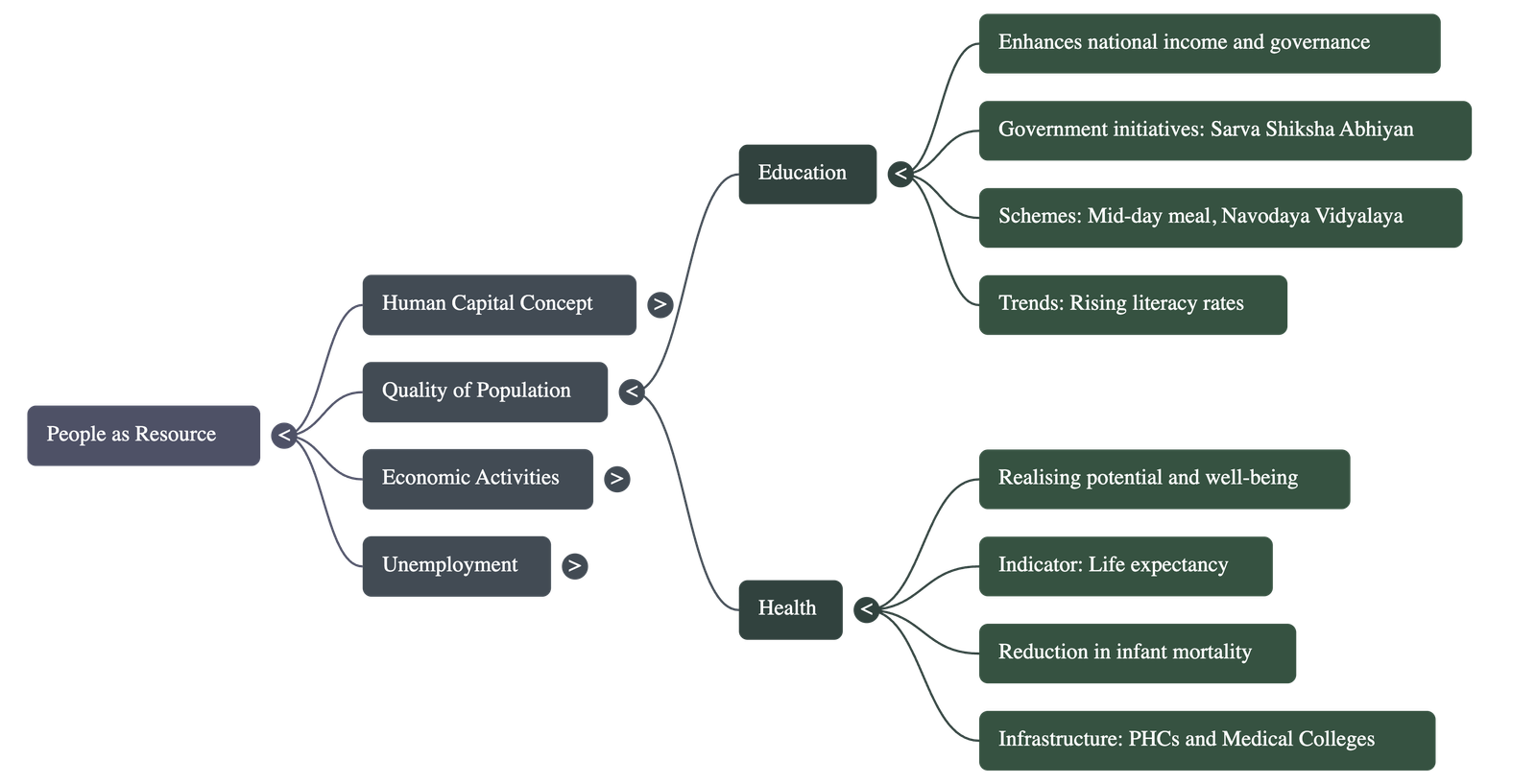
The quality of the population decides the growth rate of the country. It depends on:
1. Education
- Education opens new horizons, provides new aspirations, and develops values of life.
- It contributes to the growth of society, enhances national income and cultural richness, and increases the efficiency of governance.
- Government initiatives include Sarva Shiksha Abhiyan for elementary education, Mid-day meal schemes to encourage attendance, and the establishment of Navodaya Vidyalayas.
- The 12th Plan focused on increasing access, quality, and adoption of state-specific curriculum modifications, targeting a Gross Enrolment Ratio (GER) of 25.2% by 2017-18 and 30% by 2020-21.
2. Health
- Health is indispensable for realizing one's well-being and ability to fight illness. An unhealthy person becomes a liability for an organization.
- National policy aims to improve accessibility of healthcare, family welfare, and nutritional services, focusing on the underprivileged.
- Significant improvements have been made in life expectancy, and reductions in Infant Mortality Rate (IMR), birth rates, and death rates.
Unemployment
Unemployment exists when people willing to work at going wages cannot find jobs.
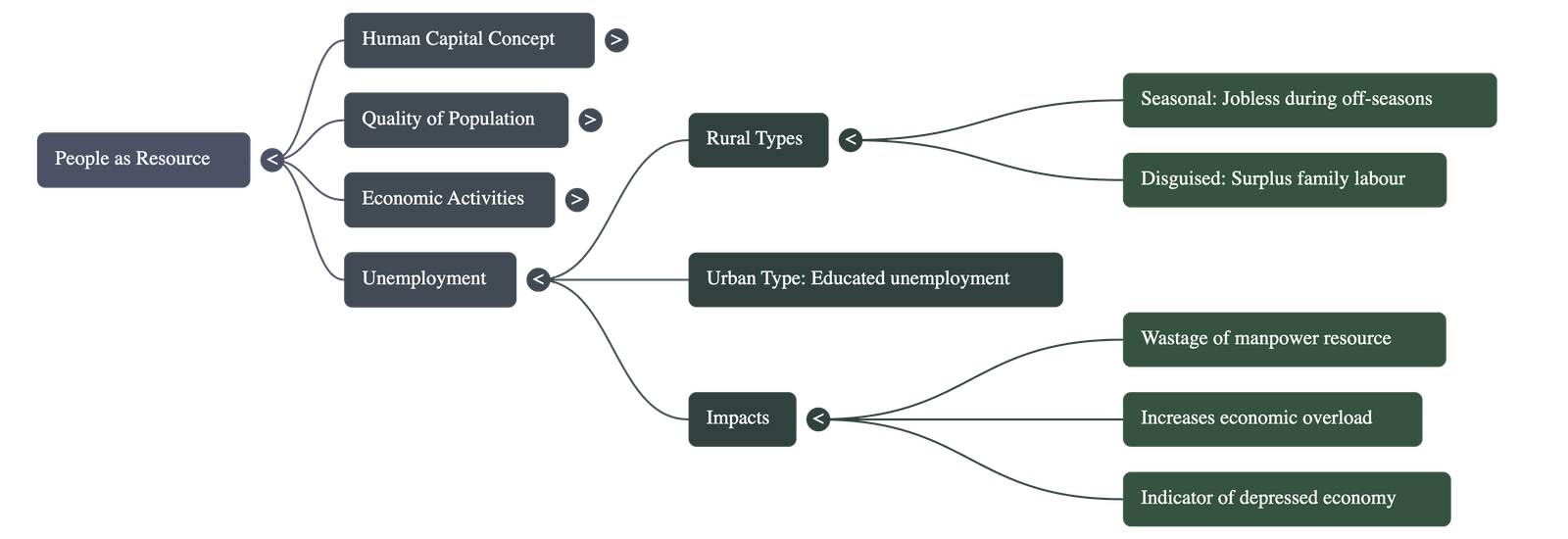
Types of Unemployment:
- Seasonal Unemployment (Rural): Happens when people are not able to find jobs during certain months of the year (e.g., during off-seasons in agriculture).
- Disguised Unemployment (Rural): People appear employed but are not. For example, a farm requires the service of five people but engages eight. The contribution of the three extra people does not add to total productivity.
- Educated Unemployment (Urban): Many youth with matriculation, graduation, and post-graduation degrees cannot find jobs. A paradox exists where there is a surplus of manpower in certain categories (like general graduates) alongside a shortage of technical skills required for economic growth.
Consequences of Unemployment:
- Wastage of Manpower: People who are assets turn into liabilities.
- Economic Overload: The dependence of the unemployed on the working population increases.
- Social Impact: It creates a feeling of hopelessness and despair. It adversely affects the quality of life and health status.
- Depressed Economy: Increasing unemployment is an indicator of a depressed economy.
Case Studies
- Story of Sakal and Vilas: Illustrates the difference human capital formation makes. Sakal, who received education and training, got a good job and increased his productivity. Vilas, who lacked education and health care, remained in the same cycle of poverty and low income as his mother.
- Story of a Village: A village evolved from having no job opportunities to becoming prosperous. This happened because families invested in their children's education (e.g., in agro-engineering). The educated youth returned, created new technologies (improved ploughs), and new jobs (teachers, tailors) were created, leading to a complex and modern economic structure.
Do checkout all questions & answers of this chapter.
Quick Navigation:
| | |
1 / 1
Quick Navigation:
| | |