Quick Navigation:
| | |
The Story of Village Palampur
1. Overview of Palampur
- Purpose: The story of the hypothetical village "Palampur" is used to introduce basic concepts relating to production.
- Location and Connectivity: Palampur is well-connected to neighboring villages and towns. "Raiganj" (a big village) is 3 kms away, and the nearest small town is "Shahpur". An all-weather road connects them, supporting transport ranging from bullock carts to motor vehicles like trucks and tractors.
- Demographics: The village has about 450 families from various castes. The 80 upper-caste families own the majority of the land and live in large brick houses. The Dalits (SCs) constitute one-third of the population and live in smaller mud and straw houses in one corner of the village.
- Infrastructure: Most houses have electricity, which powers tubewells and small businesses. The village has two primary schools, one high school, a government primary health centre, and a private dispensary.
2. Organization of Production
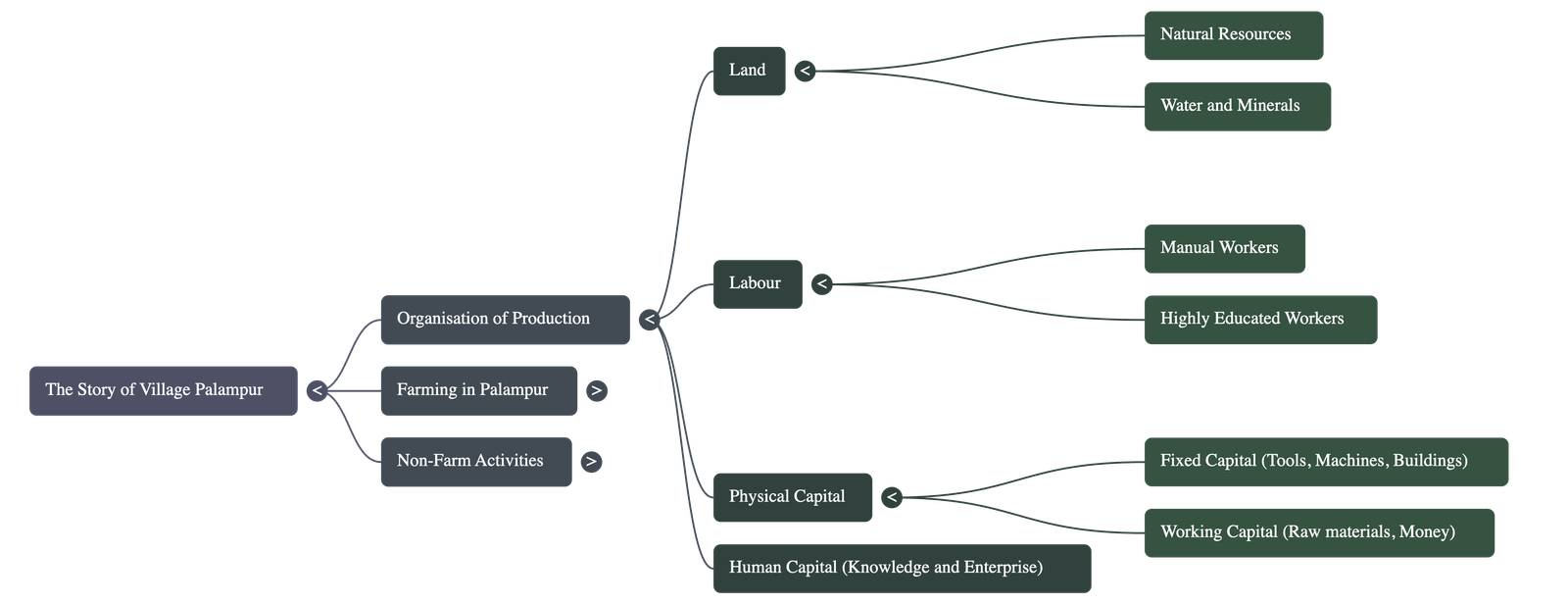
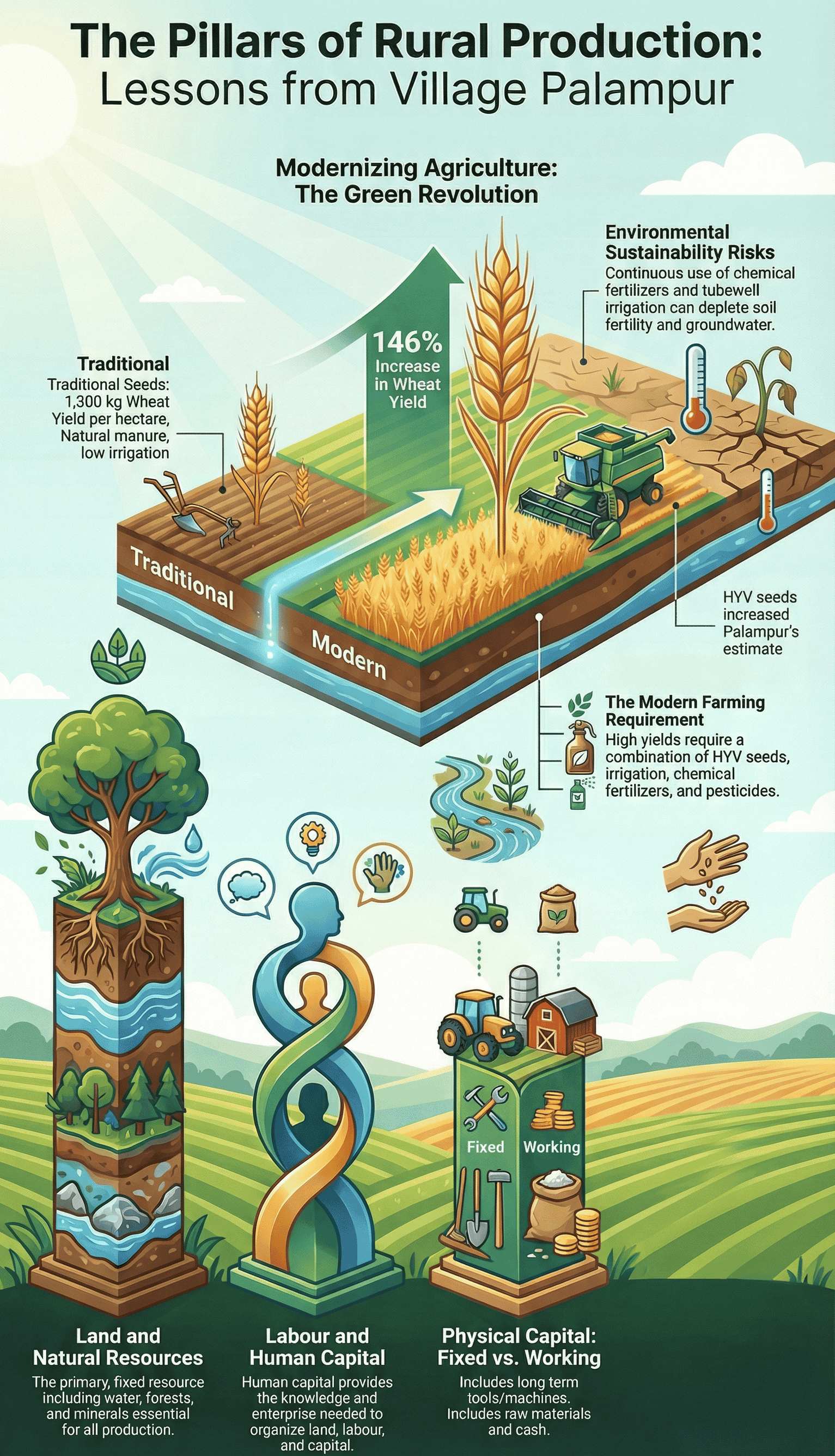
Production aims to produce goods and services. There are four essential requirements (Factors of Production):
- First Requirement: Land. This includes the land itself and other natural resources like water, forests, and minerals.
- Second Requirement: Labour. The people who do the work. This includes both highly educated workers for specialized tasks and manual labourers for physical work.
- Third Requirement: Physical Capital. The variety of inputs required at every stage of production. It is divided into:
- Fixed Capital: Tools, machines, and buildings (e.g., ploughs, generators, computers) that can be used for production over many years.
- Working Capital: Raw materials and money in hand (e.g., yarn for a weaver, clay for a potter) which are used up during production.
- Fourth Requirement: Human Capital. The knowledge and enterprise needed to combine land, labour, and physical capital to produce an output.
3. Farming in Palampur
Farming is the main production activity, supporting 75% of the working population.
A. Land Constraints
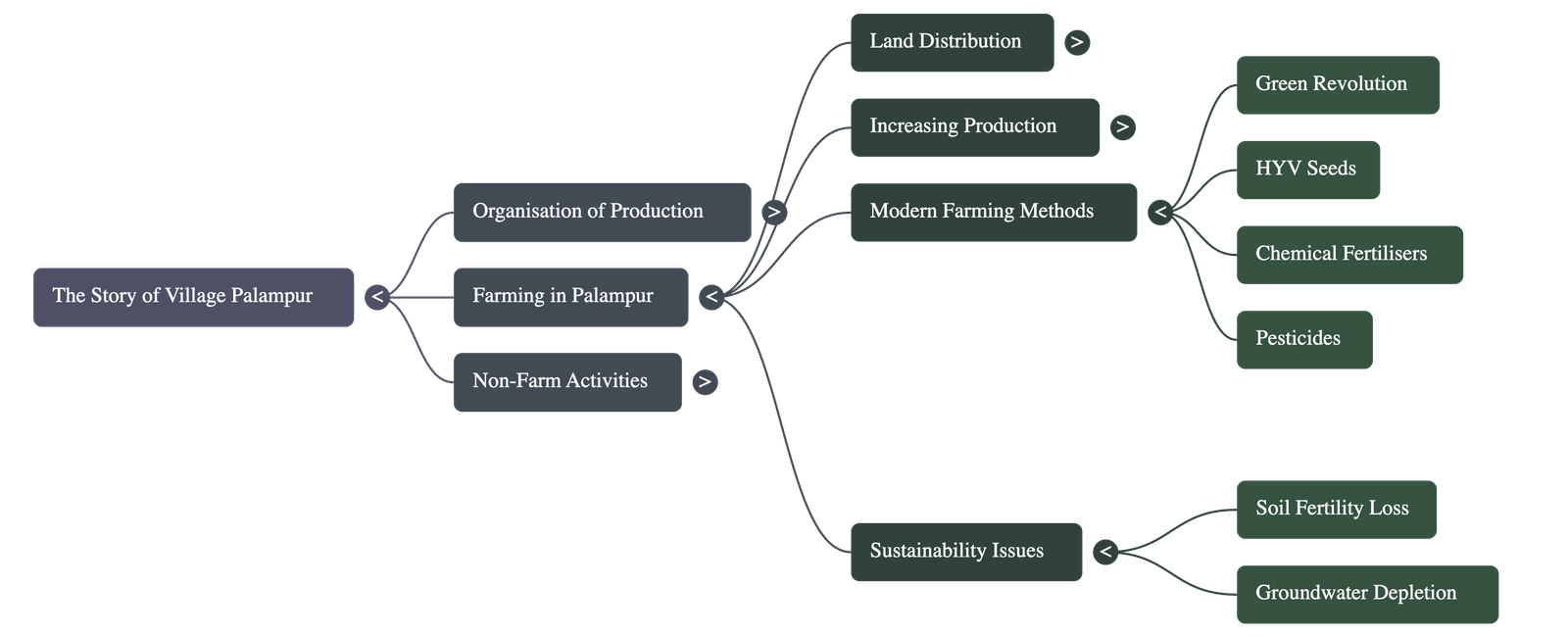
- Fixed Land Area: Since 1960, there has been no expansion of land area under cultivation in Palampur. Some wastelands were converted, but there is no further scope to increase cultivable land.
B. Methods to Increase Production
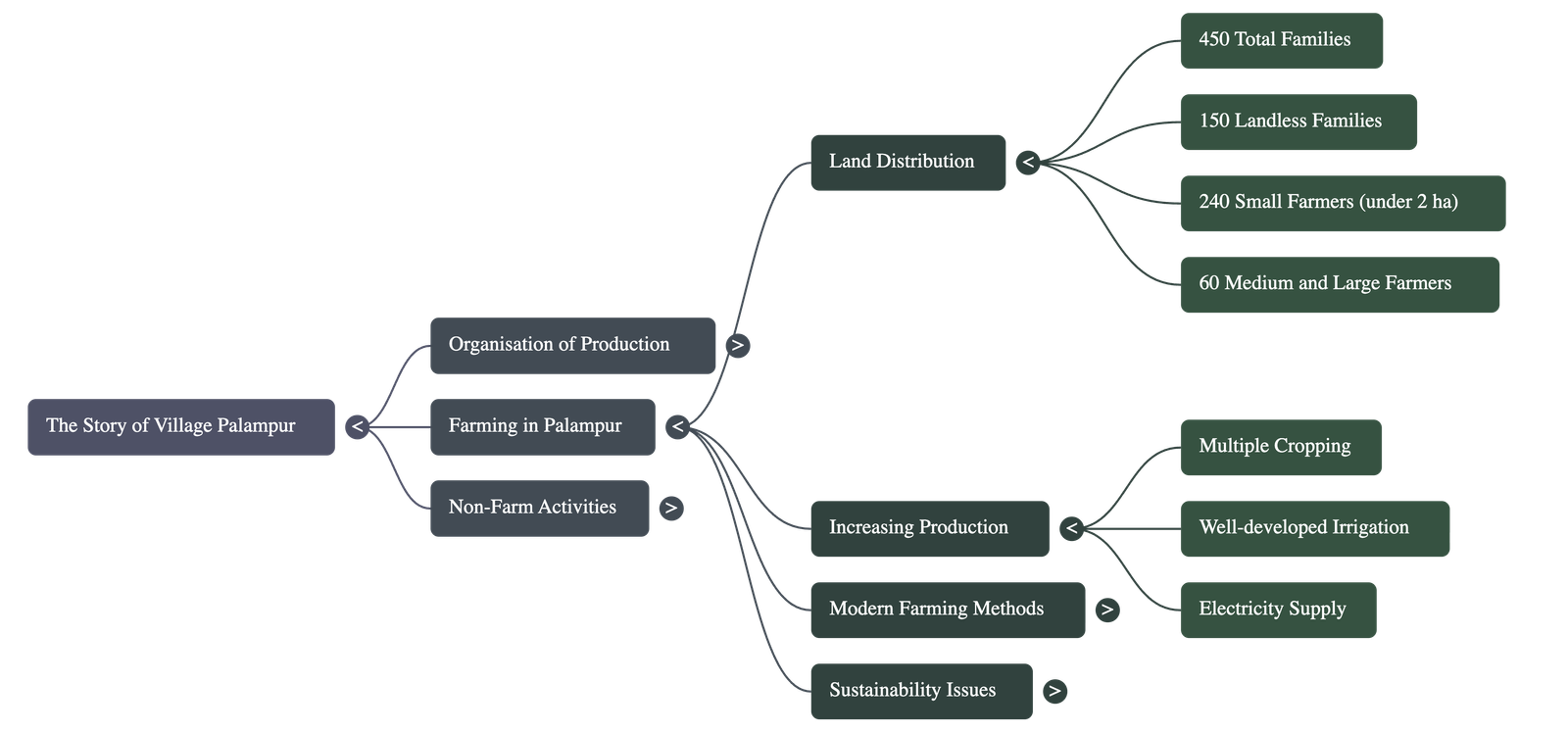
- Multiple Cropping: Growing more than one crop on a piece of land during the year. Farmers in Palampur grow at least two main crops (Jowar/Bajra in rainy season, Wheat in winter) and often a third crop like potato.
- Irrigation: A well-developed system of electric tubewells allowed farmers to irrigate larger areas effectively, unlike the old Persian wheels.
- Modern Farming Methods (Green Revolution): Introduced in the late 1960s, this involves using High Yielding Varieties (HYVs) of seeds. HYVs produce much more grain per plant but require plenty of water, chemical fertilizers, and pesticides. In Palampur, wheat yields increased from 1300 kg/ha (traditional) to 3200 kg/ha (modern).
C. Sustainability Concerns
- Soil Degradation: Green Revolution is associated with the loss of soil fertility due to the increased use of chemical fertilizers, which kill necessary bacteria in the soil.
- Water Depletion: Continuous use of groundwater for tubewell irrigation has led to a depletion of the water table.
D. Distribution of Land
- Unequal Distribution: About one-third of the families (150 families) are landless. Of the remaining, 240 families cultivate small plots of less than 2 hectares, which does not provide adequate income.
- Large Farmers: 60 families of medium and large farmers cultivate more than 2 hectares of land, with a few owning over 10 hectares.
E. Labour
- Source of Labour: Small farmers cultivate their own land with family help. Medium and large farmers hire farm labourers.
- Condition of Labourers: Farm labourers come from landless families or small plot owners. They do not have a right to the crops grown. They are paid wages in cash or kind, which vary widely. Due to heavy competition for work, labourers often accept wages lower than the government minimum.
F. Capital
- Small Farmers: Find it difficult to arrange capital. They borrow from large farmers or moneylenders at very high interest rates and often have to work on the lender's farm as part of the deal.
- Medium/Large Farmers: They have their own savings from farming (by selling surplus) to arrange for capital.
G. Sale of Surplus
- After harvest, farmers keep part of the crop for family consumption and sell the surplus at the market (e.g., Raiganj).
- Large farmers sell substantial surplus, earning money that is saved for the next season's capital, buying fixed assets like tractors, or lending to small farmers.
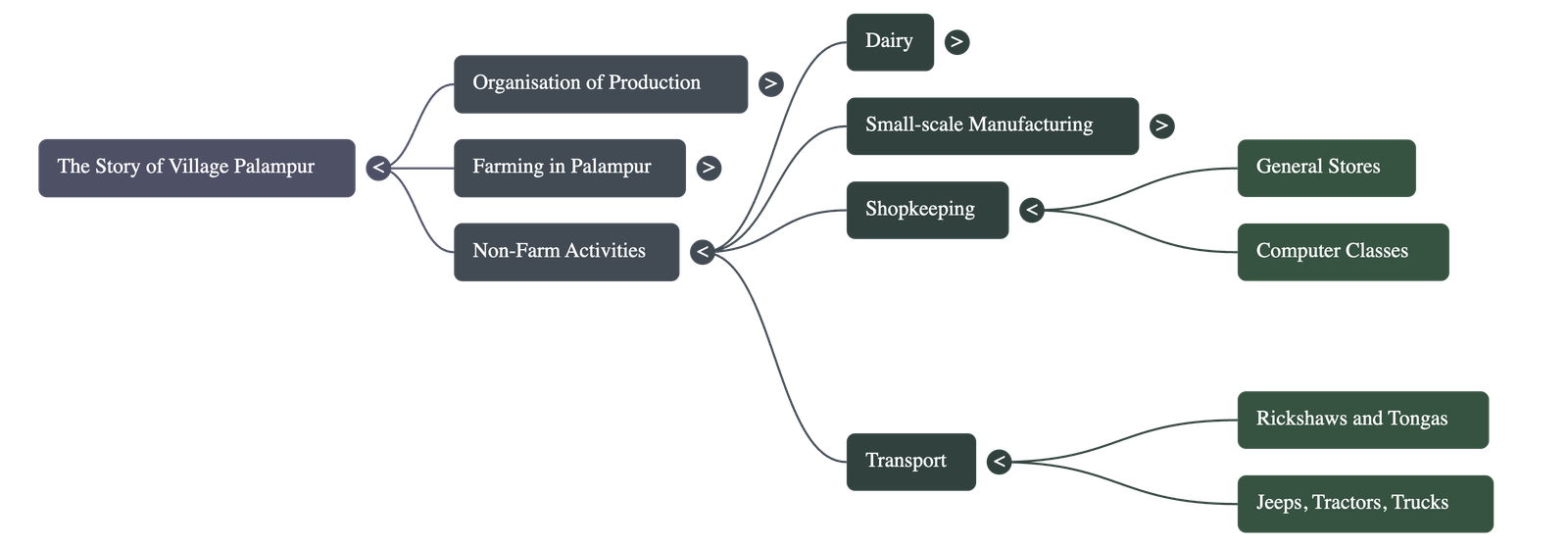
4. Non-Farm Activities
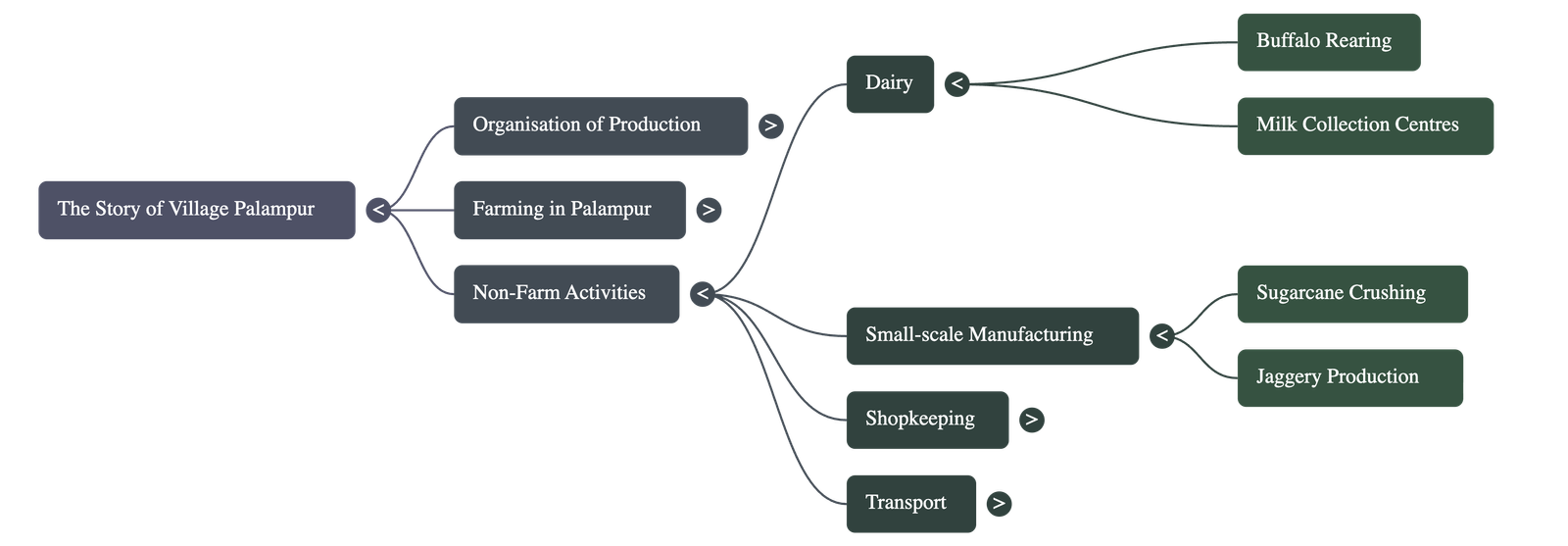
Only 25% of the working population in Palampur is engaged in activities other than agriculture.
- Dairy: A common activity. People feed buffaloes grass and jowar/bajra. Milk is sold in Raiganj, where collection centers chill it for transport to cities.
- Small-scale Manufacturing: Involves simple production methods, usually done at home or in fields with family labour (e.g., sugarcane crushing to make jaggery). Very little hired labour is used.
- Shopkeeping: Traders buy goods from wholesale markets in cities and sell them in the village. Stores sell general items like rice, tea, oil, soap, and stationary. Some families near the bus stand sell eatables.
- Transport: A fast-developing sector. Rickshawallahs, tongawallahs, jeep, tractor, and truck drivers ferry people and goods, getting paid in return. This sector has grown over the years.
Do checkout all questions & answers of this chapter.
Quick Navigation:
| | |
1 / 1
Quick Navigation:
| | |