Quick Navigation:
| | |
Compound Interest [Without Using Formula]
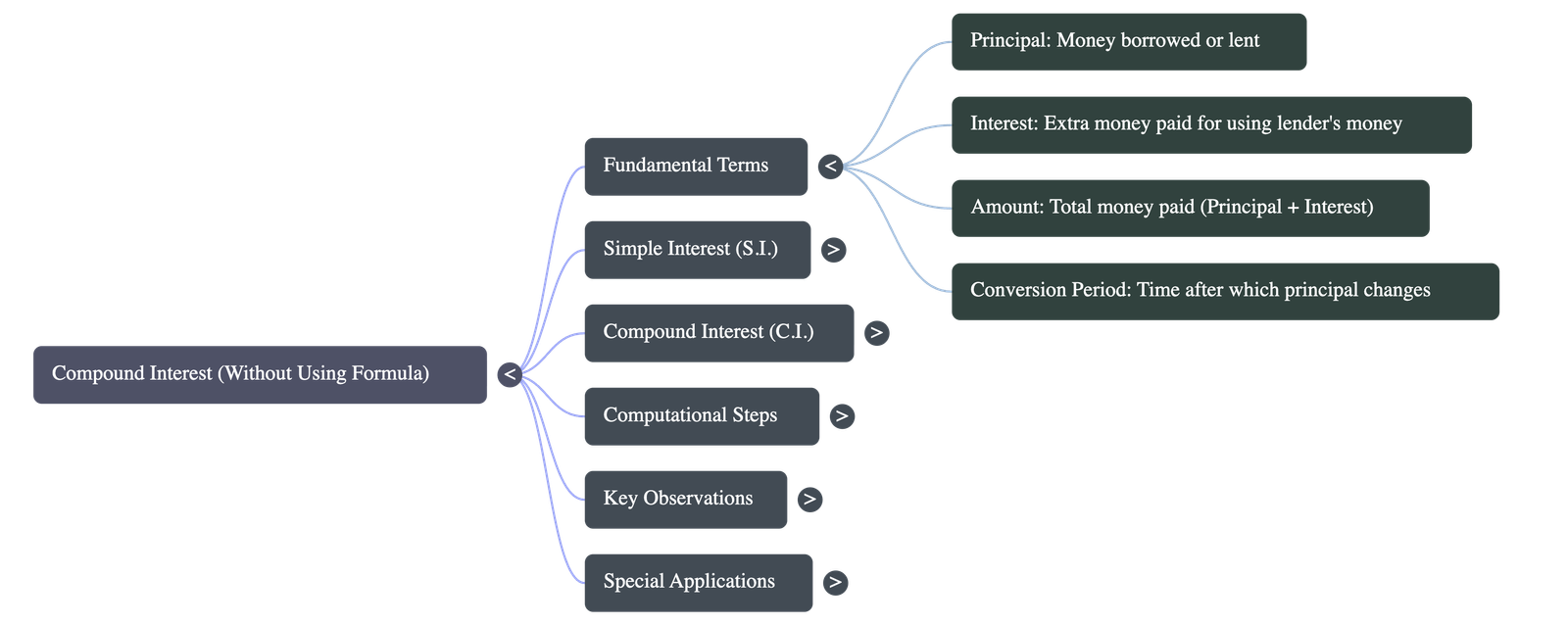
1. Introduction to Basic Financial Terms
- ✦ Principal: The original sum of money borrowed from a bank or lender for a specified period.
- ✦ Interest: The additional money paid by the borrower for the privilege of utilizing the lender's money.
-
✦
Amount: The total money returned to the lender at the end of the specified period.
Amount = Principal + Interest (A = P + I)
2. Understanding Simple Interest (S.I.)
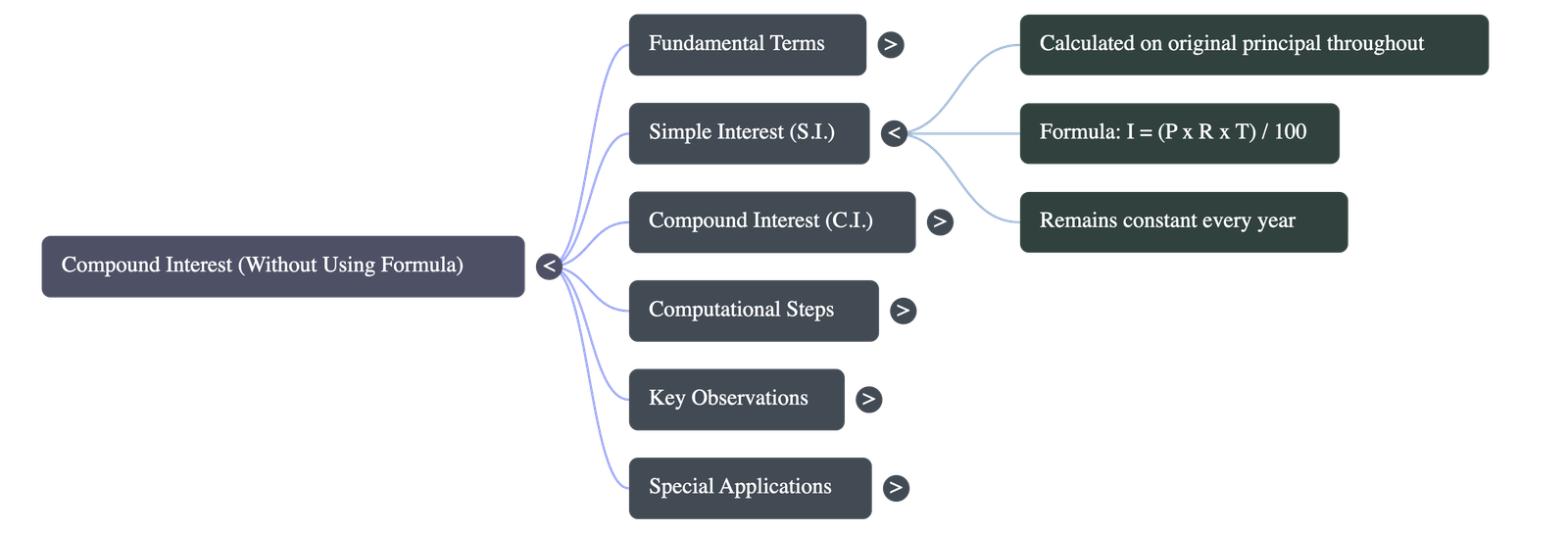
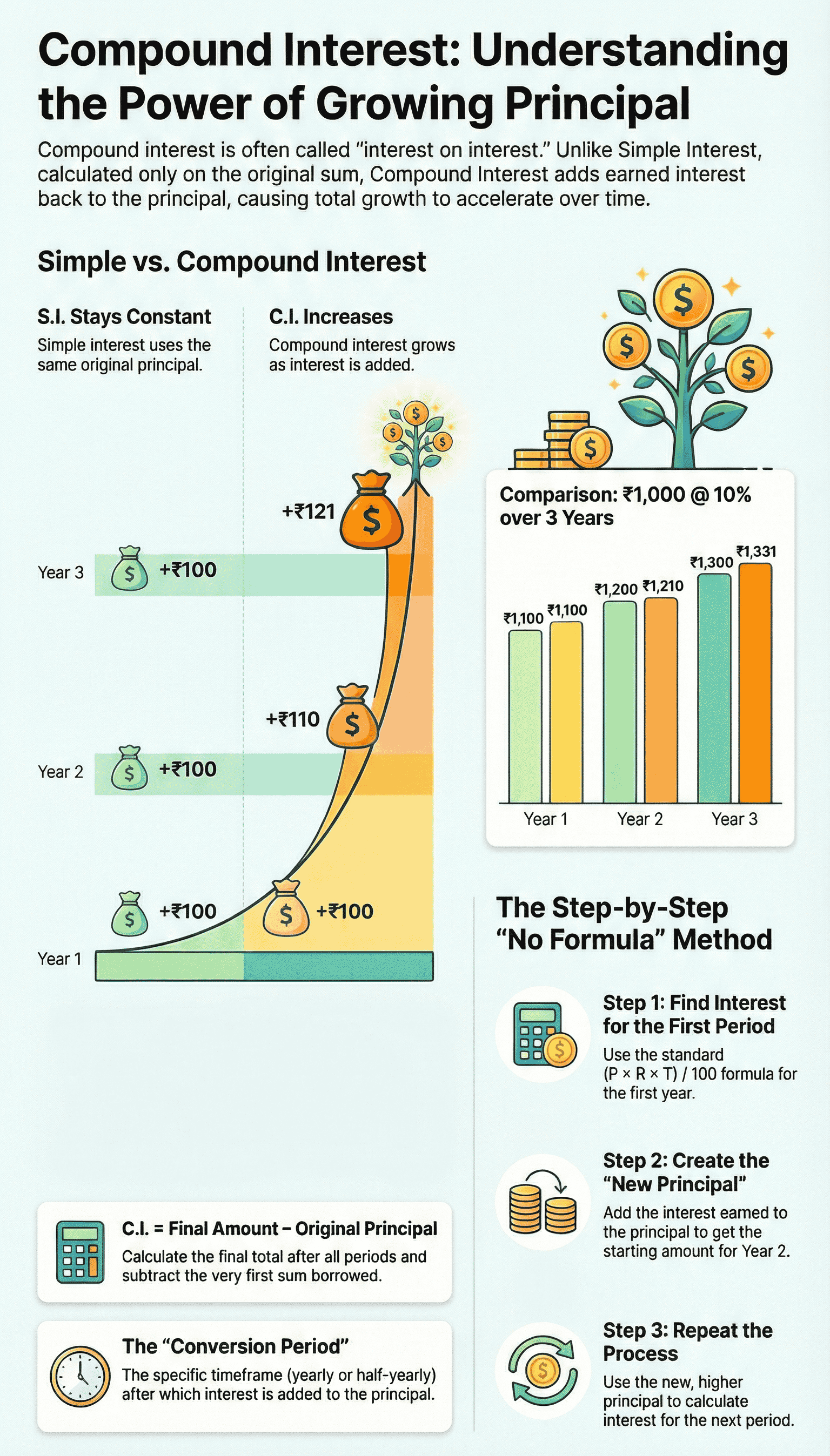
- ✦ Interest is considered "simple" when it is calculated strictly on the original principal throughout the entire duration of the loan.
- ✦ If a problem merely uses the word "interest" without specifying the type, it inherently refers to simple interest.
-
✦
Formula:
S.I. = (Principal × Rate × Time) / 100
3. Mechanics of Compound Interest (C.I.)
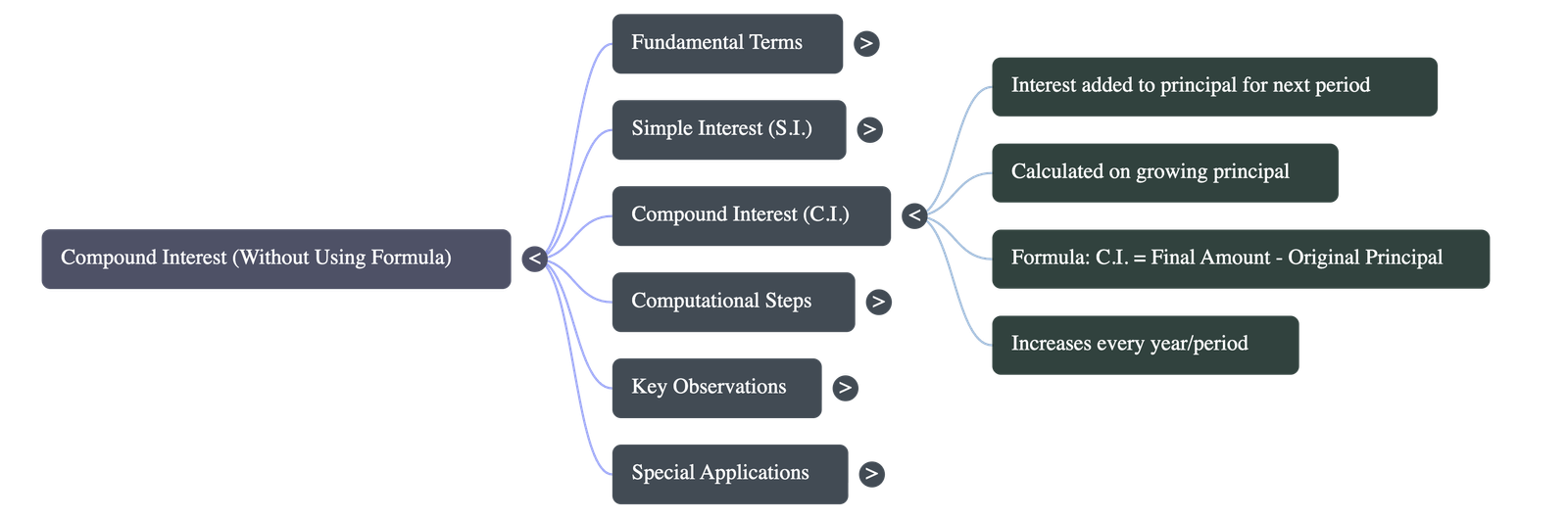
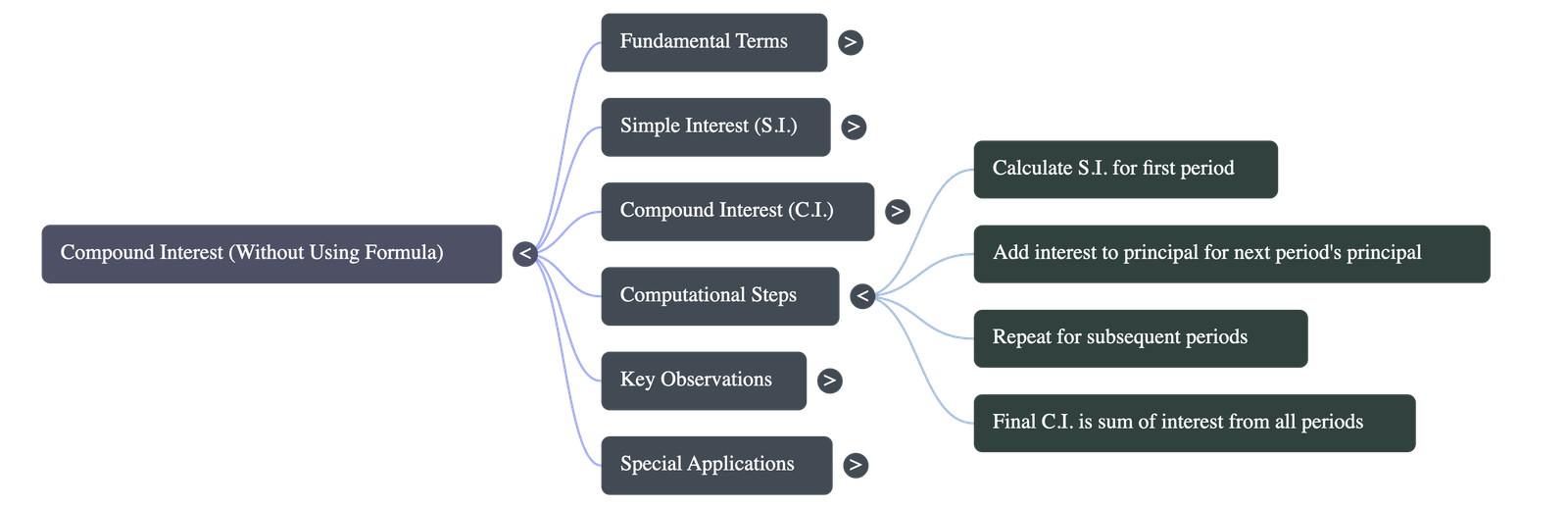
- ✦ The Core Concept: Money is lent at compound interest when the interest due at the end of a fixed period is not paid immediately but is added directly to the principal.
- ✦ A Growing Principal: The total amount obtained at the end of one period becomes the new principal for the next period. This process repeats until the final period concludes.
-
✦
Calculation of C.I.:
Compound Interest = Final Amount - Original Principal - ✦ Total Compound Interest over several years can also be determined by calculating the individual compound interests for each year sequentially and adding them together.
4. The Conversion Period
- ✦ The conversion period is the specific duration after which the principal changes (increases).
- ✦ Compounded Yearly: The principal increases every year, making the conversion period one year.
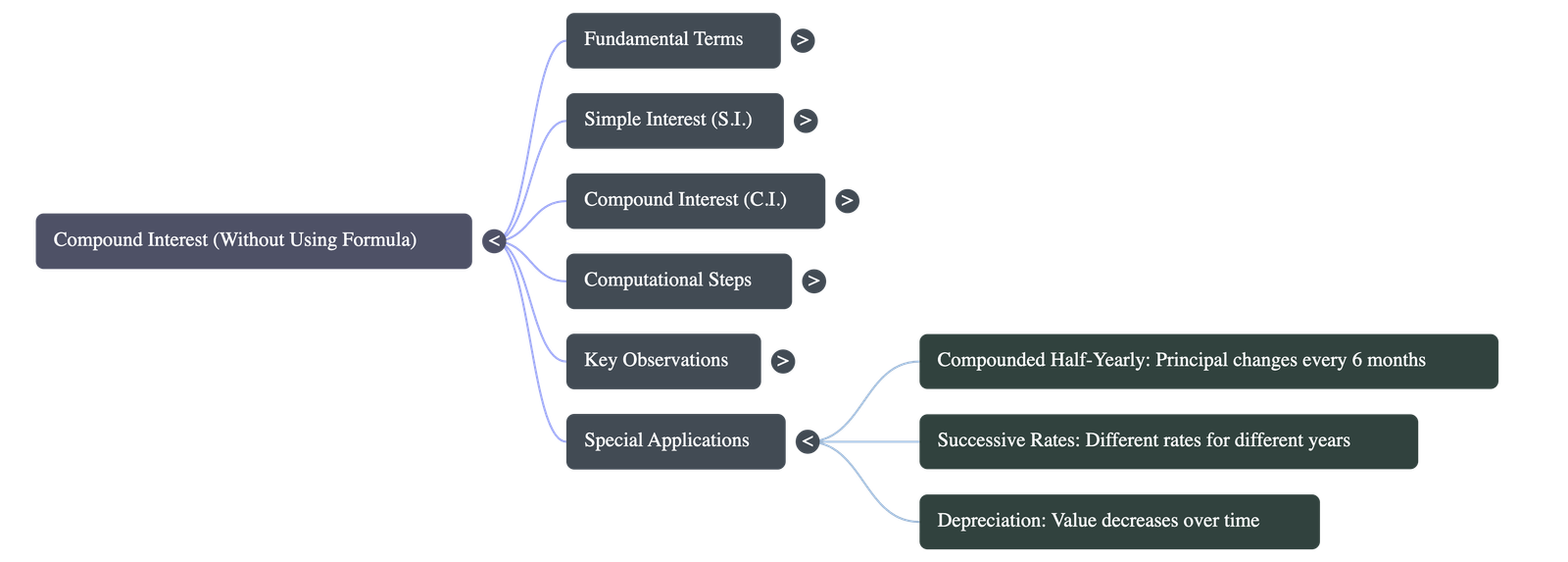
- ✦ Compounded Half-Yearly: The principal increases every six months, making the conversion period a half-year.
5. Important Properties of Compound Interest
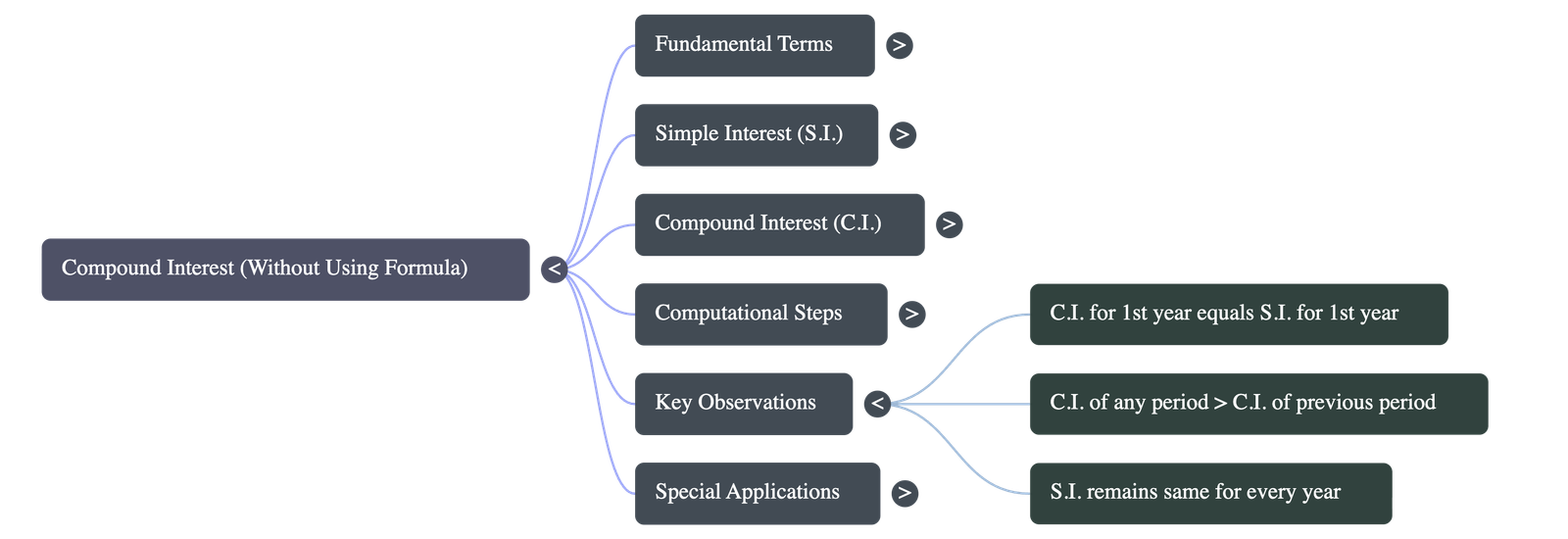
- ✦ Increasing Interest: For a given principal and interest rate, the C.I. for any subsequent period is always greater than the C.I. of the preceding period (e.g., C.I. of 2nd year > C.I. of 1st year).
- ✦ Difference in Consecutive Interests: The difference between the compound interests for any two consecutive conversion periods equals the interest calculated for one period on the C.I. of the preceding period.
- ✦ Difference in Consecutive Amounts: Similarly, the difference between the accumulated amounts for any two consecutive conversion periods equals the interest calculated for one period on the amount of the preceding period.
6. Relationship Between S.I. and C.I.
- ✦ The First Period Equality: Simple Interest and Compound Interest are absolutely identical for the first year (or first conversion period) provided the principal and rate are the same.
- ✦ Constant vs. Growing: Simple interest remains exactly the same every year, whereas compound interest increases progressively.
-
✦
Predicting the Next Period's C.I.: If the Compound Interest of the 1st period is denoted as x, the C.I. for the next period will be:
x + (Interest on x for one period) -
✦
Predicting the Next Period's Amount: If the Amount at C.I. in a particular period is denoted as x, the Amount for the next period will be:
x + (Interest on x for one period)
Quick Navigation:
| | |
1 / 1
Quick Navigation:
| | |