Quick Navigation:
| | | |
Quick Navigation:
| | | |
Compound Interest [Using Formula]
1. Introduction to the Formula Method
- Calculating compound interest step-by-step using repeated simple interest formulas becomes extremely tedious as the number of conversion periods (years, half-years, etc.) increases.
- Standardized formulas are utilized to make calculations direct, fast, and easy.
2. Primary Formulas for Yearly Compounding
-
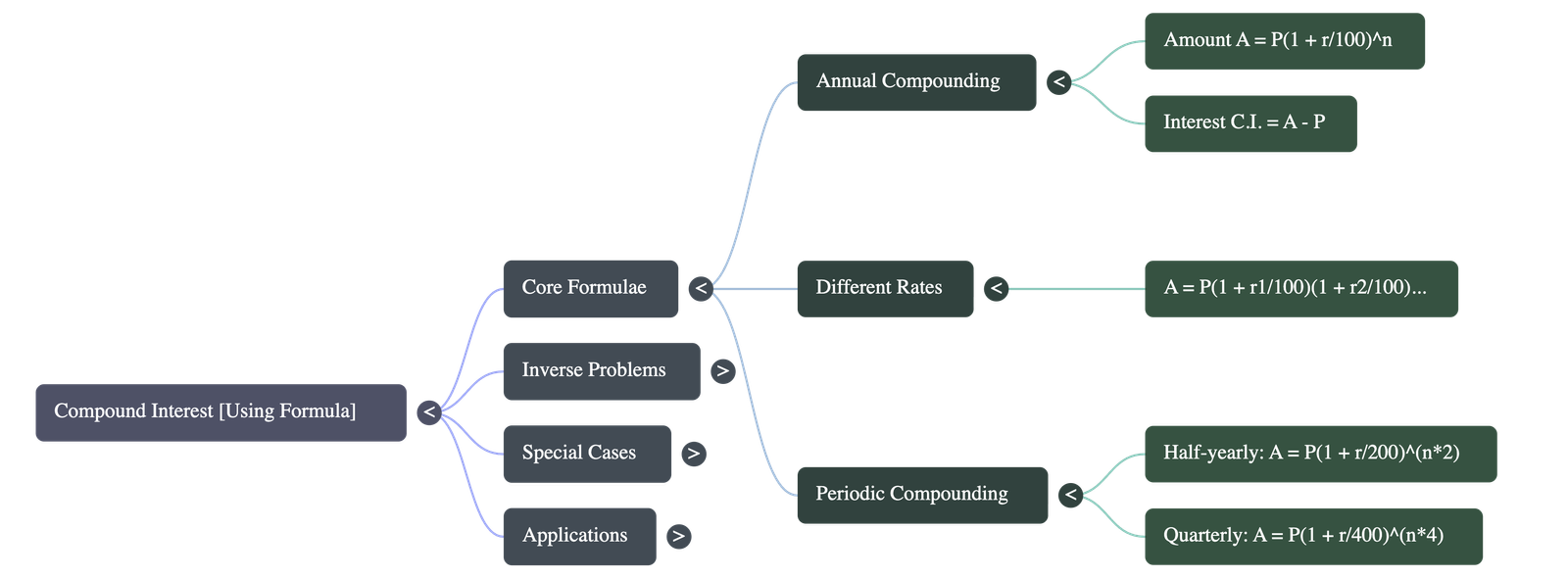
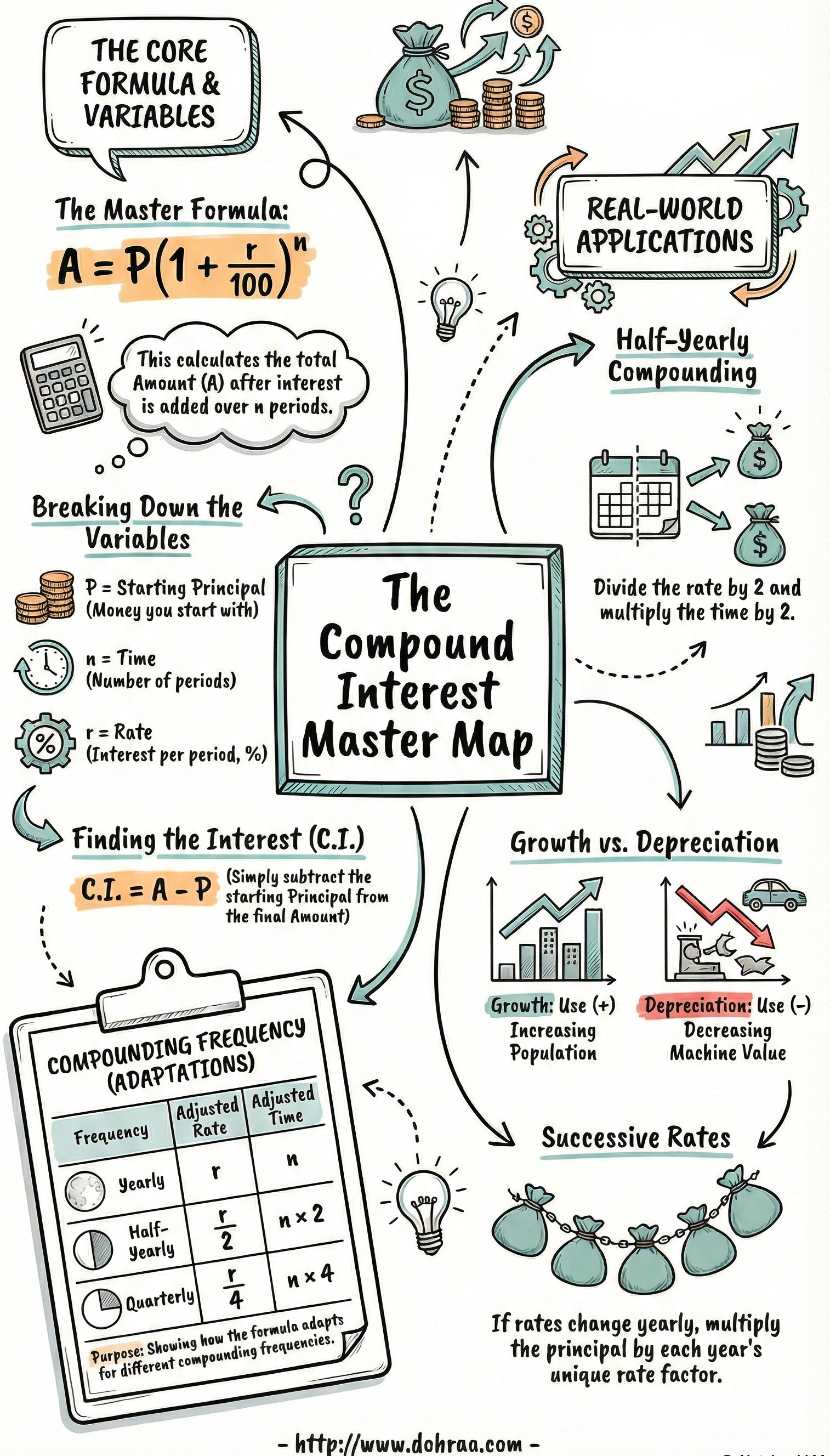
Finding the Amount (A): When interest is compounded yearly, the formula is:
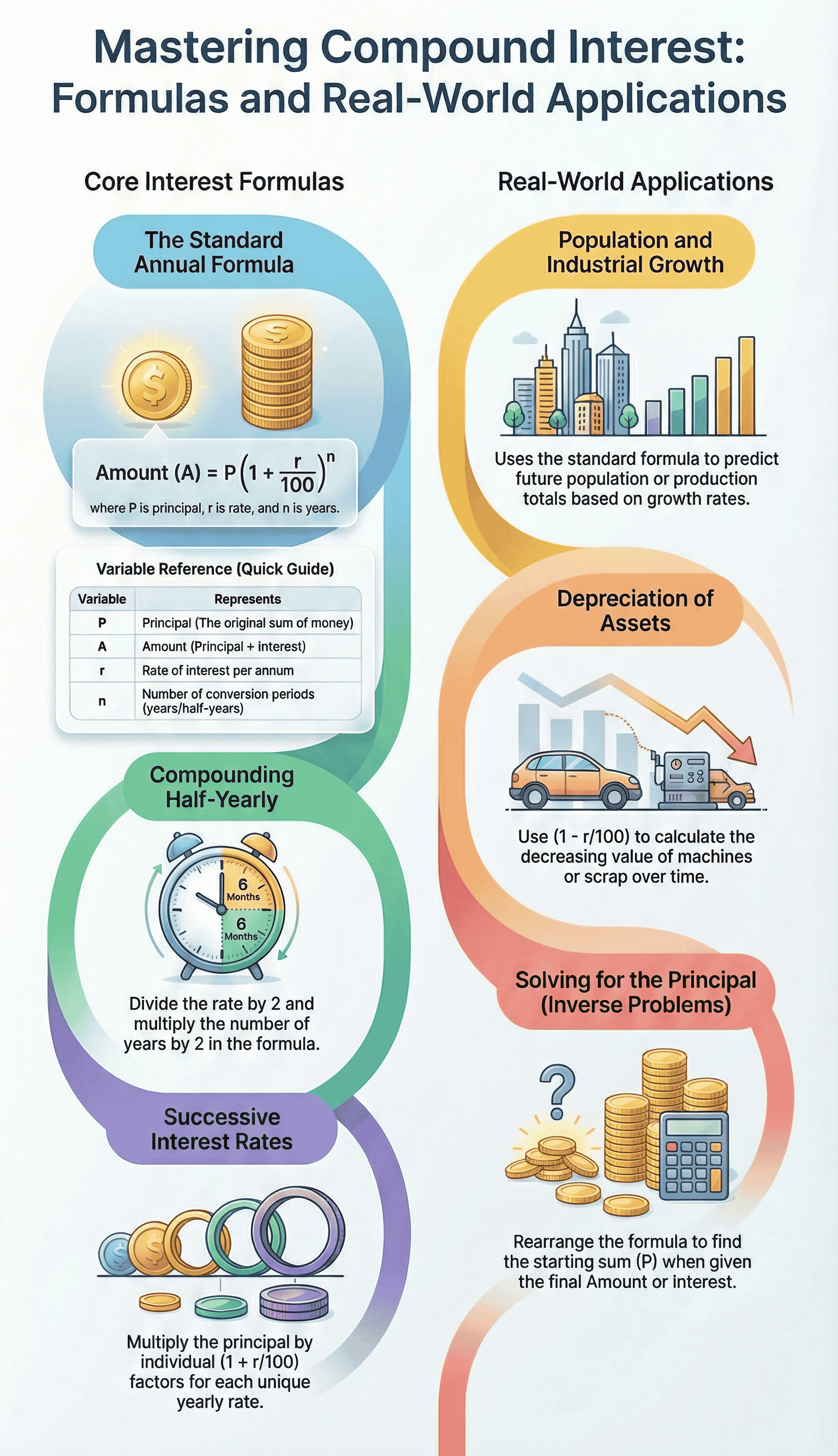
A = P(1 + r⁄100)n
(Where A = Amount, P = Principal, r = Rate of interest compounded yearly, and n = Number of years) -
Direct Method for Compound Interest (C.I.):
C.I. = A - P or C.I. = P[ (1 + r⁄100)n - 1 ] -
Successive Years with Different Rates: If the rates of interest for successive years are different (e.g., r1%, r2%, r3%), the formula expands to:
A = P(1 + r1⁄100)(1 + r2⁄100)(1 + r3⁄100)...
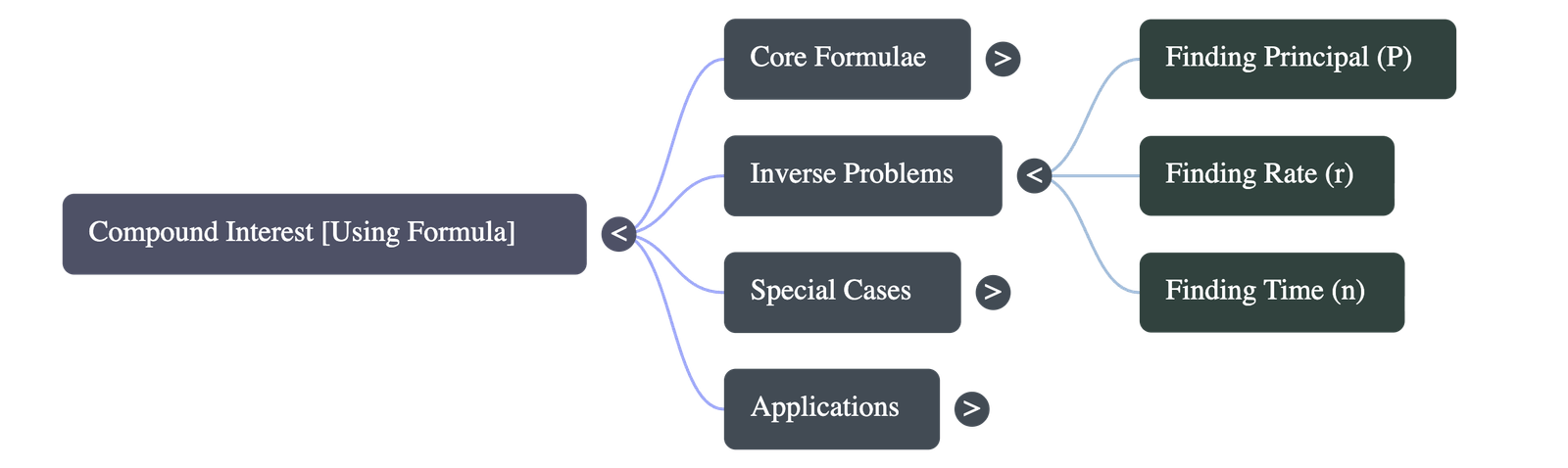
3. Solving Inverse Problems
- The standard formula can be rearranged to find unknown variables when the Amount is given.
- Finding the Principal (P): Calculate the base sum required to reach a specific amount over a given time and rate.
- Finding the Rate Percent (r): Used when the Principal, Amount, and Time are known. It often involves finding the n-th root of the given values.
- Finding the Time (n): Used when Principal, Amount, and Rate are known. This requires equating the bases to solve for the exponent n.
- Miscellaneous Problems: The formulas can also be combined to find the principal when the difference between Compound Interest and Simple Interest for a certain duration is provided.
4. Different Compounding Frequencies & Time Periods
-
Half-Yearly Compounding: The rate percent is halved (divided by 2) and the number of conversion periods is doubled (years multiplied by 2).
A = P(1 + r⁄2 × 100)n × 2 -
Quarterly Compounding: The rate percent is divided by 4, and the number of years is multiplied by 4.
A = P(1 + r⁄4 × 100)n × 4 -
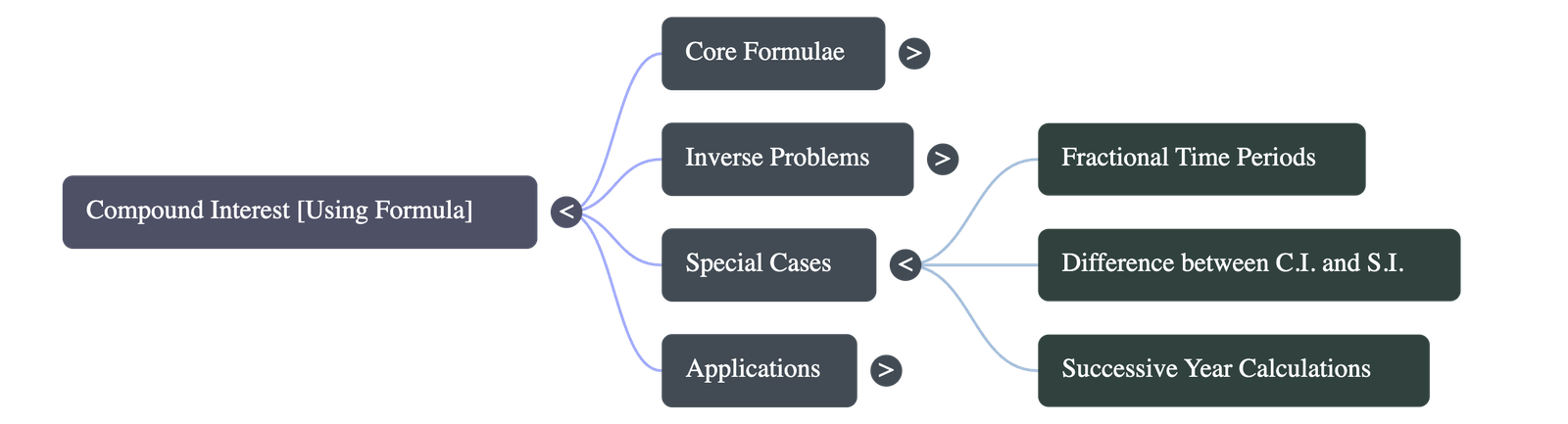
Fractional Years: When time is not an exact number of years (e.g., 2½ years) and compounding is yearly, the formula can be split. For 2½ years, it takes the form:
A = P(1 + r⁄100)2 × (1 + r⁄2 × 100)
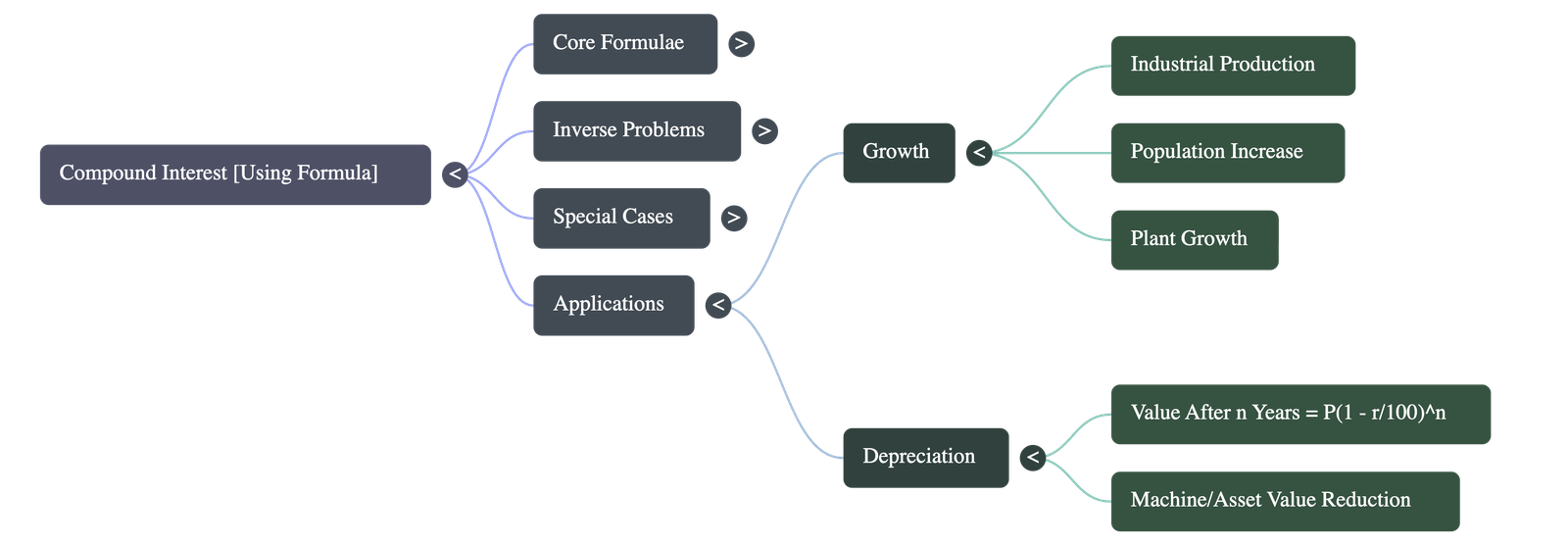
5. Practical Applications of the Formula
-
Growth (Industries, Inflation, Plants): Treated exactly like standard compound interest.
- Production after n years = Initial Production × (1 + r⁄100)n
- Present Production = Production n years ago × (1 + r⁄100)n
-
Population Problems: Modeled using the same growth mechanics when the population of a town/village increases at a certain rate per year.
- Population after n years = Present Population × (1 + r⁄100)n
-
Depreciation: Used when the value of an asset (like a machine) decreases by r% every year. The plus sign changes to a minus sign.
- Value after n years = Present Value × (1 - r⁄100)n
- Present Value = Value n years ago × (1 - r⁄100)n
Quick Navigation:
| | | |
1 / 1
Quick Navigation:
| | | |